A tablespoon of vinegar in water before lunch costs almost nothing, which is half the reason it keeps coming back. The other half is that it isn't pure folklore. Glucose really does run lower after a starchy meal with vinegar, and small labs have measured that again and again for twenty years.
What gets left out is the fine print. The gap is mostly gone by two hours, so a standard meter check can miss it. The long-term reviews disagree by a factor of four. And the gummies on the shelf hold a small fraction of the dose anyone tested. We went through the trials to see what's left once those are counted, and who should leave vinegar alone. If you're weighing kitchen remedies, our piece on fenugreek, cinnamon and turmeric asks the same questions of the spice rack.
What one dose did at one meal
These are the single-meal tests most articles lean on. All of them are small, and all of them used a real dose of liquid vinegar, either in water or on the food:
| Study | People | Vinegar | Meal | What changed |
|---|---|---|---|---|
| Johnston, Diabetes Care 2004 | 29: 8 without diabetes, 11 insulin-resistant, 10 with type 2 | 20 g apple cider vinegar in water, just before eating | Bagel, butter, orange juice | Insulin sensitivity 34% better in the insulin-resistant group, 19% in type 2 |
| Östman, Eur J Clin Nutr 2005 | 12 healthy | 18, 23 or 28 mmol acetic acid (about 1.1, 1.4, 1.7 g) | White bread, 50 g carbs | Higher dose, lower glucose at 30 min. At 120 min, no difference from plain bread |
| Leeman, Eur J Clin Nutr 2005 | 13 healthy | 28 g white vinegar (6%) with 8 g olive oil | Chilled boiled potatoes, 50 g carbs | GI 96 against 168 for fresh hot potatoes (white bread = 100), with chilling and vinegar combined |
| Johnston, Ann Nutr Metab 2010 | 4 small trials, 9 to 10 people each | 10 g (2 teaspoons) | Bagel and juice, or a dextrose drink | About 20% lower after the starchy meal. No change with dextrose |
That last row is the most useful one. Vinegar did nothing to a drink of pure dextrose, and sodium acetate, the same acetate without the acid, did nothing either. So this looks like an effect on starch digestion in the gut, and on the acid in particular, rather than a general glucose-lowering action. It fits with a 2021 French trial that blamed low pH for slowing salivary amylase, the enzyme that begins breaking starch down. Starchy meals are where the idea applies. Don't expect it to touch sugar that needs no digesting.
The two-hour check can miss it
Siddiqui and colleagues (2018) pooled the short-term tests in people with type 1 or type 2 diabetes. Read across the rows:
| After the meal | Glucose lower with vinegar | In mg/dL (our conversion) | 95% CI, mmol/L | People |
|---|---|---|---|---|
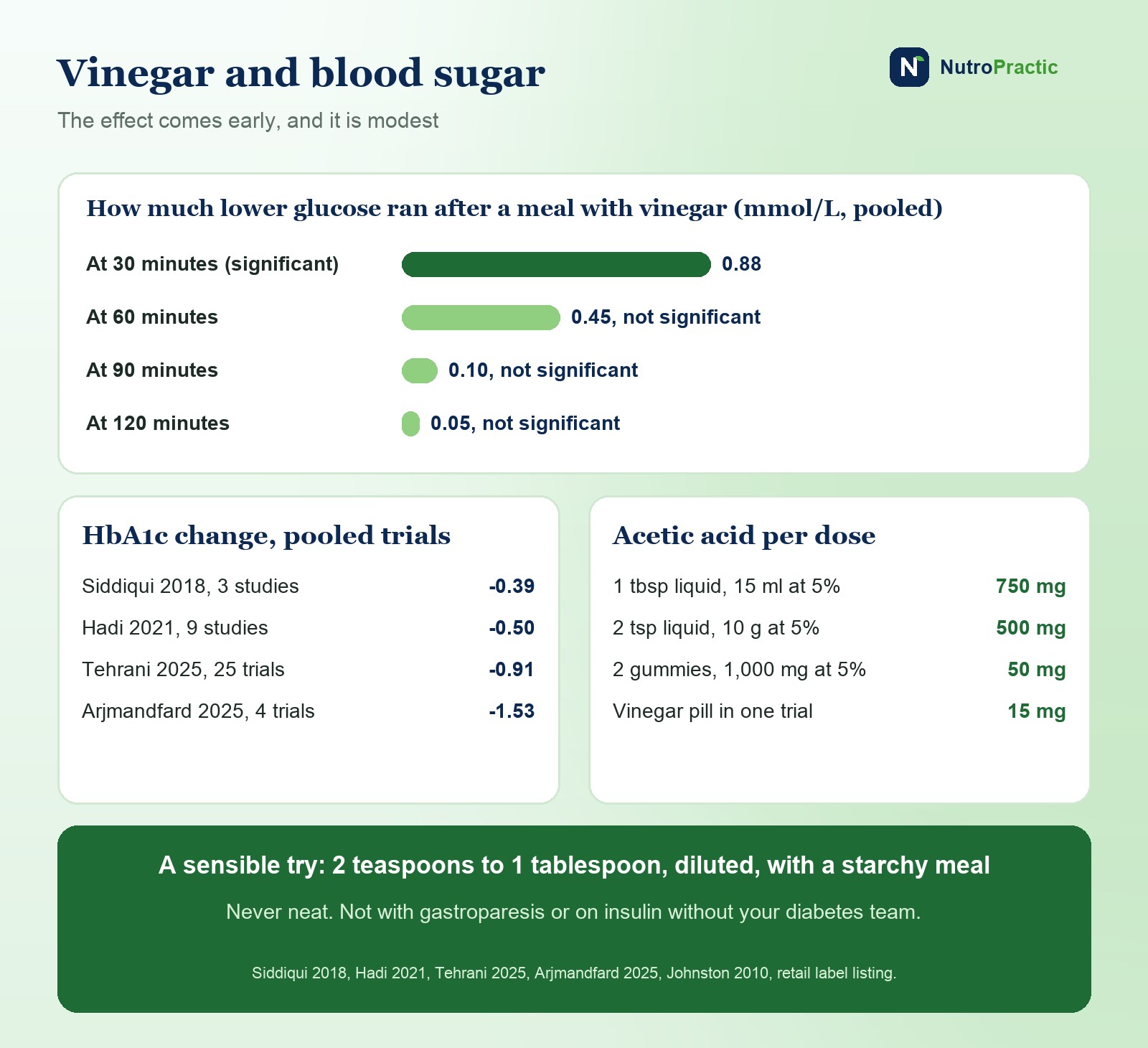
| 30 minutes | 0.88 mmol/L | about 16 | 0.51 to 1.25 | 102 |
| 60 minutes | 0.45 mmol/L | about 8 | -0.31 to 1.21 (not significant) | 92 |
| 90 minutes | 0.10 mmol/L | about 2 | -0.52 to 0.73 (not significant) | 74 |
| 120 minutes | 0.05 mmol/L | about 1 | -1.11 to 1.20 (not significant) | 74 |
So vinegar trims the early peak, and then the two curves come back together. Östman's bread test found the same shape in healthy people, with no difference left at 120 minutes. In practice, someone who checks only two hours after eating might conclude vinegar does nothing. Someone wearing a sensor might see a lower peak. Whether a lower early peak alone improves health over the years is something no trial here has measured.
Weeks of daily vinegar: why we trust the smallest number
Several meta-analyses have looked at daily use over weeks. They all point the same way, but look at the size of the disagreement:
| Review | Pooled | Fasting glucose | HbA1c, points | How consistent |
|---|---|---|---|---|
| Siddiqui 2018 | Diabetes, 3 studies, 147 to 161 people, 8+ weeks | -0.80 mmol/L (about -14 mg/dL) | -0.39 | I² 0% |
| Hadi 2021 | Adults, 9 studies, apple cider vinegar, 2+ weeks | -7.97 mg/dL | -0.50 | I² 75% and 91% |
| Tehrani 2025 | Adults, 25 trials, 1,320 people, apple cider vinegar | -21.20 mg/dL | -0.91 | I² 95.8% and 98.9% |
| Arjmandfard 2025 | Type 2, 7 trials, 463 people, 13.75 to 30 mL a day, 4 to 12 weeks | -21.93 mg/dL | -1.53 (4 trials, 319 people) | I² 20% and 83%; HbA1c certainty rated low |
I² is a measure of how much trials disagree beyond chance, and above 75% is high. Our reading: the 1.5-point figure is hard to believe. Arjmandfard's own authors rated most of the trials at high risk of bias, five of the seven came from one country, and vinegar is awkward to blind because people can taste it. A Danish systematic review (Launholt, 2020) looked at much the same field and called the evidence insufficient. Cheng's 2020 review of six trials and 317 people found significantly better fasting glucose and HbA1c, and also warned against extrapolating.
If we had to plan around a number, we'd take the low end, a third to half a point of HbA1c, and treat even that as unproven. It's also worth knowing that most of these trials ran 12 weeks or less, we saw none that measured complications, and Hadi's analysis found fasting glucose went up rather than down in apparently healthy people. This is a possible small help in diabetes. Nobody has shown it prevents anything.
So how much, and when?
For one meal: 10 g, about 2 teaspoons, is the lowest dose that clearly worked in Johnston's 2010 trials. Östman's doses work out at 22 to 34 mL of a 5% vinegar. Per day: the long-term trials used 13.75 to 30 mL. Arjmandfard reports a stronger effect on fasting glucose above 10 mL a day and about 1.26 mg/dL more per extra mL, though its own meta-regression found no significant link with dose. Nothing shows that more is safer or better, so we see no reason to go past a tablespoon at a meal.
Timing: in the trials people took it just before or with the food, so there's no need to drink it half an hour ahead. In Johnston's 2010 tests it worked best at mealtime, and less well taken five hours earlier. A bedtime version has been tried too: 11 adults with well-controlled type 2 took 2 tablespoons with an ounce of cheese, and waking glucose fell 4% against 2% with water (White and Johnston, 2007). That's 0.26 against 0.15 mmol/L, which is tiny.
Which vinegar: the trials used apple cider, wine and white vinegar, and we found no head-to-head trial showing apple cider beats the rest. The active part appears to be acetic acid, which is why strength matters more than the "mother" in the bottle. Check the label: mL × % ÷ 100 gives you grams of acid, near enough. So 15 mL at 5% is about 0.75 g. Plain Indian sirka and rice vinegar are fine if they're a similar strength, while balsamic and sweetened "vinegar drinks" can bring sugar along with them.
The easiest way to take it is the way Leeman served it: on the food, as a dressing. It's a good fit with cold boiled potatoes, a salad before the pasta, or a vinegar-and-onion kachumber beside rice.
Gummies and tablets: do the sums
| Form | Serving | Acetic acid |
|---|---|---|
| Liquid at 5% | 1 tablespoon (15 mL) | about 750 mg |
| Liquid at 5% | 2 teaspoons (10 g) | about 500 mg |
| Goli gummies, as listed by one retailer | 2 gummies, 1,000 mg vinegar at 5% | about 50 mg |
| A vinegar pill in one trial reviewed by Siddiqui | 1 pill | 15 mg |
To match the smallest dose that worked, 2 teaspoons, you'd need ten servings, or 20 gummies. To match a tablespoon, 30. We didn't find a randomised trial testing gummies against blood glucose. Retailer listings for the same product also disagree on the sugar per serving, so read your own label. We name this brand only because its label states the percentage, and we have no link to it.
Tablets have a worse record. After a patient's oesophagus was burned by an apple cider vinegar tablet, Hill and colleagues (2005) tested eight products. Size, pH, acid content and label claims varied widely, and the authors doubted whether some contained apple cider vinegar at all. None of the eight had the lactic acid expected from true apple cider vinegar, and five carried acid at three to ten times the concentration of household vinegar. We'd skip both forms.
Lemon and tamarind in an Indian kitchen
Vinegar may not be the only acid that does this. Freitas and colleagues (Eur J Nutr, 2021) gave healthy adults 100 g of bread with 250 mL of water, tea or lemon juice. Lemon juice cut the glucose peak by 30% and pushed it back by over 35 minutes, 78 against 41 minutes. Tea did nothing. But 250 mL is about a cup of lemon juice, and no one squeezes that over a plate of dal and rice. A teaspoon or two hasn't been tested, so we can't promise anything from it, though it certainly won't hurt the meal.
A PubMed search turned up no comparable glucose trial for tamarind, so we won't give you a number for it. On an Indian plate, the bigger gains come from elsewhere, and we've gone through them in cooking rice far from home and the balanced plate under the ICMR-NIN guidelines.
Who should be careful, and why
| Concern | What was found | What to do |
|---|---|---|
| Slow stomach emptying | Ten people with type 1 diabetes and gastroparesis took 30 mL in 200 mL water: median emptying fell from 27% to 17%. One reported more low blood sugars (Hlebowicz, 2007; not randomised) | If you have gastroparesis, or type 1 with bloating and unpredictable sugars, skip it unless your team agrees |
| Low blood sugar | Those authors warn that mealtime insulin may need adjusting, and glucose checking more often | On insulin or a sulfonylurea, talk to your team first. Never change a dose on your own |
| Tooth enamel | Lab study, enamel soaked for hours: vinegars at pH 2.7 to 3.95 stripped minerals, up to about 20% in the outer layer (Willershausen, 2014). This was in a dish, not a mouth | Always dilute, take it with food, rinse with water afterwards, and wait before brushing |
| Throat burns | The tablet injury above; the authors also note burns and ulcers from household vinegar used as a remedy | Never neat, never as tablets |
| Reflux | We found no trial testing vinegar in reflux, despite claims that it helps | If it burns, stop. Our heartburn article covers what has been tested |
| Low potassium | One case: low potassium, high renin and osteoporosis in a person drinking large amounts of cider vinegar (Lhotta, 1998) | One report proves little, but keep to food-sized amounts. With kidney disease or diuretics, ask first |
If you suspect vinegar is setting off your reflux, the free heartburn diary makes that easy to check over a couple of weeks.
How to test it on your own numbers
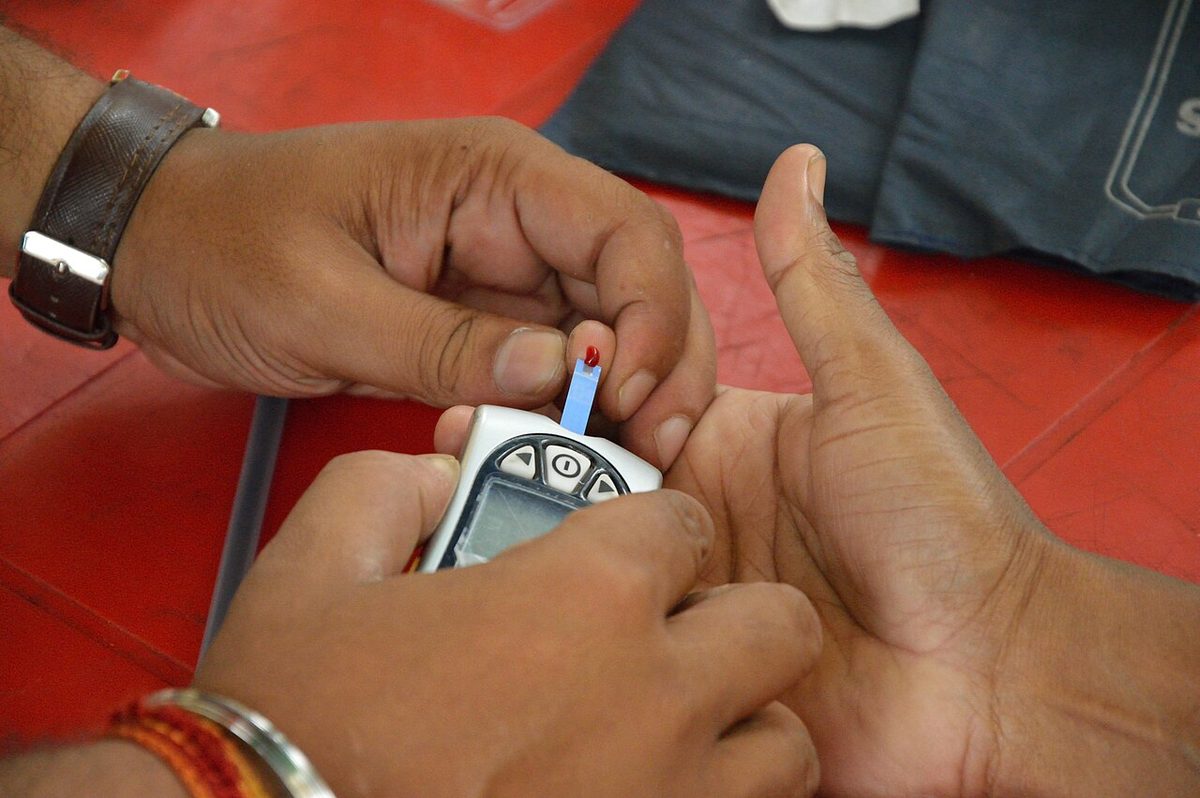
1. Check with your team first if you take insulin or a sulfonylurea. 2. Pick one repeatable starchy meal and weigh the carbs. 3. Have it plain on two separate days, checking before eating and then at 30, 60 and 120 minutes. A sensor does this for you. 4. Add one tablespoon in a large glass of water or as a dressing on two more days, keeping everything else the same. 5. Compare the peak as well as the two-hour figure. 6. Stop if you get heartburn, sore teeth or low readings.
Then keep it in proportion. A 20% trim at one meal is real but small, and the portion usually matters far more. As our pasta article shows, going from 80 g to 150 g of dry pasta adds 50 g of carbohydrate, which no spoonful will undo. For a larger change in type 2, the numbers are in the DiRECT remission article.
Vinegar in the salad dressing is a small, cheap help. It isn't a treatment, and two hours later your meter may never know it was there.
Want to know what will really shift your own glucose readings? Dr. Triveni can go through your meals, medicines and numbers in a virtual consultation and build a plan that fits your kitchen.
Book a consultationThis article is general information, not medical advice. If you have diabetes, gastroparesis or kidney disease, or you use insulin or a sulfonylurea, talk to your doctor or diabetes team before adding vinegar. Do not stop or change a medicine because of anything you read here. Brands are named only as label examples; we have no link to them.
Sources
Single meals: Johnston C.S. et al., Vinegar improves insulin sensitivity to a high-carbohydrate meal, Diabetes Care 27:281-282 (2004). We couldn't open the full text, so the group sizes and the 34% and 19% figures are as reported by Dr. Gourmet, and the meal by Science News. Östman E. et al., Vinegar supplementation lowers glucose and insulin responses, Eur J Clin Nutr 59:983-988 (2005). Leeman M. et al., Vinegar dressing and cold storage of potatoes, Eur J Clin Nutr 59:1266-1271 (2005). Johnston C.S. et al., Examination of the antiglycemic properties of vinegar in healthy adults, Ann Nutr Metab 56:74-79 (2010). White A.M., Johnston C.S., Vinegar ingestion at bedtime moderates waking glucose, Diabetes Care 30:2814-2815 (2007), figures as reported by the Glycemic Index Foundation and Arizona State University.
Reviews: Siddiqui F.J. et al., Diabetes control: is vinegar a promising candidate?, J Evid Based Integr Med 23 (2018). Cheng L.J. et al., Vinegar consumption on glycaemic control in type 2 diabetes, J Adv Nurs 76:459-474 (2020). Hadi A. et al., Apple cider vinegar on lipid profiles and glycemic parameters, BMC Complement Med Ther 21:179 (2021). Tehrani S.D. et al., Apple cider vinegar on cardiometabolic risk factors, Curr Med Chem 32:2257-2274 (2025). Arjmandfard D. et al., Apple cider vinegar in type 2 diabetes: dose-response meta-analysis, Front Nutr 12:1528383 (2025). Launholt T.L. et al., Safety and side effects of apple vinegar intake, Eur J Nutr 59:2273-2289 (2020).
Other acids: Freitas D. et al., Lemon juice, but not tea, reduces the glycemic response to bread, Eur J Nutr 60:113-122 (2021).
Safety and products: Hlebowicz J. et al., Effect of apple cider vinegar on delayed gastric emptying in type 1 diabetes, BMC Gastroenterol 7:46 (2007). Hill L.L. et al., Esophageal injury by apple cider vinegar tablets, J Am Diet Assoc 105:1141-1144 (2005), and the University of Arkansas summary. Willershausen I. et al., Dental erosion caused by different vinegar varieties, Clin Lab 60:783-790 (2014). Lhotta K. et al., Hypokalemia, hyperreninemia and osteoporosis in a patient ingesting large amounts of cider vinegar, Nephron 80:242-243 (1998). Gummy label as listed by Vitacost, read 5 November 2026; acid sums are ours.