Blood sugar · November 5, 2026
Drink the apple juice 30 minutes before breakfast and the glucose peak dropped by 0.51 mmol/L in 19 young adults. The total glucose rise over the morning didn't move
Same juice, same bread, same egg; only the timing changed. The spike got smaller, but the sugar still went in. A small Beijing trial shows what a lower peak can and can't tell you.
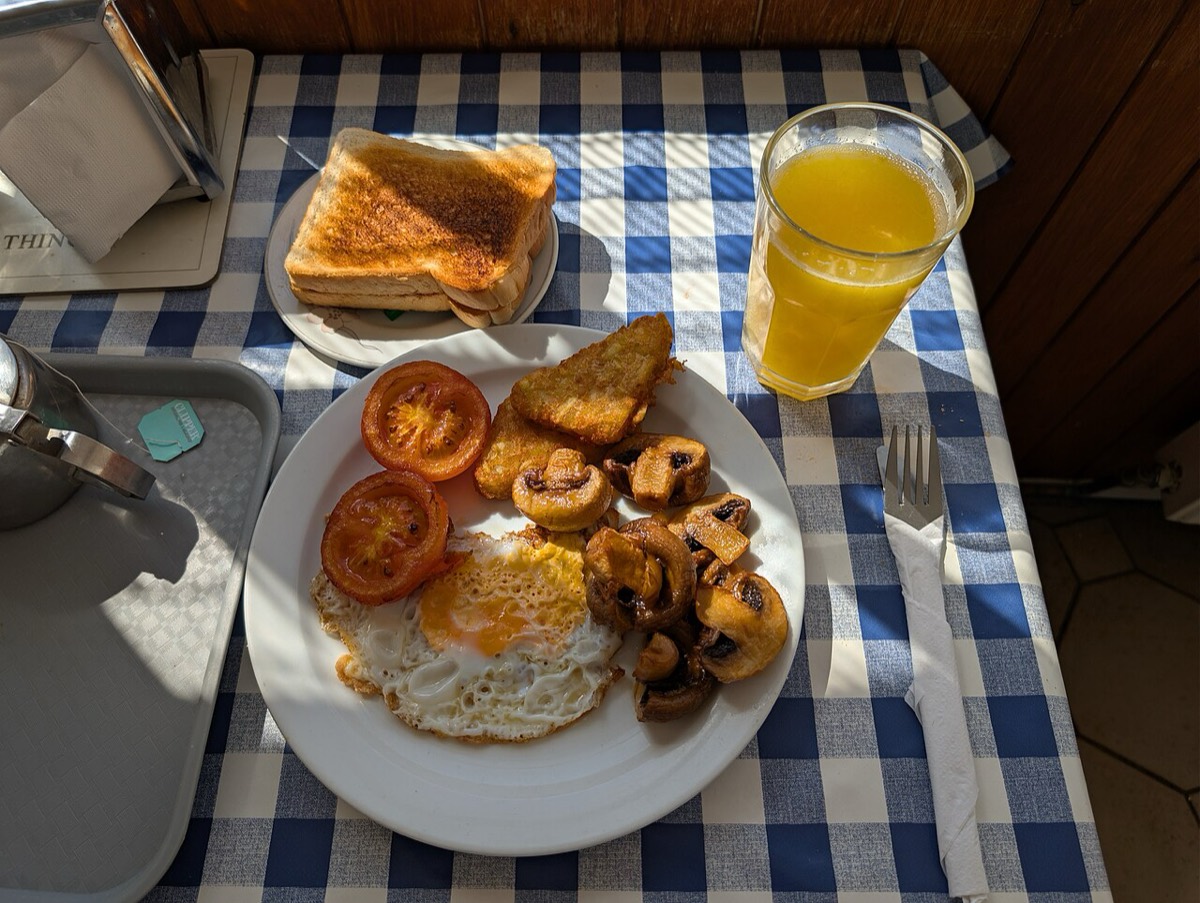
If you have juice with breakfast, does it matter when you drink it? Researchers at China Agricultural University in Beijing gave the same people the same meal on two days, four days apart. On one day they drank 200 mL of 100% apple juice with a breakfast of whole-wheat bread and a boiled egg. On the other they drank the juice first and ate 30 minutes later. A glucose sensor on the upper arm recorded what followed.
Twenty healthy adults were randomised and 19 gave usable data; the other lost a sensor that came off. Their median age was 23, five were men, and all of them already drank fruit juice. The main measure was the highest glucose reading after breakfast. It averaged 6.78 mmol/L when juice came with the meal and 6.28 mmol/L when it came first, a difference of 0.51 mmol/L (the figures are rounded), or about 9 mg/dL. The biggest swing between low and high readings also shrank, from 2.75 to 2.33 mmol/L.
Now the part a quick summary could skip. The total glucose rise across the 3.5-hour breakfast window was nearly identical: 2.59 against 2.52 mmol/L·h, with a p value of 0.83. The authors read this as a change in the shape of the curve, not a cut in glucose exposure. Both days had the same 25 g of juice carbohydrate. Drinking it early spreads the load out, so the later peak is lower, and the total stays put.
One extra analysis looks far more dramatic. Start the clock at the first bite of breakfast rather than the first sip of juice, and the glucose area falls by 2.35 mmol/L·h. The authors warn against reading much into that: by then most of the juice carbohydrate had already been absorbed, so the two windows differ by about 25 g of carbohydrate. It isn't a fair comparison of timing.
The effect also stopped at breakfast. Lunch and dinner were served under supervision and no glucose measure differed at either meal. Over the whole day, the top reading was 0.37 mmol/L lower with the juice first, and that fell just short of statistical significance (p = 0.053).
How much should anyone care? The confidence interval runs from 0.07 to 0.94 mmol/L, which the authors say could mean anything from a negligible effect to one bigger than the trial was designed to find. No study has established whether half a millimole at the peak matters clinically, and these were young people with healthy glucose control, whose peaks stayed modest either way. People with diabetes weren't included. So this isn't a reason to take up juice, or a proven trick for anyone who manages blood sugar. It's a small, cheap, testable idea for people who already drink it, and a neat reminder that the height of a spike and the size of the total are separate questions.
Same juice, different timing
19
Healthy adults analysed, each trying both timings; 20 were randomised
200 mL
100% apple juice, giving about 25 g of carbohydrate, with or 30 minutes before breakfast
6.78 v 6.28
Breakfast peak glucose in mmol/L: juice with the meal v juice first (reported difference 0.51; 95% CI 0.07 to 0.94)
2.75 v 2.33
Largest breakfast glucose swing in mmol/L, with the meal v first (difference 0.42; p = 0.040)
2.59 v 2.52
Total glucose rise over 3.5 hours in mmol/L·h: no clear difference (p = 0.83)
0
Adverse events reported; no glucose measure differed at lunch or dinner
Randomised crossover trial, single centre, March 2026; participants couldn't be blinded, though the statistician was. Glucose came from sensors reading tissue fluid, analysed at intervals of 15 minutes or more, so a true peak could fall between readings. Funded by a Gansu provincial science fund, which the authors say had no role in the study; the authors declare no conflicts of interest.
- The authors sized the trial on an earlier study in which whole apple eaten 30 minutes before a rice meal cut the incremental peak by 1.2 mmol/L. They assumed juice might keep about 60% of that, or 0.7 mmol/L. The observed difference was 0.51.
- Juice has lost the intact plant cell walls of whole fruit, along with nearly all the fibre, and both can slow how quickly sugars reach the blood. A result for whole apple doesn't automatically transfer to juice, or the other way round.
- The 'second-meal effect' is the idea that one meal can change the glucose response to the next. The authors thought it unlikely here, partly because apple juice contains so little fermentable fibre, and lunch and dinner bore that out.
- Lunch and dinner were eaten on site under direct observation, and participants could have only water beyond the study food, a level of control that is hard to copy at home.
- Effect of Timing of Apple Juice Consumption on Postprandial Glycemia: A Randomized Crossover TrialNutrients, 4 November 2026 (CC BY) · Primary study; design, flow, Table 3 results, sensitivity analysis, limitations and funding read in the full text.
- Small Breakfast with Orange Juice, The Lido Restaurant, WorthingWikimedia Commons · Photograph by Andy Li, CC0; general illustration only.
General information, not medical advice. This was a small, one-day-per-condition trial in young adults without diabetes, and it doesn't show that apple juice is good for blood sugar or that the timing improves health. If you have diabetes or prediabetes, talk to your doctor or dietitian before changing how you time food or drinks, and don't change your medication on the strength of this study.
Analysis by NutroPractic from the sources listed. Written for general readers; it does not replace advice from your own doctor.
From our articles
Our guides on this subject
Plain-language guides on nutrition and wellness, backed by research.
Diabetes
Pasta and blood sugar: al dente, cooled and reheated, and what the glucose tests measured
Head-to-head tests found little gap between 5 and 15 minutes of boiling. Chilling and reheating ranged from no change to a large drop. Moving from 80 g to 150 g adds 50 g of carbs. The tests, the sums, and legume and whole-wheat pastas per 100 g.
4 Nov 2026
Diabetes
Fenugreek, cinnamon and turmeric for blood sugar: what the trials in an Indian kitchen measured
Fenugreek seed at 5-10 g a day lowered HbA1c by about 0.85 points in pooled trials, and in a 3-year Hyderabad study 23% went on to diabetes against 55%. Cinnamon trims fasting glucose by 15-25 mg/dL, but a teaspoon of cassia tops the coumarin limit. Curcumin: about 0.3-0.4 points, and rare liver injury from capsules. Doses in teaspoons, and a fair way to test it at home.
1 Nov 2026
Diabetes
Potatoes and blood sugar: boiled, cooled, mashed or fried, and what the cohorts and trials found
Fries were linked to 20% higher diabetes risk per three servings a week in 205,000 US adults; boiled, baked and mashed potatoes to almost none. GI by cooking method, resistant starch in grams after chilling, the glycaemic load of a potato against a cup of rice, and how to fit aloo into an Indian plate.
30 Oct 2026
Newsfeed for your website
Want this feed on your website?
Add it to any site with one copy-and-paste snippet. No sign-up, and it updates itself every hour.
Start with a virtual consultation
Tell Dr. Triveni what you want to change. You will leave with a clear next step, whether you are in Toronto, London, New York or Chennai.