Methi seeds, a stick of dalchini and a spoon of haldi sit in almost every Indian spice box, and all three turn up in WhatsApp forwards promising to "cure" diabetes. In the US and Europe the same three are sold as capsules: cinnamon for blood sugar, turmeric for everything. So it's fair to ask what happened when someone actually measured HbA1c in a trial.
The short version: all three nudge blood sugar down a little in pooled trials, fenugreek most convincingly. But the doses that worked are far bigger than anything in a home-cooked dal, the trials are mostly small and short, and two of the three carry safety catches that matter more in capsule form than in the kitchen. Here are the numbers.
The three spices at a glance
Pooled results from the largest recent meta-analyses in people with type 2 diabetes or prediabetes, against placebo or usual care. HbA1c is in percentage points; fasting glucose (FBG) in mg/dL:
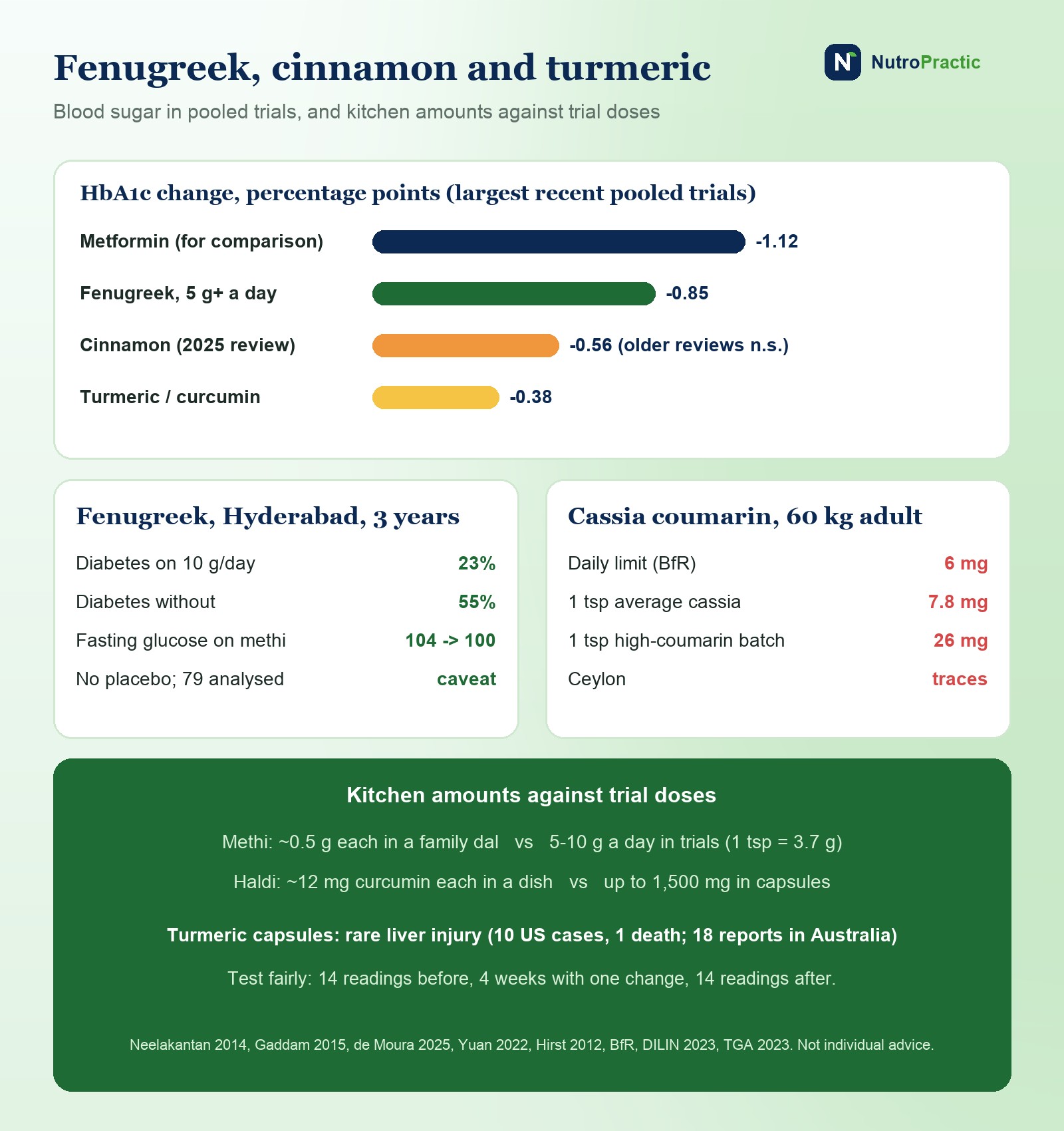
Fenugreek seed powder, 5-25 g a day: HbA1c -0.85 to -0.88; FBG about -17 mg/dL in one analysis, not significant in another. Main catch: gut upset, and it adds to diabetes medicines.
Cinnamon, 120 mg-6 g a day: HbA1c -0.16 (not significant) to -0.56; FBG -15 to -25 mg/dL. Main catch: coumarin in cassia cinnamon.
Turmeric or curcumin, usually 500-1,500 mg curcuminoids: HbA1c -0.31 to -0.38; FBG -6 to -8 mg/dL. Main catch: rare but serious liver injury from supplements.
For comparison, metformin on its own: HbA1c -1.12 (35 trials, Hirst and colleagues, Diabetes Care 2012).
Every one of these pooled spice results comes with high heterogeneity (I² often above 80%), which means the individual trials disagreed a lot. Treat the ranges as "somewhere in here", not as a promise.
Fenugreek (methi): the strongest case, at a real dose
Fenugreek seeds are about a quarter fibre by weight, much of it a sticky soluble gum (galactomannan) that thickens in water and slows how fast starch is absorbed. They also contain an unusual amino acid, 4-hydroxyisoleucine, that raised insulin release in animal studies.
The most careful pooled analysis (Neelakantan and colleagues, Nutrition Journal 2014) took 10 trials and found, against control:
Fasting glucose: -0.96 mmol/L (about -17 mg/dL), 10 trials
2-hour glucose after a glucose drink: -2.19 mmol/L (about -39 mg/dL), 7 trials
HbA1c: -0.85 points, 3 trials
The detail that matters: the effect showed up only in people with diabetes taking 5 g a day or more of seed powder (the trials ranged from 1 g to 100 g). Trials that used under 2 g of an alcohol extract found nothing. The authors also rated most trials as low quality.
Two later analyses point the same way. Shabil and colleagues (Medicina 2023; 14 trials, 894 people) found HbA1c -0.88 but no significant change in fasting or after-meal glucose. Kim and colleagues (International Journal of Molecular Sciences 2023; 10 trials, 706 people) found significant drops in fasting glucose, 2-hour glucose and HbA1c, with no liver or kidney harm and only mild stomach side effects.
The Hyderabad prevention trial
The most striking fenugreek study ran for three years at Nizam's Institute of Medical Sciences in Hyderabad (Gaddam and colleagues, 2015). Adults aged 30-70 with prediabetes took 5 g of debittered fenugreek powder twice a day, stirred into 200 ml of water about 30 minutes before lunch and dinner, or had no supplement.
Developed diabetes in 3 years: 23% on fenugreek against 55% without
Fasting glucose on fenugreek: 103.7 → 99.7 mg/dL
Post-meal glucose on fenugreek: 142.9 → 129.0 mg/dL
Controls: no significant change
Before you take that as settled: participants knew they weren't getting powder (there was no placebo), only 52 of 74 on fenugreek and 27 of 66 controls were analysed at the end, some people skipped doses because of the taste, and the powder was supplied by a pharmaceutical company. It's a promising signal, not proof.
Worked example: what 10 g looks like in a kitchen
USDA FoodData Central puts a level teaspoon of whole fenugreek seeds at 3.7 g. So:
10 g a day (the Hyderabad dose) = about 2¾ teaspoons of seeds
5 g (the lowest dose that worked in the pooled trials) = about 1⅓ teaspoons
A tadka for a family pot of dal or sambar, ½ teaspoon for four people = about 0.5 g each: 10 to 20 times less than the trial doses
10 g of seeds also brings about 2.5 g of fibre, 2.3 g of protein, 3.4 mg of iron and 32 kcal (USDA values per 100 g: 24.6 g fibre, 23 g protein, 33.5 mg iron, 323 kcal). Cooking with methi is good food, but it won't reach a trial dose by itself.
If you want to try it: soak 1 heaped teaspoon of seeds overnight and eat them (or drink the water and chew the seeds) before breakfast, and again before dinner; or stir ground seed into water 30 minutes before the two main meals, as in Hyderabad. Sprouted methi in a salad or a spoon of methi powder worked into the day's roti dough adds a little more. The bitterness is real; the trial used debittered powder for that reason. An early Israeli study (Madar and colleagues, 1988) gave 15 g of soaked powder with a test meal and saw a lower post-meal glucose rise.
Safety: wind, loose stools and a maple-syrup smell in sweat and urine are common. Fenugreek is a legume, so people allergic to peanuts or chickpeas may react. The US National Center for Complementary and Integrative Health advises against amounts above normal food use in pregnancy. And if you take insulin or a sulfonylurea (gliclazide, glimepiride), the extra drop can tip you into a low; check with your doctor first.
Cinnamon (dalchini): smaller effect, and know which bark you're buying
Cinnamon's reputation comes from a 2003 trial in Pakistan (Khan and colleagues, Diabetes Care). Sixty adults with type 2 diabetes took 1, 3 or 6 g a day for 40 days, and fasting glucose fell by 18-29% in every cinnamon group. It was cited hundreds of times. In August 2025 the journal attached an Expression of Concern to the paper, a formal warning to readers about its reliability.
The pooled evidence since then is mixed:
Allen and colleagues, Annals of Family Medicine 2013 (10 trials, 543 people, 4-18 weeks): fasting glucose -24.6 mg/dL; HbA1c -0.16, not significant; LDL cholesterol -9.4 and triglycerides -29.6 mg/dL
Cochrane review, Leach and Kumar 2012 (10 trials, 577 people, average 2 g a day, mostly cassia): effect on fasting glucose inconclusive, no significant change in HbA1c; "insufficient evidence"
de Moura and colleagues, Nutrition Reviews 2025 (28 trials, 3,054 people, 30-120 days): fasting glucose -15.3 mg/dL, after-meal glucose -39.2 mg/dL, HbA1c -0.56; only doses of 2 g a day or less lowered HbA1c in the subgroup analysis
So cinnamon probably shaves 15-25 mg/dL off fasting glucose. Whether that shows up in HbA1c is less clear, and the trials disagree wildly (I² up to 94%).
Cassia, Ceylon and the coumarin sum
There are two cinnamons on the shelf. Ceylon (Cinnamomum verum) is thin, papery bark rolled into many layers like a cigar, light tan, and crumbles easily. Cassia (Cinnamomum cassia or aromaticum) is a single thick, hard curl, darker and redder. Most supermarket ground cinnamon in North America, and a lot of the dalchini sold loose in India, is cassia; most of the trials used cassia too.
Cassia carries coumarin, which can injure the liver in sensitive people. Germany's Federal Institute for Risk Assessment (BfR) sets the tolerable daily intake at 0.1 mg per kg of body weight, and its testing found an average of 3,000 mg of coumarin per kg of cassia, with some samples at 10,000 mg/kg. Ceylon has only traces. Our arithmetic, using a USDA teaspoon of ground cinnamon (2.6 g):
60 kg adult: limit = 0.1 × 60 = 6 mg coumarin a day
1 teaspoon of average cassia: 2.6 g × 3 mg/g = 7.8 mg, or 130% of the limit
Same teaspoon from a high-coumarin batch: 2.6 × 10 = 26 mg, over four times the limit
20 kg child: limit 2 mg, reached with about ⅔ g of average cassia, a quarter teaspoon
BfR says going a little over for a week or two isn't a concern. A daily 3-6 g cassia habit, the top doses in the trials, is 1.5 to 3 times the limit every day. If you use cinnamon daily for blood sugar, buy Ceylon (labels say "verum" or "zeylanicum"), or keep cassia to about half a teaspoon a day.
Turmeric (haldi) and curcumin: the dose gap is huge
The active compound people mean is curcumin, and turmeric powder doesn't have much of it. US researchers tested 28 spice products (Tayyem and colleagues, 2006): pure turmeric averaged 3.14% curcumin by weight. A USDA teaspoon of ground turmeric weighs 3 g, so:
1 teaspoon of turmeric: 3 g × 3.14% = about 94 mg curcumin
A family dish with ½ teaspoon for four people: about 12 mg each
A typical trial dose of 1,500 mg curcuminoids: the curcumin in about 16 teaspoons of turmeric
Curcumin is also poorly absorbed. In an often-quoted study (Shoba and colleagues, Planta Medica 1998), 2 g of curcumin alone gave blood levels that were "undetectable or very low" in volunteers; adding 20 mg of piperine from black pepper raised availability by 2,000%. That study had 8 volunteers, and one author founded the company that sells the piperine extract. It's why so many capsules now combine curcumin with black pepper or use special formulations, and that matters for safety below.
In trials using those concentrated supplements, the effect on blood sugar is modest:
Yuan and colleagues, Pharmacological Research 2022 (17 trials in people with metabolic disease): fasting glucose -7.9 mg/dL, HbA1c -0.38, insulin resistance (HOMA-IR) -1.01
Chuengsamarn and colleagues, Diabetes Care 2012 (240 adults with prediabetes in Thailand, 9 months): 16.4% on placebo developed type 2 diabetes against none on curcumin capsules
The Thai result looks dramatic, but it's a single trial and hasn't been repeated at that scale.
The liver reports
Liver injury from turmeric supplements appears to be rising in the US. The Drug-Induced Liver Injury Network (Halegoua-DeMarzio and colleagues, American Journal of Medicine 2023) described 10 cases: 5 people were hospitalised and 1 died of liver failure. Injury came 1 to 4 months after starting, 3 of the 7 tested products also contained piperine, and 7 of the 10 carried a gene variant, HLA-B*35:01, that is uncommon in the general population.
Australia's medicines regulator, the TGA, had 18 reports of liver problems with turmeric or curcumin products up to 29 June 2023; 9 had enough detail to suggest the product could be the cause, and one was fatal. It noted the risk may be higher with enhanced-absorption products and higher doses. The UK Committee on Toxicity (2024) called the injuries rare and idiosyncratic, sometimes at doses below the acceptable daily intake. These cases involve concentrated supplements, not the haldi in your sabzi.
Where this leaves someone with diabetes
Put the best spice result next to the alternatives. Fenugreek's -0.85 points of HbA1c, if it holds up, is worth having, but it's below what metformin does on its own, and it came from small trials. Weight loss does far more: in the DiRECT trial, 86% of people who lost 15 kg or more were in remission at one year; our DiRECT article has the details.
Keep cooking with all three. They make vegetables, dal and whole grains taste good, which is where the real gains are; our Rice, roti and blood sugar article shows how to build the plate.
If you try fenugreek as a supplement, use 5 g of seed or powder twice a day before meals, not a pinch, and tell your doctor if you're on insulin or a sulfonylurea.
If you take cinnamon daily, choose Ceylon, or keep cassia to about half a teaspoon.
Skip turmeric capsules for blood sugar. The gain is small, and the liver risk, though rare, is real. If you take them for another reason, avoid high-dose "enhanced absorption" products and stop at once with dark urine, yellow eyes or pain under the right ribs.
Never swap a prescribed medicine for a spice.
Testing it on yourself, honestly
A home meter is allowed to be off by ±15 mg/dL below 100 mg/dL and ±15% above it (ISO 15197:2013), so a single reading tells you very little. A fairer test:
Week 0: change nothing. Check fasting glucose on 7 mornings and 2 hours after your main meal on 7 days, and write down the averages.
Weeks 1-4: add one thing only, for example 5 g of soaked methi seeds before lunch and dinner. Keep meals, walks and medicines the same.
Week 4: repeat the 14 readings and compare averages. A change under about 10 mg/dL may just be noise.
Month 3: an HbA1c test, compared with the one before you started, is the number that counts.
Bring the log to your doctor or dietitian rather than adjusting medicines yourself.
Methi earns its place in the spice box and might earn a spoon before meals. Cinnamon and turmeric belong in the food, not in a capsule bought to replace a prescription.
Living with type 2 diabetes or prediabetes and want a plan that uses the food you already cook, methi included? Dr. Triveni can go through your readings and your kitchen in a virtual consultation.
Book a consultationThis article is general information, not medical advice. If you take insulin, a sulfonylurea, a blood thinner or any regular medicine, talk to your doctor before adding a spice supplement.
Sources
Neelakantan N. et al., Effect of fenugreek (Trigonella foenum-graecum L.) intake on glycemia: a meta-analysis of clinical trials, Nutr J 13:7 (2014). Shabil M. et al., Effect of fenugreek on hyperglycemia: a systematic review and meta-analysis, Medicina 59(2):248 (2023). Kim J. et al., The effect of fenugreek in type 2 diabetes and prediabetes: a systematic review and meta-analysis of randomized controlled trials, Int J Mol Sci 24(18):13999 (2023). Gaddam A. et al., Role of fenugreek in the prevention of type 2 diabetes mellitus in prediabetes, J Diabetes Metab Disord 14:74 (2015). Madar Z. et al., Glucose-lowering effect of fenugreek in non-insulin dependent diabetics, Eur J Clin Nutr 42(1):51-54 (1988). NCCIH, Fenugreek.
Khan A. et al., Cinnamon improves glucose and lipids of people with type 2 diabetes, Diabetes Care 26(12):3215-3218 (2003), and the journal's Expression of Concern, Diabetes Care 48(9):1646 (2025). Allen R.W. et al., Cinnamon use in type 2 diabetes: an updated systematic review and meta-analysis, Ann Fam Med 11(5):452-459 (2013). Leach M.J., Kumar S., Cinnamon for diabetes mellitus, Cochrane Database Syst Rev CD007170 (2012). de Moura S.L. et al., Effects of cinnamon supplementation on metabolic biomarkers in individuals with type 2 diabetes, Nutr Rev 83:249-279 (2025). BfR, FAQ on coumarin in cinnamon and other foods and High daily intakes of cinnamon: health risk cannot be ruled out.
Tayyem R.F. et al., Curcumin content of turmeric and curry powders, Nutr Cancer 55(2):126-131 (2006). Shoba G. et al., Influence of piperine on the pharmacokinetics of curcumin in animals and human volunteers, Planta Med 64(4):353-356 (1998). Yuan F. et al., Turmeric and curcuminoids ameliorate disorders of glycometabolism among subjects with metabolic diseases, Pharmacol Res 177:106121 (2022). Chuengsamarn S. et al., Curcumin extract for prevention of type 2 diabetes, Diabetes Care 35(11):2121-2127 (2012). Halegoua-DeMarzio D. et al., Liver injury associated with turmeric: a growing problem, Am J Med 136(2):200-206 (2023). TGA, Medicines containing turmeric or curcumin: risk of liver injury (2023). UK Committee on Toxicity, Statement on the potential risk to human health of turmeric and curcumin supplements (COT/2024/07, 2024).
Hirst J.A. et al., Quantifying the effect of metformin treatment and dose on glycemic control, Diabetes Care 35(2):446-454 (2012). ISO 15197:2013, In vitro diagnostic test systems: requirements for blood-glucose monitoring systems for self-testing. USDA FoodData Central, SR Legacy: spices, fenugreek seed; spices, cinnamon, ground; spices, turmeric, ground.