At 18 months your child ate everything. At three, the list is down to pasta, bananas, one brand of yogurt and anything beige, and a single pea on the plate can end dinner. You've tried hiding, bargaining and the "one more bite" rule, and every meal is now a negotiation.
If this sounds familiar, you have a lot of company, and the research has some reassuring and practical things to say. Here is what feeding studies have tested, what worked, and what made things worse.
It's a stage, and it's common
Fear of new foods (food neophobia) rises sharply in the second year, peaks somewhere between two and six, and then slowly fades. One explanation is evolutionary: a toddler who has just learned to walk and put things in their mouth is safer if they distrust anything unfamiliar, bitter or green.
In the Generation R study, which followed thousands of children in Rotterdam, about a quarter of children were picky eaters at one and a half and at three, and about one in eight at six. Most outgrow it.
It also isn't mostly about parenting. In the UK Gemini study of twins, close to half of the differences in fussiness between children were explained by genes, and even more for neophobia. Parents of a fussy eater are usually doing the same things as parents of an easy one; the children are different. What parents do still shapes how quickly the stage passes, which is where the studies come in.
Repeated tasting: the strongest tool
The best-tested approach is the simplest: offer a tiny taste of a food the child doesn't like, often, without fuss.
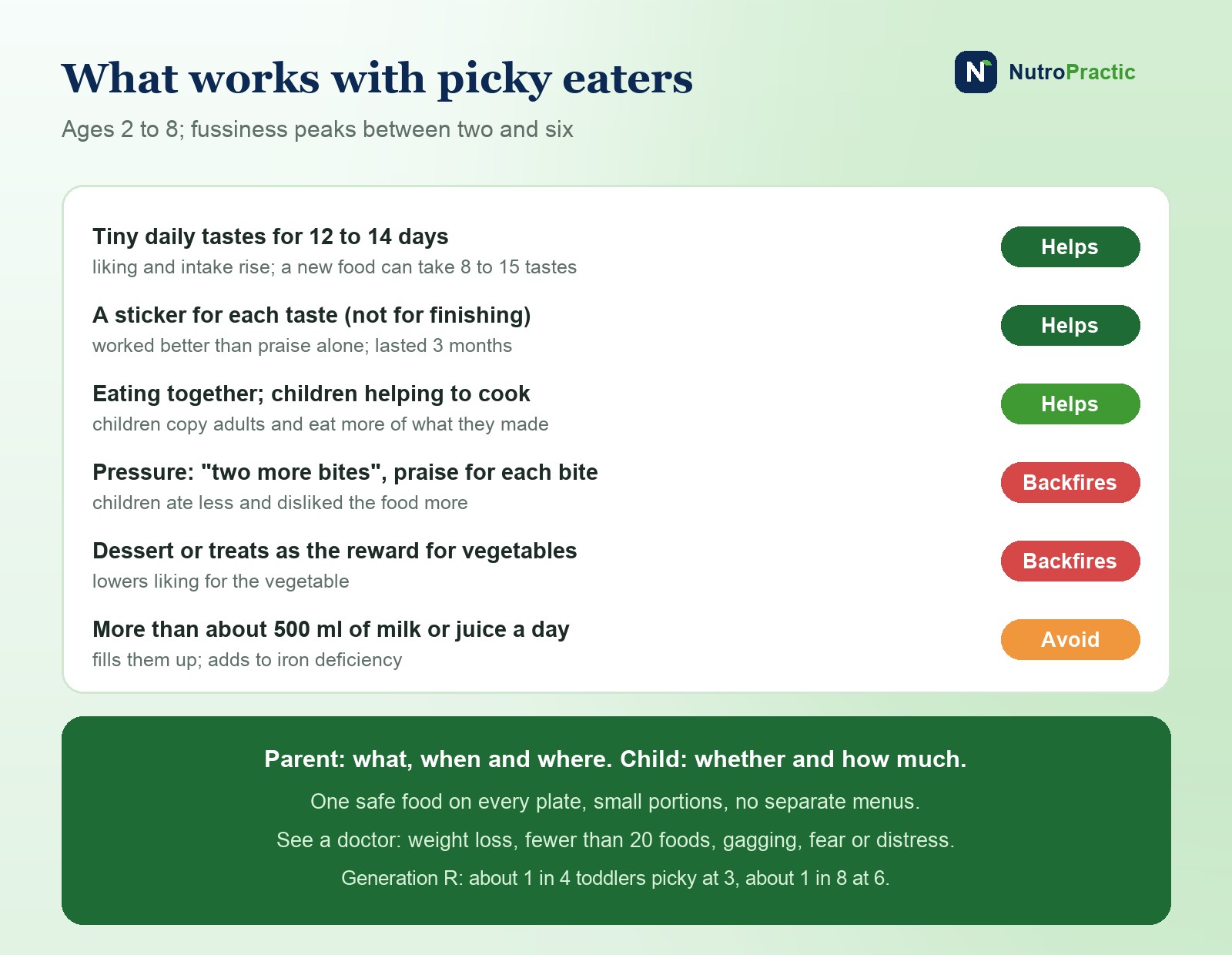
In a London trial, parents offered a small piece of a vegetable their child had rejected, every day for 14 days. Liking and intake rose, while children who were just given advice didn't change. In the larger "Tiny Tastes" trial of 173 families of three- and four-year-olds, 12 daily tastes of a disliked vegetable, with a sticker for each taste, increased both how much the children ate and how much they said they liked it, and the effect was still there three months later.
The common rule of thumb, that a new food can take 8 to 15 tastes before it is accepted, comes from this body of research. The key points:
The taste is tiny, a pea-sized piece, and it counts if it goes in the mouth, even if it comes out again.
It's repeated close together, daily or every other day, not once a month.
Seeing and touching count too. Food on the table, on the plate or in a picture book builds familiarity before the first taste.
One food at a time, served next to foods the child already eats.
A 2025 review for the US Dietary Guidelines rated the evidence that repeated tasting increases vegetable acceptance in children aged two to six as moderate, which is strong for nutrition research in young children.
A rejected food isn't a failed food. It's one taste out of the ten or fifteen it may take.
Pressure backfires
"Two more bites and you can leave the table" is the most common rule in family meals, and the studies are clear that it doesn't help. In a Penn State experiment, preschoolers ate soup on days they were urged to finish it and on days they weren't. They ate more when they weren't pressured, and made far more negative comments about the soup when they were. Adults who remember being made to finish their plate often still avoid those foods.
Pressure includes the subtle forms: praising each bite, spooning food in while the child is distracted by a phone or TV, or a parent's visible disappointment. Feeding with screens on is common in many families, including in India, where a grandparent may feed a child by hand with a cartoon playing. It gets food in today, but the child learns nothing about the taste or about their own hunger.
Rewards: the kind matters
Food rewards backfire. Classic studies by Leann Birch found that when children were given a treat for eating a food, they liked that food less afterwards, and when dessert is the reward for vegetables, the lesson is that vegetables are the price and dessert the prize.
Small non-food rewards for tasting can help. In the Tiny Tastes trial, a sticker for each taste worked better than praise alone. The reward is for tasting, not for finishing a plate, and it is phased out after the two weeks.
The division of responsibility
Many feeding specialists use Ellyn Satter's "division of responsibility": the parent decides what, when and where food is served; the child decides whether to eat and how much. It hasn't been tested as one package in big trials, but each part matches what the studies show: structure and repeated exposure help, pressure doesn't.
In practice that means:
Regular meals and snacks at roughly set times, three meals and two or three snacks, with nothing but water in between. A child who grazes on crackers, juice or milk all afternoon arrives at dinner not hungry.
One safe food on every plate, something the child reliably eats, such as rice, bread or a fruit, alongside the family food and the food being learned.
Small portions: a spoonful of each, with seconds available. A full plate is overwhelming.
Eating together, with adults eating the same food and enjoying it. Children copy, and the studies on modelling find it works best when the adult is someone they like and eats the food without comment.
No separate menus. Cooking a special meal for the fussy child keeps the list of foods short.
Neutral language. "This is broccoli, it's crunchy" rather than "it's good for you" or "just try it".
Getting them involved
Children are more willing to try what they have handled. In a Swiss experiment, children who helped prepare a meal ate more of the salad and vegetables than those whose parents cooked alone. Washing vegetables, tearing lettuce, choosing between two vegetables at the shop, growing a pot of cherry tomatoes or herbs: all count as exposure.
Drinks that fill them up
Large amounts of milk and juice are a common, fixable reason a toddler won't eat. After the first birthday, about 350 to 500 ml of milk a day is plenty. More fills them up and, in excess, contributes to iron deficiency, which itself can blunt appetite. Water between meals; milk with meals or as part of a snack.
Lunchboxes and school
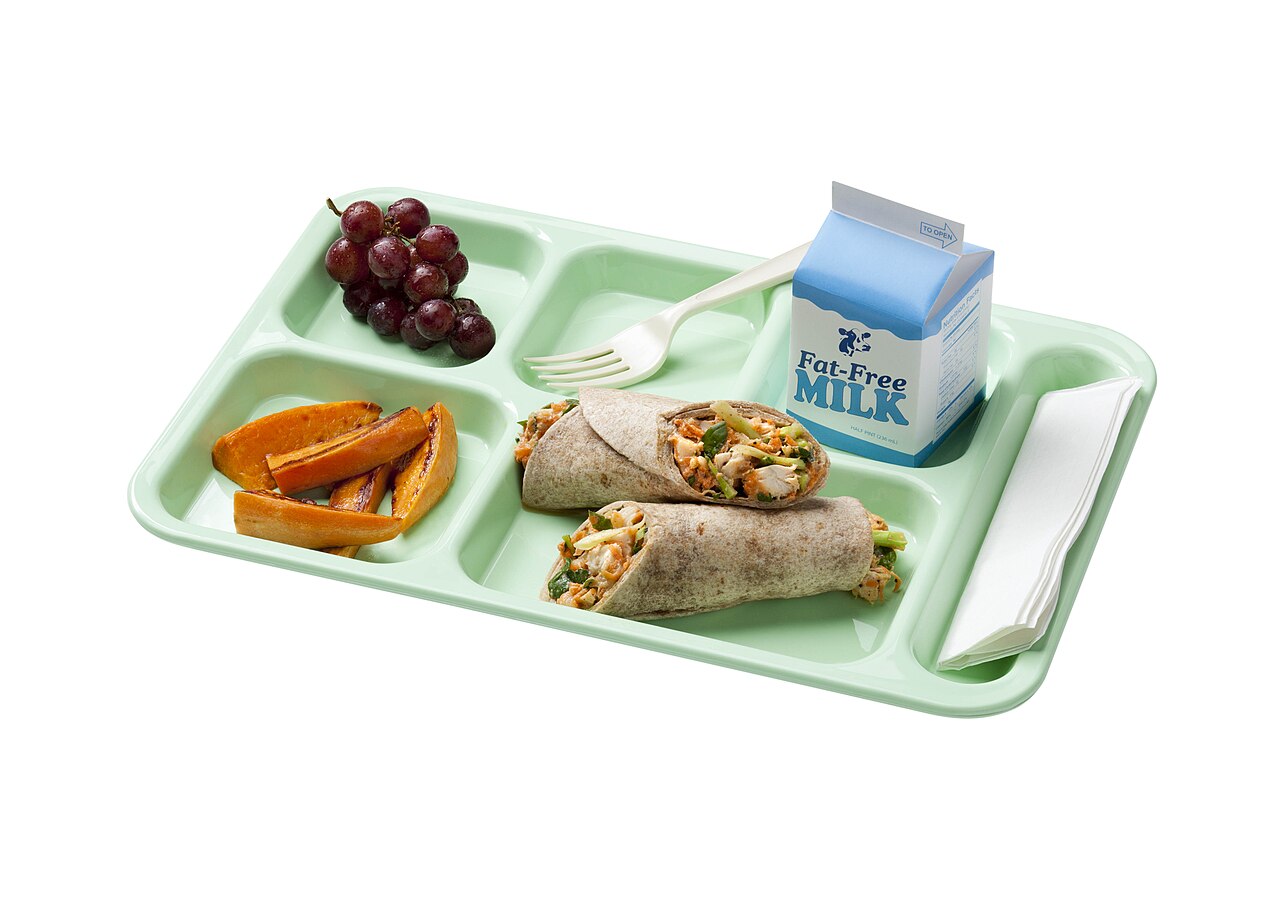
The same rules apply away from home. Put one familiar food and one learning food in the box, keep the learning portion tiny, and don't judge success by what comes back on the first day; it may take weeks. Teachers and school lunch staff who sit with children and eat the same food help in the same way parents do. Packing the box with the child gives them a stake in it.
Nutrients worth watching
Most picky eaters get enough calories and grow normally. The nutrients that can run short when the list of foods is narrow are iron (if meat, pulses and fortified cereals are refused), fibre (if fruit and vegetables are; our fibre gap article has easy ways to add it), calcium and vitamin D (if dairy is), and sometimes zinc. A children's multivitamin with vitamin D can fill gaps while you work on the food; in the UK, vitamin drops with A, C and D are advised for all children aged six months to five years. Constipation is common in children who eat few fruit and vegetables and can itself put them off food, so treat it.
When it's more than picky eating
See your doctor or a feeding specialist if any of these apply:
Growth: weight loss, or your child falling across centile lines on the growth chart.
A very short list: fewer than about 20 foods, or whole food groups dropped and the list keeps shrinking.
Fear or distress: gagging, vomiting or panic at new foods, or refusing food after choking.
Pain or illness: reflux, constipation, chewing or swallowing problems.
Other signs: strong sensory sensitivities, or speech, social or developmental concerns, which can go with autism.
These can point to ARFID (avoidant/restrictive food intake disorder), which affects a small percentage of children and is driven by fear, sensory sensitivity or low interest in eating rather than ordinary dislikes. It is treatable, and getting help early makes a difference.
A two-week plan
Pick one food your child has refused, ideally one the family eats often.
Every day for two weeks: put a pea-sized piece on their plate next to familiar foods, and ask for one taste. A sticker for each taste; nothing for refusing.
Eat it yourself at the same meal, without comment.
Keep meals and snacks regular, water in between, milk to about 500 ml a day.
No pressure, no deals, no dessert-for-vegetables. If they eat nothing else, the next meal or snack comes as usual.
After two weeks, look at what changed. Then pick the next food.
Worried about a fussy eater's growth, iron or the battles at the table? Dr. Triveni works with families one to one, and runs nutrition programmes for schools; book a virtual consultation for your child, or ask about a school programme.
Book a consultationThis article is general information, not medical advice. If your child is losing weight, not growing as expected, choking or gagging on food, or very distressed at meals, see your doctor.
Sources
Cardona Cano S. et al., Trajectories of picky eating during childhood: a general population study (Generation R), Int J Eat Disord 48(6):570-579 (2015). Smith A.D. et al., Food fussiness and food neophobia share a common etiology in early childhood (Gemini), J Child Psychol Psychiatry 58(2):189-196 (2017). Wardle J. et al., Increasing children's acceptance of vegetables; a randomized trial of parent-led exposure, Appetite 40(2):155-162 (2003). Remington A. et al., Increasing food acceptance in the home setting: a randomized controlled trial of parent-administered taste exposure with incentives, Am J Clin Nutr 95(1):72-77 (2012). USDA Nutrition Evidence Systematic Review, Repeated exposure and acceptance of vegetables in children (2025 Dietary Guidelines Advisory Committee). Galloway A.T. et al., 'Finish your soup': counterproductive effects of pressuring children to eat on intake and affect, Appetite 46(3):318-323 (2006). Birch L.L. et al., Eating as the "means" activity in a contingency: effects on young children's food preference, Child Dev 55(2):431-439 (1984). Satter E., The feeding relationship, J Am Diet Assoc 86(3):352-356 (1986). van der Horst K. et al., Involving children in meal preparation: effects on food intake, Appetite 79:18-24 (2014). NHS, Vitamins for children; and Fussy eating (nhs.uk). Kurz S. et al., Early-onset restrictive eating disturbances in primary school boys and girls, Eur Child Adolesc Psychiatry 24(7):779-785 (2015).