Polycystic ovary syndrome (PCOS) is the commonest hormone condition in women of reproductive age, and one of the most frustrating to live with. Periods come every six weeks, or every three months, or not at all. There may be acne, hair on the chin or thinning on the scalp, weight that goes on easily and comes off slowly, and, for some, trouble getting pregnant.
Many women leave the clinic with a pill to regulate bleeding and the instruction to lose weight, and then meet a wall of online advice: no dairy, no gluten, keto, seed cycling, expensive supplements. Here is what the research actually supports.
What PCOS is
PCOS is diagnosed when, once other causes are ruled out, an adult woman has at least two of three features (the Rotterdam criteria, kept in the 2023 international guideline):
Irregular or absent ovulation: cycles shorter than 21 or longer than 35 days, or fewer than eight periods a year.
Signs of higher androgens: excess facial or body hair, acne, scalp hair thinning, or raised testosterone on a blood test.
Polycystic ovaries on an ultrasound, or, since 2023, a raised AMH blood test instead of the scan in adults. The "cysts" are not true cysts but many small, paused follicles.
In teenagers, the scan and AMH aren't used, because many healthy teenagers have irregular cycles and ovaries that look polycystic. The guideline estimates that PCOS affects 10 to 13% of women worldwide, and up to 70% don't know they have it. Studies in India find rates in the same range or higher.
Why insulin is at the centre
The ovaries in PCOS make more androgens than usual. Insulin pushes them to make even more, and lowers the protein (SHBG) that keeps testosterone inactive in the blood. So insulin resistance (the body needing more insulin to do the same job) feeds the hormone side of PCOS directly.
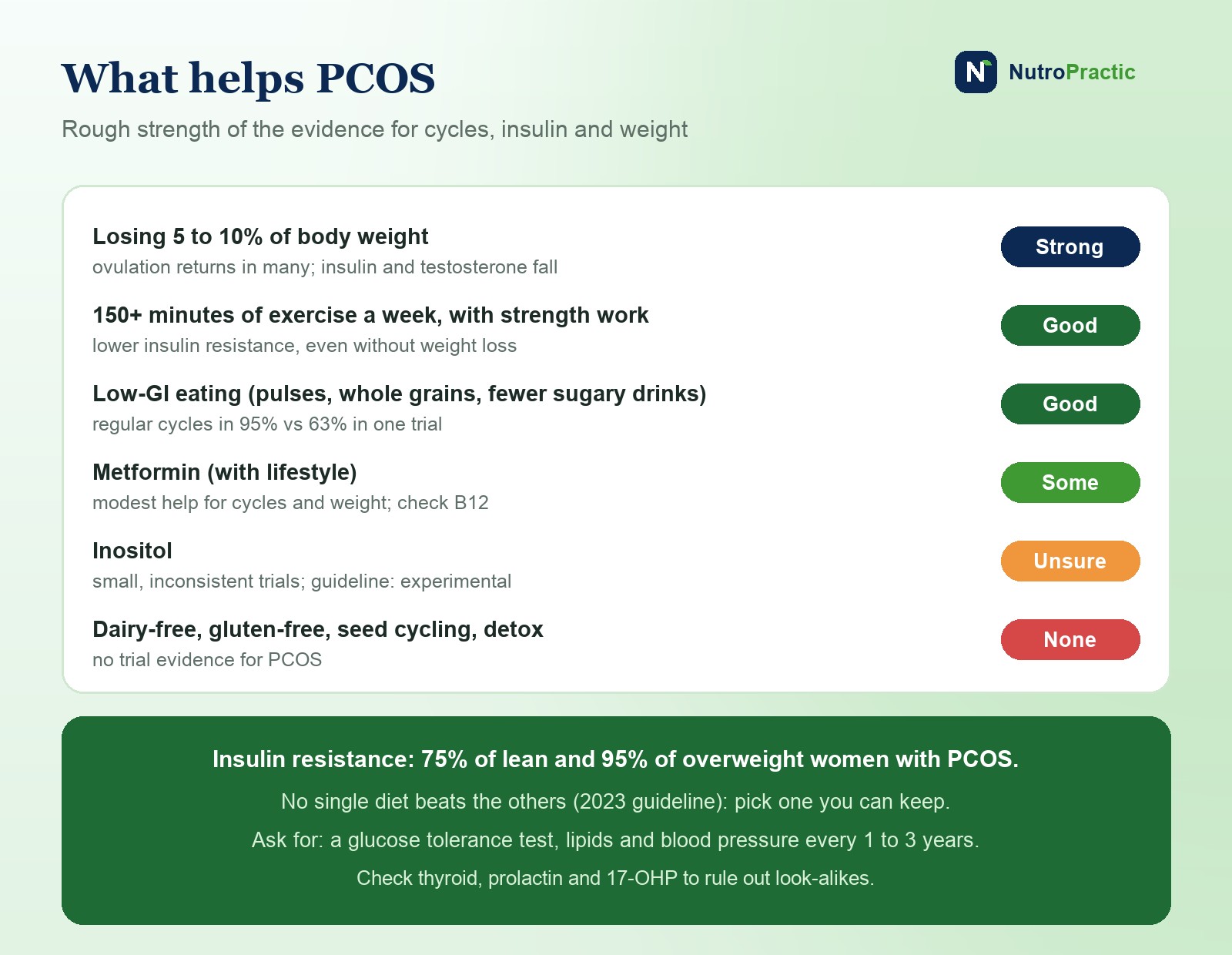
It isn't only about weight. In an Australian study using the gold-standard clamp test, insulin resistance was found in 75% of lean women with PCOS and 95% of overweight women with PCOS, against 62% of overweight women without it. Extra weight makes insulin resistance worse, but slim women with PCOS have it too, and should have their blood sugar checked like everyone else.
This is also why women with PCOS have a several-fold higher risk of type 2 diabetes and of diabetes in pregnancy, and why the condition matters long after fertility questions are settled.
How much weight loss helps
For women carrying extra weight, losing 5 to 10% of body weight is the most consistent finding in the research. In trials and clinic programmes, that much loss lowers insulin and testosterone and raises SHBG. It brings back ovulation and more regular cycles in a good share of women; in an early Australian programme, most of the women who lost around 6 kg started ovulating again and many conceived. It improves the chance of pregnancy with or without fertility treatment, and it improves the blood fats, blood pressure and blood sugar that carry the long-term risk.
For a woman weighing 80 kg, that is 4 to 8 kg. It doesn't have to reach a "normal" BMI for the hormones to shift. And weight loss in PCOS is genuinely harder: appetite hormones are different, and many women have been dieting since their teens. A slow, steady loss that you can keep is worth far more than a crash diet that rebounds.
You don't need to reach a "normal" weight. A loss of 5% is often enough for the hormones and the cycles to start moving.
Which diet? What the trials show
The 2023 guideline looked at the trials and concluded that no one diet is better than another for PCOS. What matters is a healthy pattern you can keep, with a modest calorie deficit if weight loss is the aim. Within that, a few patterns have some support.
Low glycaemic index (GI). In an Australian trial of 96 overweight women with PCOS, a low-GI diet and a conventional healthy diet led to similar weight loss. But among the women who completed it, 95% on the low-GI diet had more regular cycles, against 63% on the conventional diet, and insulin sensitivity improved more. Half the women dropped out, so the result is promising rather than settled. In practice, low GI means pulses, whole grains, oats, most fruit and vegetables, and fewer white breads, sugary drinks and refined snacks.
Mediterranean-style eating. Small studies link a closer Mediterranean pattern with lower testosterone and better insulin, and it is the pattern with the strongest evidence for the heart, which matters more over time in PCOS.
Lower carbohydrate. Some trials of moderately lower carbohydrate diets show better insulin and testosterone, mostly through weight loss. Very low-carb or keto diets can work in the short term but are hard to keep up and haven't beaten other approaches over a year. If you are trying to conceive, check with your doctor before starting one.
Protein and fibre at each meal help with appetite and blood sugar, whatever the pattern. Our fibre gap article has an easy 30-gram day.
What the trials don't support: cutting out dairy or gluten for PCOS (unless you have coeliac disease or a dairy problem), "seed cycling", spearmint tea as a cure, and detox programmes. None has trial evidence for cycles or fertility.
Exercise
Exercise lowers insulin resistance even without weight loss. The guideline suggests at least 150 minutes a week of moderate activity (or 75 vigorous) plus muscle-strengthening on two days, and 250 minutes a week for weight loss. Strength training is particularly useful because muscle is where most glucose goes.
Inositol: what it can and can't do
Myo-inositol and D-chiro-inositol are sugar-like molecules involved in insulin signalling. They are sold widely for PCOS, often at 2 to 4 g a day. A 2024 review for the guideline pooled 30 trials and found that inositol may improve some metabolic markers and, in some studies, cycles, but the evidence was weak and inconsistent. The guideline treats inositol as experimental: reasonable to try if you want to, knowing the benefit is uncertain, and not a replacement for treatment that works. It is well tolerated. It is not regulated like a medicine, so dose and purity vary by brand.
Metformin and the newer medicines
Metformin lowers insulin resistance. The guideline recommends it alongside lifestyle for adults with PCOS and a BMI of 25 or more for weight, hormones and metabolic health, and it can be considered for slimmer women. It helps cycles a little and weight modestly. Stomach side effects are common at the start; starting low, using the slow-release form and taking it with food help. Long-term use can lower vitamin B12, which is worth checking yearly, especially in vegetarians.
GLP-1 medicines such as semaglutide are increasingly used in PCOS with obesity and lead to much larger weight loss. They must be stopped before trying to conceive. If you are on one, protein becomes even more important (see our GLP-1 eating guide).
For fertility, letrozole is now the first-choice tablet to trigger ovulation, ahead of clomiphene.
The tests to ask for
At diagnosis, and then every one to three years, the 2023 guideline recommends checking:
Blood sugar: ideally an oral glucose tolerance test (OGTT), which picks up problems that a fasting glucose or HbA1c can miss. Every year before trying to conceive and early in pregnancy.
Blood fats (cholesterol and triglycerides) and blood pressure.
To rule out look-alikes: thyroid (TSH), prolactin and 17-hydroxyprogesterone, as well as testosterone and SHBG.
Mood and sleep: depression, anxiety and sleep apnoea are more common in PCOS and worth raising.
Heavy or long periods add iron loss on top of everything else; our iron for women article covers ferritin and how to absorb more.
A practical start
Each meal: half vegetables, a quarter protein (dal, beans, eggs, fish, paneer, tofu, chicken), a quarter whole grains or low-GI carbs.
Swap the drinks: water, tea or coffee instead of juice and sugary drinks.
Move most days: a brisk walk after meals, and two strength sessions a week.
Aim small: 5% of your weight over three to six months, if weight loss is a goal.
Track your cycles: they are the best sign of whether something is working.
Get the tests: an OGTT, lipids and blood pressure, and ask about metformin if you have insulin resistance.
Living with PCOS and tired of conflicting advice? Dr. Triveni can build a realistic eating and activity plan around your cycles, tests and goals, including if you're planning a pregnancy, in a virtual consultation.
Book a consultationThis article is general information, not medical advice. Irregular or absent periods need a doctor's assessment, because PCOS is diagnosed only after other causes are ruled out. Don't start or stop medicines, or start supplements in pregnancy, without your doctor.
Sources
Teede H.J. et al., Recommendations from the 2023 international evidence-based guideline for the assessment and management of polycystic ovary syndrome, Hum Reprod 38(9):1655-1679 (2023), and the summary of the guideline. Stepto N.K. et al., Women with polycystic ovary syndrome have intrinsic insulin resistance on euglycaemic-hyperinsulaemic clamp, Hum Reprod 28(3):777-784 (2013). Marsh K.A. et al., Effect of a low glycemic index compared with a conventional healthy diet on polycystic ovary syndrome, Am J Clin Nutr 92(1):83-92 (2010). Moran L.J. et al., Lifestyle changes in women with polycystic ovary syndrome, Cochrane Database Syst Rev (2011), CD007506. Clark A.M. et al., Weight loss results in significant improvement in pregnancy and ovulation rates in anovulatory obese women, Hum Reprod 10(10):2705-2712 (1995). Fitz V. et al., Inositol for polycystic ovary syndrome: a systematic review and meta-analysis to inform the 2023 update of the international evidence-based PCOS guidelines, J Clin Endocrinol Metab 109(6):1630-1655 (2024). Legro R.S. et al., Letrozole versus clomiphene for infertility in the polycystic ovary syndrome, N Engl J Med 371:119-129 (2014). Barrea L. et al., Adherence to the Mediterranean diet, dietary patterns and body composition in women with polycystic ovary syndrome, Nutrients 11(10):2278 (2019).