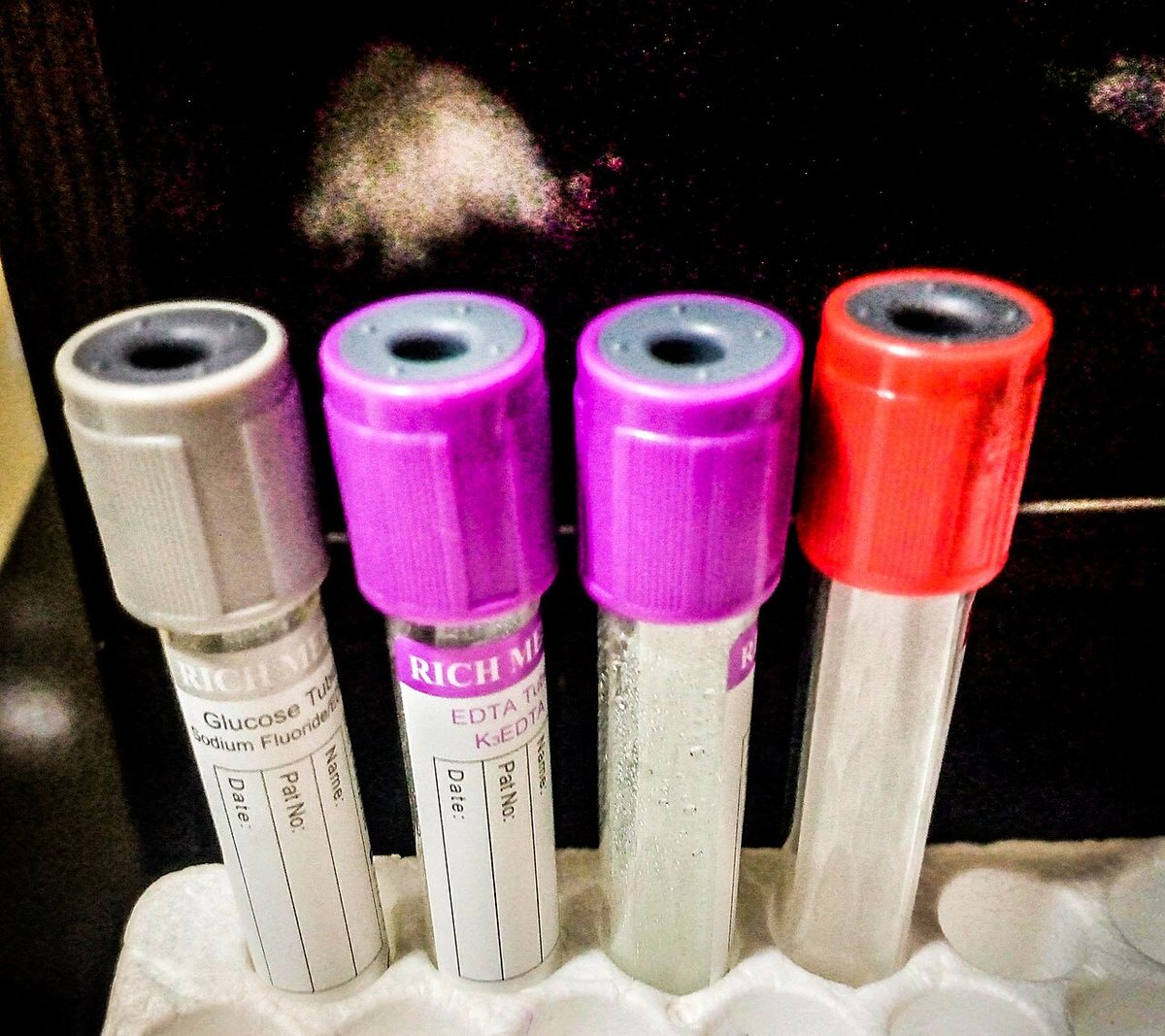
You're tired in a way sleep doesn't fix. The stairs feel steeper than they did last year, your hair is coming out in the shower, and you've started chewing the ice at the bottom of the glass. You have a blood test. It comes back "normal". Nobody mentions iron.
That story is common, and there's usually a simple reason for it: the test that was run looked for anaemia, and you can be short of iron for a long time before you become anaemic. This guide is about that gap. It covers who runs low and why, which number to ask about, and how to get more iron out of ordinary food, including vegetarian food, before anyone reaches for tablets.
How common it is
Very. The World Health Organization estimates that 30.7% of women aged 15 to 49 worldwide were anaemic in 2023, a figure that has barely moved in a decade, and iron deficiency is the largest single cause.
It isn't only a problem of poor countries. A 2023 study in JAMA used US national survey data on 3,490 girls and women aged 12 to 21. 38.6% were iron deficient (ferritin below 25 µg/L). Only 6.3% had iron-deficiency anaemia. Put the other way round: of those short of iron, more than eight in ten were not anaemic, so a haemoglobin test alone would have passed them.
Why women, and which women
The arithmetic is unkind. Periods take iron out every month, and food has to put it back. That's why the US recommended intake for women aged 19 to 50 is 18 mg a day, against 8 mg for men and for women after menopause. In pregnancy it rises to 27 mg. Many women eat less food than men to begin with, so they are asked to find more than twice the iron in fewer calories.
Some groups have it harder still: women with heavy periods, teenagers who are still growing, anyone who is pregnant or has recently given birth, regular blood donors, endurance athletes, and vegetarians and vegans. Plant iron is absorbed less well, which is why the US guidance suggests vegetarians aim for about 1.8 times the usual figure. People on a weight-loss medicine who are eating much less are worth adding to the list; we cover that in Eating on Ozempic, Wegovy or Mounjaro.
Low iron without anaemia, and the number to ask about
Think of iron as money in two accounts. Haemoglobin is the current account: it's what you spend every day carrying oxygen. Ferritin reflects the savings. When intake falls short the body empties the savings first and keeps haemoglobin going for as long as it can. A full blood count only looks at the current account. Ferritin is the test that shows the savings are gone.
Where to draw the line is argued over. The WHO uses below 15 µg/L for adults. Many haematologists treat anything under 30 as deficient, and the American Gastroenterological Association uses 45 when investigating anaemia, because the lowest cut-off misses a lot of real cases. Labs print different "normal" ranges for the same reason. One catch: ferritin goes up with infection and inflammation, so a normal result during an illness can hide low stores.
Does low ferritin without anaemia matter? A French trial published in CMAJ in 2012 tested it. It took 198 menstruating women with unexplained fatigue, no anaemia and ferritin below 50 µg/L, and gave them iron or a placebo for 12 weeks. Fatigue scores fell by 48% on iron and 29% on placebo. The placebo effect was large, as it always is with tiredness, but iron did clearly better. Later reviews have reached the same conclusion: in iron-deficient adults without anaemia, iron reduces fatigue, though it doesn't reliably improve measured fitness.
If you're tired and your blood count is normal, ask whether ferritin was measured. If it wasn't, ask for it.
Two kinds of iron on the plate
Haem iron comes from meat, poultry and fish. The body takes up roughly 15 to 35% of it, whatever else is on the plate. Non-haem iron is the iron in beans, lentils, tofu, greens, nuts, eggs and fortified cereals and flours. It makes up most of the iron in almost everyone's diet, and its absorption swings widely, from about 2% to 20%, depending on what it's eaten with and on how much your body needs. That swing is the useful part. It's the part you can change.
Some typical amounts, from the US National Institutes of Health tables: a serving of fortified breakfast cereal, up to 18 mg; a cup of canned white beans, 8 mg; half a cup of cooked lentils, 3 mg; half a cup of firm tofu, 3 mg; half a cup of cooked spinach, 3 mg; half a cup of chickpeas or kidney beans, 2 mg; 85 g (3 oz) of beef, 2 mg; 30 g of cashews, 2 mg; a square or two of dark chocolate, 2 mg.
Spinach deserves a footnote. The iron is there, but spinach also contains compounds that hold on to it, so less gets through than the number suggests. Eat it; just don't rely on it alone.
What helps, and what gets in the way
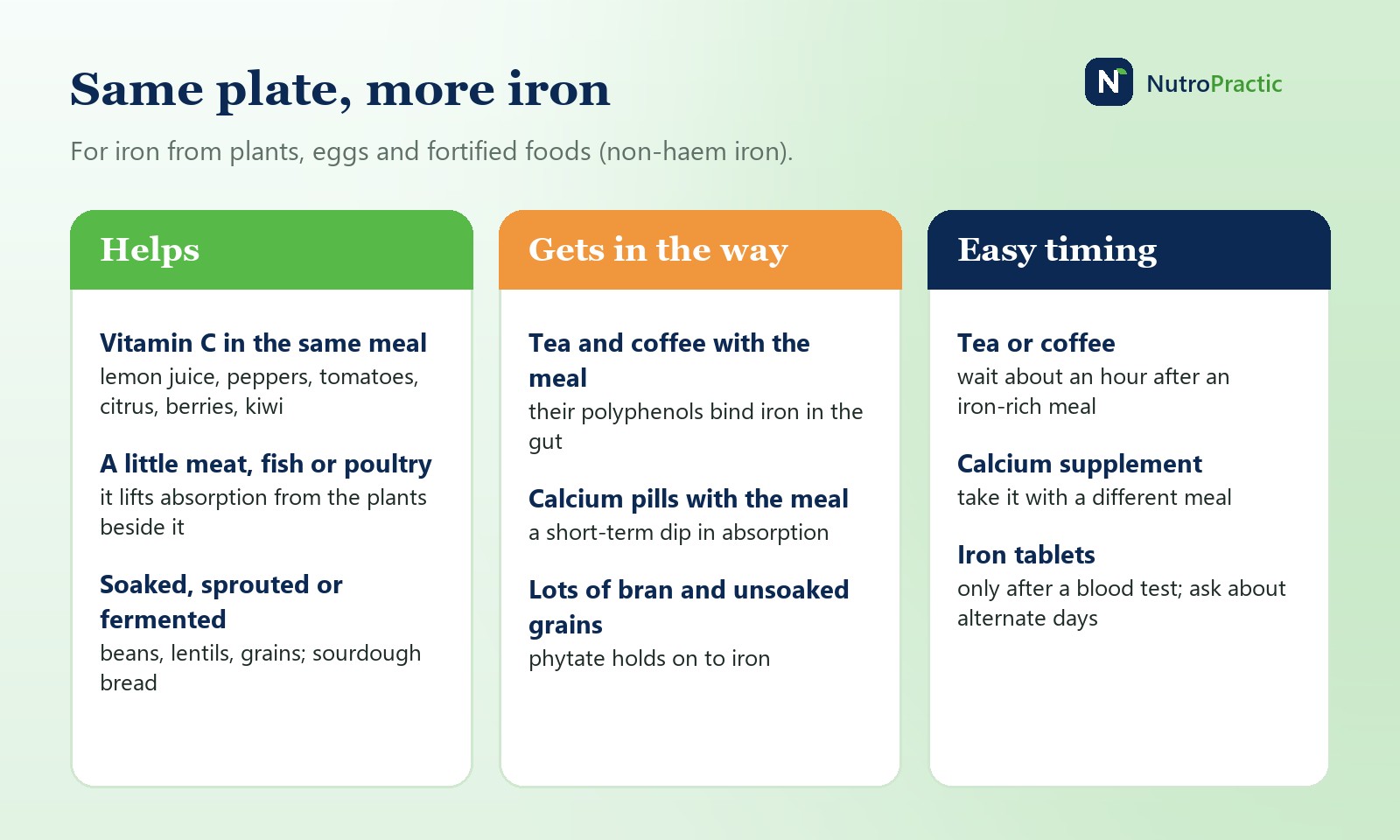
Vitamin C, in the same meal. It keeps non-haem iron in a form the gut can take up, and it partly cancels the blockers below. In single-meal studies the effect is large; over a whole varied diet it's smaller, but it's free and it tastes good. Lemon or lime juice over lentils, peppers or tomatoes in a bean dish, an orange or a kiwi with fortified cereal, berries with oats.
A little meat or fish. Beyond its own haem iron, a small amount of meat, poultry or fish raises the absorption of the plant iron eaten alongside it. For people who eat both, a bean chilli with a bit of mince does more than either half would alone.
Soaking, sprouting, fermenting. Whole grains and pulses carry phytate, which binds iron. Soaking beans overnight, sprouting lentils and letting dough ferment (real sourdough, or the fermented batters used for idli and dosa) all break some of it down.
Tea and coffee, with the meal. The polyphenols in tea, coffee and cocoa bind non-haem iron in the gut; in single-meal tests a cup with the food cut absorption by half or more. Timing fixes most of it. In a 2017 study of British women, moving the tea to one hour after an iron-containing meal removed about half of that blocking effect. Nobody needs to give up tea. Just let breakfast go down first.
Calcium supplements. Calcium briefly reduces iron absorption when the two arrive together. Over months the body seems to adjust, and dairy foods aren't worth worrying about. If you take a calcium tablet, though, have it with a different meal from your most iron-rich one.
Four vegetarian plates that do the work
Lentil soup with lemon and peppers. A big bowl gives about 6 mg of iron, and the lemon and peppers are the vitamin C. Bread on the side, sourdough if you have it.
Fortified cereal or oats with strawberries or an orange. Check the label for iron; fortified cereals range from 4 to 18 mg a serving. Coffee an hour later.
Tofu and broccoli stir-fry with cashews. Around 6 to 7 mg, with the vitamin C built into the broccoli. Cook it briefly so some of the vitamin survives.
Dal with tomatoes and a squeeze of lime, or chickpea salad with tomato and parsley. The same idea in two kitchens. A sprouted-moong salad with lemon works the same way.
A cast-iron pan adds a little iron too, mostly to acidic, slow-cooked food like tomato sauce. It's a small bonus, not a treatment. If most of your protein comes from plants, Vitamin D and B12: two common gaps covers the other nutrient worth checking.
Before you buy iron tablets
Food is the right first step for keeping stores up. It's often too slow for refilling stores that are already empty, and that's when a doctor may suggest a supplement. Three things are worth knowing first.
Test, don't guess. Tiredness has many causes. And iron isn't harmless in excess: about 1 in 300 people of northern European descent carry the genes for haemochromatosis, a condition in which the body stores too much. The safe upper limit from food and supplements for adults is 45 mg a day unless a doctor is treating a deficiency.
More often isn't better. A dose of iron raises hepcidin, a hormone that shuts down absorption for about a day. In a 2017 trial in The Lancet Haematology, iron-depleted women absorbed about 22% of each dose when they took it on alternate days and 16% when they took it daily. Many doctors now suggest one dose every other morning. It's also easier on the stomach, since constipation and nausea are the usual reasons people stop.
Find the leak. If periods are heavy (soaking through a pad or tampon every hour or two, passing large clots, bleeding for more than seven days), say so; it's treatable, and no diet can keep up with it. And iron deficiency in a man or in a woman after menopause is not a food problem until proven otherwise. It needs a doctor to look for blood loss from the gut.
A plan for the next month
1. If the first paragraph sounded like you, ask your doctor for ferritin along with a blood count. 2. Pick your two most iron-rich meals of the day and add a source of vitamin C to each. 3. Move tea and coffee to an hour after those meals. 4. Put beans, lentils, chickpeas or tofu on the plate once a day; soak the dried ones overnight. 5. If you're prescribed iron, ask whether alternate days would suit you, and have ferritin rechecked after about three months.
Low on iron, vegetarian, or not sure your meals are covering what your body loses each month? Dr. Triveni can look at what you eat now and build iron into it, in a virtual consultation.
Book a consultationThis article is general information, not medical advice. Don't start iron supplements without a blood test, and keep them away from children: iron tablets are a serious poisoning risk for small children. See your doctor if you have heavy periods, are pregnant, have a bowel condition, or have black or bloody stools.
Sources
World Health Organization, Anaemia in women and children, Global Health Observatory (2025 estimates). Weyand A.C. et al., Prevalence of iron deficiency and iron-deficiency anemia in US females aged 12-21 years, 2003-2020, JAMA 329(24):2191-2193 (2023); summary from Michigan Medicine. Vaucher P. et al., Effect of iron supplementation on fatigue in nonanemic menstruating women with low ferritin: a randomized controlled trial, CMAJ 184(11):1247-1254 (2012). Houston B.L. et al., Efficacy of iron supplementation on fatigue and physical capacity in non-anaemic iron-deficient adults, BMJ Open (2018). NIH Office of Dietary Supplements, Iron: fact sheet for health professionals (recommended intakes, food values, upper limit). WHO, Guideline on use of ferritin concentrations to assess iron status (2020); Ko C.W. et al., AGA clinical practice guidelines on the gastrointestinal evaluation of iron deficiency anemia, Gastroenterology (2020). Ahmad Fuzi S.F. et al., A 1-h time interval between a meal containing iron and consumption of tea attenuates the inhibitory effects on iron absorption, Am J Clin Nutr 106(6):1413-1421 (2017). Hurrell R., Egli I., Iron bioavailability and dietary reference values, Am J Clin Nutr 91(5):1461S-1467S (2010). Stoffel N.U. et al., Iron absorption from oral iron supplements given on consecutive versus alternate days and as single morning doses versus twice-daily split dosing in iron-depleted women, Lancet Haematology 4(11):e524-e533 (2017).