Ten years ago an alcohol-free beer was something you ordered when you were driving and regretted by the second sip. Now most big lagers come in a 0.0% version, supermarkets have a shelf of dealcoholised wine and most bars print a mocktail menu. In the US, no-alcohol beer volume grew 23% in 2024 and another 15% in 2025, while total alcohol volume fell 5% (IWSR). In Spain, about one beer in seven sold is alcohol-free.
If you are cutting down, the questions are practical. Are these drinks actually lighter? How much sugar is in them? Does "alcohol-free" mean zero? And the big one: do people who buy them drink less alcohol, or just more drinks? Here is what the labels and the trials show.
What "alcohol-free" means on the label
It is not the same everywhere. A drink sold as alcohol-free in one country would need a different word in the next:
UK (2018 guidance): "alcohol-free" up to 0.05% ABV, "de-alcoholised" up to 0.5%, "low alcohol" up to 1.2%. The government consulted in 2023 on raising alcohol-free to 0.5% and had not decided as of October 2026.
US (TTB rules for beer and malt drinks): "non-alcoholic" means under 0.5%, and the label must say "contains less than 0.5 percent alcohol by volume" right beside it. A 0.0% claim is allowed only if the drink is also labelled alcohol-free and has no alcohol in it.
Canada (CFIA): "non-alcoholic" or "alcohol-free" means under 0.05%; "dealcoholized" is under 1.1%.
EU wine (Regulation 2021/2117): "dealcoholised" wine is 0.5% or less; "partially dealcoholised" sits between that and the normal minimum strength for the wine.
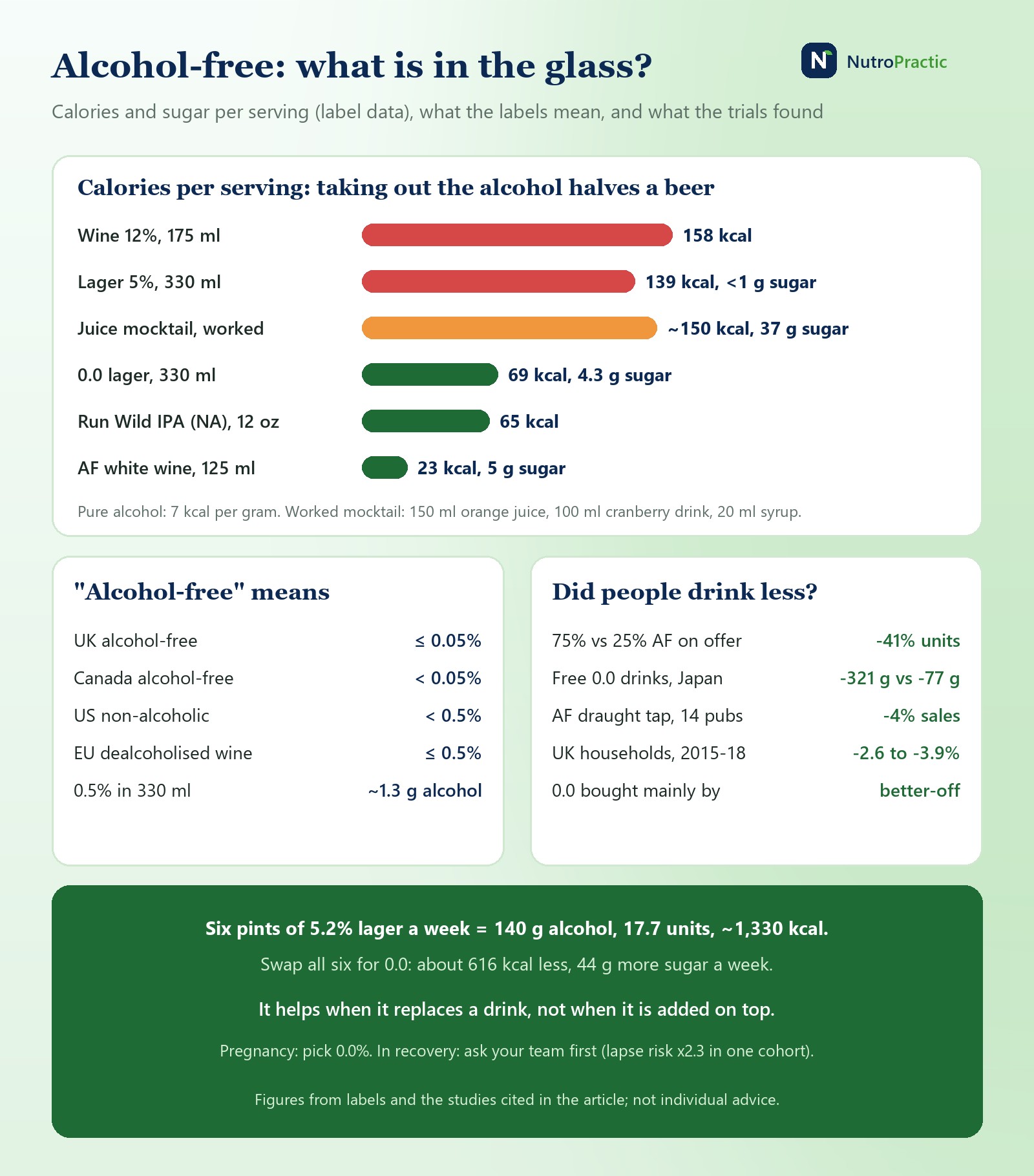
How much is 0.5%? A 330 ml bottle at 0.5% holds about 1.3 g of alcohol (330 ml × 0.005 × 0.789 g/ml), against about 13 g in the same bottle at 5%. For comparison, a German lab that tested everyday foods (Gorgus and colleagues, 2016) found up to 0.77 g of alcohol per litre in some orange, apple and grape juices, which is close to 0.1%. For most adults, 0.5% is not a meaningful dose. For pregnancy and for recovery from alcohol dependence it is a different question, covered further down.
Calories: the real saving is the alcohol
Pure alcohol carries 7 kcal per gram, nearly as much as fat. That is why taking it out cuts the calories so sharply, even when the brewer leaves more sugar behind. These are label figures from retail listings, per usual serving:
Heineken (5%), 330 ml: about 139 kcal, under 1 g sugar
Heineken 0.0, 330 ml: about 69 kcal, 4.3 g sugar
Guinness 0.0, 500 ml can: about 80 kcal, 2 to 3.5 g sugar (the two listings we found differ)
Athletic Brewing Run Wild IPA (non-alcoholic), 12 oz: 65 kcal, 14 g carbohydrate
Wine at 12%, 175 ml glass: about 158 kcal (Alcohol Change UK)
Eisberg alcohol-free Sauvignon Blanc, 125 ml: about 23 kcal, 5 g sugar
Eisberg alcohol-free Merlot, 125 ml: about 29 kcal, 6 g sugar
The pattern: most alcohol-free beers have half the calories of the regular version, or less, but more sugar. A regular lager ferments almost all of its sugar into alcohol; a 0.0 beer is either brewed so that fermentation stops early or has its alcohol taken out afterwards, and some malt sugar (mostly maltose) stays in. Alcohol-free wines often get grape juice or sugar added back for body. Five grams of sugar in a glass is modest, about a teaspoon, but it adds up over several.
A worked week
Take someone who has six pints of 5.2% lager a week, three on Friday and three on Saturday.
Alcohol: 568 ml × 0.052 × 0.789 g/ml = 23.3 g a pint, or 2.9 UK units. Six pints = 140 g, 17.7 units: over the UK's 14-unit limit and about 10 Canadian standard drinks, in Canada's "increasingly high risk" band of seven or more a week.
Calories: about 222 kcal a pint (Alcohol Change UK) = 1,332 kcal a week.
Swap all six for a 0.0 lager at about 21 kcal per 100 ml: about 119 kcal a pint, 716 kcal a week. Saving: about 616 kcal a week, roughly what a 70 kg adult burns walking 9 km.
Sugar added: 1.3 g per 100 ml = 7.4 g a pint, 44 g a week, about 6 g a day, a fifth of the NHS's 30 g daily limit for free sugars.
Swap half (three pints): alcohol falls to 70 g, about 8.9 units, and calories drop by about 308 kcal.
To see your own week in UK units, US drinks or Canadian standard drinks against each country's guidance, our free weekly drinks counter adds it up in a few taps. Try it once with your usual week and once with the swaps.
Mocktails: the sugar is in the mixers
A mocktail has no alcohol to take out, so its calories are juice and sugar. We found no survey of bar mocktails, so here is a worked example of a common build, using USDA food-table values: 150 ml orange juice (about 8.4 g sugar per 100 ml = 12.6 g), 100 ml cranberry juice drink (about 12 g per 100 ml = 12 g) and 20 ml simple syrup (1:1 sugar syrup, about 0.6 g sugar per ml = 12 g), topped with soda water.
That is about 37 g of sugar, roughly 150 kcal, in one glass: more than the NHS's whole 30 g daily limit for an adult's free sugars, and more calories than a 330 ml regular lager. Ready-to-drink alcoholic premixes are often similar: when Action on Sugar checked 202 of them in 2020, only 9% showed sugar on the label, and the examples ran from 33 g in a 250 ml can of Archers & Lemonade to 59 g in a 700 ml bottle of WKD Blue.
Easy fixes when you order or make one: ask for half the syrup or none; top up with soda water rather than lemonade or regular tonic; get flavour from lime, mint, cucumber, ginger and frozen fruit; or choose a 0.0 beer or a dry alcohol-free wine, which carry less sugar than most mocktails.
Do they help people drink less?
This is the question that matters most, and the answer is: sometimes, when they replace a drink, not when they are added on top. Here is what the studies found.
When there are more of them on offer
In an online-shop experiment in England (Clarke and colleagues, PLOS Medicine 2023), 607 adults who drink picked drinks from a simulated supermarket where 25%, 50% or 75% of the range was alcohol-free. With three-quarters alcohol-free they chose 17.5 units of alcohol, against 29.4 units with a quarter: 41% less. In a real-world test in 14 English pubs and bars (De-Loyde and colleagues, Addiction 2024), adding an alcohol-free beer on draught cut alcoholic draught sales by about 20 litres a week, around 4%, with no clear change in takings. Small, but across a country's pubs it adds up.
When people get them for free
A Japanese trial (Yoshimoto and colleagues, BMC Medicine 2023) gave 123 adults who drank often free 0.0% drinks for 12 weeks. Their alcohol intake fell by 321 g per four weeks, against 77 g in the control group, and the gap was still there eight weeks after the free drinks stopped. Caveats: it was open-label, intake was self-reported, and it was part-funded by a brewer.
In whole shopping baskets
British household purchase data (Anderson and colleagues, BMJ Open 2020, 64,286 households, 2015 to 2018) linked new no and low beers, and especially strong beers being reformulated weaker, with 2.6% to 3.9% fewer grams of alcohol bought overall. But a second paper by the same group (IJERPH 2021, 79,411 households) found 0.0% beer was bought mostly by younger, better-off households, not by the households that buy the most alcohol. And a 2021 scoping review of 70 studies found only two that suggested no and low drinks replaced alcohol rather than being drunk alongside it.
Put together: for a moderate drinker who wants to cut down, a 0.0 beer instead of the second or third drink is a real, measurable saving. Treating 0.0 drinks as an extra, or as a reason to stay out longer, is not.
Two groups who should be careful
Pregnancy
The UK Chief Medical Officers' advice is that not drinking at all is the safest approach in pregnancy, and 0.0% to 0.05% drinks fit that. Drinks labelled up to 0.5% are a judgement call, partly because labels are not always right: when a Canadian team tested 45 "no" and "low" alcohol drinks (Goh and colleagues, 2010), 13 (29%) held more alcohol than their label said, and six that claimed no alcohol contained over 1%. If you want zero, pick drinks labelled 0.0%, or alcohol-free under the UK or Canadian 0.05% rule, and ask your midwife or doctor.
Recovery from alcohol dependence
A drink that looks, smells and tastes like beer can set off the urge to drink. A 2022 review (Caballeria and colleagues, Nutrients) found craving rose after no and low alcohol drinks in people with alcohol use disorder, more so the more severe the dependence. A Japanese study of alcohol-dependent men followed for a year after treatment (Yokoyama and colleagues, 2026) found those who drank non-alcoholic beer had more than twice the risk of a lapse (hazard ratio 2.30). It is observational, but the direction is consistent. If you are in recovery, check with your treatment team first.
Are they good for you?
Better than the alcoholic version, but not a health drink. A small trial (Marques and colleagues, 2022) gave 22 men 330 ml of 0.0% beer a day for four weeks: gut microbial diversity rose a little, and weight and blood markers didn't change. The sugar in alcohol-free beer is mostly maltose, which is absorbed fast: in a Finnish test (Hätönen and colleagues, 2012) non-alcoholic beer had a glycaemic index of about 80. If you have diabetes, count a 0.0 beer as a carbohydrate drink, around 14 g in a 12 oz bottle of some brands, not as water.
A simple plan
1. Count your week first. Most people underestimate. Write down every drink for seven days.
2. Swap the drinks you care least about. Often the second drink of the evening, the weeknight beer with dinner, or the drink at a work event.
3. Alternate. One alcoholic, one alcohol-free. At a 50/50 split with 0.0 lager, the six-pint week above drops from 17.7 units to about 8.9.
4. Read the label. Look for 0.0% or 0.05% if you want none, and check sugar per 100 ml: under 2 g is low for a beer.
5. Keep mocktails simple. Less syrup, soda water, and flavour from citrus, herbs and ginger.
For the bigger picture on limits, see our article on what Canada, the US, the UK and WHO now say about alcohol. If sugar-free soft drinks are your other swap, our sweeteners article covers what the 2023 WHO decisions did and didn't mean.
A 0.0 beer instead of a pint saves about 23 g of alcohol and 100 kcal. A 0.0 beer as well as the pint saves nothing.
Want to drink less without feeling you are missing out, or planning a team wellness programme that covers alcohol? Dr. Triveni can help you set realistic goals in a virtual consultation.
Book a consultationThis article is general information, not medical advice. If you are pregnant, take medicines that interact with alcohol, or are in recovery from alcohol dependence, talk to your doctor before using alcohol-free or low-alcohol drinks.
Sources
IWSR, US beverage alcohol consumption drops 5% in volume during 2025 (2026), and IWSR no-alcohol market data for 2024. Cerveceros de España, Informe Socioeconómico del Sector de la Cerveza en España 2024 (alcohol-free share 14%), as reported in the Spanish press.
UK government, Response to consultation on low alcohol descriptors (2018) and Updating labelling guidance for no and low-alcohol alternatives (2023). US 27 CFR §7.65, alcohol content statements. Canadian Food Inspection Agency, Labelling requirements for alcoholic beverages. Regulation (EU) 2021/2117.
Gorgus E., Hittinger M., Schrenk D., Estimates of ethanol exposure in children from food not labeled as alcohol-containing, J Anal Toxicol 40(7):537-542 (2016). Alcohol Change UK, Alcohol and calories. Product figures from retailer label listings (Heineken 0.0, Heineken, Guinness 0.0, Athletic Brewing Run Wild, Eisberg), checked October 2026; recipes vary by country. Juice values: USDA FoodData Central. NHS, Sugar: the facts. Action on Sugar, Ready-to-drink alcoholic beverages survey (2020).
Clarke N. et al., Impact on alcohol selection and online purchasing of changing the proportion of available non-alcoholic versus alcoholic drinks: a randomised controlled trial, PLOS Med 20(3):e1004193 (2023). De-Loyde K. et al., The impact of introducing alcohol-free beer options in bars and public houses on alcohol sales and revenue: a randomised crossover field trial, Addiction 119(6):1071-1079 (2024). Yoshimoto H. et al., Effect of provision of non-alcoholic beverages on alcohol consumption: a randomized controlled study, BMC Med 21:379 (2023).
Anderson P. et al., Impact of low and no alcohol beers on purchases of alcohol: interrupted time series analysis of British household shopping data, 2015-2018, BMJ Open 10(10):e036371 (2020). Anderson P. et al., Is buying and drinking zero and low alcohol beer a higher socio-economic phenomenon?, IJERPH 18(19):10347 (2021). Anderson P., Kokole D., Llopis E.J., Production, consumption, and potential public health impact of low- and no-alcohol products: results of a scoping review, Nutrients 13(9):3153 (2021).
UK Chief Medical Officers' low risk drinking guidelines (2016). Goh Y.I., Verjee Z., Koren G., Alcohol content in declared non- to low-alcoholic beverages, Can J Clin Pharmacol 17(1):e47-50 (2010). Caballeria E. et al., "Doctor, can I drink an alcohol-free beer?" Low-alcohol and alcohol-free drinks in people with heavy drinking or alcohol use disorders: systematic review of the literature, Nutrients 14(19):3925 (2022). Yokoyama A. et al., Self-help group participation, avoidance of nonalcoholic beer, and nonsmoking independently predict better drinking outcomes in Japanese alcohol-dependent men, Alcohol Clin Exp Res 50(2):e70227 (2026).
Marques C. et al., Impact of beer and nonalcoholic beer consumption on the gut microbiota: a randomized, double-blind, controlled trial, J Agric Food Chem 70(41):13062-13070 (2022). Hätönen K.A. et al., Modifying effects of alcohol on the postprandial glucose and insulin responses in healthy subjects, Am J Clin Nutr 96(1):44-49 (2012).