For years the rule of thumb was simple: a glass of wine with dinner is fine, maybe even good for your heart. Since 2023 that rule has been taken apart, piece by piece. Canada now calls two drinks a week the low-risk line. The US Surgeon General put out an advisory on alcohol and cancer in January 2025. And the new US Dietary Guidelines, published in January 2026, dropped the old "one a day for women, two for men" numbers altogether.
So is a drink a day still fine? Here is what changed, what the studies behind it actually show, where experts still disagree, and how to size up your own drinking, whether you count in US drinks, UK units or Indian pegs.
What the guidelines say now
Canada (2023): two a week is low risk
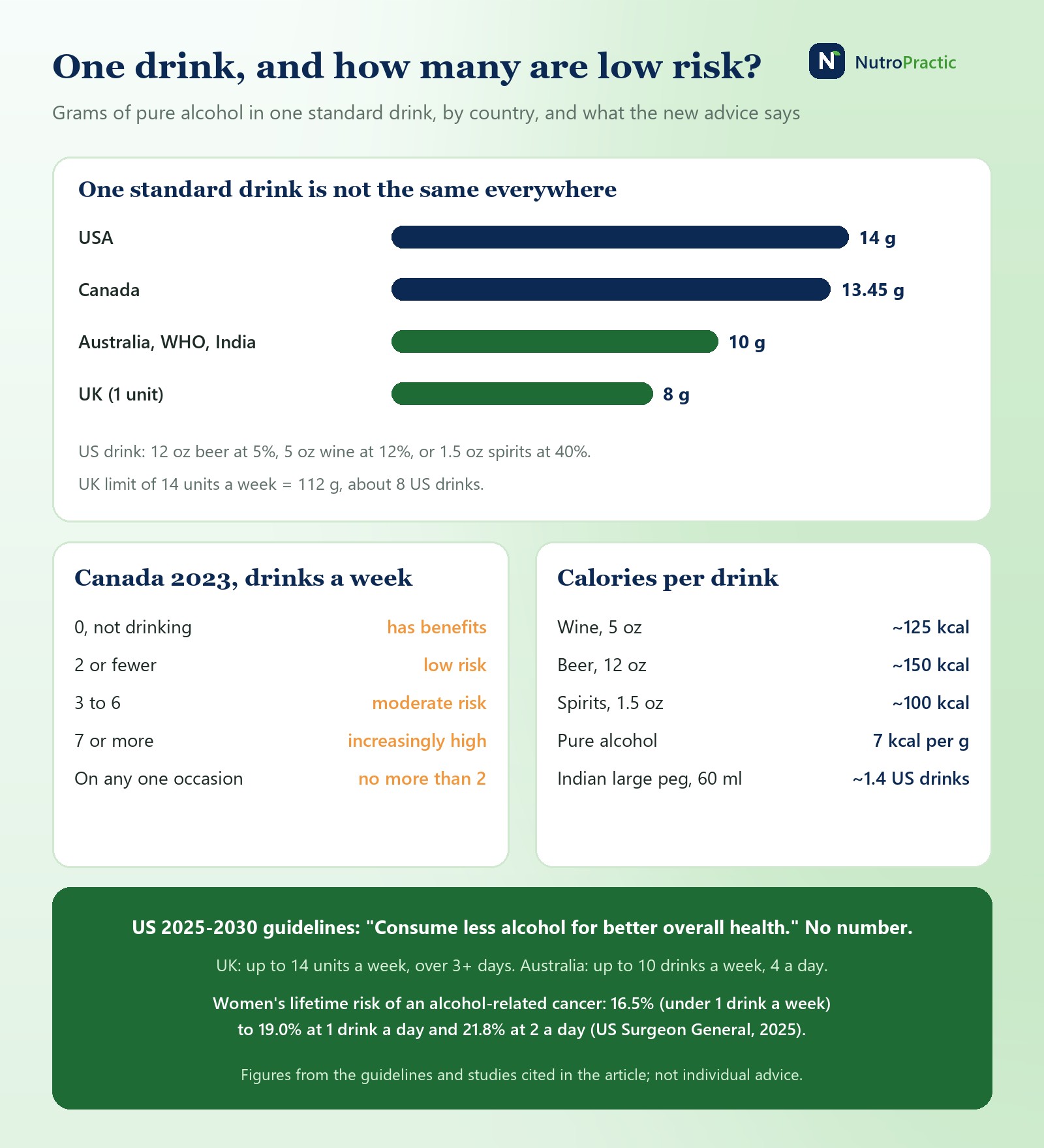
Canada's Guidance on Alcohol and Health (Canadian Centre on Substance Use and Addiction, January 2023) replaced the 2011 limits of 10 drinks a week for women and 15 for men with a sliding scale of risk, the same for men and women:
0 drinks a week: not drinking "has benefits, such as better health, and better sleep".
2 or fewer: low risk; you are likely to avoid alcohol-related harm.
3 to 6: moderate risk; the risk of several cancers, including breast and colon, goes up.
7 or more: increasingly high risk; heart disease and stroke risk rise significantly.
And on any one occasion, no more than 2 drinks.
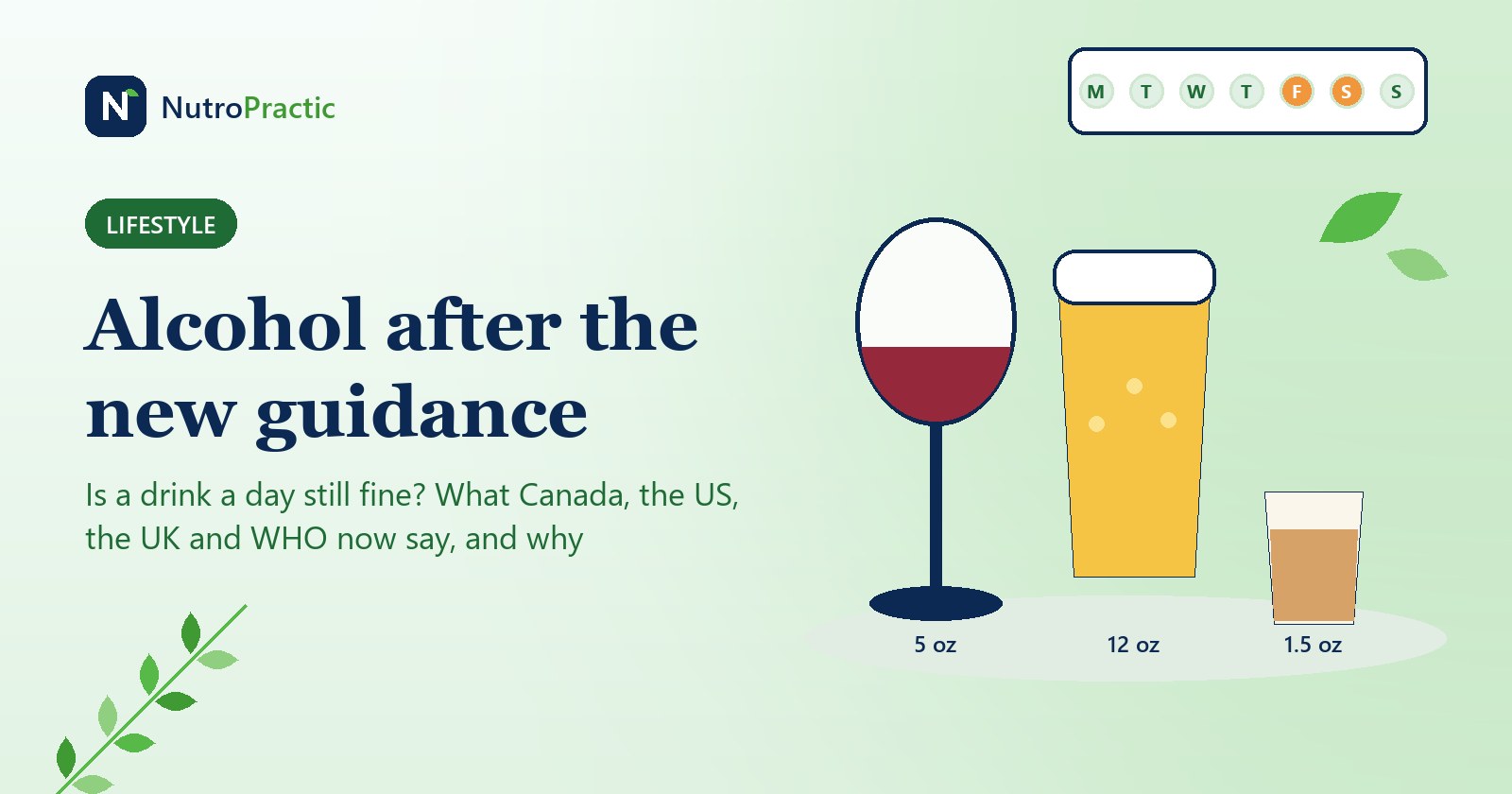
A Canadian standard drink holds 13.45 g of pure alcohol: a 341 ml (12 oz) bottle of 5% beer, a 142 ml (5 oz) glass of 12% wine, or 43 ml (1.5 oz) of 40% spirits. The report's modelling put the 1-in-1,000 lifetime risk of dying from alcohol at about 2 drinks a week, and 1-in-100 at about 6.
United States (2025-2026): a cancer advisory and no number
In January 2025, Surgeon General Vivek Murthy's advisory called alcohol the third leading preventable cause of cancer in the US, after tobacco and obesity, linked to nearly 100,000 cancer cases and about 20,000 cancer deaths a year. It names at least seven cancers: breast, colon and rectum, oesophagus, liver, mouth, throat and voice box. For breast, mouth and throat cancer, it says risk "may start to increase around one or fewer drinks per day". In a 2019 survey, only about 45% of Americans knew alcohol raises cancer risk. The advisory asked Congress to add cancer to the warning label; as of October 2026 that hasn't happened.
Then the Dietary Guidelines for Americans 2025-2030 (January 7, 2026) replaced the old daily limits with one line: "Consume less alcohol for better overall health." Pregnant women, people recovering from alcohol use disorder or unable to control their drinking, and people on medicines or with conditions that interact with alcohol should avoid it completely. There is no number at all, and no mention of cancer.
The UK, Australia, WHO and India
UK (Chief Medical Officers, 2016): no more than 14 units a week for men and women, spread over three or more days, with several drink-free days. A UK unit is only 8 g of alcohol, so 14 units is 112 g, about 8 US drinks a week. Australia (NHMRC, 2020): no more than 10 standard drinks a week and 4 on any one day, with a 10 g drink. WHO Europe (The Lancet Public Health, January 2023) said that no safe amount of alcohol can be set for cancer and health, because there is no level at which alcohol's cancer-causing effect switches on.
In India, about 18.8% of men and 1.3% of women aged 15 and over drink (NFHS-5, 2019-21). A standard drink is usually counted as 10 g, and new food-regulator (FSSAI) labelling rules reported for 2026 ask brands to show standard drinks per bottle. A bar's "large peg" of 60 ml whisky holds about 19 g of alcohol: roughly two Indian standard drinks, or 1.4 US drinks.
What happened to the "glass of red is good for your heart" idea?
The old advice rested on a pattern in observational studies: light drinkers seemed to live a little longer than non-drinkers, the famous J-curve. The problem is who ends up in the "non-drinker" group. In 1988, Shaper and colleagues (Lancet) followed 7,735 British men and found the curve came from men who had stopped drinking because they were already ill. Put those "sick quitters" in with lifelong non-drinkers, and moderate drinkers look healthy by comparison.
In 2023, Zhao and colleagues (JAMA Network Open) pooled 107 studies with 4.8 million people and corrected for this. Against lifelong non-drinkers, low-volume drinkers (up to about 24 g a day, under two US drinks) had no significant reduction in deaths (relative risk 0.93, not significant). Risk was clearly higher from 45 g a day (about three US drinks): 19% more deaths, and 35% more at 65 g or above. Women's risk rose at lower amounts than men's.
Genetic studies point the same way. Using UK Biobank data from 371,463 adults, Biddinger and colleagues (JAMA Network Open, 2022) found that heart disease and blood pressure risk rose with alcohol at every level: slightly at light intakes and steeply at heavier ones. The apparent benefit of light drinking shrank once lifestyle was taken into account; light drinkers also tend to exercise more, smoke less and eat better.
Where experts still disagree
To be fair, not every review agrees. A US National Academies (NASEM) review in December 2024 found 16% lower all-cause mortality in moderate drinkers (up to one drink a day for women, two for men) than in people who had never drunk, rated "moderate certainty". The same review found 10% higher breast cancer risk. A separate US government study (the ICCPUD Alcohol Intake and Health Study, shelved in 2025 and published in a journal in July 2026) found no protective effect at low levels, and a 1-in-25 lifetime risk of an alcohol-caused death for men at 14 drinks a week.
Our reading: the heart benefit, if it exists, is small and uncertain. The cancer risk is better established. Nobody recommends starting to drink for your health.
Cancer: how big is the risk, really?
Relative risk sounds scary, so here are absolute numbers. Each extra daily drink raises breast cancer risk by about 5 to 10%, depending on the study (7.1% per 10 g a day in a 2002 pooled analysis of 53 studies; 5% in the NASEM review). The Surgeon General's advisory turned this into lifetime risk, using an Australian cohort of 226,162 adults:
Women, any alcohol-related cancer: 16.5% at under one drink a week, 19.0% at one drink a day, 21.8% at two a day.
Men: 10.0%, 11.4% and 13.1%.
Women, breast cancer alone: 11.3%, 13.1% and 15.3%.
So one drink a day adds about 2.5 percentage points to a woman's lifetime risk of an alcohol-related cancer: about 1 extra case for every 40 women who drink that much (our calculation). That's not a reason to panic over a glass at a wedding. It is a real, measurable cost of a daily habit, and it climbs with every extra drink.
Sleep, calories and the rest
Sleep. Alcohol helps you fall asleep faster, which is why so many people use a nightcap. But a 2013 review (Ebrahim and colleagues, Alcoholism: Clinical and Experimental Research) found that at every dose it delays the first dream (REM) sleep and disturbs the second half of the night, and moderate to large amounts cut total REM sleep. In a study of 4,098 Finnish employees wearing heart-rate monitors (Pietilä and colleagues, 2018), the body's recovery score in the first three hours of sleep fell by 9 percentage points after a small amount of alcohol, 24 after a moderate amount and 39 after a large amount. Our article on foods for sleep has more on evening habits.
Calories. Alcohol carries 7 kcal per gram, nearly as much as fat. A 5 oz glass of wine is about 125 kcal, a 12 oz regular beer about 150, and a 1.5 oz shot of spirits about 100 before any mixer (USDA FoodData Central). Four drinks over a weekend add 500 to 600 kcal, a full meal, and they tend to come with salty snacks.
Liver and stomach. Alcohol is one of the main drivers of liver fat: see our article on fatty liver (MASLD), weight loss, coffee and alcohol. It is also a common heartburn and acid reflux trigger.
A practical way to think about your own drinking
Count in standard drinks, not glasses. A restaurant pour of wine is often 6 to 9 oz, and a pint of 7% craft beer is close to two US drinks. Check the strength (ABV) on the label.
Look at the week, not the day. If you drink, keep it to a few drinks a week and leave most days alcohol-free. The Canadian scale is a useful yardstick: 2 or fewer is low risk, 3 to 6 is moderate. Our free weekly drinks counter adds up your week in US drinks, UK units or Canadian drinks and checks it against each country's limits.
No more than 2 on one occasion. Injuries and other harms rise above that.
Have it with food, and alternate with water or an alcohol-free option.
Don't drink at all if you are pregnant or trying to be, take medicines that interact with alcohol, have liver disease, or find it hard to stop at one or two.
If you have been drinking a glass or two every evening, cutting down to weekends only already moves you from "increasingly high" toward "moderate" on the Canadian scale, and many people notice they sleep better.
Less is better, none is lowest risk, and nobody should start drinking for their health: that is where the evidence has settled.
Want to cut down without feeling deprived, or work out what your drinking means for your weight, liver or sleep? Dr. Triveni can help you build a realistic plan in a virtual consultation, and our corporate wellness programmes cover alcohol and lifestyle for whole teams.
Book a consultationThis article is general information, not medical advice. If you are pregnant, take regular medicines, have liver disease or a family history of alcohol problems, or are worried about your drinking, talk to your doctor. If you find it hard to cut down, ask your doctor about support services in your country.
Sources
Paradis C. et al., Canada's Guidance on Alcohol and Health: Final Report, Canadian Centre on Substance Use and Addiction (2023). Office of the Surgeon General, Alcohol and Cancer Risk: The U.S. Surgeon General's Advisory, HHS (2025). US Departments of Agriculture and Health and Human Services, Dietary Guidelines for Americans 2025-2030 (2026).
UK Chief Medical Officers, Low Risk Drinking Guidelines (2016). NHMRC, Australian Guidelines to Reduce Health Risks from Drinking Alcohol (2020). Anderson B.O. et al., Health and cancer risks associated with low levels of alcohol consumption00317-6), Lancet Public Health 8(1):e6-e7 (2023). International Institute for Population Sciences, National Family Health Survey (NFHS-5), India 2019-21.
Shaper A.G., Wannamethee G., Walker M., Alcohol and mortality in British men: explaining the U-shaped curve92890-5), Lancet 2(8623):1267-1273 (1988). Zhao J. et al., Association between daily alcohol intake and risk of all-cause mortality, JAMA Netw Open 6(3):e236185 (2023). Biddinger K.J. et al., Association of habitual alcohol intake with risk of cardiovascular disease, JAMA Netw Open 5(3):e223849 (2022).
National Academies of Sciences, Engineering, and Medicine, Review of Evidence on Alcohol and Health (2025). George M.D. et al., Alcohol Intake and Health Study: no protective effect at low levels, J Stud Alcohol Drugs 87(4):621-638 (2026). Collaborative Group on Hormonal Factors in Breast Cancer, Alcohol, tobacco and breast cancer, Br J Cancer 87(11):1234-1245 (2002).
Ebrahim I.O. et al., Alcohol and sleep I: effects on normal sleep, Alcohol Clin Exp Res 37(4):539-549 (2013). Pietilä J. et al., Acute effect of alcohol intake on cardiovascular autonomic regulation during the first hours of sleep, JMIR Ment Health 5(1):e23 (2018). NIAAA, What is a standard drink?; USDA FoodData Central.