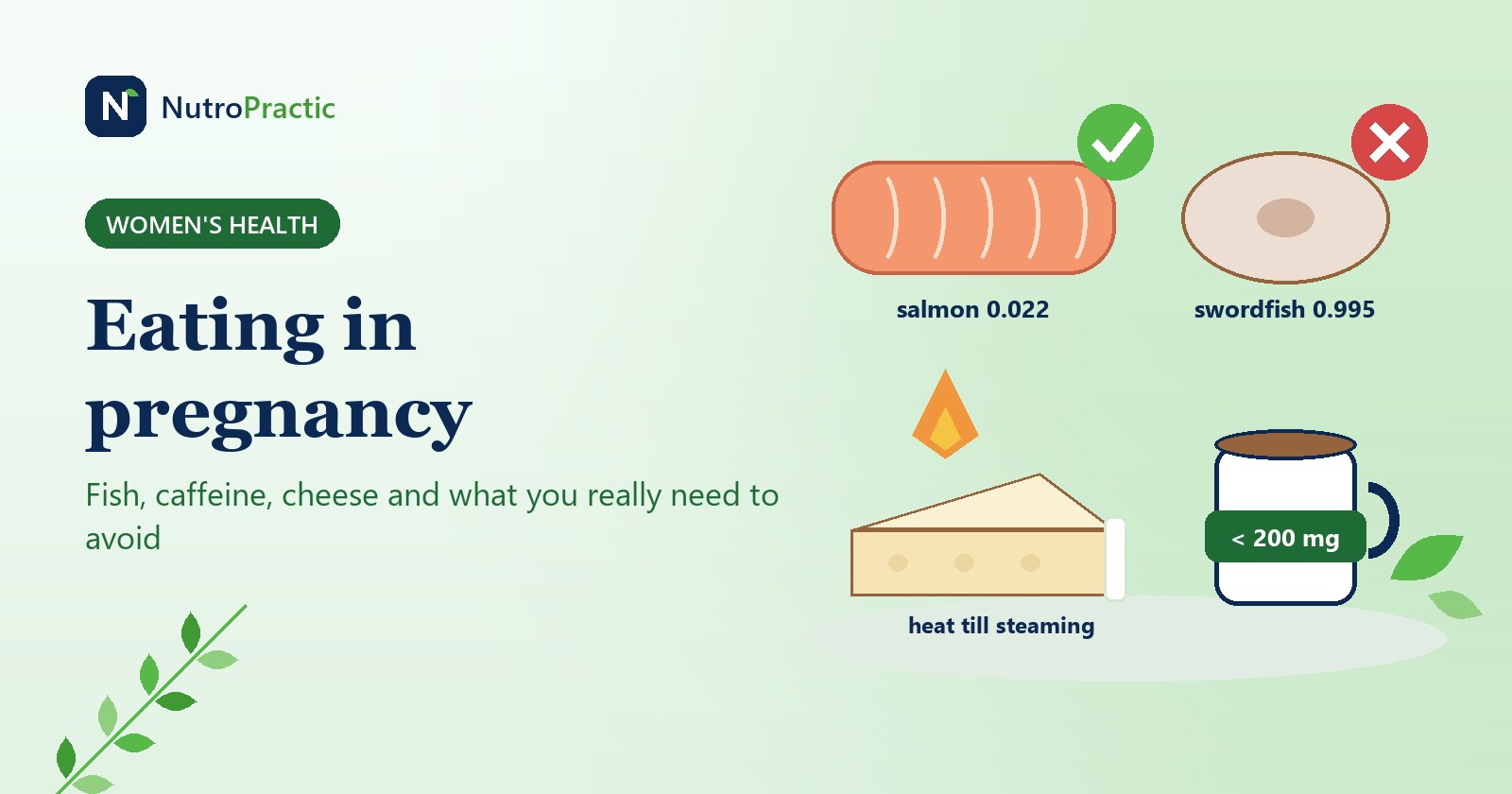
Pregnancy food lists tend to arrive as a wall of "avoid": fish, coffee, cheese, eggs, deli meat, sushi, liver, herbal tea. Taken at face value, many people cut out far more than they need to, including foods that do the baby good. Oily fish is the clearest example: the US and UK advice is to eat more of it, not less, from the right list.
Each rule exists for one of four reasons: mercury (some fish), listeria and other infections (some cheeses, chilled ready-to-eat foods, raw meat), too much of a nutrient (vitamin A in liver, caffeine) or alcohol. Knowing which reason sits behind a rule tells you how strict to be and when a food becomes safe again, usually by heating it until steaming. Below are the numbers behind each one. If you are planning a pregnancy, start with folic acid before pregnancy, which has to begin before you know.
Fish: eat it, from the low-mercury list
Fish gives omega-3 DHA for the baby's brain and eyes, plus iodine, vitamin D and protein. The FDA and EPA advice (revised October 2021) for anyone pregnant or breastfeeding is 2-3 servings a week, 8-12 oz (225-340 g) in total, from the "Best Choices" list, or 1 serving a week from "Good Choices". A serving is 4 oz (113 g), about the size of your palm. The NHS says up to 2 portions of oily fish a week, plus any amount of white fish within reason.
The difference between fish is mercury, which builds up in large, long-lived predators. Mean levels from FDA testing (parts per million, 1990-2012 data):
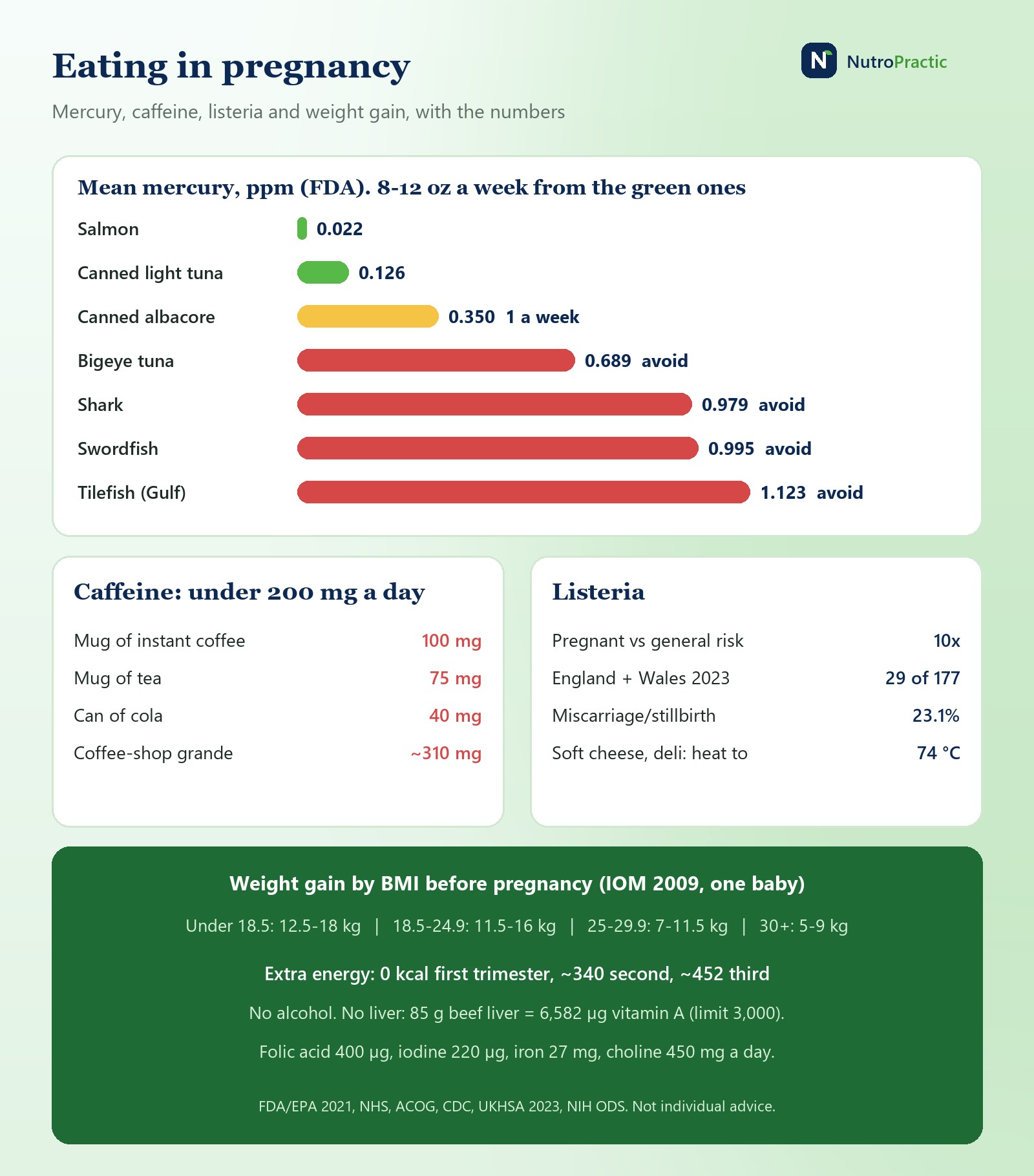
Shrimp 0.009 · Sardine 0.013 · Tilapia 0.013 · Salmon, canned 0.014 · Anchovies 0.016 · Salmon, fresh/frozen 0.022 · Pollock 0.031 · Cod 0.111 · Tuna, canned light 0.126 — Best Choices
Tuna, canned albacore 0.350 · Tuna, yellowfin 0.354 — Good Choices, 1 serving a week
Marlin 0.485 · Orange roughy 0.571 · Bigeye tuna 0.689 · King mackerel 0.730 · Shark 0.979 · Swordfish 0.995 · Tilefish (Gulf of Mexico) 1.123 — Choices to Avoid
A worked example shows why the lists sit where they do. The US EPA's safe daily dose for methylmercury is 0.1 µg per kg of body weight. For a 65 kg woman that is 6.5 µg a day, or about 45 µg a week. Twelve ounces (340 g) of fish a week gives:
Salmon: 340 g × 0.022 = 7.5 µg (17% of the weekly limit)
Canned light tuna: 340 g × 0.126 = 43 µg (95%, right at the edge)
Canned albacore: 340 g × 0.350 = 119 µg (2.6 times the limit), which is why it's one serving a week
One 113 g swordfish steak: 113 g × 0.995 = 112 µg (2.5 times the limit in a single meal)
So a mix like two salmon or sardine meals plus a tuna sandwich in a week is well inside the limit. The NHS adds a cap of 4 medium cans of tuna (about 140 g drained each) or 2 fresh tuna steaks a week, and lists shark, swordfish and marlin to avoid. Raw fish and sushi made with it are out in the UK advice (cook or freeze first); cold-smoked salmon should be cooked until steaming. For how omega-3 from fish compares with walnuts and capsules, see Omega-3: oily fish, walnuts or capsules?
Caffeine: 200 mg a day, and what that looks like
ACOG in the US, the NHS and the European Food Safety Authority all give the same ceiling: under 200 mg of caffeine a day. Caffeine crosses the placenta, and the fetus can barely break it down; in the mother its half-life roughly doubles by the third trimester.
The evidence for the limit comes from cohorts. In a Kaiser Permanente study of 1,063 pregnant women (Weng and colleagues, 2008), 200 mg a day or more was linked to about twice the miscarriage risk of no caffeine (hazard ratio 2.23). In the NICHD Fetal Growth Studies (Gleason and colleagues, JAMA Network Open 2021; 2,055 women), even about 50 mg a day, half a cup of coffee, was linked to babies 66 g lighter at birth, with 0.32 cm smaller thigh circumference. Neither study can prove cause, and the 66 g finding is small, but it's why some researchers now argue for less than 200 mg rather than more.
Typical caffeine per drink (NHS for UK mugs, USDA and brand figures for US cups):
Mug of instant coffee: 100 mg · Brewed coffee, 8 oz (240 ml): 95 mg · Single espresso: 63 mg
Coffee-shop brewed, 16 oz "grande": about 310 mg (Starbucks' own figure for Pike Place), over the daily limit in one cup
Mug of black or green tea: 75 mg · Can of cola: 40 mg · 250 ml energy drink: 80 mg
50 g dark chocolate: under 25 mg · 50 g milk chocolate: under 10 mg
Worked days: one mug of instant coffee + one mug of tea + a small bar of dark chocolate = 100 + 75 + 25 = 200 mg, at the limit. Two mugs of tea and a can of cola = 190 mg. One large coffee-shop filter coffee alone = 310 mg. Decaf has 2-15 mg a cup. To add up your own day, use our free caffeine counter.
Cheese, deli food and listeria: rare, but serious
Listeria is a bacterium that, unlike most, grows at fridge temperature. It is rare: the CDC currently estimates about 1,250 infections and 172 deaths a year in the US, and England and Wales recorded 177 cases in 2023. But pregnancy changes the odds sharply. The CDC found pregnant women 10 times more likely to get listeriosis than the general population (24 times for pregnant Hispanic women, linked to soft Latin-style cheeses). In England and Wales, 29 of the 177 cases in 2023 were pregnancy-associated, and of those with a known outcome, 23.1% ended in miscarriage or stillbirth. The mother may only feel a mild flu.
That combination, uncommon but devastating, is why the rules focus on foods where listeria has a chance to grow: soft, moist, chilled and eaten without cooking. What the CDC and NHS lists agree on:
Fine: hard cheeses (cheddar, Parmesan, Swiss, Gouda); pasteurised mozzarella, feta, cottage cheese, cream cheese, halloumi, paneer and ricotta; pasteurised milk, yoghurt and ice cream; any cheese cooked until steaming; freshly cut melon
Only if cooked until steaming (74 °C / 165 °F): brie, camembert and other white-rind cheeses; soft blue cheeses (gorgonzola, Roquefort); deli meats, hot dogs and cured meats (salami, chorizo, prosciutto); chilled smoked fish; queso fresco, queso blanco and other soft Latin-style cheeses (CDC: even pasteurised ones); raw sprouts; enoki mushrooms
Avoid: unpasteurised milk and cheeses made from it (unless cooked); refrigerated pâté and meat spreads (shelf-stable sealed ones are fine); deli salads made in store (coleslaw, tuna or chicken salad); cut melon that has sat out over 2 hours
Melon is on the list because of the 2011 US cantaloupe outbreak: contaminated melons from one Colorado farm caused 147 illnesses and 33 deaths, including a miscarriage. For Indian kitchens: paneer made at home from boiled milk is fine, as is shop paneer from pasteurised milk; the risk is cut fruit, chaat and salads from stalls that have sat unchilled.
Liver and vitamin A: too much of a good thing
Vitamin A in its retinol form, the kind in animal liver and some supplements, can cause birth defects in large amounts. The upper limit for adults, pregnant or not, is 3,000 µg a day. Liver blows past it: a 3 oz (85 g) portion of pan-fried beef liver contains about 6,582 µg, more than twice the daily limit in one meal (US National Institutes of Health). That is why the NHS lists liver and liver products such as liver pâté to avoid, along with fish liver oil and supplements containing retinol. Beta-carotene from carrots, sweet potato and greens is safe: the body only converts what it needs. Pregnancy multivitamins are formulated without high-dose retinol; ordinary multivitamins may not be, so check the label.
Eggs, meat and alcohol
Eggs: in the UK, hens' eggs with the British Lion stamp or "Laid in Britain" mark can be eaten runny, following the Food Standards Agency's 2017 review of salmonella. US advice is still to cook eggs until yolk and white are firm, and to avoid raw-egg foods unless made with pasteurised eggs. In India, cook eggs through.
Meat: cook until there is no pink and no blood, to avoid toxoplasma as well as listeria. Wash fruit and vegetables well, and wear gloves for gardening or the cat's litter tray.
Alcohol: none. The CDC, ACOG and the UK Chief Medical Officers all say there is no known safe amount at any stage. A US study of first-graders in four communities (May and colleagues, JAMA 2018) estimated fetal alcohol spectrum disorders in 1.1% to 5.0% of children. If you drank before you knew you were pregnant, the risk from that is likely low; stopping now is what matters, and your midwife or doctor will not judge you for raising it.
What you do need more of
Avoiding is half the picture. The daily amounts that rise in pregnancy (US recommended intakes; UK figures where they differ):
Folic acid: 400 µg as a supplement from before conception to 12 weeks (higher dose for some; see the folic acid article)
Iodine: 220 µg a day (from 150 µg); dairy, fish, eggs, iodised salt; ACOG and the American Thyroid Association suggest a prenatal vitamin with 150 µg
Iron: 27 mg a day (from 18 mg); red meat, pulses, fortified cereals, with vitamin C at the same meal
Choline: 450 mg a day; two eggs give about 300 mg
Vitamin D: 600 IU (15 µg) in the US; the NHS advises a 10 µg supplement for everyone pregnant
DHA: about 200 mg a day on average, which 2 portions of oily fish a week provide
Calories and weight gain: the actual ranges
"Eating for two" overshoots. The US National Academies estimate no extra calories in the first trimester, about 340 kcal a day extra in the second and 452 kcal in the third. The NHS is more conservative: about 200 kcal extra a day, in the last three months only. 340 kcal is a pot of Greek yoghurt with a banana and a small handful of almonds, not a second dinner.
Recommended total weight gain depends on your BMI before pregnancy (Institute of Medicine, 2009, single baby; weekly rate from the second trimester):
Underweight (BMI under 18.5): 12.5-18 kg (28-40 lb), about 0.51 kg a week
Healthy weight (18.5-24.9): 11.5-16 kg (25-35 lb), about 0.42 kg a week
Overweight (25-29.9): 7-11.5 kg (15-25 lb), about 0.28 kg a week
Obesity (30 or more): 5-9 kg (11-20 lb), about 0.22 kg a week
Worked example: a woman 1.63 m tall weighing 62 kg before pregnancy has a BMI of 62 ÷ (1.63 × 1.63) = 23.3, so her range is 11.5-16 kg. After 0.5-2 kg in the first trimester, that means roughly 0.4 kg a week from week 14. If weight is climbing much faster, or blood sugar is flagged at the glucose test, ask your midwife or doctor about a dietitian referral early rather than late.
Eat fish twice a week from the low-mercury list, keep caffeine under 200 mg, heat soft cheese and deli food until steaming, leave out liver and alcohol, and gain weight by your BMI, not by eating for two.
Pregnant or planning, and unsure what to eat with nausea, a vegetarian diet, gestational diabetes or a long list of dos and don'ts? Dr. Triveni can plan your meals trimester by trimester in a virtual consultation.
Book a consultationThis article is general information, not medical advice. Your midwife, obstetrician or doctor may give different advice for your pregnancy, and theirs comes first.
Sources
US FDA and EPA, Advice about eating fish (revised October 2021). US FDA, Mercury levels in commercial fish and shellfish (1990-2012). US EPA, IRIS assessment of methylmercury, reference dose 0.1 µg/kg/day (2001). NHS, Foods to avoid in pregnancy.
ACOG Committee Opinion 462, Moderate caffeine consumption during pregnancy (2010, reaffirmed). Weng X., Odouli R., Li D.K., Maternal caffeine consumption during pregnancy and the risk of miscarriage: a prospective cohort study, Am J Obstet Gynecol 198(3):279.e1-8 (2008). Gleason J.L. et al., Association between maternal caffeine consumption and metabolism and neonatal anthropometry, JAMA Netw Open 4(3):e213238 (2021); NICHD news release, 25 March 2021.
CDC, About Listeria infection and Preventing Listeria infection. CDC Vital Signs, Listeria illnesses, deaths, and outbreaks, United States, 2009-2011 (June 2013). UK Health Security Agency, Listeriosis in England and Wales: summary for 2023. CDC, Multistate outbreak of listeriosis linked to whole cantaloupes from Jensen Farms, Colorado (2011).
NIH Office of Dietary Supplements, Vitamin A fact sheet for health professionals. Food Standards Agency, advice on runny eggs (October 2017). May P.A. et al., Prevalence of fetal alcohol spectrum disorders in 4 US communities, JAMA 319(5):474-482 (2018). UK Chief Medical Officers' Low Risk Drinking Guidelines (2016).
Institute of Medicine and National Research Council, Weight gain during pregnancy: reexamining the guidelines (2009). Institute of Medicine, Dietary Reference Intakes for energy (2005) and for vitamin A, iron and iodine (2001); choline (1998). NHS, Have a healthy diet in pregnancy.