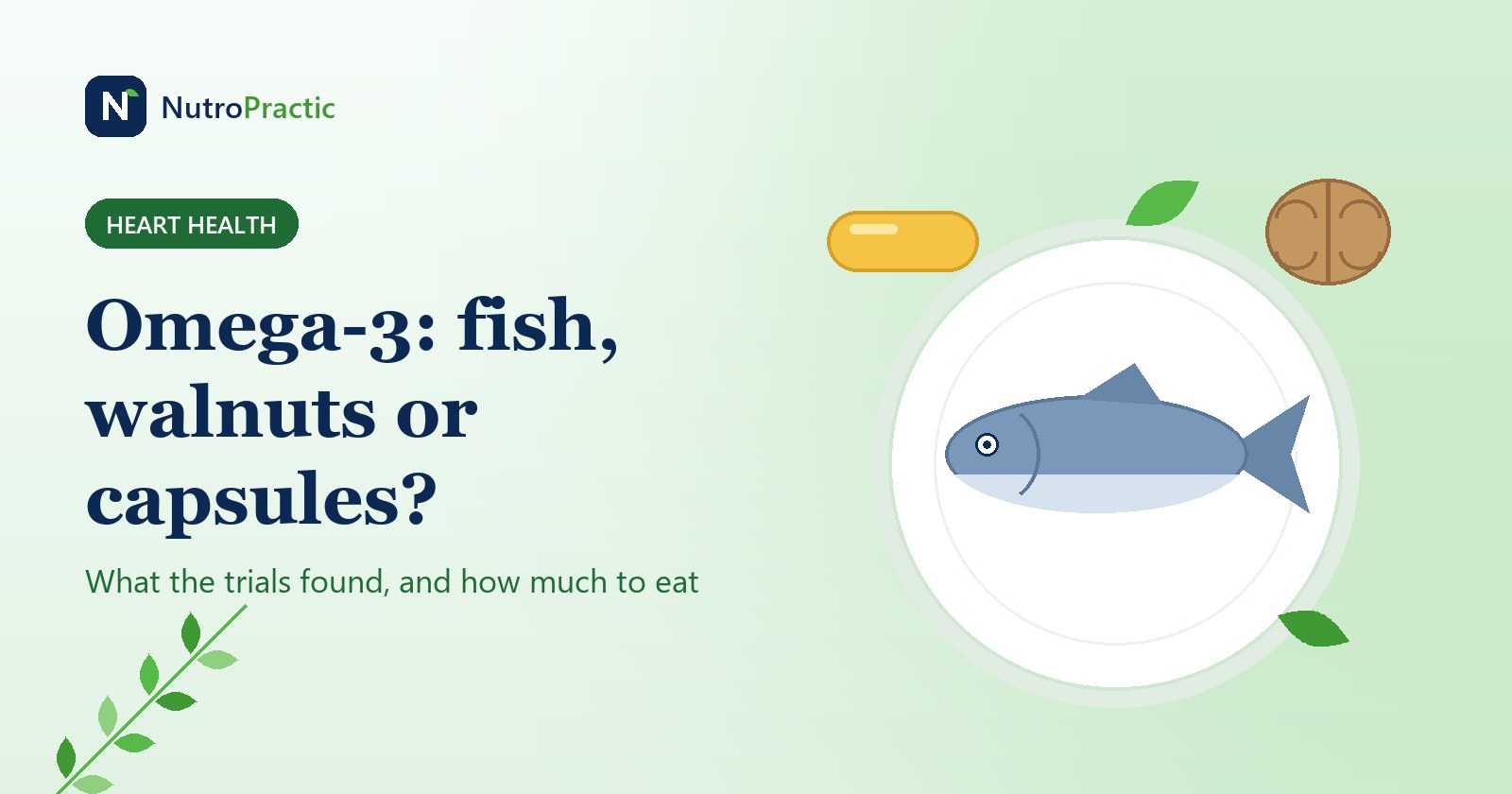
Fish oil is one of the most bought supplements in the world, and one of the most argued about. One year a headline says it does nothing for the heart. The next, a cardiologist prescribes it. Meanwhile the walnut bag says "rich in omega-3" and so does the bottle of flaxseed oil, and nobody mentions that these are not the same substance.
The confusion clears up once you know two things: there are three omega-3s, not one, and the trials that disagree were testing very different doses in very different people. This article goes through both, then gets practical about fish, nuts and capsules.
Three omega-3s, and only one is in walnuts
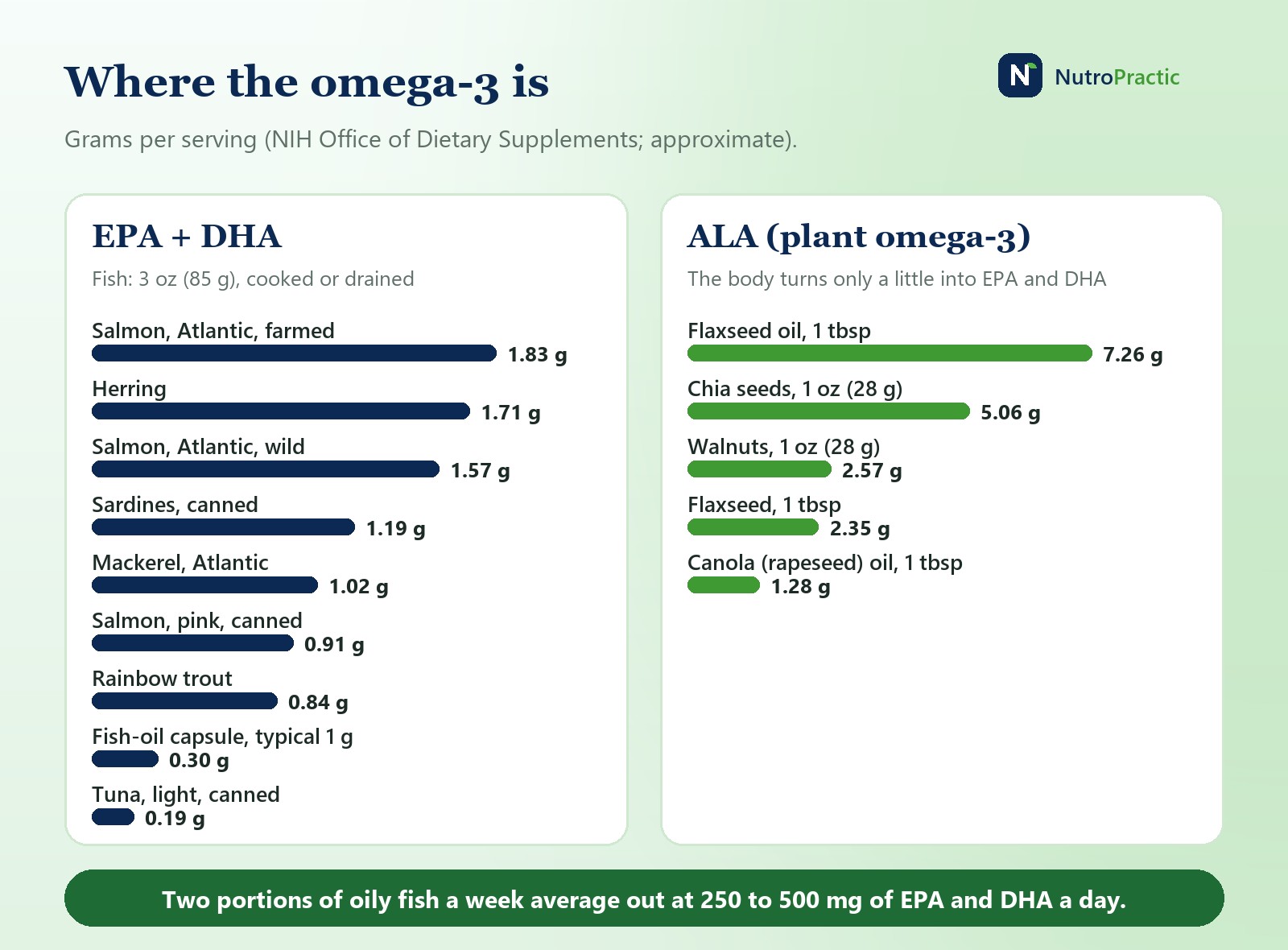
ALA (alpha-linolenic acid) is the plant omega-3. It's in flaxseed, chia, walnuts, and canola (rapeseed), soybean and mustard oils. It is the only omega-3 the body strictly cannot do without, and the amount needed is small: the US reference intake is 1.6 g a day for men and 1.1 g for women. A small handful of walnuts (28 g, about 2.6 g of ALA) or a tablespoon of flaxseed covers it.
EPA and DHA are the long-chain omega-3s. They are the ones in oily fish, and the ones the heart and brain research is about. Fish don't make them; microalgae do, and the fish collect them by eating their way up the food chain.
The body can turn ALA into EPA and then DHA, but poorly. The US National Institutes of Health puts the conversion at under 15%, and most studies that measure it directly find a few percent for EPA and less for DHA. Women of childbearing age convert rather more than men. So walnuts and flaxseed are good food, and they cover your ALA, but they are not a back door to the EPA and DHA in a piece of salmon.
VITAL: an ordinary capsule, in ordinary people
VITAL is the trial to know if you are a healthy adult wondering whether to take fish oil. It enrolled 25,871 Americans (men over 50, women over 55) with no history of heart disease or cancer, and gave half of them a 1 g capsule a day supplying 840 mg of EPA and DHA. The other half took a placebo. It ran for a little over five years.
The main result, published in the New England Journal of Medicine in 2019: heart attacks, strokes and cardiovascular deaths taken together were 8% lower in the fish-oil group, a difference small enough to be chance. That's the finding behind the "fish oil doesn't work" headlines, and for the main question it's a fair summary.
Two details underneath are worth knowing. Heart attacks on their own were 28% lower with fish oil. And among people who ate fish less than about one and a half times a week, the capsule did lower major events, by 19%, while it did nothing for people who already ate fish regularly. Both are secondary findings, the kind that need confirming before anyone leans on them. But they point the same way as common sense: a supplement helps most where the diet is short.
A British trial called ASCEND tested the same 1 g dose for seven years in 15,480 people with diabetes and found no difference in serious cardiovascular events. A 2020 Cochrane review pooling 86 trials came to the same place: for most people, long-chain omega-3 capsules make little or no difference to heart attacks, strokes or deaths.
REDUCE-IT: a prescription dose, in people with heart disease
REDUCE-IT asked a different question. Its 8,179 participants were already on statins, still had raised triglycerides, and either had cardiovascular disease or had diabetes with other risk factors. They took 4 g a day of icosapent ethyl, a purified prescription form of EPA with no DHA. That's roughly thirteen ordinary fish-oil capsules' worth of omega-3.
After nearly five years, 17.2% of the treated group had had a heart attack, stroke, cardiovascular death or a related event, against 22.0% on placebo: 25% fewer. On that result the drug was approved in the US and Europe for people who fit the trial's description.
Then came the argument. The placebo in REDUCE-IT was mineral oil, and in the placebo group LDL cholesterol rose by about 11% over the first year. If the placebo did a little harm, the drug looks better than it is. A second trial, STRENGTH, gave 4 g a day of a combined EPA and DHA product to 13,078 similar patients, used corn oil as the placebo, and was stopped early because it was clearly going nowhere.
Cardiologists still disagree about how much of REDUCE-IT's benefit is real. What everyone agrees on is that it says nothing about supermarket fish oil in healthy people. It was a drug, at a drug dose, in people at high risk.
High doses have a cost. Hospital admissions for atrial fibrillation, an irregular heartbeat, were more common on 4 g a day in both REDUCE-IT (3.1% against 2.1%) and STRENGTH. A pooled analysis of seven trials found the risk about 50% higher at doses above 1 g a day and about 12% higher at 1 g or less.
So why does every guideline still say eat fish?
Because the evidence for fish is older and broader than the evidence for capsules. People who eat fish once or twice a week have less heart disease than people who eat none, across dozens of long-running studies in different countries. That can't prove cause the way a trial can. Fish eaters differ in other ways, and a fish dinner is a dinner that wasn't sausages. But the replacement is part of the point. Fish brings protein, vitamin D, iodine and selenium along with the omega-3, and it takes the place of something.
The advice is consistent. The American Heart Association recommends one to two seafood meals a week, preferably oily fish and not fried. The UK's NHS says two portions of fish a week, one of them oily, a portion being about 140 g cooked. The European Food Safety Authority sets an adequate intake of 250 mg of EPA and DHA a day, which two portions of oily fish a week comfortably supply.
Oily means salmon, sardines, herring, mackerel, trout, anchovies, pilchards and kippers. Canned counts, and it's the cheapest way to do this: a tin of sardines on toast is a full portion. White fish such as cod and haddock is good food but carries little omega-3, and canned light tuna has surprisingly little.
Mercury, in proportion
Mercury builds up in big, long-lived predators. The fish that carry the most omega-3 are mostly small and short-lived, and sit at the low-mercury end. The US Food and Drug Administration's list of fish to avoid in pregnancy and for young children is short: shark, swordfish, king mackerel, marlin, orange roughy, bigeye tuna and tilefish from the Gulf of Mexico. Albacore (white) tuna is a once-a-week fish.
For pregnant and breastfeeding women, the FDA's advice is to eat fish, not avoid it: 8 to 12 ounces (about 230 to 340 g) a week from the low-mercury list, which includes salmon, sardines, herring, trout, anchovies and Atlantic mackerel. The NHS adds a ceiling of two portions of oily fish a week for girls and for women who are pregnant or may become pregnant, because of other pollutants that build up in fish fat. For everyone else the ceiling is four.
If you don't eat fish
Start with ALA every day, because it's easy: a tablespoon of ground flaxseed or chia in porridge or yogurt, a handful of walnuts, and canola or mustard oil for cooking. Grind flaxseed or buy it milled; whole seeds tend to pass straight through. Walnuts have decent evidence of their own. In a two-year trial in 708 healthy older adults, a daily portion nudged LDL cholesterol down without adding weight.
Then think about algal oil. It's EPA and DHA from the microalgae the fish get theirs from, so it skips the conversion problem and the fish. Most products supply 100 to 300 mg of DHA a capsule, some with EPA as well. It matters most in pregnancy and breastfeeding, when the baby's brain and eyes are drawing on the mother's DHA, and it's worth considering for long-term vegans. Vegetarian diets have a couple of other gaps worth checking at the same time, which we cover in Vitamin D and B12: two common gaps.
If you're going to buy capsules
Read the back, not the front. "1,000 mg fish oil" is the weight of the oil. A typical capsule holds about 180 mg of EPA and 120 mg of DHA, 300 mg in all. The number that matters is EPA plus DHA.
Stay modest. Without a doctor's advice there is no good reason to go above about 1 g of EPA and DHA a day. The benefit at higher doses was seen only with a prescription product in high-risk patients, and the heart-rhythm risk climbs with the dose.
Mercury isn't the worry here. Refining removes it from fish oil. Rancid oil is the more likely problem, so buy from a brand that publishes independent testing, keep the bottle cool and dark, and throw out capsules that smell sharply fishy.
Tell your doctor, especially if you take warfarin or another blood thinner, have had atrial fibrillation, or are due for surgery.
What to do with all this
If you eat fish: make it oily fish twice a week. Tinned sardines or mackerel at lunch and salmon or trout for one dinner does it. It also counts towards your protein, which matters more with age: see Protein after 40. You don't need a capsule on top.
If you eat fish now and then: this is the group VITAL suggests might gain from a standard capsule. Adding one fish meal a week is the better fix. A daily 1 g fish-oil capsule is a reasonable second best.
If you eat no fish: ALA from seeds, walnuts and oil every day, and an algal oil supplement if you're pregnant, breastfeeding or have been vegan for years.
If you have heart disease or high triglycerides: this is a conversation with your cardiologist about prescription omega-3, not a trip to the supplement aisle.
Not sure whether your week has enough omega-3 in it, or how to get there without fish? Dr. Triveni can look at what you eat now and build it in with food you already like, in a virtual consultation.
Book a consultationThis article is general information, not medical advice. Don't start high-dose omega-3, or stop a prescribed one, without talking to your doctor. Check first if you take blood thinners, have a heart rhythm problem or a fish or shellfish allergy, or are pregnant.
Sources
Manson J.E. et al., Marine n-3 fatty acids and prevention of cardiovascular disease and cancer (VITAL), N Engl J Med 380(1):23-32 (2019). ASCEND Study Collaborative Group, Effects of n-3 fatty acid supplements in diabetes mellitus, N Engl J Med 379(16):1540-1550 (2018). Bhatt D.L. et al., Cardiovascular risk reduction with icosapent ethyl for hypertriglyceridemia (REDUCE-IT), N Engl J Med 380(1):11-22 (2019). Nicholls S.J. et al., Effect of high-dose omega-3 fatty acids vs corn oil on major adverse cardiovascular events (STRENGTH), JAMA 324(22):2268-2280 (2020). Gencer B. et al., Effect of long-term marine omega-3 fatty acids supplementation on the risk of atrial fibrillation, Circulation 144(25):1981-1990 (2021). Abdelhamid A.S. et al., Omega-3 fatty acids for the primary and secondary prevention of cardiovascular disease, Cochrane Database of Systematic Reviews (2020). Rimm E.B. et al., Seafood long-chain n-3 polyunsaturated fatty acids and cardiovascular disease: a science advisory from the American Heart Association, Circulation 138(1):e35-e47 (2018). Rajaram S. et al., Effects of walnut consumption for 2 years on lipoprotein subclasses among healthy elders (WAHA), Circulation 144(13):1083-1085 (2021). US National Institutes of Health, Office of Dietary Supplements, Omega-3 fatty acids: fact sheet for health professionals (food values, reference intakes, conversion of ALA, supplement contents). US Food and Drug Administration and Environmental Protection Agency, Advice about eating fish. NHS, Fish and shellfish. European Food Safety Authority, dietary reference values for fats (2010) and tolerable upper intake level of EPA, DHA and DPA (2012).