Muscle is easy to take for granted until it starts to go. From midlife onwards most of us slowly lose muscle mass and strength, and the loss speeds up in our 60s and 70s. Less muscle means a slower metabolism, weaker balance and a harder time staying independent later in life.
Two things slow that loss more than anything else: regular strength training and enough protein, spread well across the day. This guide covers the second, with numbers you can actually use.
The official number is a floor, not a target
In the USA and Canada the Recommended Dietary Allowance (RDA) for adults is 0.8 g of protein per kilogram of body weight per day. The European Food Safety Authority sets a very similar reference intake of 0.83 g/kg. For a 70 kg (154 lb) adult that is about 56 g a day.
These values were designed to prevent deficiency in healthy adults. They were not designed to keep muscle as we age, and they don't account for illness, weight loss or a lot of training.
What experts suggest as you get older
Two expert groups looked specifically at older adults. The international PROT-AGE study group (2013) recommended 1.0 to 1.2 g/kg per day for healthy adults over 65. The European Society for Clinical Nutrition and Metabolism (ESPEN) came to the same range in 2014, and suggested 1.2 to 1.5 g/kg for older people with acute or chronic illness.
For the same 70 kg person, that is roughly 70 to 84 g a day instead of 56 g. Many people in their 40s and 50s who are trying to lose fat, or who train regularly, also do well in this range.
Kidney disease changes the picture. If you have reduced kidney function, ask your doctor before increasing protein.
Why spreading it out helps
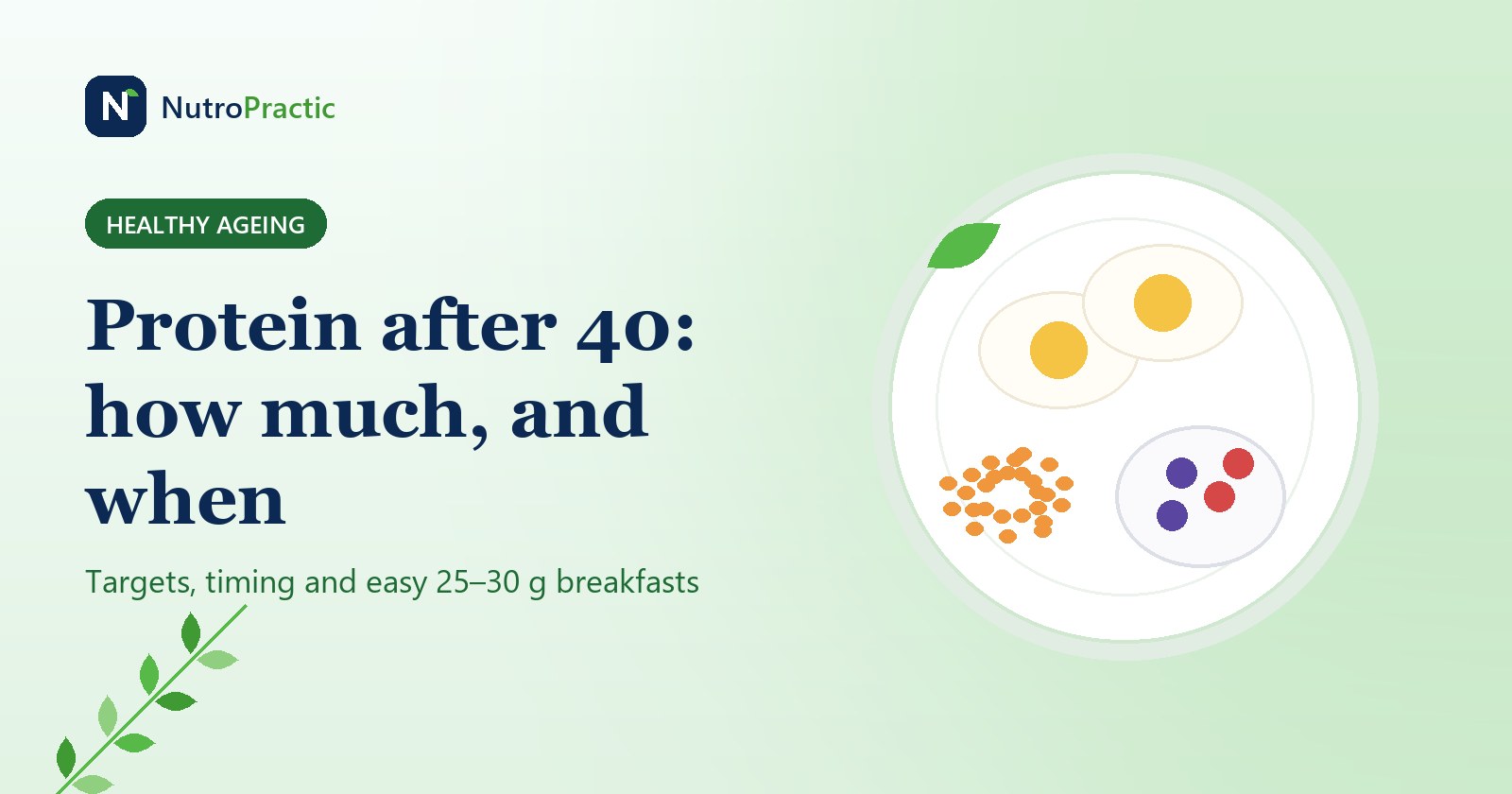
Your muscles respond to protein meal by meal. Research on muscle protein synthesis suggests that about 25 to 30 g of high-quality protein in a meal gives a strong muscle-building signal, while a very small serving gives a weak one.
Many people in North America and Europe eat very little protein at breakfast, a moderate amount at lunch and most of it at dinner. Moving some of that dinner protein to breakfast is one of the simplest changes you can make.
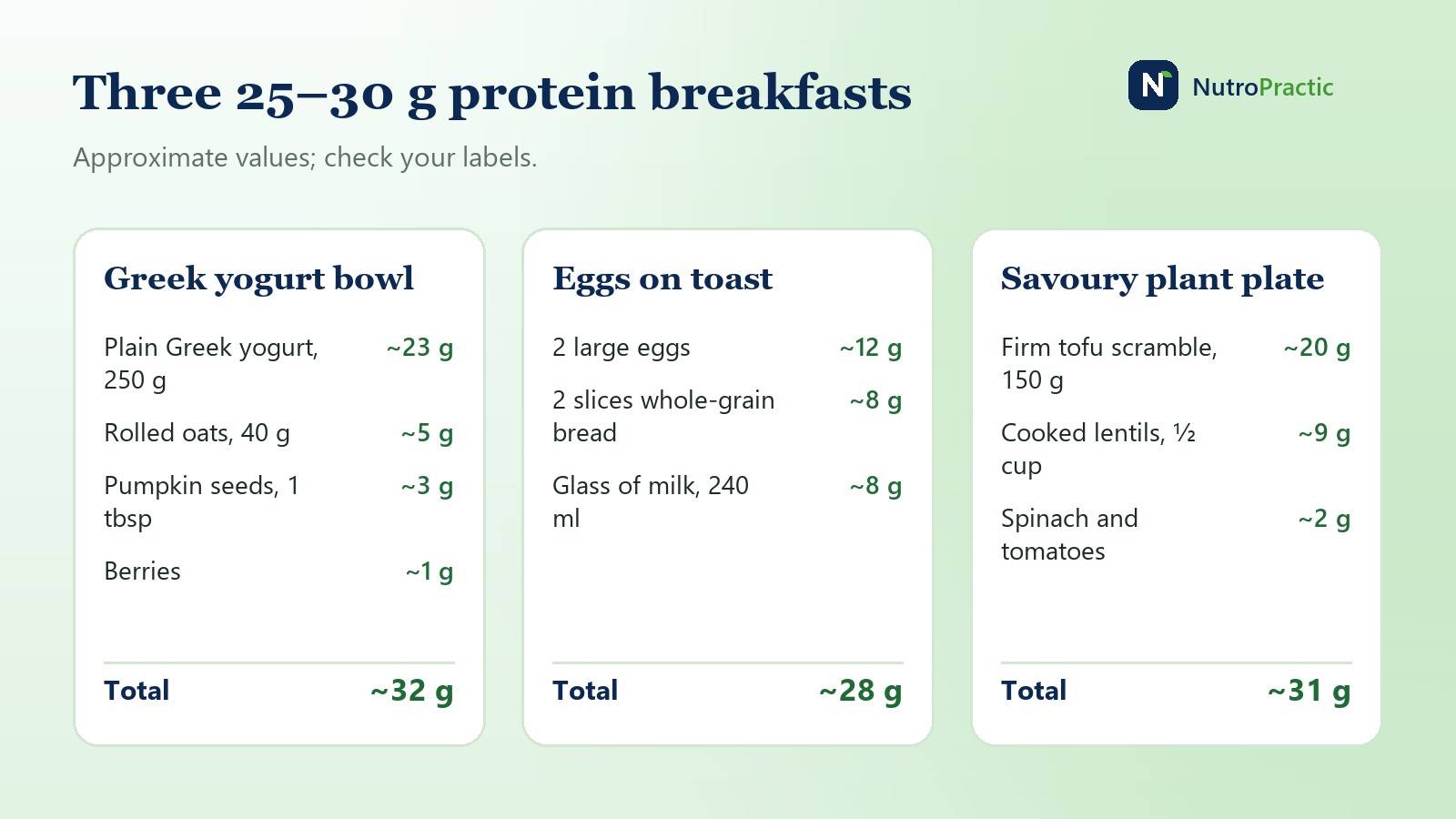
Easy protein, in numbers
Approximate protein per serving: 2 large eggs, about 12 g. 170 g (6 oz) plain Greek yogurt, about 15 to 18 g. 100 g cooked chicken breast, about 30 g. 100 g canned tuna, about 25 g. 1 cup cooked lentils, about 18 g. 100 g firm tofu, about 12 to 17 g. 1 cup (240 ml) milk, about 8 g. 30 g (1 oz) almonds, about 6 g.
Plant-based eaters can reach the same targets by combining legumes, soy foods, dairy if they eat it, nuts and seeds, and whole grains through the day.
Protein works best with strength training
Protein supplies the building blocks; resistance exercise tells the muscle to use them. The US Physical Activity Guidelines recommend muscle-strengthening activity on two or more days a week, working all the major muscle groups. Bodyweight exercises, resistance bands and weights all count.
A simple plan for this week
1. Work out your range: body weight in kg times 1.0 to 1.2. 2. Aim for 25 to 30 g at breakfast and at lunch. 3. Keep a protein-rich snack handy (yogurt, roasted chickpeas, a boiled egg). 4. Book two short strength sessions in your calendar.
Not sure how much protein suits your body, diet and health? Dr. Triveni can work it out with you in a 15-minute virtual consultation.
Book a 15-minute consultationSources
National Academies, Dietary Reference Intakes for Energy, Carbohydrate, Fiber, Fat, Fatty Acids, Cholesterol, Protein, and Amino Acids (2005). EFSA, Scientific Opinion on Dietary Reference Values for protein (2012). Bauer J. et al., Evidence-based recommendations for optimal dietary protein intake in older people: a position paper from the PROT-AGE Study Group, JAMDA (2013). Deutz N. et al., Protein intake and exercise for optimal muscle function with aging: recommendations from the ESPEN Expert Group, Clinical Nutrition (2014). Paddon-Jones D. and Rasmussen B., Dietary protein recommendations and the prevention of sarcopenia, Curr Opin Clin Nutr Metab Care (2009). US Department of Health and Human Services, Physical Activity Guidelines for Americans, 2nd edition (2018).