Polycystic ovary syndrome (PCOS) affects an estimated 8% to 13% of women of reproductive age worldwide, presenting as an intricate crossroads of endocrine dysfunction, anovulation, and metabolic resistance. While metformin and oral contraceptive pills remain standard medical mainstays, thousands of women struggle with gastrointestinal side effects or desire an evidence-backed nutritional approach to restore regular ovulation.
Over the past fifteen years, inositol supplementation has emerged as one of the most thoroughly investigated nutritional interventions in reproductive endocrinology. However, supermarket and online supplement shelves are flooded with confusing formulations: pure myo-inositol, pure D-chiro-inositol, 5:1 blends, and multi-vitamin complexes. Understanding what randomized controlled trials (RCTs) actually show requires examining cellular second messengers, the famous "ovarian paradox," and why the exact 40:1 ratio dominates clinical guidelines.
Myo vs D-chiro: two stereoisomers with opposing tissue roles
Inositols are carbocyclic polyols (formerly categorized as vitamin B8, though synthesized endogenously by humans). While nine distinct stereoisomers exist, human physiology relies primarily on two: Myo-inositol (MI) and D-chiro-inositol (DCI). Both act as structural precursors for inositol phosphoglycan (IPG) second messengers, but their intracellular functions diverge dramatically:
- Myo-Inositol (MI): Represents over 99% of the intracellular inositol pool in human tissues. MI mediates cellular glucose uptake by promoting GLUT4 glucose transporter translocation to the cell membrane. Crucially, within the ovaries, MI acts as the dedicated second messenger for Follicle-Stimulating Hormone (FSH), regulating granulosa cell proliferation, follicular recruitment, and oocyte maturation.
- D-Chiro-Inositol (DCI): Represents less than 1% of the total inositol pool in most tissues. DCI mediates insulin signaling for glycogen synthesis in the liver, adipose tissue, and skeletal muscle. In the ovary, DCI regulates insulin-dependent androgen synthesis in theca cells.
In healthy human blood plasma, the physiological ratio of circulating Myo-inositol to D-chiro-inositol is precisely 40:1. Healthy peripheral tissues convert MI into DCI via an insulin-dependent enzyme called epimerase.
The "ovarian paradox": why pure D-chiro harms egg quality
In classic metabolic insulin resistance (such as in liver or muscle), tissues become resistant to insulin signals, down-regulating epimerase activity and resulting in low tissue DCI levels. Early researchers mistakenly assumed the entire body suffered from epimerase deficiency in PCOS, leading to trials testing massive doses of pure D-chiro-inositol (up to 1,200 to 2,400 mg/day).
The results in reproductive trials were alarming: high-dose D-chiro impaired egg quality, reduced fertilization rates, and damaged embryo morphology. The breakthrough explanation came from Carlomagno, Unfer, and colleagues (2011, 2014) in what is now recognized as the Ovarian Paradox:
1. The ovary never becomes insulin resistant: Even when a woman's muscle and liver cells ignore insulin, her ovaries remain fully sensitive to circulating insulin levels.
2. Hyperinsulinemia drives excessive epimerization: In women with PCOS and elevated compensatory fasting insulin, excessive insulin hyper-stimulates ovarian epimerase, converting large amounts of ovarian myo-inositol into D-chiro-inositol.
3. Intra-follicular myo-inositol deficiency: As a consequence, the ovarian follicle experiences severe local MI depletion (down to 1:5 or 1:1 instead of normal ratios). Without sufficient MI, FSH signaling is crippled, halting follicle development into immature cysts.
4. Aromatase suppression and androgen excess: High local DCI concentrations down-regulate aromatase (CYP19A1), the enzyme responsible for converting testosterone into estradiol. This trapped androgen excess worsens hirsutism, cystic acne, and theca cell hyperplasia.
Administering pure DCI or skewed low-ratio supplements (like 5:1) exacerbates this intra-follicular imbalance. Conversely, supplying the physiological 40:1 MI:DCI ratio restores peripheral insulin sensitivity in the liver while replenishing vital follicular MI pools in the ovary.
What randomized controlled trials actually measured
Over 30 randomized controlled trials and multiple systematic reviews have evaluated the 40:1 ratio (4,000 mg Myo-inositol + 100 mg D-chiro-inositol daily, typically taken as 2,000 mg MI + 50 mg DCI twice daily in water):
- Ovulation and cycle recovery (Nordio et al., 2019): In an influential trial published in European Review for Medical and Pharmacological Sciences, researchers tested seven different ratios of MI to DCI (ranging from 1:3.5 to 80:1) in 54 women with PCOS. The 40:1 ratio was unequivocally superior, restoring regular spontaneous ovulation in 70% of participants within 3 months, compared to only 20% in the 5:1 group and 12% in the DCI-dominant arms.
- Insulin sensitivity and HOMA-IR: A comprehensive meta-analysis of 26 RCTs (Unfer et al., 2017) demonstrated that 4 g daily of the 40:1 formulation resulted in a statistically significant reduction in HOMA-IR (homeostatic model assessment for insulin resistance) by 25% to 40%, alongside an average 30% drop in fasting plasma insulin within 12 to 24 weeks.
- Hyperandrogenism and free testosterone: Randomized comparisons against metformin (such as Raffone et al., 2010 and Jamilian et al., 2017) documented a 20% to 32% reduction in total and free testosterone, a significant rise in sex hormone-binding globulin (SHBG), and measurable improvements in Ferriman-Gallwey hirsutism scores after 6 months.
- Tolerability vs Metformin: Metformin frequently causes nausea, cramping, and osmotic diarrhea, leading to 15% to 25% patient discontinuation rates in clinical practice. In contrast, inositol powder is mildly sweet, highly water-soluble, and exhibits near-zero gastrointestinal adverse events (<2% mild loose stools at doses exceeding 6 g/day).
Inositol in whole foods: milligrams vs trial grams
Can a woman with PCOS achieve the benefits of inositol purely from her grocery basket? Biochemical analysis of dietary foods reveals that while inositol is widely distributed in plant foods, quantitative realities present a significant clinical hurdle:
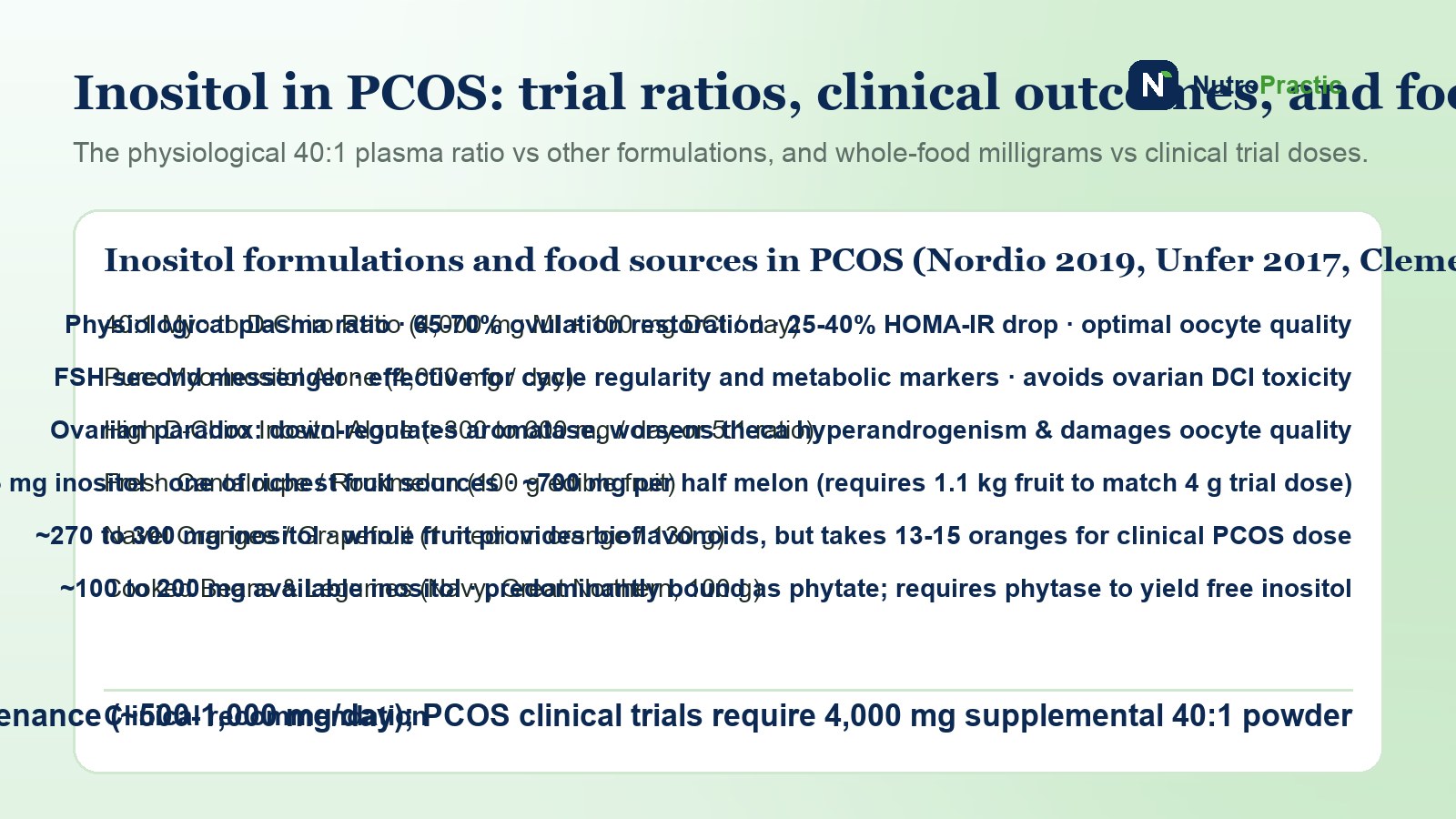
| Food source | Serving size | Total inositol (mg) | Inositol chemical form | Practical clinical limitation |
|---|---|---|---|---|
| Cantaloupe / Rockmelon | 100 g fresh edible flesh | 355 mg | Free myo-inositol & lipid-bound | 1 half cantaloupe provides ~700 mg; requires 1.1 kg of melon daily to reach 4,000 mg |
| Navel Orange | 1 medium fruit (130 g) | 307 mg | Free myo-inositol & glycosides | High natural fructose content; consuming 13 oranges daily would spike glucose |
| Grapefruit | 1/2 fresh fruit (120 g) | 200 mg | Free myo-inositol | Inhibits intestinal CYP3A4; interacts with statins and blood pressure medications |
| Great Northern / Navy Beans | 100 g cooked | 280 to 440 mg | Predominantly phytic acid (IP6) | Bound phytate requires human phytase or gut microbial enzymes to release free inositol |
| Steel-Cut / Rolled Oats | 1 cup cooked (230 g) | 120 to 180 mg | Phytate / inositol hexaphosphate | Excellent soluble beta-glucan source, but low net free bioavailable inositol |
| Green Peas / Legumes | 100 g cooked | 160 to 240 mg | Phytate & free inositol | Modest contributor; high carbohydrate load relative to net inositol |
| Typical Mixed Daily Diet | Whole foods standard intake | 500 to 1,000 mg / day | Mixed free & phytate | Adequate for baseline human maintenance, but insufficient for PCOS trial remission |
The data is clear: an unprocessed whole-food diet rich in citrus, cantaloupe, and legumes delivers roughly 500 to 1,000 mg of dietary inositol daily. This provides an excellent foundational baseline. However, attempting to ingest 4,000 mg of myo-inositol from fruit alone would require eating 1.1 kilograms of cantaloupe or 14 oranges every single day—introducing over 150 grams of simple sugars that would aggravate the very insulin resistance driving PCOS.
Therefore, while whole foods form the dietary foundation, clinical trials treat inositol as a targeted nutritional medicine delivered via standardized 40:1 powder sachets (2,000 mg MI + 50 mg DCI taken twice daily in water).
Practical protocol: how to implement inositol safely
If you are managing PCOS, irregular cycles, or insulin resistance, follow this clinical roadmap:
1. Insist on the verified 40:1 ratio: Examine product labels carefully. Ensure each daily serving provides 4,000 mg of Myo-inositol and 100 mg of D-chiro-inositol. Avoid products containing only D-chiro-inositol or low ratios like 5:1.
2. Split the dose morning and evening: Dissolve one 2,000 mg MI / 50 mg DCI sachet in a glass of water with breakfast, and a second sachet with dinner. Consistent divided dosing maintains steady plasma concentrations across the 24-hour cycle.
3. Check for synergistic co-factors: Many evidence-based formulations pair the 40:1 ratio with 200 to 400 mcg of active folate (L-5-methyltetrahydrofolate or folic acid) to support homocysteine metabolism and early preconception cellular division.
4. Commit to a 3 to 6-month trial window: In clinical trials, metabolic improvements (fasting glucose, insulin, HOMA-IR) emerge within 8 to 12 weeks, whereas follicular recruitment, androgen suppression, and regular spontaneous menses require 16 to 24 weeks. Learn more in our guide on dietary patterns for PCOS and insulin sensitivity and managing metformin gastrointestinal tolerance.
5. Pair with personalized nutrition: Inositol works synergistically with low-glycemic dietary planning, adequate dietary protein, and lifestyle modifications tailored to your lipid and androgen profile. Book an evidence-based consultation with Dr. Triveni to design a comprehensive PCOS management plan.
References and clinical sources
1. Nordio, M., Basciani, S., & Camajani, E. (2019). The 40:1 myo-inositol/D-chiro-inositol plasma ratio is able to restore ovulation in PCOS: results from a prospective study. European Review for Medical and Pharmacological Sciences, 23(12), 5512–5521.
2. Unfer, V. et al. (2017). Effects of inositol(s) in women with PCOS: a systematic review of randomized controlled trials. International Journal of Endocrinology, 2017, 1849162.
3. Carlomagno, G., Unfer, V., & Roseff, S. (2011). The D-chiro-inositol paradox in the ovary. Fertility and Sterility, 95(7), 2515–2516.
4. Facchinetti, F. et al. (2020). Experts' opinion on inositols in treating polycystic ovary syndrome and non-insulin dependent diabetes mellitus: a further step. Gynecological Endocrinology, 36(7), 555–563.
5. Raffone, E., Rizzo, P., & Benedetto, V. (2010). Insulin sensitizer agents alone and in co-treatment with r-FSH for ovulation induction in PCOS women: a randomized clinical trial. Gynecological Endocrinology, 26(4), 275–280.
6. Clements, R. S. & Darnell, B. (1980). Myo-inositol content of common foods: development of a high-myo-inositol diet. The American Journal of Clinical Nutrition, 33(9), 1954–1967.
7. Jamilian, M. et al. (2017). Comparison of myo-inositol and metformin on glycemic control, lipid profiles, and markers of oxidative stress in women with polycystic ovary syndrome: a randomized clinical trial. Hormone and Metabolic Research, 49(4), 279–285.