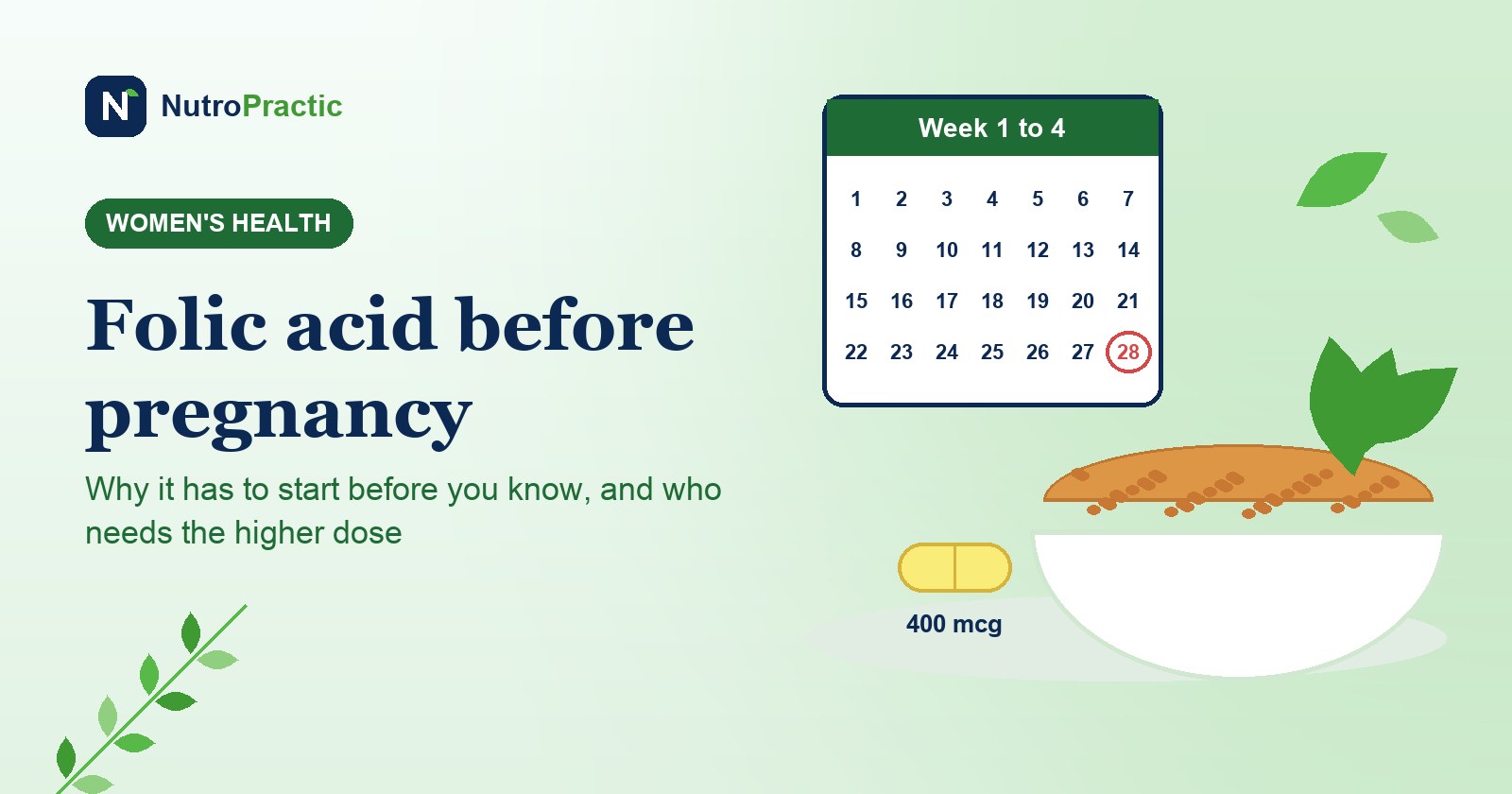
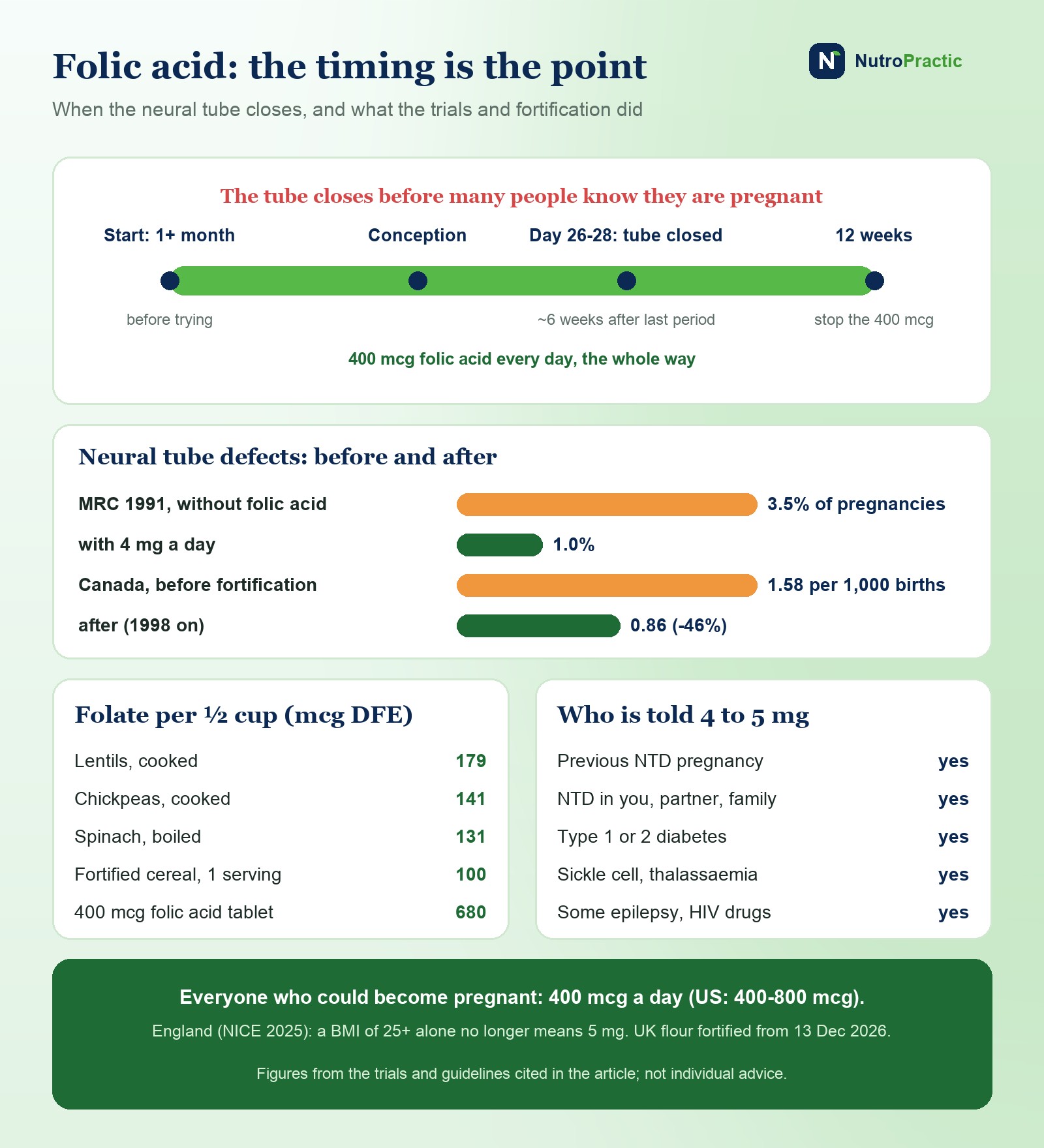
Most pregnancy advice starts once you know you are pregnant. Folic acid is the exception, and the reason is a matter of days. The neural tube, the fold of tissue that becomes a baby's brain and spinal cord, closes 26 to 28 days after conception. Counted the way pregnancies usually are, from the first day of the last period, that is about six weeks: roughly when a period is two weeks late, and before many people have done a test.
If it doesn't close fully, the result is a neural tube defect (NTD): spina bifida, or anencephaly, which is fatal. Folic acid taken in the weeks before conception prevents most of them. Taken from the first antenatal visit, it is too late for this purpose. Here is the evidence, the dose for most people, who needs more, and how the US, Canada, the UK, Europe and India differ.
The trials that settled it
The MRC Vitamin Study (Lancet, 1991) enrolled 1,817 women in seven countries who had already had a pregnancy affected by an NTD, and so had a high chance of another. They were randomised to 4 mg of folic acid a day, other vitamins, both, or neither, starting before conception. Among 1,195 completed pregnancies, 6 of 593 (1.0%) in the folic acid groups had an NTD, against 21 of 602 (3.5%) without: about 72% fewer. The other vitamins made no difference.
A year later a Hungarian trial (Czeizel and Dudás, NEJM 1992) gave women planning a pregnancy, mostly their first, a multivitamin containing 0.8 mg folic acid or a trace-element control, from at least a month before conception. There were no NTDs in 2,104 pregnancies on the vitamin, against 6 in 2,052 on the control. Because it was a multivitamin the effect can't be pinned on folic acid alone, but together the two trials changed advice worldwide.
Why "before you know" is the whole point
Nearly half of US pregnancies are unplanned (45% in 2011, the latest national estimate). In Britain, the Natsal-3 survey found only 55% of pregnancies were planned; 16% were unplanned and 29% were ambivalent. A pregnancy that wasn't planned is often not noticed until after the neural tube has already closed.
Even among people who plan, uptake is low. In a London screening study of 466,860 women, only 31% had taken folic acid before pregnancy in 2011-12, down from 35% a decade earlier; among women under 20 it was 6%, and among South Asian women 20%. Only 51% of women who had had a previous NTD pregnancy took it. In the US, surveys put pre-pregnancy use at roughly 20 to 40%. The CDC's clinical guidance puts it bluntly: "Waiting until the first prenatal visit to start folic acid consumption will not prevent NTDs."
So the advice is aimed at anyone who could become pregnant, not only those who are trying.
How much: the standard dose
US: the US Preventive Services Task Force (2023, its highest grade A) recommends 400 to 800 mcg of folic acid a day for everyone planning or able to become pregnant, starting at least one month before conception and continuing through the first two to three months of pregnancy. The CDC says 400 mcg.
UK: the NHS advises 400 mcg a day from before conception until the 12th week.
India: the national Anemia Mukt Bharat guidance also gives 400 mcg a day before conception and through the first trimester.
A prenatal vitamin or a plain 400 mcg tablet both work. Folic acid is the synthetic form in supplements and fortified food, and it is the form that was tested in the trials.
Who needs the higher dose
Some people are advised to take 5 mg a day (in the UK, where that is the available tablet, and on prescription) or 4 mg (in the US), before conception and through the first 12 weeks. England's NICE guideline (NG247, January 2025) lists:
- A previous pregnancy affected by an NTD, or an NTD in you, your partner or the family
- Type 1 or type 2 diabetes
- Sickle cell disease, thalassaemia and similar blood conditions
- Medicines that affect folate, such as some anti-epileptic drugs and some HIV medicines
The US route is the same for the highest-risk group: the CDC advises 4 mg (4,000 mcg) a day for anyone who has had an NTD-affected pregnancy, from a month before trying until the end of the third month. Doses this high are above the upper limit for supplements and should be taken on a doctor's advice.
What changed for higher BMI: older UK advice (RCOG, 2018) gave 5 mg to anyone with a BMI of 30 or more, and many leaflets still say so. NICE's 2025 guideline reversed this: people with a BMI of 25 or more should be reassured that 400 mcg is enough unless they have one of the risk factors above. The same applies to people at higher risk of pre-eclampsia. If you were told 5 mg because of your weight alone, ask your GP or midwife which applies to you.
About anti-epileptic drugs: folic acid does not make valproate safe in pregnancy. The UK medicines regulator says about 1 in 9 babies exposed to valproate in the womb have a major birth defect and up to 4 in 10 a neurodevelopmental disorder. Anyone on an anti-epileptic who could become pregnant should review their treatment with their specialist before trying, and should never stop a medicine suddenly on their own.
Fortified flour: what it did, and where it doesn't exist
Because so many pregnancies are unplanned, some countries put folic acid into staple food so that it is already there.
United States: since January 1998, enriched grain products must carry 140 mcg per 100 g. NTDs fell by 28% across US birth-defect programmes (35% in those that counted prenatal diagnoses), and the CDC estimates about 1,326 affected births are prevented each year.
Canada: fortification from 1998 at 150 mcg per 100 g of white flour. NTDs fell from 1.58 to 0.86 per 1,000 births, a 46% drop (De Wals, NEJM 2007).
United Kingdom: after years of debate, non-wholemeal wheat flour must carry 250 mcg per 100 g from 13 December 2026, expected to prevent about 200 NTDs a year, around one in five. Wholemeal flour is exempt.
Most of Europe: no mandatory fortification. Across 28 European registries covering 12.5 million births from 1991 to 2011, NTDs stayed at about 9 per 10,000 births with no clear fall.
India: no folic acid mandate for atta. Rice in government schemes has been fortified with iron, folic acid and B12 since March 2024, but at roughly 10 mcg per 100 g it is far too little for NTD prevention. Indian studies, mostly in hospitals, put NTDs at about 4.5 per 1,000 births, several times the US rate.
Fortified bread or cereal helps, but it is not a substitute for a tablet before pregnancy: a typical day's fortified food gives far less than 400 mcg, and wholemeal and home-milled flour usually carry none.
Folate in food
Folate is the natural form, in leafy greens, pulses and fruit. Food amounts are measured in dietary folate equivalents (DFE), because the body absorbs folic acid better than food folate: a 400 mcg folic acid tablet counts as 680 mcg DFE. The daily need is 400 mcg DFE for adults and 600 in pregnancy. Per serving (USDA data):
- Lentils, cooked, ½ cup: about 179 mcg DFE
- Chickpeas, cooked, ½ cup: about 141
- Spinach, boiled, ½ cup: 131
- Black-eyed peas, ½ cup: 105
- Fortified breakfast cereal, one serving: about 100
- Asparagus, 4 spears: 89
- Brussels sprouts, ½ cup: 78
- Avocado, ½ cup: 59
- Broccoli, ½ cup: 52
- Kidney beans, ½ cup: 46
- An orange: 29; an egg: 22
A day with a bowl of dal, a serving of greens and a piece of fruit can reach 400 mcg DFE from food. That is good eating, and it matters through the whole pregnancy. But the trials that prevented NTDs used folic acid, and the CDC notes that folic acid is the only form proven to prevent them. Food is "as well as", not "instead of". For dal in particular, see our article on pulses in an Indian kitchen.
Pair it with B12
Folate and vitamin B12 work together. High doses of folic acid can correct the anaemia of B12 deficiency while the nerve damage carries on unnoticed, which is why the NHS says folic acid is not suitable for people with B12 deficiency or pernicious anaemia without treatment. And low B12 seems to matter for the neural tube on its own: in an Irish study (Molloy and colleagues, Pediatrics 2009), women in the lowest quarter of B12 levels had two to three times the odds of an NTD-affected pregnancy, with the highest risk below 250 ng/L. The authors suggested aiming for B12 above 300 ng/L before pregnancy.
That is an association, not a trial, but it is worth acting on if you are vegetarian or vegan, since B12 comes almost entirely from animal foods. Many prenatal vitamins include it; a blood test before trying settles the question. Our article on vitamin D and B12 covers vegetarian kitchens in more detail.
The MTHFR question
Online forums often say that people with an MTHFR gene variant can't use folic acid and need "methylfolate" instead. The CDC updated its guidance on this in July 2026: people with MTHFR variants can process folic acid, should take the same 400 mcg, and the claim that they need other forms is "not true". There is no recommendation to test for the variant before pregnancy.
A simple checklist
1. Could you become pregnant in the next year? Take 400 mcg folic acid daily now (US: 400 to 800 mcg).
2. Planning? Start at least one month, ideally three, before you stop contraception.
3. Any of the high-risk reasons above? Ask your doctor about 4 or 5 mg before you start trying.
4. Keep going until 12 weeks (UK, India) or 2 to 3 months (US). Most prenatal vitamins carry on after that for the rest of pregnancy.
5. Eat folate every day: dal, beans, greens, fruit.
6. Vegetarian or vegan? Check your B12 and include it.
7. Already pregnant and haven't taken any? Start as soon as you find out, as the NHS advises, and take it to 12 weeks. Don't panic: NTDs are uncommon, and your antenatal scans check for them.
The neural tube closes before most people know they are pregnant, so folic acid has to be in place before the test, not after it.
Planning a pregnancy and want a food and supplement plan that covers folate, B12, iron and iodine, or managing diabetes or PCOS before you try? Dr. Triveni can help in a virtual consultation.
Book a consultationThis article is general information, not medical advice. Talk to your doctor, midwife or pharmacist about the right dose for you, especially if you have diabetes, epilepsy, a blood disorder, take regular medicines, or have had a pregnancy affected by a neural tube defect.
Sources
MRC Vitamin Study Research Group, Prevention of neural tube defects: results of the Medical Research Council Vitamin Study, Lancet 338(8760):131-137 (1991); CDC, Use of folic acid for prevention of spina bifida and other neural tube defects, MMWR 40(30):513-516 (1991). Czeizel A.E., Dudás I., Prevention of the first occurrence of neural-tube defects by periconceptional vitamin supplementation, NEJM 327(26):1832-1835 (1992).
US Preventive Services Task Force, Folic acid supplementation to prevent neural tube defects: reaffirmation recommendation statement, JAMA 330(5):454-459 (2023). CDC, Folic acid: clinical overview and MTHFR gene variant and folic acid facts (2026). NIH Office of Dietary Supplements, Folate fact sheet for health professionals. NHS, Folic acid.
NICE, Maternal and child nutrition: nutrition and weight management in pregnancy, and nutrition in children up to 5 years (NG247) (2025). RCOG Green-top Guideline No. 72, Care of women with obesity in pregnancy (2018). MHRA, New measures to reduce ongoing serious harms of valproate (2023).
Finer L.B., Zolna M.R., Declines in unintended pregnancy in the United States, 2008-2011, NEJM 374(9):843-852 (2016). Wellings K. et al., The prevalence of unplanned pregnancy and associated factors in Britain (Natsal-3)62071-1), Lancet 382(9907):1807-1816 (2013). Bestwick J.P. et al., Prevention of neural tube defects: a cross-sectional study of the uptake of folic acid supplementation in nearly half a million women, PLoS One 9(2):e89354 (2014).
Williams J. et al., Updated estimates of neural tube defects prevented by mandatory folic acid fortification, United States, 1995-2011, MMWR 64(1):1-5 (2015). De Wals P. et al., Reduction in neural-tube defects after folic acid fortification in Canada, NEJM 357(2):135-142 (2007). UK Government, Folic acid added to flour to prevent brain and spinal conditions in foetuses (2022) and Bread and flour: labelling and composition (2025). Khoshnood B. et al., Long term trends in prevalence of neural tube defects in Europe, BMJ 351:h5949 (2015). Allagh K.P. et al., Birth prevalence of neural tube defects and orofacial clefts in India, PLoS One 10(3):e0118961 (2015).
Molloy A.M. et al., Maternal vitamin B12 status and risk of neural tube defects, Pediatrics 123(3):917-923 (2009). USDA FoodData Central, SR Legacy entries for boiled lentils and chickpeas. Ministry of Health and Family Welfare, India, Anemia Mukt Bharat operational guidelines (2018).