Dal is so ordinary in an Indian home that it is easy to stop thinking about it. It is on the plate at lunch and again at dinner, it is what a child is fed first after rice, and it is what everyone wants when they are unwell. It is also, for most vegetarian families, the main source of protein that isn't milk.
That raises practical questions people do ask: how much protein is really in a katori of dal? Is rice with dal a complete protein? Does soaking matter, or is it something grandmothers did? Why does rajma give some people so much gas? And if you have diabetes, is dal-chawal a good meal or a bad one? Here are the answers, with the numbers from India's own food tables and the ICMR-NIN 2024 dietary guidelines.
How much protein is in a katori of dal?
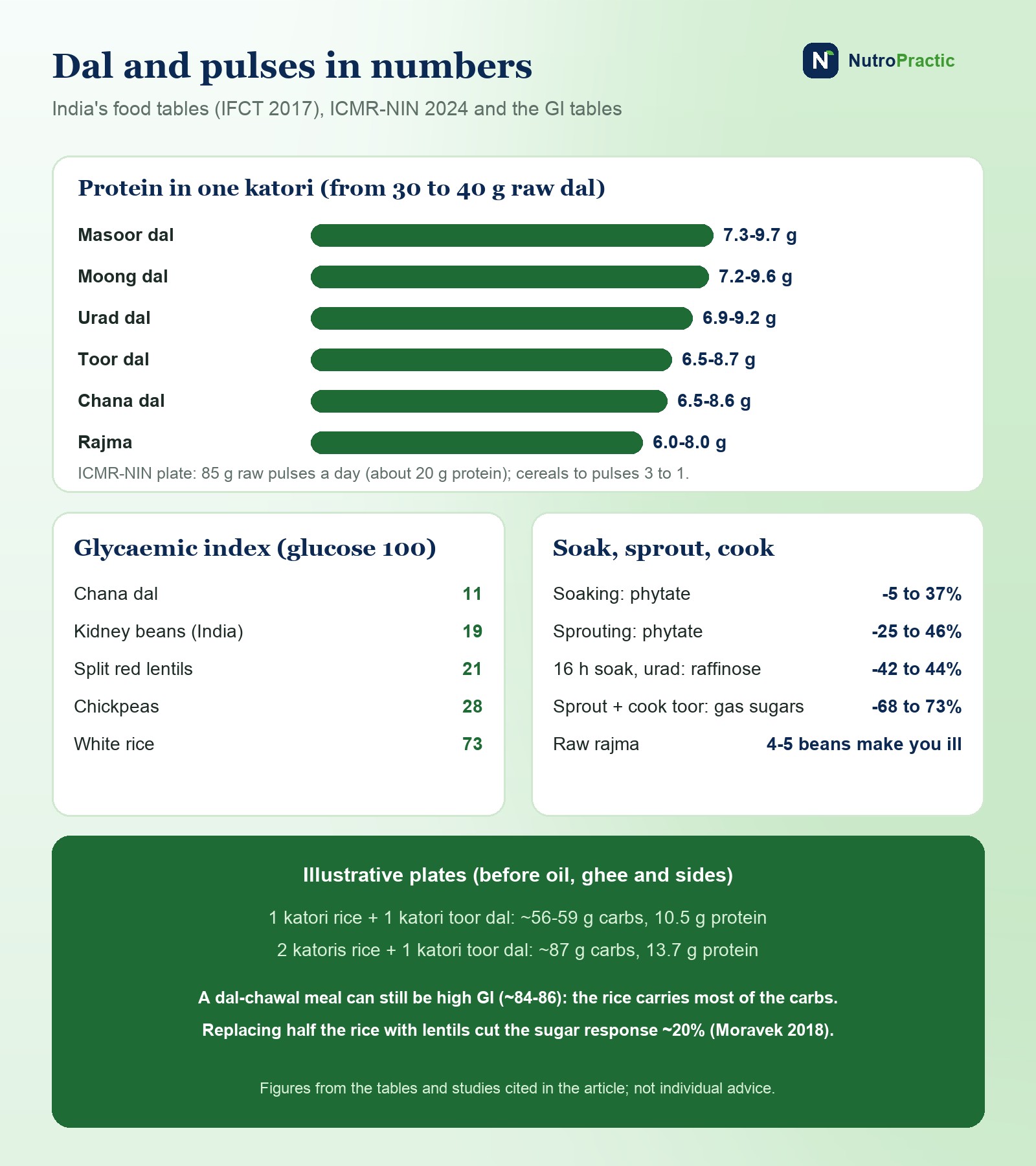
Less than many people think, because cooked dal is mostly water. The useful number is the raw weight: a typical home katori (about 150 g cooked) is made from 30 to 40 g of raw dal, depending on how thick you like it. Per 100 g of raw dal, from the Indian Food Composition Tables (IFCT 2017):
- Masoor dal: 24.4 g protein, 10.4 g fibre
- Moong dal (split): 23.9 g protein, 9.4 g fibre
- Urad dal: 23.1 g protein, 11.9 g fibre
- Whole moong: 22.5 g protein, 17.0 g fibre
- Toor (arhar) dal: 21.7 g protein, 9.1 g fibre
- Chana dal: 21.6 g protein, 15.2 g fibre
- Kabuli chana (USDA): 20.5 g protein, 12.2 g fibre
- Rajma, red: 19.9 g protein, 16.6 g fibre
So one katori of dal gives about 6 to 10 g of protein: about 6.5 g from 30 g of toor dal, about 9.7 g from 40 g of masoor. For comparison, one egg has about 6 g and a glass of milk about 8. An adult needs roughly 50 to 60 g a day, so dal alone, at one katori a meal, covers only part of it.
Two quick ways to get more from the same dal: make it thicker (more raw dal per person) and choose whole pulses with the husk sometimes. Whole moong has 17 g fibre per 100 g against 9.4 g for split moong dal, and whole urad 20.4 g against 11.9 g.
Rice and dal: why the pairing works
Cereals and pulses fill each other's gaps. In the ICMR-NIN's words, cereals are low in lysine but higher in methionine and cysteine, and pulses are the reverse. The IFCT tables show it plainly: per 100 g of protein, milled rice has 3.7 g of lysine and toor dal 6.2 g, while rice has 2.6 g of methionine and toor dal only 0.9 g.
The 2024 Dietary Guidelines for Indians say that cereals and pulses in a ratio of 3:1 by raw weight meet the need for all essential amino acids, and a glass of milk a day improves it further. Their 2,000 kcal "My Plate for the Day" has 250 g of cereals and 85 g of pulses (raw), and the pulses alone give about 20 g of protein, which is about two to three katoris of dal in a day. The plate notes that eggs, fish or meat can stand in for part of the pulses.
Most Indian households eat well short of that. Pulses supply only about 9% of the protein Indians eat, and cereals about 46% in villages and 39% in cities (MoSPI, 2023-24), the cereal share having fallen since 2009-10. So for many families, "more dal" is the simplest protein upgrade there is.
Soaking, pressure cooking and sprouting: what they really do
Phytate and minerals
Pulses contain phytate, which binds iron and zinc and reduces how much the body absorbs. Urad dal has about 579 mg per 100 g, chana dal 450, rajma 465, toor dal 277 and moong dal 170 (IFCT). Household methods reduce it, but not to zero:
- Soaking (overnight, 12 to 18 hours): about 5 to 37% less phytate in Indian studies
- Sprouting: about 25 to 46% less
- Pressure cooking soaked pulses: a further 6 to 18%
This matters most for people who rely on plant food for iron, especially women and growing children. In a mixed diet with some milk, eggs or meat, a lot of dal is not considered a risk to mineral intake. For iron specifically, adding lemon, amla or tomato to dal helps more than worrying about phytate; see our article on iron for women.
The guideline's cooking tips
The ICMR-NIN booklet gives a few simple rules: don't wash grains and pulses again and again; prefer pressure or steam cooking; don't cook in excess water and throw it away; eat more sprouted or fermented foods; and don't add baking soda when cooking pulses. The way to square that with soaking: throw away the soaking water, keep the water the dal cooks in.
Raw rajma: the one that can make you sick
Red kidney beans contain a lectin (phytohaemagglutinin) that causes violent vomiting within one to three hours. The US FDA says as few as four or five raw beans can do it. Raw beans carry 20,000 to 70,000 units of it; properly cooked beans 200 to 400. Boiling at 100°C for 10 minutes destroys it in lab tests, and the FDA advises soaking for at least five hours, discarding the water, and boiling for at least 30 minutes to be safe. Never cook raw rajma in a slow cooker: they often stay below 75°C, which can make the beans more toxic, and the UK recorded 50 suspected poisonings from undercooked beans between 1976 and 1989. A pressure cooker until the beans are soft, or canned rajma, is safe.
Gas: why dal does it, and what helps
The culprits are sugars the body can't digest, the raffinose family (raffinose, stachyose, verbascose). Gut bacteria ferment them, and gas is the result. IFCT 2017 gives the totals per 100 g of raw dal: masoor 0.7 g, chana dal 0.8 g, moong dal 1.3 g, urad dal 1.4 g, rajma 1.5 g, toor dal 1.8 g, whole moong 2.0 g. So masoor and chana dal are the gentlest; toor and whole moong carry the most.
What reduces them, measured in Indian pulses:
- Soaking: a 16-hour soak of urad cut raffinose by 42 to 44% and the other sugars by 16 to 48%, as long as the soak water is thrown away
- Cooking: 60 minutes of cooking removed all the raffinose in urad and half or more of the stachyose
- Sprouting then pressure cooking: removed about 68 to 73% of all three sugars in toor dal
- Sprouting longer: in lentils, three days of sprouting cut them by 18 to 40%, and six days removed them completely
The other help is time. In three US feeding studies of half a cup of beans a day (Winham and Hutchins, 2011), about half the people noticed more gas in the first week; by the third week most of those had settled, though up to a fifth still noticed some at 12 weeks, and 3 to 11% on the control diets reported more gas too. Those were American beans, not dal, but the lesson carries: if you are adding more pulses, start small and build up over two to three weeks.
Hing (asafoetida) is the traditional fix, and it may well help flavour. But we found no trial of hing for gas from dal; the only randomised trial used a high-dose extract for indigestion, made by the sponsor. If you have IBS, the low-FODMAP approach treats pulses carefully: drained, rinsed canned pulses carry less of these sugars because they leach into the liquid. Check the serving sizes in the Monash University FODMAP app, and see our IBS and FODMAP article.
Dal and blood sugar
Pulses on their own raise blood sugar slowly. On the glycaemic index (glucose = 100), from the international GI tables: chana dal 11, kidney beans from India 19, split red lentils 21, toor (pigeon pea) 22, chickpeas 28, lentils 32, mung beans 31 boiled and 42 pressure-cooked, against white rice 73 and wheat roti 62. Values vary with the variety and cooking: kidney beans tested in the UK came in at 51. An old Indian study (Dilawari and colleagues, 1981) found the peak rise in blood sugar after chana dal was 82% lower than after glucose, and after rajma 67% lower, against 16% lower for rice.
In trials, eating more pulses improves diabetes control. In a Canadian trial of 121 adults with type 2 diabetes (Jenkins and colleagues, 2012), at least a cup of pulses a day for three months lowered HbA1c by 0.5 percentage points, against 0.3 on a high wheat-fibre diet, and lowered systolic blood pressure by 4.5 mm Hg more. A meta-analysis of 41 trials (Sievenpiper, 2009) found pulses lowered fasting glucose. There is even a "second-meal" effect: young men who ate a chickpea or lentil meal had lower blood sugar after a pizza served more than four hours later.
But dal-chawal is not automatically a low-GI meal
Here is the catch. Most of the carbohydrate on a dal-chawal plate comes from the rice. A North Indian study (Nayar and Madhu, 2020) measured a meal of moong dal and bhindi with either chapati or rice, and its GI was about 84 to 86, high either way. In a Canadian trial, replacing half the rice with lentils cut the blood-sugar response by about 20%. In other words, the dal helps most when it takes the place of some rice, not when it sits beside a full plate of it.
A worked example, using IFCT and USDA values (illustrative, before oil, ghee or sides):
- Plate A, 1 katori rice + 1 katori toor dal (about 50 g raw rice, 30 g raw dal): about 56 to 59 g carbohydrate, 10.5 g protein
- Plate B, 2 katoris rice + 1 katori dal (90 g raw rice, 30 g dal): about 87 g carbohydrate, 13.7 g protein
Moving from plate B to plate A, with an extra vegetable to fill the space, takes out roughly 30 g of carbohydrate while keeping most of the protein. A thicker dal, or a second katori of dal instead of more rice, pushes it further. There is no official Indian rule like "one katori rice to one katori dal" for diabetes, so treat this as a starting point to discuss with your doctor or dietitian. Our article on rice, roti and blood sugar has more on building the whole plate.
Dal and uric acid
Many people with high uric acid are told to stop dal. In a 12-year study of 47,150 US men (Choi and colleagues, NEJM 2004), purine-rich vegetables, which included peas, beans and lentils, were not linked to gout, while meat (41% higher risk at the top intake) and seafood (51%) were, and dairy was linked to lower risk. That study was about developing gout, not about people who already have it, so if you are on gout treatment, check with your doctor, but dal is not a trigger the way meat, seafood and alcohol are.
Putting it together
1. Weigh your dal once. See how many grams of raw dal go into your family's pot per person; aim for 30 to 40 g a katori.
2. Two to three katoris a day gets close to the ICMR-NIN's 85 g of pulses, or fewer if you eat eggs, fish or meat.
3. For gas: start with masoor or moong dal, soak toor, chana and rajma, throw away the soak water, pressure cook, and build up over a few weeks.
4. For iron: sprouts, a squeeze of lemon or amla, and no tea with the meal.
5. For blood sugar: less rice, more dal and vegetables on the same plate; chana dal and rajma are the slowest.
6. Rajma: soaked, then pressure cooked until soft; never slow-cooked from raw.
7. Vary it: sundal, chilla, sprouts chaat, sambar and kadhi-with-pakoda all count. Our millets article pairs well if you are changing the grain too.
A katori of dal gives 6 to 10 grams of protein; two or three a day, in place of some of the rice, is one of the easiest upgrades an Indian kitchen can make.
Vegetarian and not sure you are getting enough protein, or managing diabetes and wondering how much rice and dal belong on your plate? Dr. Triveni can plan meals around your family's own kitchen in a virtual consultation.
Book a consultationThis article is general information, not medical advice. If you have diabetes, kidney disease, gout or IBS, talk to your doctor or dietitian before making big changes to your diet.
Sources
Longvah T. et al., Indian Food Composition Tables 2017, ICMR-National Institute of Nutrition, Hyderabad. ICMR-NIN, Dietary Guidelines for Indians 2024 and booklet. MoSPI, Nutritional Intake in India 2022-23 and 2023-24 (2025). USDA FoodData Central, SR Legacy.
Kataria A., Chauhan B.M., Punia D., Antinutrients and protein digestibility of black gram and mung bean amphidiploids as affected by domestic processing, Plant Foods Hum Nutr 39(3):257-266 (1989). Bains K., Uppal V., Kaur H., Optimization of germination time and heat treatments for enhanced availability of minerals from leguminous sprouts, J Food Sci Technol 51(5):1016-1020 (2014). Duhan A. et al., Antinutrients and protein digestibility of pigeon pea, Plant Foods Hum Nutr 57:275-284 (2002). Sandberg A.S., Bioavailability of minerals in legumes, Br J Nutr 88 Suppl 3:S281-285 (2002).
US FDA, Bad Bug Book, 2nd ed.: Phytohaemagglutinin (2012). Rodhouse J.C. et al., Red kidney bean poisoning in the UK, Epidemiol Infect 105(3):485-491 (1990). Girigowda K. et al., Effect of soaking and cooking on raffinose family oligosaccharides in black gram, Plant Foods Hum Nutr 60(4):173-180 (2005). Devindra S. et al., Reduction of raffinose family oligosaccharides in red gram, J Sci Food Agric 91(10):1829-1835 (2011). Frias J. et al., Changes in alpha-galactosides during germination of lentils, Z Lebensm Unters Forsch 202:35-39 (1996). Winham D.M., Hutchins A.M., Perceptions of flatulence from bean consumption among adults in 3 feeding studies, Nutr J 10:128 (2011).
Atkinson F.S., Foster-Powell K., Brand-Miller J.C., International tables of glycemic index and glycemic load values: 2008, Diabetes Care 31(12):2281-2283 (2008). Jenkins D.J. et al., Effect of legumes as part of a low glycemic index diet on glycemic control and cardiovascular risk factors in type 2 diabetes, Arch Intern Med 172(21):1653-1660 (2012). Sievenpiper J.L. et al., Effect of non-oil-seed pulses on glycaemic control, Diabetologia 52(8):1479-1495 (2009). Mollard R.C. et al., First and second meal effects of pulses, Appl Physiol Nutr Metab 36(5):634-642 (2011). Dilawari J.B. et al., Reduced postprandial hyperglycemia after ingestion of certain legumes, Am J Clin Nutr 34(11):2450-2453 (1981). Nayar S., Madhu S.V., Glycemic index of wheat and rice are similar when consumed as part of a North Indian mixed meal, Indian J Endocrinol Metab 24(3):251-255 (2020). Moravek D. et al., Carbohydrate replacement of rice or potato with lentils reduces the postprandial glycemic response, J Nutr 148(4):535-541 (2018).
Choi H.K. et al., Purine-rich foods, dairy and protein intake, and the risk of gout in men, NEJM 350(11):1093-1103 (2004).