Digital nutrition support · October 31, 2026
A phone prompt after dinner did not improve glucose overall in 56 adults with type 2 diabetes — and its early effect faded
A small Australian trial sent picture-based prompts to people who often snack after dinner, timing them to the moment a glucose sensor suggested a snack might follow. Across two weeks the prompts did not improve overnight glucose or time in range. There was an early signal, but it faded — a useful warning that a clever notification is not automatically a lasting habit change.
After-dinner snacking is a stubborn habit: by the time someone remembers their plan, the cupboard door may already be open. Researchers in Adelaide tested whether a phone could intervene in that small gap. Their study, published on 20 October, used continuous glucose monitors to identify people with type 2 diabetes who regularly snacked after dinner, then sent a picture-based prompt on selected evenings.
Sixty-six adults completed a two-week lead-in period. Fifty-six then entered the two-week micro-randomized phase, in which each person could receive a prompt or no prompt on a given evening. This design means participants served as their own comparison across many nights, rather than being assigned permanently to one group. The team collected sensor data from 780 nights during that phase and sent 410 prompts.
The main result was not a win: across the full two weeks, prompts did not change the glucose measure the study had set as its primary outcome, the rise in sensor glucose from 90 minutes after dinner until 4 am. The authors also found no overall improvement in reported snacking or glucose time in range. Secondary analyses suggested that prompts may have helped at first, then lost their effect as the study went on.
That pattern is interesting but preliminary. The trial was small and brief, and the early effect was a secondary finding rather than the main endpoint. It cannot show whether a different message, a less frequent schedule, practical support at home, or a longer programme could make a difference. It does underline a sensible point for anyone using an app around food: a notification can be a cue, but it is not a substitute for an eating plan or diabetes care agreed with a clinician.
After-dinner smartphone-prompt study (Diabetes, Obesity and Metabolism, 2026)
66
Adults completing the two-week lead-in with continuous glucose monitoring
56
Adults with available glucose data in the two-week prompt phase
780
Nights of sensor data collected during the prompt phase
410
Picture-based prompts delivered across the two weeks
No overall effect
On the primary overnight sensor-glucose outcome across the full prompt phase
Micro-randomized feasibility study: after a two-week lead-in, eligible participants were randomized each day to receive a just-in-time pictographic prompt or no prompt for another two weeks. The primary outcome was incremental sensor-glucose area under the curve from 90 minutes after dinner until 4 am. The published abstract reports no overall effect; its early, fading effect is from secondary analyses and needs confirmation.
- A micro-randomized trial can assign the same participant to an intervention on some days and control on others. It is designed to test moment-by-moment support, such as a prompt on a particular evening.
- Continuous glucose monitors measure glucose in fluid under the skin, rather than directly in blood. They are useful for seeing patterns over many hours but are not a diagnosis by themselves.
- Time in range is a common continuous-glucose-monitoring measure: the share of time readings stay within an individually appropriate target range. The paper reported no overall improvement in it.
- The study enrolled people who already reported snacking after dinner on at least three nights a week, so its results may not apply to everyone with type 2 diabetes.
- An early change that disappears can reflect novelty, message fatigue, or chance. A short study cannot distinguish those explanations on its own.
- Efficacy and Feasibility of Just-in-Time Nudging in Reducing Evening Snacking Measured by Continuous Glucose Monitoring in Adults With Type 2 Diabetes: A Micro-Randomized StudyDiabetes, Obesity and Metabolism · Original study, published online 20 October 2026; design, participant counts, monitoring nights, prompt total and outcomes
- PubMed record PMID 42901530US National Library of Medicine · Abstract used to cross-check the published date, methods and conclusion
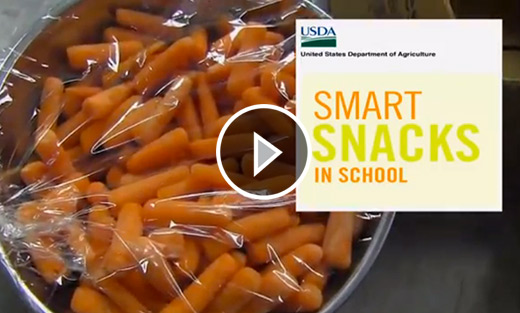
- Smart Snacks Video ScreenshotWikimedia Commons · Public-domain USDA image used as a general illustration
General information, not medical advice. This was a short, small study of adults with type 2 diabetes who regularly snacked after dinner. Do not change diabetes medicines, eating plans or glucose-monitoring targets based on an app prompt or this report. Discuss changes with your diabetes clinician or a registered dietitian.
Analysis by NutroPractic from the sources listed. Written for general readers; it does not replace advice from your own doctor.
From our articles
Our guides on this subject
Plain-language guides on nutrition and wellness, backed by research.

Diabetes
Potatoes and blood sugar: boiled, cooled, mashed or fried, and what the cohorts and trials found
Fries were linked to 20% higher diabetes risk per three servings a week in 205,000 US adults; boiled, baked and mashed potatoes to almost none. GI by cooking method, resistant starch in grams after chilling, the glycaemic load of a potato against a cup of rice, and how to fit aloo into an Indian plate.
30 Oct 2026
Women's health
PCOS and food: what the diet trials show for cycles, insulin and weight
PCOS affects about one woman in ten, and most are told to "lose weight" with little else. Here is what drives it, why insulin matters even in slim women, how much weight loss brings cycles back, what the low-GI and Mediterranean trials found, what inositol and metformin do, and which tests to ask for.
30 Oct 2026
Indian kitchen
Millets in an Indian kitchen: what they do for blood sugar, and how to cook them
Ragi, jowar, bajra and the small millets are sold as the answer to diabetes. A meta-analysis of 65 studies says they help on average, but two Chennai studies found ragi meals no better than white rice and cooked foxtail millet with a GI of 89. What actually makes the difference, and how to cook each one so it does.
30 Oct 2026
Newsfeed for your website
Want this feed on your website?
Add it to any site with one copy-and-paste snippet. No sign-up, and it updates itself every hour.
Start with a virtual consultation
Tell Dr. Triveni what you want to change. You will leave with a clear next step, whether you are in Toronto, London, New York or Chennai.