Since 2023, the International Year of Millets, ragi, jowar and bajra have moved from the back of the kitchen cupboard to the front of the supermarket shelf. Foxtail millet "rice", ragi dosa mix and multi-millet atta are now sold as the answer to diabetes, often by the same companies that sell biscuits.
Some of that is deserved. Millets are whole grains with real fibre, minerals and a long history in Indian cooking. But the blood-sugar claims are bigger than the evidence, and two careful studies from Chennai found results that every millet buyer should know. This article goes through what the research shows, which forms of millet actually help, and how to cook them so they earn their place on the plate.
What counts as a millet
Millets are small-seeded grasses that grow with little water. The ones you'll find in an Indian kitchen are ragi (finger millet), jowar (sorghum) and bajra (pearl millet), which are cooked mostly as flour, and the small millets that are cooked whole like rice: foxtail (thinai, kangni), little (samai, kutki), kodo (varagu), barnyard (kuthiraivali, sanwa) and proso (panivaragu, chena).
Next to polished white rice, they bring more of almost everything. Whole millet grain has roughly 8 to 12 g of dietary fibre per 100 g, against under 3 g in polished rice. Ragi has around 340 to 360 mg of calcium per 100 g of flour, which is unusual for a grain and useful in a home that eats little dairy. Bajra carries more iron than most cereals, though, like all grains, much of it is held back by phytate.
Two things don't change. Dry millet is still 65 to 75% starch, much like rice and wheat. And compared with whole-wheat atta rather than white rice, the fibre gap mostly disappears. Millets are a better grain, not a different food group.
What the big review found
The largest summary of the evidence is a 2021 systematic review and meta-analysis led by Seetha Anitha at ICRISAT, published in Frontiers in Nutrition. It gathered 80 human studies and pooled 65 of them.
On average, millet meals had a glycaemic index (GI) of about 53, against about 72 for milled rice and 74 for refined wheat. In the longer studies, where people with diabetes ate millet every day for weeks or months, fasting blood sugar fell by about 12% (from 134 to 118 mg/dl on average) and the after-meal reading by about 15% (202 to 172 mg/dl). Six studies measured HbA1c, which came down from an average of 8.1% to 7.0%.
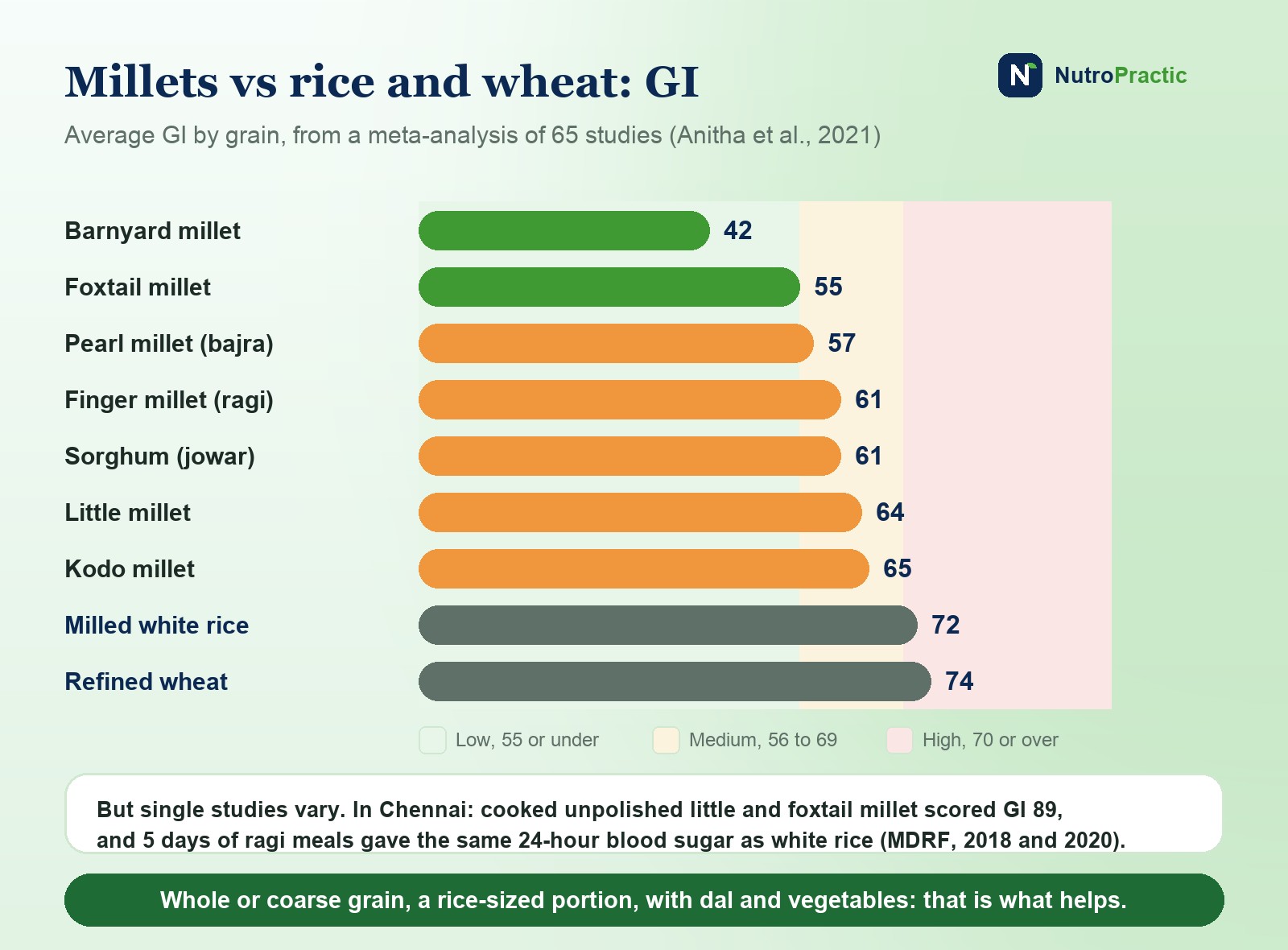
That sounds decisive, and the authors are careful to say it isn't. Many of the studies had fewer than ten people, some as few as three. Most were not blinded, few followed the international method for measuring GI, and the shape of the data suggested that studies with disappointing results were less likely to be published. Only two studies included people with prediabetes. And the averages hide a wide spread: ragi and jowar came out in the medium range, not the low one.
Two Chennai studies that don't fit the label
Researchers at the Madras Diabetes Research Foundation in Chennai tested millets the way Indian families actually eat them, and got results the packet doesn't mention.
In the first, 14 healthy adults ate a ragi-based diet for five days and a white-rice-based diet for five days, wearing continuous glucose monitors throughout. The ragi diet had nearly twice the fibre. Their 24-hour blood sugar was no different between the two (Shobana et al., 2018). The ragi came as flour and dehusked grain, which is how most of it is sold.
In the second, 12 volunteers ate cooked, unpolished little millet and foxtail millet bought from Chennai shops. Both had a GI of about 89, as high as white rice (Malavika et al., 2020). The authors' point: being a whole grain doesn't by itself make a millet low-GI. How the grain is processed and cooked, and how fine the flour is ground, change the result a lot.
Neither study says millets are bad. They say the benefit isn't automatic. A soft, finely ground ragi porridge or a large plate of millet "rice" can raise blood sugar about as fast as the white rice it replaced.
The grain is only part of the story. Portion size, how coarse the grain or flour is, and what you eat with it decide most of the blood-sugar response.
How to make millets work for your blood sugar
Keep the portion where the rice portion should have been. Swapping two cups of rice for two cups of millet doesn't change much. The ICMR-NIN Dietary Guidelines for Indians (2024) want cereals and millets together to supply no more than about 45% of the day's calories, which in practice is about a quarter of the plate. Our article on building a balanced Indian plate shows what that looks like.
Prefer whole grain and coarse forms. Whole foxtail, kodo or barnyard millet cooked like rice, broken jowar in upma, or a coarse-ground flour hold up better than fine flour, flakes or instant mixes. With ragi, which is almost always eaten as flour, the next two rules matter more.
Never eat it alone. Dal, sambar, curd, an egg, paneer or a big portion of vegetables beside the millet slows the rise. Eating the vegetables and protein first and the grain last helps further.
Watch the extras that come with the trend. Ragi biscuits, millet noodles and multi-millet cookies are still biscuits, noodles and cookies. Check the label: if maida or sugar is near the top of the ingredients, it isn't a millet food in any useful sense.
Mix, don't convert. You don't need to give up rice or atta. Replacing a third to a half of it with millet, most days, gets most of the fibre and mineral benefit and is much easier to keep up than an all-millet diet.
Cooking them, one by one
Small millets (foxtail, little, kodo, barnyard, proso)
Rinse two or three times, then soak for 4 to 6 hours or overnight. Soaking shortens cooking, makes the grain fluffier and reduces phytate a little. Cook like rice with about 2 to 2½ cups of water per cup of soaked millet, or 2 to 3 whistles in a pressure cooker, and let it rest 10 minutes before opening. Use it for pongal, khichdi, lemon or curd "rice", or under sambar. A first try that turns out mushy usually means too much water.
Idli and dosa batter
Replace half of the rice in your usual batter with soaked little, kodo or foxtail millet. Keep the urad dal the same. It ferments the same way, and most families can't tell the difference in idli. Full-millet dosas work too, but are better a little thicker and on a well-seasoned tawa.
Ragi
Ragi roti or dosa with vegetables mixed into the batter, ragi mudde (sankati) with a dal-based saaru or a sambar, or a ragi and vegetable adai. Ragi malt and thin porridges are traditional and nourishing for children and older people, but they're the least helpful form for blood sugar: drink them in small cups, unsweetened or with milk rather than jaggery, and with something else that has protein.
Jowar and bajra
Jowar bhakri or roti is easiest with warm water and a pinch of salt, patted by hand rather than rolled. Jowar also works as broken grain in upma or as whole grain cooked like rice (soak it overnight; it takes longer). Bajra roti and bajra khichdi are winter food in much of north and west India. Bajra flour turns bitter quickly because of its oil content, so buy small packs, store them airtight, and use them within a few weeks.
Who should take care
If you take medicine or insulin for diabetes, a real change in diet can lower your blood sugar, and doses may need adjusting: check your readings and tell your doctor. People with coeliac disease can eat millets, which are gluten-free, but should buy brands that guard against wheat contamination. And if you're on dialysis or have been told to limit phosphorus or potassium, ask your renal dietitian before switching, because millets carry more of both than polished rice.
The short version
Millets are better grains than polished white rice: more fibre, more minerals, and on average a gentler blood-sugar response. They're not a diabetes treatment. Whole or coarse millet, in a rice-sized portion, with dal and vegetables, helps. A fine-flour porridge or a mountain of millet "rice" doesn't help much. For more on raising fibre without the discomfort, see the fibre gap and an easy 30-gram day.
Want millets to fit your family's meals and your blood-sugar numbers, without cooking two menus? Dr. Triveni can plan it around your region, your routine and your reports, in a virtual consultation.
Book a consultationThis article is general information, not medical advice. If you have diabetes, kidney disease or another medical condition, or take medicines that lower blood sugar, talk to your doctor before making large changes to your diet.
Sources
Anitha S. et al., A systematic review and meta-analysis of the potential of millets for managing and reducing the risk of developing diabetes mellitus, Frontiers in Nutrition 8:687428 (2021). Shobana S. et al., Finger millet (Eleusine coracana L.) and white rice diets elicit similar glycaemic response in Asian Indians: evidence from a randomised clinical trial using continuous glucose monitoring, Malaysian Journal of Nutrition 24(3) (2018). Malavika M. et al., Assessment of quality of minor millets available in the South Indian market & glycaemic index of cooked unpolished little & foxtail millet, Indian Journal of Medical Research 152(4):401-409 (2020). ICMR-National Institute of Nutrition, Dietary Guidelines for Indians (2024). Longvah T. et al., Indian Food Composition Tables, ICMR-National Institute of Nutrition (2017). Shukla A. et al., Food order has a significant impact on postprandial glucose and insulin levels, Diabetes Care 38(7):e98-e99 (2015).