If there is one nutrient almost everyone could use more of, it is fibre. The Dietary Guidelines for Americans 2020–2025 report that more than 90% of women and 97% of men in the US don't meet the recommended intake. Surveys in Canada, the UK and much of Europe tell a similar story.
How much fibre do you need?
USA and Canada: an Adequate Intake of about 25 g a day for women and 38 g for men (ages 19 to 50), or 14 g for every 1,000 calories you eat. UK: the Scientific Advisory Committee on Nutrition recommends 30 g a day for adults. European Union: EFSA considers 25 g a day adequate for normal bowel function, and notes that more brings further benefits.
Typical adult intakes in these countries sit somewhere around 15 to 20 g a day, so most people are 10 to 15 g short.
Why it matters
Fibre feeds the bacteria in your gut, keeps you regular, slows the rise in blood sugar after meals and helps you feel full. In a large analysis for the World Health Organization, published in The Lancet in 2019, people who ate the most fibre had 15 to 30% lower rates of death from all causes and from heart disease, and lower rates of coronary heart disease, stroke, type 2 diabetes and bowel cancer, than people who ate the least. The biggest benefits were seen at 25 to 29 g a day or more.
You don't need special products. Beans, lentils, whole grains, vegetables, fruit, nuts and seeds do the job.
Where the fibre is
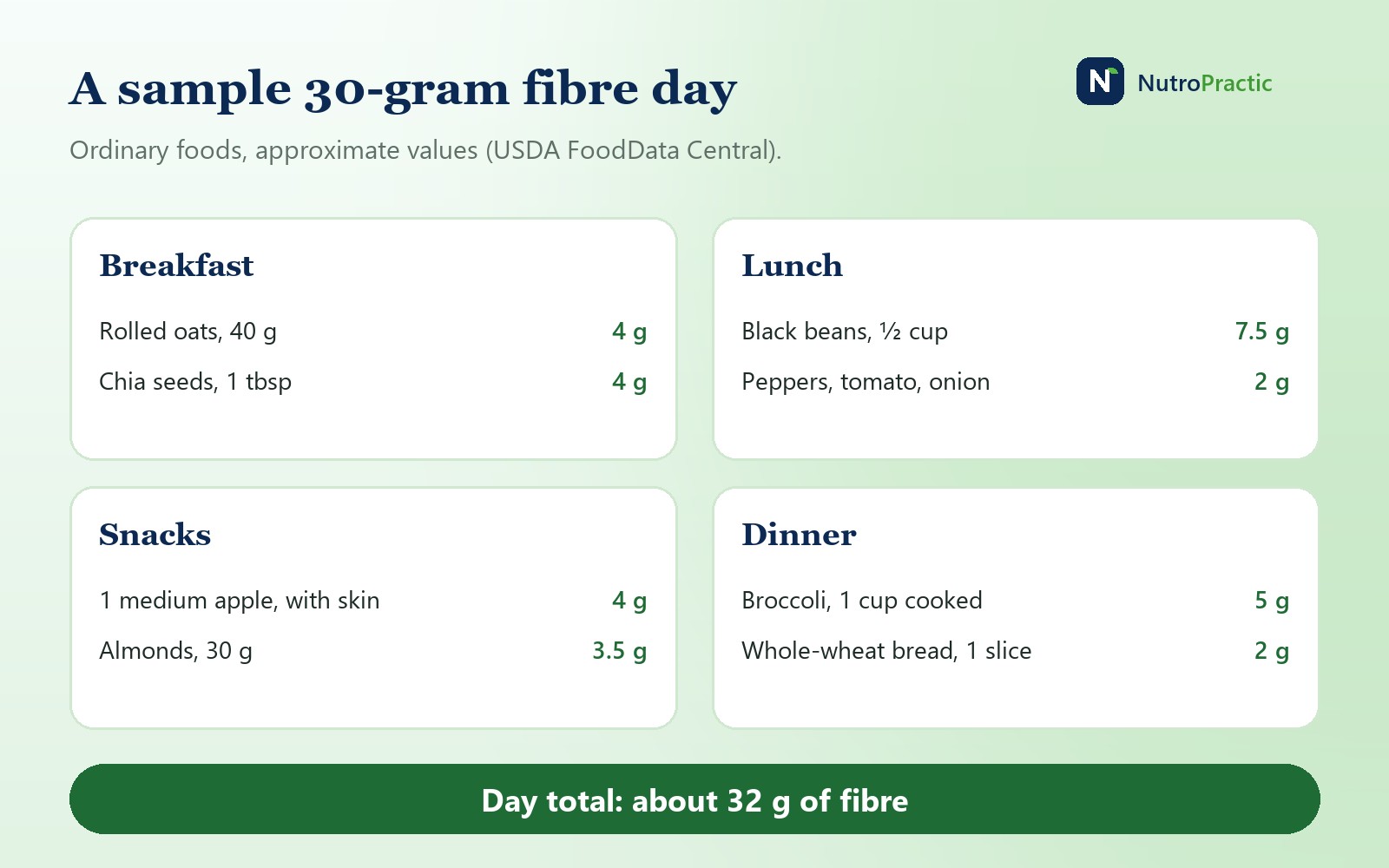
Approximate fibre per serving: ½ cup cooked lentils, about 8 g. ½ cup cooked black beans, about 7 to 8 g. 1 cup raspberries, about 8 g. 1 medium pear with skin, about 5 to 6 g. 1 cup cooked broccoli, about 5 g. 1 medium apple with skin, about 4 g. 1 tablespoon chia seeds, about 4 g. 40 g (½ cup) rolled oats, about 4 g. 1 medium baked potato with skin, about 4 g. 30 g (1 oz) almonds, about 3.5 g. 3 cups air-popped popcorn, about 3.5 g. 1 slice whole-wheat bread, about 2 g.
Eight easy upgrades
1. Switch white bread, pasta and rice for whole-grain versions, at least half the time. 2. Add a tablespoon of chia or ground flaxseed to oats, yogurt or smoothies. 3. Keep canned beans and lentils in the cupboard; rinse and add them to soups, salads and pasta sauces. 4. Eat fruit whole instead of as juice. 5. Keep the skins on potatoes, apples and pears. 6. Make half your plate vegetables at lunch and dinner. 7. Snack on nuts, popcorn or fruit instead of crisps and biscuits. 8. Try one meatless, bean-based dinner a week.
Go slowly
A sudden jump in fibre can cause bloating and wind. Add a few grams every few days and drink enough water. If you have a digestive condition such as IBS or inflammatory bowel disease, ask for advice that fits your situation, because some high-fibre foods can trigger symptoms.
Want a fibre-rich eating plan that suits your gut and your routine? Book a 15-minute virtual consultation with Dr. Triveni.
Book a 15-minute consultationSources
US Department of Agriculture and US Department of Health and Human Services, Dietary Guidelines for Americans, 2020–2025. National Academies, Dietary Reference Intakes for Energy, Carbohydrate, Fiber, Fat, Fatty Acids, Cholesterol, Protein, and Amino Acids (2005). Scientific Advisory Committee on Nutrition, Carbohydrates and Health (2015). EFSA, Scientific Opinion on Dietary Reference Values for carbohydrates and dietary fibre (2010). Reynolds A. et al., Carbohydrate quality and human health: a series of systematic reviews and meta-analyses, The Lancet (2019). USDA FoodData Central for food values.