Irritable bowel syndrome is the diagnosis people get when their gut hurts, bloats and misbehaves, and every test comes back normal. It isn't dangerous, but it can run a life: which restaurant, which meeting, how far from a toilet. Many people work out on their own that food is involved and then start cutting things out, one by one, until the list of safe foods is short and the symptoms are still there.
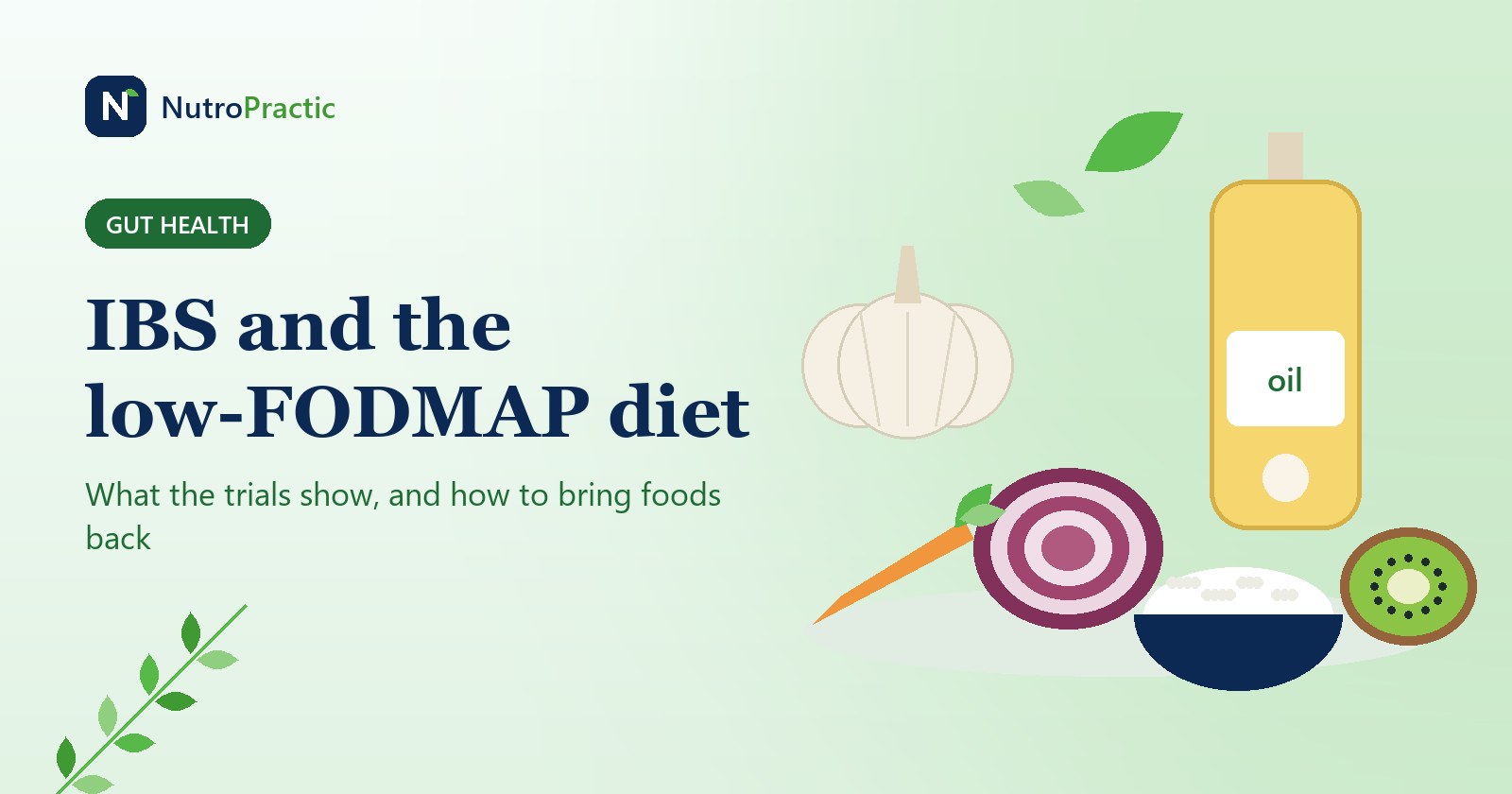
The low-FODMAP diet is the best-tested way to find out which foods actually matter. It is also widely misunderstood. It is a short test followed by a careful return of foods, not a permanent way of eating. Here is what the trials found, how the three steps work, and what to try before you start.
What IBS is, and what to rule out first
Doctors diagnose IBS from the pattern of symptoms. Under the current Rome IV criteria, it means belly pain on at least one day a week for three months, linked to bowel movements or to a change in how often you go or what comes out. It is grouped by the main bowel habit: mostly diarrhoea (IBS-D), mostly constipation (IBS-C), or mixed. Depending on how strictly it is defined, roughly 4 to 10% of adults worldwide have it, women more often than men.
Because the symptoms overlap with other conditions, a few things should be checked first. US, UK and European guidelines advise a blood test for coeliac disease before any diet change (it needs you to still be eating gluten), and usually a blood count and inflammation markers. See a doctor promptly if you have blood in your stool, weight loss you can't explain, symptoms that wake you at night, anaemia, symptoms that started after about 50, or a family history of bowel cancer, coeliac disease or inflammatory bowel disease. Those are not IBS until proven otherwise.
What FODMAPs are
FODMAP stands for fermentable oligosaccharides, disaccharides, monosaccharides and polyols: a family of short-chain carbohydrates that are poorly absorbed in the small intestine. They pull water into the gut and are then fermented by bacteria in the colon, which makes gas. In most people that goes unnoticed. In people with IBS, whose gut is often more sensitive to stretching, the same amount of water and gas can mean pain, bloating and a change in bowel habit.
There are five groups. Fructans are in wheat, rye, onion and garlic. GOS (galacto-oligosaccharides) are in beans, chickpeas and lentils. Lactose is the sugar in milk, yogurt and soft cheese. Excess fructose is in apples, pears, mango and honey. Polyols (sorbitol, mannitol and other sugar alcohols) are in apples, stone fruit, mushrooms, cauliflower and sugar-free gum and mints. Few people react to all five; most react to one or two.
What the trials found
The diet was developed at Monash University in Melbourne, and the first tightly controlled trial came from there in 2014. Halmos and colleagues gave 30 people with IBS three weeks of a low-FODMAP diet and three weeks of a typical Australian diet, with all meals provided, in random order. On the low-FODMAP weeks, overall symptom scores were about half as high, and around seven in ten people had a clear improvement.
Later trials, in everyday conditions, found smaller but real effects. In a King's College London trial (Staudacher, 2017), 104 people were given either a low-FODMAP diet or a convincing sham diet that looked just as restrictive. After four weeks, 57% versus 38% reported adequate relief. A US trial in people with IBS-D (Eswaran, 2016) found 52% versus 41% compared with standard dietary advice, with clearer gains for bloating and pain. A 2022 analysis that pooled 13 trials ranked the low-FODMAP diet first among the diets tested for overall IBS symptoms, while noting that most of the trials were small.
There is a catch, also from the London group: after four weeks of restriction, people had fewer bifidobacteria, a group of gut bacteria generally linked with good health. Fructans and GOS are prebiotics; they feed those bacteria. Nobody knows yet whether that matters in the long run, but it is one more reason the strict part is meant to be short.
The three steps
1. Swap (2 to 6 weeks). Replace high-FODMAP foods in all five groups with lower ones, so your diet stays full and varied. If nothing has improved after four to six weeks, FODMAPs are probably not your main trigger, and there is no point carrying on.
2. Test (about 6 to 8 weeks). If you are better, bring the groups back one at a time while the rest of the diet stays low. A common pattern is three days per food: a small portion on day one, a normal one on day two, a large one on day three, then a few days back on the low diet before the next test. Honey or mango tests excess fructose, milk tests lactose, a slice of wheat bread or some garlic tests fructans, a small bowl of lentils tests GOS, and so on. Note what happens and at what amount.
3. Keep (long term). Eat back everything you tolerated, and keep only the foods and amounts that really trouble you limited. Most people end up with a short personal list, often just onion and garlic, or large portions of beans, rather than the whole low-FODMAP diet. Dose matters: many people who can't manage a bowl of chickpeas are fine with a few spoonfuls.
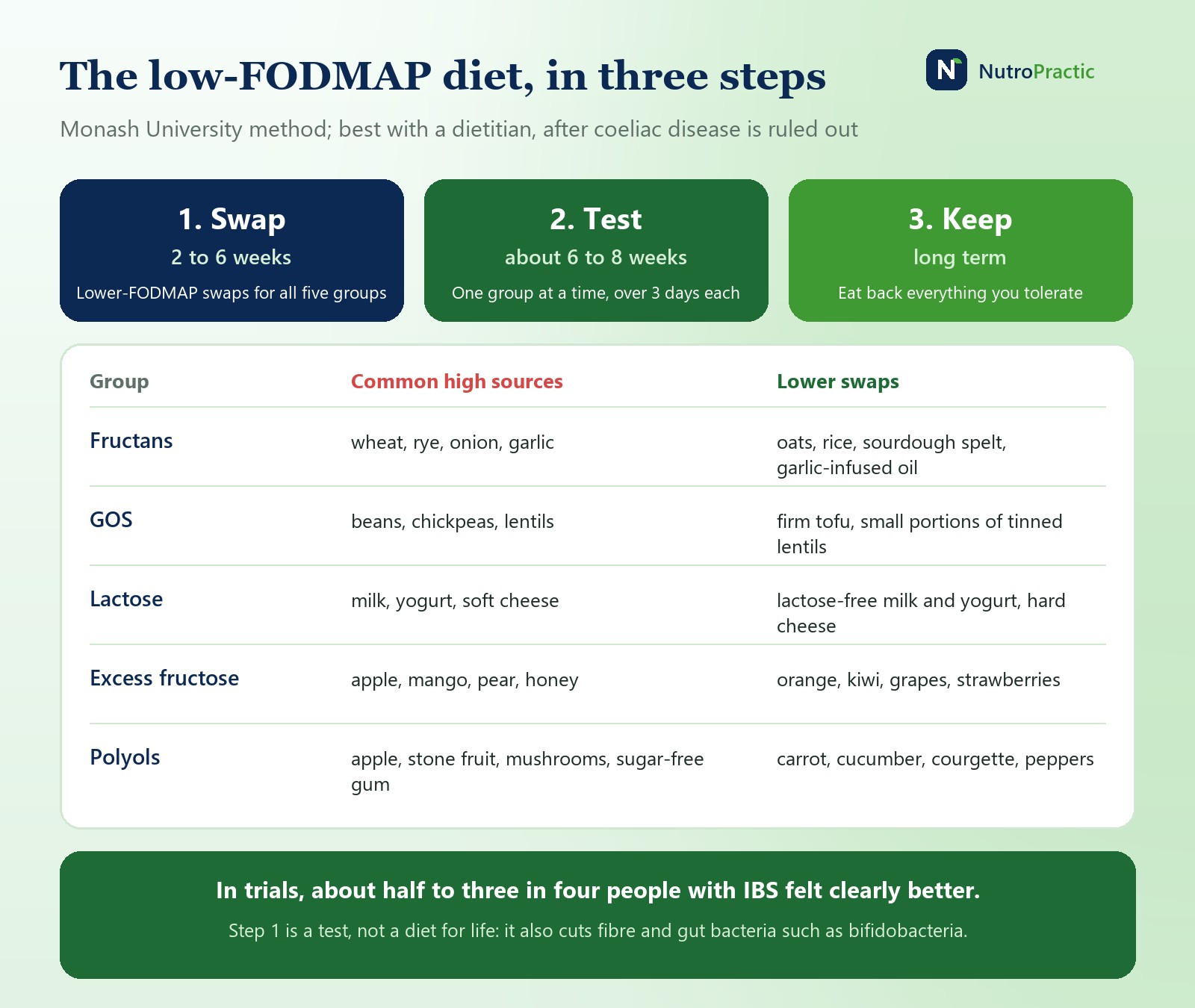
Swaps that keep meals worth eating
Garlic-infused oil is the trick most people learn first. Fructans don't dissolve in oil, so oil in which garlic has been cooked and then removed gives the flavour without the fructans. The green tops of spring onions and chives work in place of onion. Many cooks across South Asia already use asafoetida (hing) for an onion-like note; most of the powdered kind is mixed with wheat flour, though the amount used is tiny.
Grains: oats, rice, quinoa, potatoes, corn tortillas, and traditional sourdough spelt or wheat bread, where the long ferment breaks down much of the fructan. Protein: eggs, meat, fish, firm tofu and tempeh, and small portions of tinned lentils or chickpeas, rinsed (the canning water carries off some of the GOS). Dairy: lactose-free milk and yogurt, and hard cheeses such as cheddar and parmesan, which contain almost no lactose. Fruit: oranges, kiwi, grapes, strawberries, pineapple, a firm banana, one portion at a time. Vegetables: carrots, cucumber, courgette, peppers, spinach, tomatoes, aubergine, green beans.
Serving size changes the answer for many foods, and lab values are updated as testing improves. The Monash University FODMAP app is the reference most dietitians use, and it is worth its small price if you are doing the diet.
Before you go low-FODMAP
The full diet is hard work and not the only option. The UK's NICE guideline and the British Dietetic Association start with simpler, first-line advice, and in a 2022 trial from Sheffield (Rej and colleagues), 42% of people improved on that advice alone, against 55% on low-FODMAP and 58% on gluten-free, with no clear difference between the three. The basics are:
Eat regular meals and don't skip, rush or overload them. Limit fresh fruit to about three portions a day, spread out. Go easy on coffee, alcohol, fizzy drinks, very fatty or spicy meals, and sugar-free products with sorbitol or other '-itol' sweeteners. Try soluble fibre: psyllium (ispaghula) husk, built up slowly to about a dessertspoon a day, helped in a Dutch trial in primary care, while wheat bran did not and often made things worse. Drink enough water, especially with psyllium.
Beyond diet, the American College of Gastroenterology's 2021 guideline supports peppermint oil capsules for pain and gut-directed hypnotherapy or cognitive behavioural therapy, which work on the gut-brain link that makes IBS guts so sensitive. Regular physical activity helps many people too. Our fibermaxxing article shows how to add fibre in steps without the bloat, and the one on fermented foods covers what yogurt, kefir and kimchi can and can't do.
The goal of the low-FODMAP diet is to eat as many foods as possible again, not as few.
Who should be careful
Restrictive diets can cut fibre, calcium and variety, and they can tip people with a history of eating disorders or anxiety about food into worse habits. Children, pregnant women, people who are underweight and anyone with a strained relationship with food should only do it with a dietitian, if at all. Guidelines in the US, UK and Australia recommend doing the diet with a trained dietitian for everyone, partly because the reintroduction step is where people get stuck: many simply stay on the restrictive list for years.
A short plan
Get checked: coeliac blood test and the basics, and a doctor's opinion on any warning signs.
Start simple: regular meals, three fruit portions a day, less fizz, alcohol and sugar-free sweets, and psyllium built up slowly. Keep a two-week food and symptom diary.
Still struggling? Try low-FODMAP for two to six weeks, ideally with a dietitian. Stop if it hasn't helped.
If it helped, test the groups one at a time, and keep only your real triggers, in the amounts that bother you.
Bloating, pain or an unpredictable gut? Dr. Triveni runs gut health plans that include the low-FODMAP steps and, more importantly, the reintroduction, in a virtual consultation.
Book a consultationThis article is general information, not medical advice. IBS should be diagnosed by a doctor. Blood in the stool, unexplained weight loss, fever, symptoms at night or new symptoms after 50 need prompt medical attention.
Sources
Lacy B.E. et al., ACG Clinical Guideline: Management of Irritable Bowel Syndrome, Am J Gastroenterol 116(1):17-44 (2021). National Institute for Health and Care Excellence, Irritable bowel syndrome in adults: diagnosis and management (CG61) (updated 2017). Vasant D.H. et al., British Society of Gastroenterology guidelines on the management of irritable bowel syndrome, Gut 70(7):1214-1240 (2021). Sperber A.D. et al., Worldwide prevalence and burden of functional gastrointestinal disorders, results of Rome Foundation Global Study, Gastroenterology 160(1):99-114 (2021). Halmos E.P. et al., A diet low in FODMAPs reduces symptoms of irritable bowel syndrome, Gastroenterology 146(1):67-75 (2014). Staudacher H.M. et al., A diet low in FODMAPs reduces symptoms in patients with irritable bowel syndrome and a probiotic restores Bifidobacterium species: a randomized controlled trial, Gastroenterology 153(4):936-947 (2017). Eswaran S.L. et al., A randomized controlled trial comparing the low FODMAP diet vs. modified NICE guidelines in US adults with IBS-D, Am J Gastroenterol 111(12):1824-1832 (2016). Black C.J., Staudacher H.M., Ford A.C., Efficacy of a low FODMAP diet in irritable bowel syndrome: systematic review and network meta-analysis, Gut 71(6):1117-1126 (2022). Rej A. et al., Efficacy and acceptability of dietary therapies in non-constipated irritable bowel syndrome: a randomized trial of traditional dietary advice, the low FODMAP diet, and the gluten-free diet, Clin Gastroenterol Hepatol 20(12):2876-2887 (2022). Bijkerk C.J. et al., Soluble or insoluble fibre in irritable bowel syndrome in primary care? Randomised placebo controlled trial, BMJ 339:b3154 (2009). Monash University, The low FODMAP diet.