Walk into a supermarket today and "gut health" is printed on everything from crisps to cold brew. Most of it is marketing. But under the noise there's a small, interesting body of research on fermented foods, the oldest kind of processed food there is, and one trial in particular that changed how researchers think about them.
The trial: six servings a day for ten weeks
In 2021 a team at Stanford published a study in the journal Cell. They took 36 healthy adults (average age about 51, most of them women) and randomly gave them one of two diets for ten weeks. One group ate more fermented foods: yogurt, kefir, cottage cheese, kimchi, sauerkraut, fermented vegetable brine, kombucha. On average they went from less than half a serving a day to about six servings a day. The other group ate more fibre: beans, whole grains, vegetables, nuts, going from about 21 g to 45 g a day.
The results surprised the researchers. In the fermented-food group, the variety of bacteria in the gut went up steadily, and 19 of the 93 inflammation-related proteins they measured in the blood went down, including interleukin-6, which is linked to chronic, low-grade inflammation. In the fibre group, on average, neither happened in those ten weeks. Fibre still changed what the existing bacteria were doing, and the authors suspect a longer study, or a gut that already has the right microbes, might show more.
What it doesn't prove
This was a small trial in healthy people, and it measured markers, not illness. Nobody's heart attack or diabetes was prevented in ten weeks. It also doesn't say which fermented food did the work, or whether six servings is the amount you need; that's simply how much people ended up eating.
The wider evidence is mostly observational. People who eat yogurt regularly tend to have a lower risk of type 2 diabetes, enough that in 2024 the US Food and Drug Administration allowed a qualified health claim: eating at least 2 cups (3 servings) of yogurt a week "may reduce the risk of type 2 diabetes", with the FDA itself calling the evidence limited. Yogurt eaters differ from non-eaters in many other ways, which is exactly why the claim is qualified.
So the honest summary is: promising, consistent with what we know about gut bacteria and inflammation, cheap and low-risk to try. Not a cure for anything.
Fermented is not the same as live
An international expert panel (ISAPP, 2021) defined fermented foods as foods made through "desired microbial growth and enzymatic conversions of food components". That covers a lot: bread, cheese, wine, coffee, chocolate, soy sauce. But many of these no longer contain living microbes by the time you eat them, and the Stanford effect was seen with foods that mostly do.
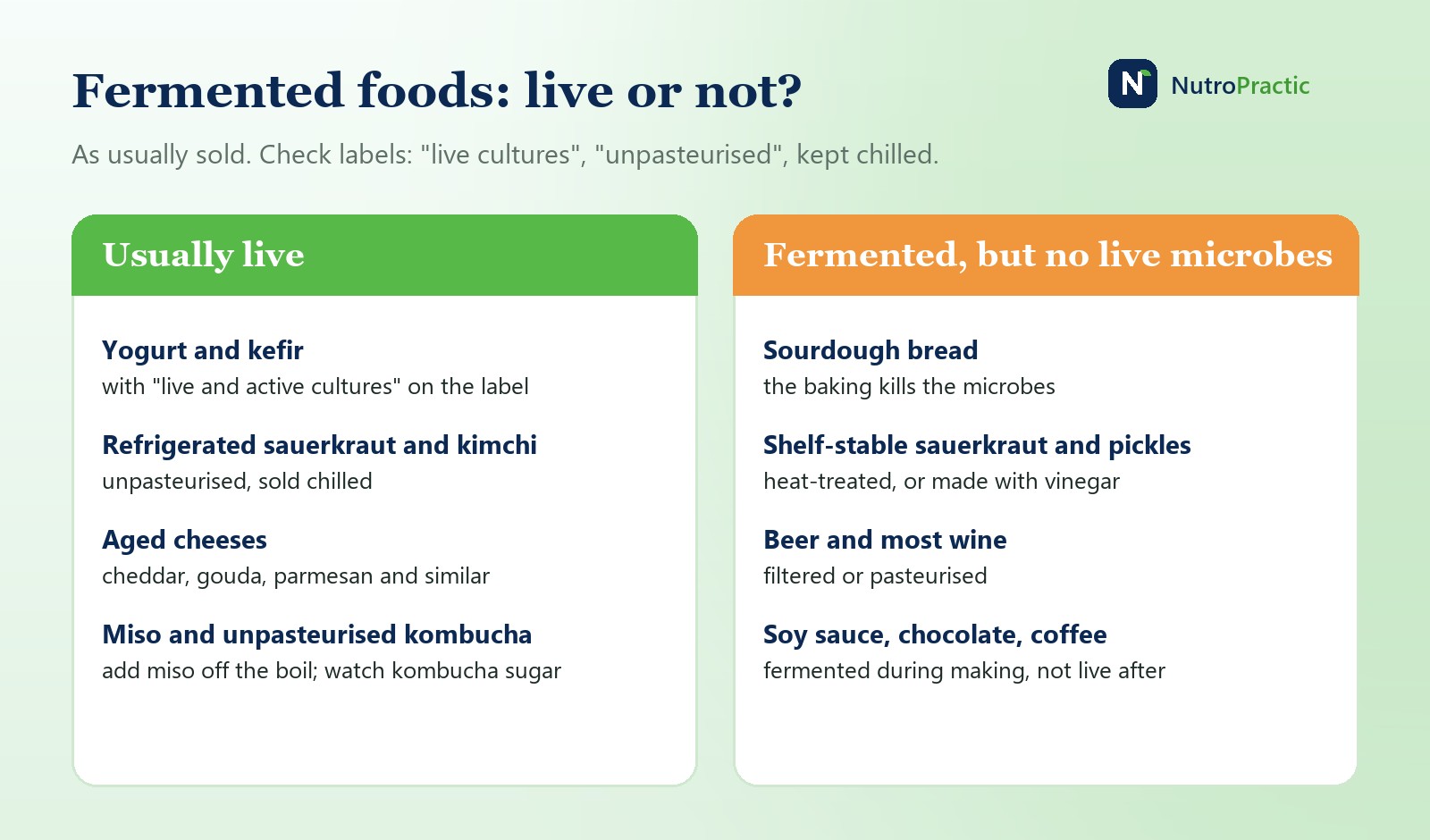
Sourdough is fermented, and some people find it easier to digest, but baking kills the microbes. Shelf-stable sauerkraut and most supermarket pickles are either heat-treated or simply soaked in vinegar; look for jars in the chiller labelled "raw" or "unpasteurised". Yogurt is live unless it's been heat-treated after fermenting; in the US and Canada the "Live & Active Cultures" seal, and in Europe phrases like "live cultures" or "bio", are your clue. Miso is live until you boil it, so stir it into soup at the end.
The catches: sugar and salt
Flavoured yogurts and kefirs can carry 10 to 15 g of added sugar per pot, the kind of sugar our article on ultra-processed foods suggests eating less of. Buy plain and add fruit. Many kombuchas are close to a soft drink in sugar; check the label and look for under about 5 g per 100 ml.
Sauerkraut and kimchi are salty, often 500 to 700 mg of sodium per 100 g. A forkful as a side is fine; a bowlful every day matters if you're watching your blood pressure.
A few people should go carefully: anyone with a severely weakened immune system (for example, during chemotherapy), and people with histamine intolerance, who may react to aged cheese, sauerkraut and wine. If fermented foods make you bloated at first, start with a spoonful and build up.
An easy way to eat more
Six servings a day is a lot, and you don't need to start there. One serving is roughly a pot of yogurt, a glass of kefir, a couple of forkfuls of sauerkraut or kimchi, or a small glass of kombucha. Try three a day for a month and see how you feel:
Breakfast: plain yogurt or kefir with oats, berries and seeds. Lunch: a forkful of kimchi or sauerkraut with eggs, a sandwich or a grain bowl. Dinner: miso stirred into soup or a dressing, or a few cubes of aged cheese after the meal.
And don't drop the fibre. The two work together: fibre feeds the microbes you already have, fermented foods may bring new ones. The fibre gap shows an easy 30-gram day built from ordinary food.
Bloating, irregular digestion, or just want to eat better for your gut without buying the hype? Dr. Triveni can review what you eat and build a gut-friendly plan that fits your kitchen, in a virtual consultation.
Book a consultationThis article is general information, not medical advice. If you have a digestive condition, a weakened immune system, or symptoms like blood in your stool, unexplained weight loss or persistent pain, see a doctor first.
Sources
Wastyk H.C. et al., Gut-microbiota-targeted diets modulate human immune status, Cell 184(16):4137-4153 (2021), doi:10.1016/j.cell.2021.06.019. Marco M.L. et al., The International Scientific Association for Probiotics and Prebiotics (ISAPP) consensus statement on fermented foods, Nat Rev Gastroenterol Hepatol 18:196-208 (2021). US FDA, qualified health claim for yogurt and reduced risk of type 2 diabetes (March 2024); FDLI summary. Sodium values: USDA FoodData Central (approximate, brands vary).