Most conversations about menopause start and end with hot flushes. They're real, they can wreck sleep, and they deserve attention. But the changes that matter most for the next thirty years are quieter. You don't feel your bones thinning, your muscle shrinking or your LDL cholesterol climbing. They show up later, as a fracture after a small fall, a harder time getting up from a low chair, or a blood test your doctor wants to talk about.
Food can't stop menopause, and it isn't a substitute for treatment when symptoms are bad. What it can do is give your bones, muscles and heart what they need during the years when oestrogen stops doing part of that job for you. This is a practical guide to that, for women in perimenopause or past it, and for anyone cooking for them.
What actually changes
The best picture comes from SWAN, the Study of Women's Health Across the Nation, which has followed more than 3,000 US women of five ethnic backgrounds through the transition since the mid-1990s. Three findings stand out.
Bone. In the late perimenopause and the first years after the final period, bone density fell by about 1.8 to 2.3% a year at the spine and 1 to 1.4% a year at the hip. Over five years that adds up to roughly 7 to 10% at the spine. It's the fastest bone loss of adult life, and you can't feel it.
Body composition. In SWAN the pace of fat gain roughly doubled, and lean mass started to fall, from about two years before the final period. Weight on the scale may barely move while fat shifts towards the waist and muscle quietly goes.
Cholesterol. LDL cholesterol rose sharply in the year before and the year after the final period, then stayed at the new, higher level. It's one reason women's heart disease risk starts catching up with men's in the decade after menopause.
None of this is a reason for alarm. It's a reason to pay attention to a few specific things now, rather than in ten years.
Protein, at every meal
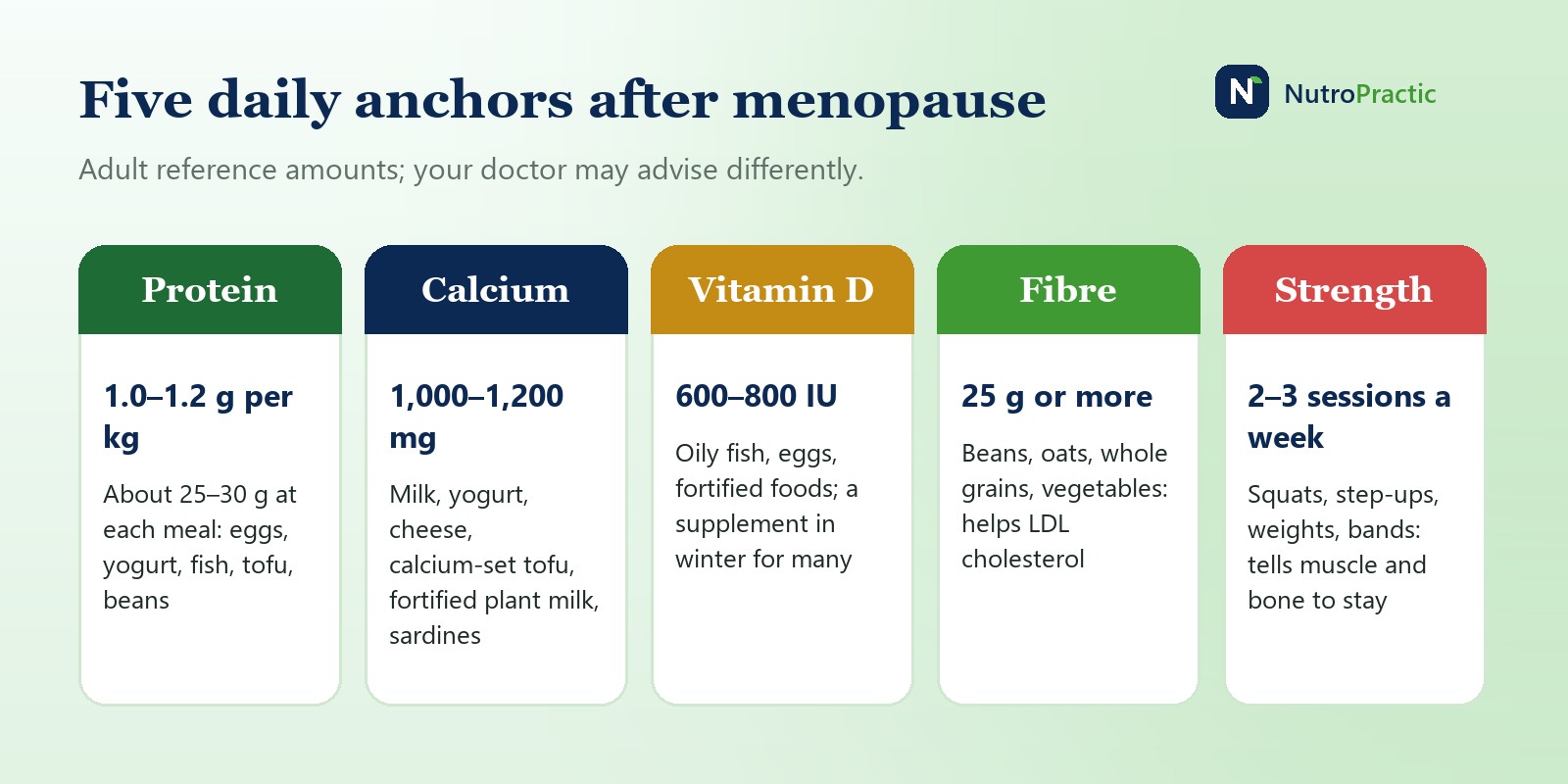
Muscle keeps you strong, steady on your feet and good at handling blood sugar. Expert groups that looked at older adults (the PROT-AGE study group and ESPEN) suggest 1.0 to 1.2 g of protein per kg of body weight a day, more than the standard 0.8 g/kg. For a 68 kg (150 lb) woman that's roughly 70 to 80 g.
How you spread it matters as much as the total. A typical day is light at breakfast and heavy at dinner. Aim for 25 to 30 g at each meal instead: Greek yogurt with oats and seeds, eggs on whole-grain toast, a tofu scramble. We explain why steady portions work better, with sample breakfasts, in Protein after 40.
Calcium and vitamin D: food first, then fill the gap
Recommendations differ by country, which is confusing but not contradictory. For women over 50, the US and Canada set 1,200 mg of calcium a day; the European Food Safety Authority uses 950 mg for adults; the UK uses 700 mg. A sensible middle for most women is about 1,000 to 1,200 mg, mostly from food.
That's easier than it sounds. A glass of milk or fortified soy milk gives about 300 mg. A pot of yogurt, 200 to 300 mg. 30 g of cheddar, about 200 mg. Calcium-set tofu (look for calcium sulphate on the label) can give 300 mg or more per 100 g, and canned sardines or salmon with the soft bones are another good source. Three servings a day from that list gets most women there.
Supplements are fine for filling a gap, but more isn't better: high-dose calcium pills have been linked to kidney stones, and the evidence on heart risk is mixed. If you use one, take 500 mg or less at a time, with food, and count what you already eat.
Vitamin D helps you absorb calcium. The US reference is 600 IU (15 µg) a day up to age 70 and 800 IU (20 µg) after. In northern winters (most of Canada, the UK, northern Europe and the northern US) the sun is too low for your skin to make enough, so many women need a supplement from October to March. Our vitamin D and B12 guide covers who's most at risk and how to check.
Strength training does what food can't
Protein and calcium are building materials. Bones and muscles only use them when they're asked to work. Resistance training, meaning lifting, pushing or pulling against a load, is the signal. Two or three sessions a week is enough to matter: sit-to-stands from a chair, step-ups, wall or counter push-ups, rows with a band, carrying shopping bags with good posture. If you've never lifted, a few sessions with a physiotherapist or trainer is money well spent.
Walking is good for your heart and mood, but on its own it does little for bone density at the spine. Add some impact (brisk uphill walking, stairs, a little skipping if your joints allow) and some load.
For your heart: fibre and the right fats
You can't eat your way back to pre-menopause cholesterol, but the classic levers still work. Soluble fibre from oats, barley, beans, lentils, apples and psyllium binds cholesterol in the gut and lowers LDL modestly. Swapping butter, fatty meat and pastries for olive oil, nuts, seeds and oily fish improves the balance of fats. Most women eat far less fibre than the 25 g or more they need; The fibre gap has a 30-gram day built from ordinary food.
Alcohol deserves a mention too. It adds calories at a time when energy needs are falling, it disturbs sleep, many women find it sets off hot flushes, and it raises breast cancer risk. Less is better, and none is fine.
Soy and hot flushes: an honest answer
Soy foods contain isoflavones, plant compounds that act weakly like oestrogen, so the idea that they could ease hot flushes makes sense. The evidence is mixed. The Menopause Society's 2023 review of non-hormone treatments concluded that soy foods and soy extracts are not recommended for hot flushes, because trials give inconsistent results.
One small US trial (WAVS) did report a large drop, about 84% fewer moderate-to-severe hot flushes over 12 weeks, in women who switched to a low-fat plant-based diet with half a cup of cooked soybeans a day. It wasn't blinded, the women knew what was being tested, and the diet changed many things at once. Our view: soy foods (tofu, edamame, soy milk, tempeh) are good sources of protein and calcium anyway, so including them is sensible. Just don't expect them to replace treatment if your symptoms are severe. Talk to your doctor: there are effective options, hormonal and non-hormonal.
Some women notice that spicy food, hot drinks, caffeine or alcohol set off a flush. The research on these triggers is thin, so a two-week notebook of your own flushes and what came before them will tell you more than any list.
A week to start on Monday
1. Work out your protein target (weight in kg × 1.0 to 1.2) and check one ordinary day against it. 2. Add one calcium-rich food you'll actually eat to each meal. 3. Ask your doctor whether you need a vitamin D supplement, especially if you live far from the equator. 4. Put two short strength sessions in your calendar, even 20 minutes at home. 5. Swap one refined grain a day for oats, beans or barley. 6. If you're over 50 or have risk factors (early menopause, a parent with a hip fracture, smoking, long-term steroid use), ask whether a bone density scan makes sense.
In perimenopause or past it, and not sure your meals are keeping up with what your body needs? Dr. Triveni can look at what you eat now and build a plan for protein, bones and heart around your life, in a virtual consultation.
Book a consultationThis article is general information, not medical advice. Talk to your doctor before starting supplements or a new exercise routine, especially if you have kidney disease, a history of kidney stones, osteoporosis or heart disease, or take medicines that affect bone.
Sources
Greendale G.A. et al., Bone mineral density loss in relation to the final menstrual period in a multiethnic cohort: results from the Study of Women's Health Across the Nation (SWAN), J Bone Miner Res (2012). Greendale G.A. et al., Changes in body composition and weight during the menopause transition, JCI Insight (2019). Matthews K.A. et al., Are changes in cardiovascular disease risk factors in midlife women due to chronological aging or to the menopausal transition?, J Am Coll Cardiol 54:2366-73 (2009). Bauer J. et al., Evidence-based recommendations for optimal dietary protein intake in older people: a position paper from the PROT-AGE Study Group, JAMDA (2013). NIH Office of Dietary Supplements, Calcium and Vitamin D fact sheets. EFSA, Scientific Opinion on Dietary Reference Values for calcium (2015). The 2023 nonhormone therapy position statement of The North American Menopause Society22.pdf), Menopause 30(6):573-590 (2023). Barnard N.D. et al., The Women's Study for the Alleviation of Vasomotor Symptoms (WAVS), Menopause (2023); PCRM summary. Calcium values: USDA FoodData Central (approximate, brands vary).