Brain health · October 12, 2026
Older adults who ate closer to the MIND diet carried less of one blood protein, and people with more of it were likelier to get dementia over the next 21 years
Researchers in Indiana scanned about 7,000 proteins in the blood of 206 older adults to ask why a diet built around leafy greens, berries, beans and fish keeps turning up beside lower dementia risk. One little-known protein, tied in other work to damage in the brain's small blood vessels, held up in two much bigger groups. It is a clue, not a mechanism, and the diet itself did not clearly lower dementia risk in the biggest group.
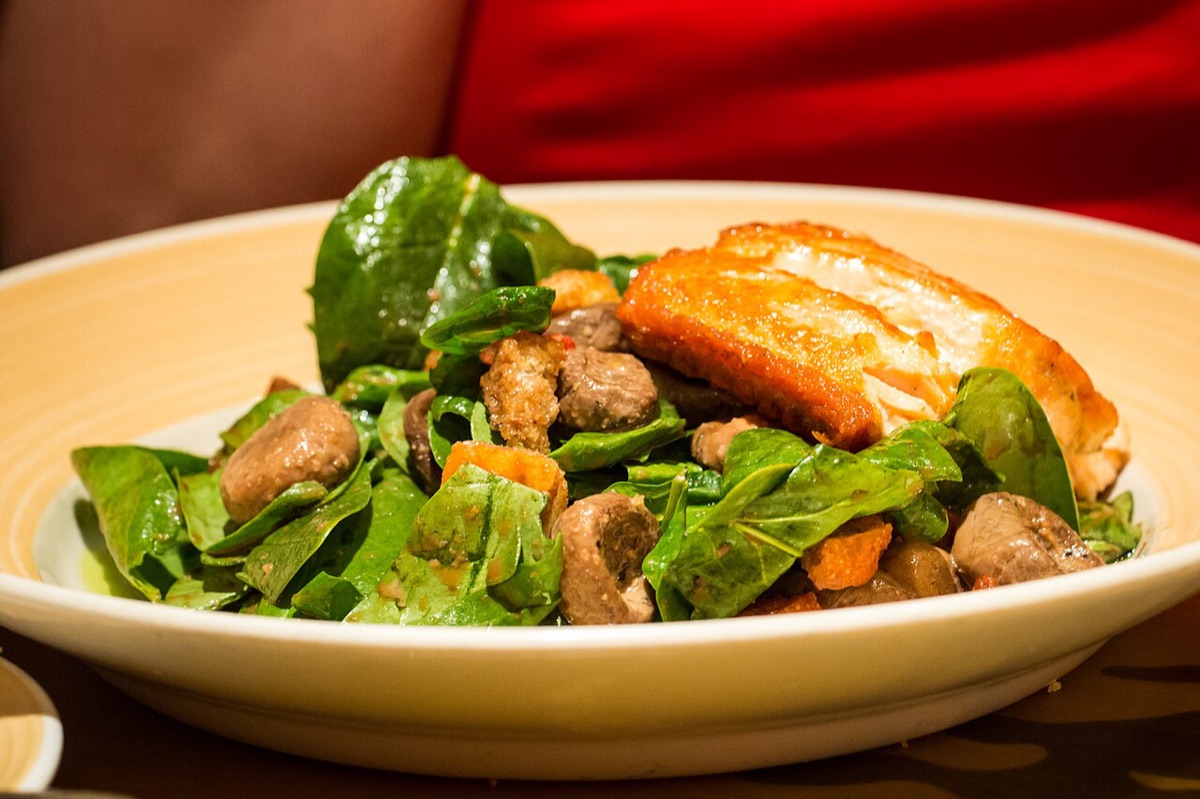
The MIND diet has a simple pitch. Take the Mediterranean diet and the blood-pressure diet known as DASH, keep the parts with the best record for the brain, and score people on how closely they follow it: points for green leafy vegetables, other vegetables, nuts, berries, beans, whole grains, fish, poultry, olive oil and a little wine; points for keeping red and processed meat, butter and margarine, cheese, pastries and sweets, and fried or fast food down. For a decade, people with higher scores have kept showing up with slower memory decline and less dementia. What nobody can yet say is how a plate of spinach and salmon would reach the brain.
A team at Indiana University School of Medicine, working with researchers at Johns Hopkins, went looking in the blood. They took 206 people aged 60 and over from the Indiana Alzheimer's Disease Research Center, some with normal thinking, some with mild cognitive impairment and some with Alzheimer's disease, who had filled in a 15-question MIND diet screener and given a blood sample within 30 days of their clinic visit. The sample was run on a platform that measures about 7,000 proteins at once. The paper came out in Alzheimer's & Dementia on 9 October 2026.
The first finding was the familiar one. People with Alzheimer's had the lowest average MIND scores, 8.8 out of 15, against 10.0 for those with normal thinking, and higher scores went with lower odds of an Alzheimer's diagnosis (odds ratio 0.75) after allowing for age, sex, body weight and the APOE4 gene. Higher scores also went with slightly lower neurofilament light, a blood marker that rises when nerve cells are damaged. But diet scores showed no link with the hallmarks of Alzheimer's itself: not with amyloid on brain scans, not with the size of the hippocampus, and not with blood tests for amyloid, tau or a marker of brain inflammation. That is worth noticing. Whatever the diet is doing, in this group it was not showing up in the classic Alzheimer's markers.
To sift 7,000 proteins without drowning in chance findings, the team grouped proteins that rise and fall together into clusters, picked the most connected proteins in the two clusters that tracked diet, and asked which of those also tracked Alzheimer's. Three came through. The two with the strongest case were cytidylate kinase, an enzyme involved in making the building blocks of DNA and RNA, and MCTS1, a protein mostly studied in cancer. In both cases, higher diet scores went with lower levels, and higher levels went with higher odds of Alzheimer's. A statistical model put roughly 38% of the diet's link to Alzheimer's through cytidylate kinase and 21% through MCTS1, but both estimates come with ranges so wide they include zero, and the authors say so.
So they checked elsewhere. In the Atherosclerosis Risk in Communities study, 10,228 middle-aged and older Americans who reported their diet and gave blood in the 1990s and were then followed for a median of 21 years, people with higher MIND scores again had lower MCTS1, and people with more MCTS1 at the start were more likely to be diagnosed with dementia later (about 6% higher risk per standard step up in the protein). In a large international pool of 3,723 people from memory studies, higher MCTS1 again went with Alzheimer's (odds ratio 1.36). Cytidylate kinase was not measured in the long US study and was only borderline in the international pool, so it stays a lead rather than a finding.
Why might MCTS1 matter? The authors point to a recent UK Biobank analysis in which people with more MCTS1 in their blood had more white matter hyperintensities, the bright spots on brain scans that mark wear in the brain's smallest blood vessels and are a common contributor to dementia of all kinds. Diets like MIND and the Mediterranean diet have been linked to fewer of those spots. That gives a plausible story, and one that fits the null results on amyloid and tau: the diet may matter more for the brain's plumbing than for the proteins that define Alzheimer's.
Now the cautions, and there are several. Everything here is observational, so people who eat well may differ in many other ways. Diet was self-reported, which is harder for someone whose memory is failing. Diet and blood were measured at the same visit, so the study cannot show the diet changed the protein rather than the other way round. The Indiana group is small and mostly well educated (about 16 years of schooling on average). The long US study could not score berries or olive oil, and in that group the MIND score's overall link with dementia was too uncertain to call, which is why the authors present MCTS1 as supporting evidence for a pathway, not proof that the diet works through it. Some Indiana participants are also in the international pool and could not be removed. And a protein in the blood may not reflect what is happening in the brain.
What can you do with this? Not much new, and that is fine. Nobody should be testing their MCTS1 or chasing a supplement for it; there is no such test in clinics and no evidence that lowering it helps. The practical message is the one the diet already carries: plenty of leafy greens and other vegetables, beans, nuts, berries, whole grains and fish, and less of the fried, the processed and the sugary. What this study adds is an early hint that part of the benefit, if it is real, may run through the health of small blood vessels in the brain, the same vessels that blood pressure, smoking and diabetes wear down.
Plasma proteomics study of the MIND diet and Alzheimer's disease: 206 older adults in the Indiana Alzheimer's Disease Research Center, with checks in the US ARIC cohort (10,228 people, median 21 years of follow-up) and the Global Neurodegeneration Proteomics Consortium (3,723 people)
8.8 vs 10.0
Average MIND diet score out of 15 in people with Alzheimer's disease against people with normal thinking (Indiana group; 9.7 with mild cognitive impairment)
0.75
Odds ratio for an Alzheimer's diagnosis with a higher MIND score, normal thinking against Alzheimer's (160 people), adjusted for age, sex, BMI and APOE4
About 7,000
Proteins measured in each blood sample (7,181 analytes targeting 6,301 unique proteins after quality checks)
21%
Share of the diet's link with Alzheimer's estimated to run through MCTS1 in the Indiana group; the 95% range runs from below zero to 73%
1.06
Hazard ratio for dementia per standard deviation higher MCTS1 at the start, US ARIC cohort, 10,228 people followed a median of 21 years
1.36
Odds ratio for Alzheimer's per standard deviation higher MCTS1 in the international proteomics pool (3,723 people)
Figures are from the open-access paper in Alzheimer's & Dementia (doi 10.1002/alz.71884, volume 22, issue 10, e71884, published online 9 October 2026, CC BY-NC-ND 4.0), read in full on PubMed Central: methods, results, Tables 1 to 4, figure captions, discussion and limitations. The supporting tables (S1 to S25) were not read. The abstract and methods give 206 Indiana participants with diet and proteomic data; Table 1 lists 208, and the diagnosis analyses used 160 (134 cognitively unimpaired, 26 with Alzheimer's). Participants were 60 and over, mean age 73, about 61% women, mean education 16.2 years. The MIND screener has 15 items scored 0, 0.5 or 1; people answering at least 12 were included with a scaled-up score. The 0.75 odds ratio is the paper's figure for higher MIND scores; the main text does not state the unit. Neurofilament light: beta -0.07 (95% CI -0.13 to -0.01) on the log scale. No association with amyloid PET, hippocampal volume, plasma amyloid-beta 42/40, p-tau181 or GFAP. Protein clusters came from an earlier network analysis of 498 Indiana samples; two clusters were nominally linked to MIND scores (false discovery rate adjusted p = 0.14 for both). Bayesian mediation, Indiana: cytidylate kinase indirect odds ratio 0.90 (95% credible interval 0.77 to 1.00), proportion mediated 38% (-1.5% to 89%); MCTS1 indirect odds ratio 0.93 (0.82 to 1.01), proportion 21% (-4.8% to 73%); DLL1 not supported. ARIC: diet from a 66-item food frequency questionnaire at visit 3 (1993 to 1995), MIND score out of 13 because berries and olive oil were not asked; MCTS1 beta -0.03 with MIND score (p < 0.001); hazard ratio 1.059 (1.016 to 1.104) for incident dementia; mediation time ratio 0.988 (0.978 to 0.998), but the total effect of MIND on dementia was not clearly supported (posterior probability 0.758). GNPC: MCTS1 odds ratio 1.364 (1.167 to 1.597); cytidylate kinase 1.085 (0.990 to 1.187, p = 0.08); no diet data; possible overlap with Indiana participants. Received 14 January 2026, accepted 18 March 2026. Funding: US National Institutes of Health grants; Indiana proteomics funded by Gates Ventures. One author reports advisory roles and in-kind support from several drug and diagnostics companies; another is the journal's editor-in-chief and had no part in handling the paper.
- The MIND diet was first described in 2015 by researchers at Rush University in Chicago, who built it from the Mediterranean and DASH diets around foods that earlier studies had tied to brain health. Berries are the only fruit it singles out.
- Wine is one of the ten 'brain-healthy' items on the MIND score. That reflects how the score was built from older observational studies, not advice to start drinking; current guidance on alcohol has grown more cautious.
- The blood test used here does not measure proteins directly. It uses aptamers, short chemically modified strands of DNA that each latch onto one protein, so thousands of proteins can be read from one small sample.
- The Atherosclerosis Risk in Communities study began in 1987 with 15,792 adults aged 45 to 64 in four US communities: Washington County in Maryland, Forsyth County in North Carolina, suburbs of Minneapolis and Jackson in Mississippi.
- The 2024 Lancet Commission on dementia, cited in the paper, estimated that about 45% of dementia cases could in principle be prevented or delayed by tackling 14 risk factors across life, including high blood pressure, hearing loss, inactivity and smoking.
- MIND diet-related plasma proteins are associated with Alzheimer's disease riskAlzheimer's & Dementia, 9 October 2026 · The study. Open access, read in full; supporting tables not read
- Full text on PubMed Central (PMC13650594)US National Library of Medicine · Version read for this item
- PubMed record (PMID 42851206)US National Library of Medicine · Abstract, authors and conflict of interest statement
- MIND diet slows cognitive decline with agingAlzheimer's & Dementia, 2015 · The original MIND diet paper, cited by the study; not read for this item
- Dementia prevention, intervention, and care: 2024 report of the Lancet standing CommissionThe Lancet, 2024 · Source of the 45% preventable estimate, as cited by the study; not read in full for this item
- Salmon Spinach PanzanellaWikimedia Commons · Image, CC BY 2.0, photo by HarshLight
General information, not medical advice. This study shows associations, not cause and effect, and there is no clinical test or treatment for the proteins it names. If you are worried about your memory or someone else's, talk to a doctor, and check with a doctor or dietitian before big changes to your diet, especially if you have a medical condition or take medicines.
Analysis by NutroPractic from the sources listed. Written for general readers; it does not replace advice from your own doctor.
From our articles
Our guides on this subject
Plain-language guides on nutrition and wellness, backed by research.
Healthy ageing
Protein after 40: how much you really need, and why timing matters
The standard protein target was set to prevent deficiency, not to protect muscle as you age. What the research and expert groups suggest for adults over 40, how to spread protein across the day, and easy ways to hit 25 to 30 grams at breakfast.
3 Oct 2026

Global data
Diabetes, obesity, child malnutrition and hunger, 1980 to 2050: what the numbers show
How diabetes, obesity, child malnutrition and hunger have changed since 1980, with sourced figures and a basic projection to 2050. Click a condition to explore the chart and its facts.
5 Oct 2026

Indian kitchen
Rice, roti and blood sugar: building a balanced Indian plate with the ICMR-NIN 2024 guidelines
About one in nine Indian adults has diabetes and many more have prediabetes. You don't have to give up rice or roti. How the ICMR-NIN Dietary Guidelines for Indians (2024) suggest building a plate, plus simple habits that help keep blood sugar steady.
3 Oct 2026
Newsfeed for your website
Want this feed on your website?
Add it to any site with one copy-and-paste snippet. No sign-up, and it updates itself every hour.
Start with a virtual consultation
Tell Dr. Triveni what you want to change. You will leave with a clear next step, whether you are in Toronto, London, New York or Chennai.