The pattern is always the same. Monday: a chia pudding, a lentil salad, a high-fibre wrap, a bowl of bran and a "gut health" soda, because a video said 50 grams a day. Wednesday: jeans that won't button and a stomach that gurgles through every meeting. Friday: back to white toast, convinced that fibre "doesn't agree with me".
Fibre agrees with almost everyone. The speed didn't. Most adults eat around 15 to 20 g a day, and the gut bacteria that break fibre down are sized for that amount. Triple their food supply in one day and they produce gas faster than your gut can move it along. Give them two weeks and the same 30 g passes without comment.
What the studies say about the gas
It's real, it's not everyone, and it fades
Researchers in the United States ran three feeding studies in which adults ate half a cup of beans every day for 8 to 12 weeks. In the first week, about half of the people eating pinto beans or baked beans said they had more wind than usual. With black-eyed peas it was 19%. The part that rarely gets quoted: in the weeks that followed, the reports fell steeply, and in the pinto bean group they were down to 6%. And a few people on the control foods, with no beans at all, also reported more gas (3 to 11% across the studies), which tells you how much of this is simply noticing (Winham and Hutchins, Nutrition Journal, 2011).
So two things are true at once. A jump in fibre does cause wind for a lot of people. And for most of them it's a first-fortnight problem, not a permanent one.
The type of fibre matters more than the grams
In a trial at the University of Nottingham, 19 people with irritable bowel syndrome drank 20 g of inulin, the fibre that's added to many "high-fibre" bars, yogurts and prebiotic sodas (on labels it's often called chicory root fibre). MRI scans showed the gas in their colon climbing for six hours. When the same people took the inulin together with psyllium, the gas was cut to about a fifth, no different from the placebo drink (Gunn and colleagues, Gut, 2022).
Inulin ferments fast. Psyllium, oats and the fibre in most whole vegetables ferment slowly or hardly at all. That's why a snack bar with 12 g of added chicory root fibre can bloat you more than a whole plate of vegetables with the same number on paper. If you're trying to raise your fibre and you feel awful, check the labels of the "fibre-boosted" products first.
You wouldn't ever run a marathon without training your leg muscles, right?
— Dr Megan Rossi, gut-health researcher, on raising fibre too fast (NutraIngredients, September 2026)
The two-week ramp
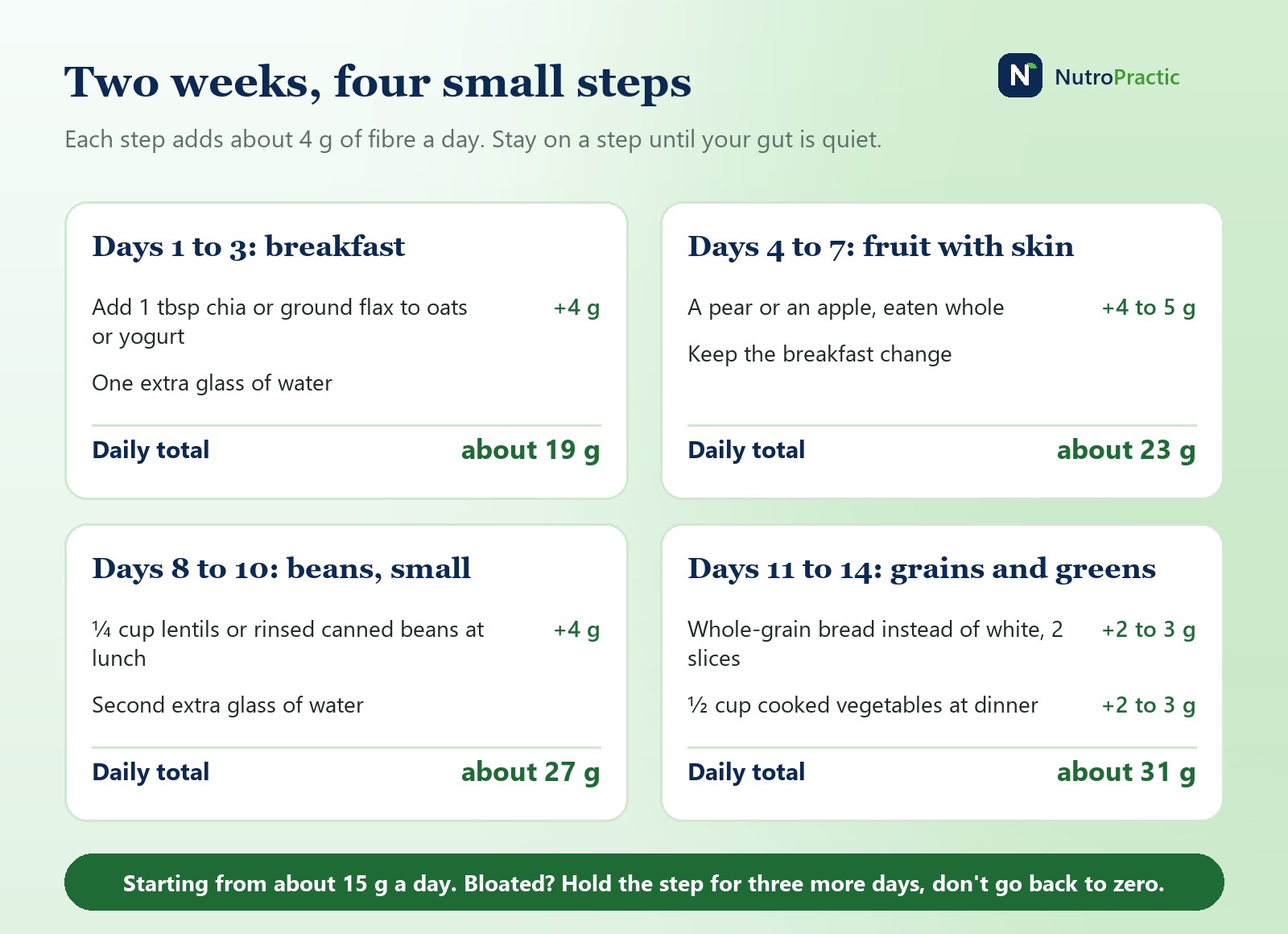
The plan assumes you're starting near 15 g a day, which is typical. Each step adds about 4 g and you stay on it for three or four days. The Mayo Clinic's advice is the same in fewer words: increase gradually over a few weeks, and drink more as you go.
Days 1 to 3: one change at breakfast
Stir a tablespoon of chia seeds or ground flaxseed into oats or yogurt. That's about 4 g, and both are gentle. Add one glass of water to your day. Nothing else changes. If you feel nothing, good. That's the idea.
Days 4 to 7: one piece of fruit, skin on
A medium pear is 5 to 6 g, an apple about 4 g. Eat it whole rather than juiced. Keep the breakfast change. You're now at about 23 g, which is already more than most adults manage.
Days 8 to 10: beans, in a small dose
A quarter cup of cooked lentils, or canned beans that you've rinsed well under the tap, on a salad or in a soup. About 4 g. Beans are where most plans go wrong, because people start with a whole can. Start with a few spoonfuls. Lentils and black-eyed peas tend to be easier than kidney or baked beans; the bean study above found the same. Second extra glass of water.
Days 11 to 14: grains and greens
Swap two slices of white bread for whole-grain (2 to 3 g more), and add half a cup of cooked vegetables to dinner, such as broccoli, carrots or green beans (another 2 to 3 g). Cooked is easier on the gut than a big raw salad at this stage. That lands you at about 31 g a day.
That's enough. The targets are 25 g a day for women and 38 g for men in the US and Canada, 30 g in the UK and 25 g in the EU. Nobody has shown that 60 g does more for you than 30, and our earlier article on the fibre gap has the evidence for why 30 is worth reaching.
If you bloat anyway
Hold, don't quit. Stay on the step you're on for three more days. Don't go back to the start; the bacteria you've been feeding are the ones that will make the next step easier.
Check the water. Fibre holds water in the gut. More fibre with the same amount to drink is a common reason for feeling blocked and heavy rather than gassy.
Spread it out. 8 g at each of three meals and a snack is far easier than 25 g at dinner.
Look for added fibre. Chicory root fibre, inulin, oligofructose and "prebiotic fibre" in bars, shakes, sodas and low-carb wraps. Drop those for a week and see what changes.
Walk for ten minutes after dinner. In a small Spanish study, gentle pedalling helped people with bloating clear gas from the gut faster and feel less distended (Villoria and colleagues, American Journal of Gastroenterology, 2006).
Who should go slower, or ask first
If you have IBS, the foods that set you off are often specific ones (onions, garlic, some beans, wheat, apples and pears), and a dietitian-led low-FODMAP approach works better than a general plan. For this ramp, swap the pear for a kiwi or an orange and keep the beans very small. If you take a GLP-1 medicine such as Ozempic, Wegovy or Mounjaro, your stomach empties more slowly, so give each step a full week. If you have Crohn's disease with narrowing of the bowel, gastroparesis, or you've had bowel surgery, ask your doctor before raising fibre at all.
And see a doctor rather than a meal plan if bloating comes with blood in your stool, weight loss you can't explain, pain that wakes you at night, or if it hasn't settled after three or four weeks on the same amount of fibre.
Want a fibre plan built around your gut, your routine and the foods you actually like? Dr. Triveni can go through what you eat now and adjust it with you in a 15-minute virtual consultation.
Book a 15-minute consultationThis article is general information, not medical advice. Talk to your doctor before changing your diet if you have a digestive condition, diabetes, kidney disease, or you take medicines that need to be timed around food.
Sources
Winham D. M. and Hutchins A. M., Perceptions of flatulence from bean consumption among adults in 3 feeding studies, Nutrition Journal 10:128 (2011). Gunn D. et al., Psyllium reduces inulin-induced colonic gas production in IBS: MRI and in vitro fermentation studies, Gut 71(5):919-927 (2022). Mayo Clinic News Network, What's the best way to boost your fiber intake?. NutraIngredients, Gut microbiome needs time to adapt to fibermaxxing, experts warn (30 September 2026). Villoria A. et al., Physical activity and intestinal gas clearance in patients with bloating, American Journal of Gastroenterology 101:2552-2557 (2006). Fibre values: USDA FoodData Central. Intake targets: National Academies Dietary Reference Intakes (US and Canada), UK Scientific Advisory Committee on Nutrition (2015), European Food Safety Authority (2010).