Search for "foods that help you sleep" and you get long lists: kiwis, cherries, warm milk, turkey, bananas, almonds, chamomile. Each comes with a nutrient and a plausible story about melatonin or serotonin.
The trials tell a less exciting but more useful story. The foods with the biggest effect on sleep are the ones that take it away: caffeine too late, alcohol in the evening, and a large meal just before lying down. The famous sleepy foods have been tested in a handful of small studies, some promising, none large. Here is what each one found, and an evening routine built on the parts that hold up.
A late, heavy meal: reflux and restless nights
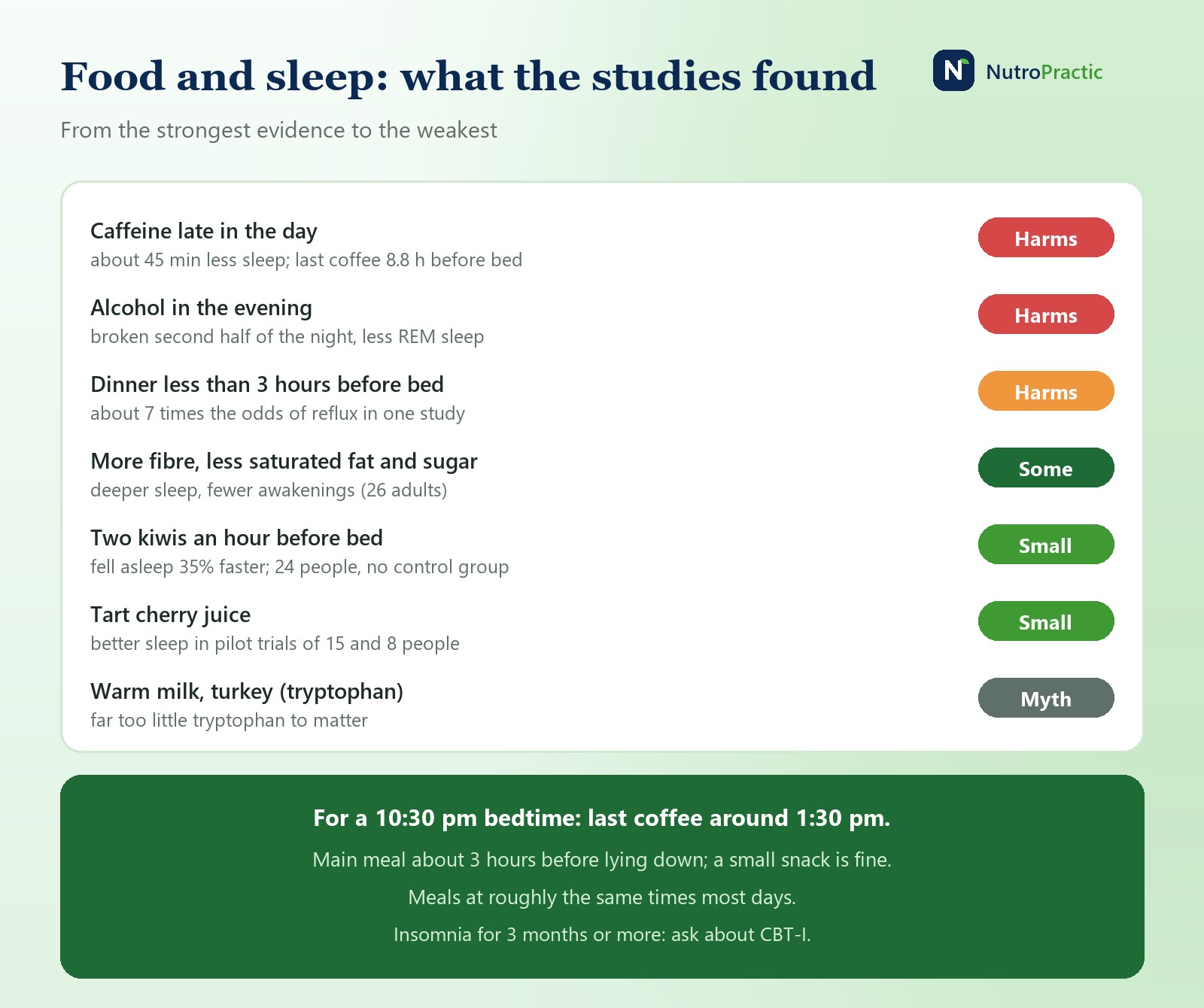
Lying down on a full stomach makes it easier for acid to rise into the gullet, and heartburn at night wrecks sleep. In a Japanese study comparing 147 people with reflux disease and 294 without, those who usually went to bed less than three hours after dinner had about seven times the odds of reflux compared with those who left four hours or more. It was a case-control study, so it can't prove cause, but it fits with what gastroenterologists have long advised: finish the main meal about three hours before bed.
If you get night-time heartburn, the other changes with evidence behind them are raising the head of the bed (blocks under the legs, not extra pillows), sleeping on the left side, and losing weight if you carry extra around the middle. Large, fatty, spicy or very late meals and alcohol are the usual triggers.
Going to bed hungry doesn't help sleep either. If dinner was early, a small snack an hour or two before bed is fine: a banana, a pot of yogurt, a slice of toast, a couple of kiwis.
What is on the plate
Two small feeding studies suggest the make-up of the evening meal matters, a little.
In a New York study of 26 healthy adults, sleep was recorded in a lab after days of set meals and after a day of eating whatever they liked. More fibre went with more deep, slow-wave sleep; more saturated fat with less of it; and more sugar with more brief awakenings. On the set meals, which were lower in saturated fat and higher in protein, people fell asleep in about 17 minutes, against about 29 minutes after eating what they chose.
In an Australian study of 12 healthy men, a dinner of high-glycaemic jasmine rice eaten four hours before bed roughly halved the time it took to fall asleep (about 9 minutes against 17.5) compared with a low-glycaemic rice. Eaten one hour before bed, the effect was smaller. That is a single small study, and a high-GI dinner is not a good idea for anyone managing blood sugar; for people who already eat rice at dinner, it is a reassurance rather than a reason to eat more.
The common thread is a normal, balanced dinner: vegetables, some protein, a starch you enjoy, and not much fried food or dessert. The same plate that helps your heart and gut seems to suit your sleep. Our fibre gap article has an easy way to get to 30 grams a day.
Kiwis: a promising small study
Kiwis are the most quoted sleep food, and the study behind them is worth knowing. In Taiwan, 24 adults with sleep problems (22 of them women) ate two kiwis an hour before bed every night for four weeks. Their sleep was tracked with a wrist monitor and diaries before and after.
By the end, they took about 35% less time to fall asleep, woke for about 29% less time in the night, slept about 13% longer and scored their sleep 42% better. Those are big changes, but there was no control group: nobody ate a placebo fruit, so some of the improvement could come from the routine, from expecting to sleep better, or from sleep simply improving over a month.
Researchers point to kiwis' serotonin, folate and antioxidants as possible reasons. Until a proper controlled trial is done, the fair summary is: two kiwis are a cheap, healthy evening snack, and they may help. There is no downside except for people with a kiwi allergy.
Tart cherry juice: two tiny trials
Montmorency (sour) cherries contain a little melatonin. In a crossover trial in 15 older adults with insomnia, two glasses of tart cherry juice a day for two weeks improved insomnia scores modestly compared with a placebo drink. A later pilot in which only 8 people finished reported 84 more minutes of sleep a night measured in a lab, a striking number from a very small group.
Tart cherry juice is pleasant and harmless for most people, but two 240 ml glasses a day add roughly 250 to 300 kcal and a fair amount of sugar, which matters if you are watching your weight or your blood sugar. Treat it as an experiment, not a treatment.
Warm milk and the tryptophan story
Milk and turkey are said to make you sleepy because they contain tryptophan, the amino acid the body uses to make serotonin and melatonin. The problem is that tryptophan in food competes with other amino acids to get into the brain, and a glass of milk carries far too little to make a difference. The post-Christmas-dinner slump comes from a huge meal and often alcohol, not from the turkey.
Trials that did show an effect used supplements or specially tryptophan-enriched milk protein, not ordinary milk. A warm milky drink can still be part of a calming bedtime routine, and routine itself helps. Just don't expect the milk to do the work.
Magnesium, chamomile and the rest
Magnesium supplements are sold heavily for sleep. The trials are small and mostly in older adults who may have been low in magnesium to begin with; in people who aren't short, the evidence is weak. Our magnesium article goes through who is actually short. Chamomile and other herbal teas have small trials with mixed results; as a caffeine-free evening drink, they are a sensible swap.
Caffeine: the long tail
Caffeine is the food factor with the strongest evidence, and its effect lasts much longer than most people think. Its half-life is about five hours in a typical adult, and anywhere from two to ten: half of a 4 pm coffee is still in your blood at 9 pm. It is longer in pregnancy and for women on the combined pill, and shorter in smokers.
In a US sleep-lab study, 400 mg of caffeine (about three or four mugs of filter coffee) taken six hours before bed still cut measured sleep by more than an hour, even though the volunteers didn't notice much difference themselves. A 2023 meta-analysis of 24 studies found that caffeine cut total sleep by about 45 minutes and deep sleep by about 11 minutes, and estimated that a standard cup of coffee (about 107 mg) should be drunk at least 8.8 hours before bed to avoid losing sleep; a high-caffeine pre-workout drink, about 13 hours.
For a 10:30 pm bedtime, that means the last coffee around 1:30 pm. Tea has less caffeine, decaf very little, and cola, energy drinks and dark chocolate count too. Our free caffeine counter draws the curve for your own day and shows how much is left at bedtime. For the heart side of coffee, see our coffee and heart article.
The foods with the biggest effect on sleep are the ones that take it away: caffeine too late, alcohol in the evening and a big meal just before bed.
Alcohol: a nightcap backfires
Alcohol makes many people fall asleep faster, which is why the nightcap is so popular. A 2013 review of 20 studies of the immediate effects of alcohol on healthy sleepers found that it does shorten the time to fall asleep and deepens sleep in the first half of the night. Then, as the body clears it, sleep in the second half becomes lighter and more broken, and at moderate and high doses REM sleep, the stage tied to memory and mood, is cut across the night.
Alcohol also relaxes the throat muscles, which makes snoring and sleep apnoea worse. The more you drink and the closer it is to bed, the bigger the effect. If you drink, keep it moderate and early in the evening, with food, and keep several nights a week alcohol-free.
Regular meals, regular sleep
Meal times help set the body's clocks, especially those in the liver and gut. In a UK lab study, moving all meals five hours later shifted the body's daily blood sugar rhythm, even though the melatonin rhythm stayed put. Eating at wildly different times from day to day sends mixed signals; shift workers know the result.
You don't need a strict schedule. A breakfast within an hour or two of getting up, lunch and dinner at roughly the same times most days, and no large meals in the middle of the night go a long way. If you are trying time-restricted eating, the trials favour an earlier eating window over a late one (see our intermittent fasting article).
An evening that helps
Last coffee about nine hours before bed, and keep the day's total under 400 mg.
Dinner about three hours before lying down, built around vegetables, protein and a starch, light on fried food and dessert.
A small snack if you're hungry later: a banana, yogurt or two kiwis.
Alcohol moderate, early and not every night.
Meals at roughly the same times most days.
Warm milk, chamomile or cherry juice if you enjoy them, as part of a routine rather than a cure.
If you've had trouble sleeping at least three nights a week for three months, see your doctor: cognitive behavioural therapy for insomnia (CBT-I) is the first-line treatment and works better long term than sleeping pills. Loud snoring with pauses in breathing or heavy daytime sleepiness needs a check for sleep apnoea.
Late dinners, heartburn at night, or a schedule that never lets you eat at normal times? Dr. Triveni can build an eating plan around your working day and your sleep in a virtual consultation.
Book a consultationThis article is general information, not medical advice. Long-term insomnia, night-time heartburn and loud snoring with pauses in breathing deserve a doctor's assessment. Don't stop or change sleep medicines without your doctor.
Sources
Fujiwara Y. et al., Association between dinner-to-bed time and gastro-esophageal reflux disease, Am J Gastroenterol 100(12):2633-2636 (2005). Katz P.O. et al., ACG clinical guideline for the diagnosis and management of gastroesophageal reflux disease, Am J Gastroenterol 117(1):27-56 (2022). St-Onge M.P. et al., Fiber and saturated fat are associated with sleep arousals and slow wave sleep, J Clin Sleep Med 12(1):19-24 (2016). Afaghi A. et al., High-glycemic-index carbohydrate meals shorten sleep onset, Am J Clin Nutr 85(2):426-430 (2007). Lin H.H. et al., Effect of kiwifruit consumption on sleep quality in adults with sleep problems, Asia Pac J Clin Nutr 20(2):169-174 (2011). Pigeon W.R. et al., Effects of a tart cherry juice beverage on the sleep of older adults with insomnia: a pilot study, J Med Food 13(3):579-583 (2010). Losso J.N. et al., Pilot study of the tart cherry juice for the treatment of insomnia and investigation of mechanisms, Am J Ther 25(2):e194-e201 (2018). Markus C.R. et al., Evening intake of alpha-lactalbumin increases plasma tryptophan availability and improves morning alertness and brain measures of attention, Am J Clin Nutr 81(5):1026-1033 (2005). Drake C. et al., Caffeine effects on sleep taken 0, 3, or 6 hours before going to bed, J Clin Sleep Med 9(11):1195-1200 (2013). Gardiner C. et al., The effect of caffeine on subsequent sleep: a systematic review and meta-analysis, Sleep Med Rev 69:101764 (2023). Ebrahim I.O. et al., Alcohol and sleep I: effects on normal sleep, Alcohol Clin Exp Res 37(4):539-549 (2013). Wehrens S.M.T. et al., Meal timing regulates the human circadian system, Curr Biol 27(12):1768-1775 (2017). Riemann D. et al., European guideline for the diagnosis and treatment of insomnia, J Sleep Res 26(6):675-700 (2017).