"Cut out the coffee" used to be the reflex answer to almost any heart complaint: a fluttering beat, a high blood pressure reading, a diagnosis of atrial fibrillation. It felt like common sense. Caffeine is a stimulant, and stimulants make the heart race.
The research of the last few years hasn't backed that reflex up for most people. It has, though, turned up a few situations where coffee does matter, and they aren't always the ones people expect. Here is what the trials and the large studies found, and how to use it.
Palpitations: the CRAVE trial
Most coffee studies ask people what they drink and follow them for years. CRAVE, run at the University of California, San Francisco, did something more direct. 100 healthy adults wore a continuous heart monitor, a step-counting wristband and a glucose sensor for two weeks, and a text message told them each morning whether today was a coffee day or a no-caffeine day, in random two-day blocks. Each person was compared with themselves.
On coffee days there were no more extra beats from the upper chambers (premature atrial contractions, the kind that can lead to atrial fibrillation) and no more bursts of fast rhythm. There were about 50% more extra beats from the lower chambers (premature ventricular contractions, PVCs), the "skipped beat" or thump many people feel. People also walked about 1,000 more steps and slept about 36 minutes less on coffee days.
So coffee didn't set off the arrhythmia people worry about most, but it did increase the harmless-feeling extra beats in some people, and it cost sleep. Those who metabolised caffeine fastest (a genetic trait) had the most extra beats; the slow metabolisers lost the most sleep.
Atrial fibrillation: the DECAF trial
Atrial fibrillation (AF) is the commonest heart rhythm problem in adults, and cardiologists and patients alike have long assumed coffee makes it worse. The DECAF trial, published in JAMA in late 2025, tested that head on.
200 adults with persistent AF, about to have their rhythm reset with a cardioversion, were randomised either to keep drinking caffeinated coffee (about a cup a day on average) or to avoid coffee and all caffeine for six months. AF came back in 47% of the coffee group and 64% of the abstainers, a 39% lower risk of recurrence with coffee. Side effects were no different.
The trial was open-label (people knew which group they were in) and small, so on its own it doesn't prove coffee protects against AF. What it does show is that, for a typical person with AF who enjoys coffee, giving it up didn't help. It fits the big observational picture: in about 400,000 UK Biobank participants, each extra daily cup of coffee was linked to about a 3% lower risk of developing an arrhythmia, and in a second UK Biobank analysis two to three cups a day was linked to the lowest rates of heart disease and death.
For most people, the evidence no longer supports giving up coffee for the sake of heart rhythm. The two clear costs it does have are sleep and, in some people, more extra beats.
Coffee, heart disease and living longer
The long-term studies have been consistent for a decade. A 2017 BMJ umbrella review, pooling over 200 meta-analyses, found the lowest risk at about three to four cups a day: roughly 17% lower death from any cause, 19% lower cardiovascular death and 15% less cardiovascular disease than among non-drinkers. Decaf showed much the same pattern in several cohorts, which hints that it isn't only the caffeine.
These are observational studies. Coffee drinkers differ from non-drinkers in many ways, and people who feel unwell often stop drinking coffee, which can make coffee look healthier than it is. The honest reading is "coffee is very unlikely to be harming the heart of a healthy adult at these amounts", not "coffee is a heart medicine".
Blood pressure: new drinkers versus regulars
A cup of strong coffee raises blood pressure for a few hours. In people who already have high blood pressure, 200 to 300 mg of caffeine (two cups or so) pushed systolic pressure up by about 8 mmHg and diastolic by about 6 mmHg within the hour, lasting three hours or more.
The effect largely fades with habit. In trials lasting weeks, regular coffee raised blood pressure by only about 2 mmHg systolic, and some found no rise at all. Pure caffeine tablets raise it more than coffee does.
Two practical points follow. First, don't drink coffee in the half hour before a blood pressure reading at the clinic or at home, or the number will read high. Second, if your blood pressure is very high (160/100 or above, grade 2 or 3), be more careful. A Japanese cohort of 18,600 adults found that people with blood pressure in that range who drank two or more cups a day had about twice the risk of dying from cardiovascular disease as those who drank none, while there was no such link at normal or mildly raised pressure. It is one observational study, but until your blood pressure is controlled, one cup is a sensible ceiling. Salt and potassium move blood pressure far more than coffee does; our salt and potassium guide has the trials.
The brewing method changes your cholesterol
Coffee beans contain two oils, cafestol and kahweol, that raise LDL cholesterol. A paper filter catches almost all of them. Metal filters and no filter at all let them through.
Higher in cafestol: boiled or Scandinavian coffee, Turkish and Greek coffee, cafetière (French press), and to a lesser degree moka pot and espresso. Unfiltered brews carry around 30 times the cafestol of paper-filtered coffee.
Low in cafestol: paper-filtered drip and pour-over coffee, and instant.
In the Tromsø study of 21,000 Norwegians, espresso drinkers had higher total cholesterol than non-drinkers, nearly as much as boiled-coffee drinkers, more so in men. In a Norwegian cohort of more than 500,000 people, filtered coffee was linked to lower death rates than either no coffee or unfiltered coffee.
One espresso a day is unlikely to matter. Four or five cafetière coffees a day might, especially if your LDL is already high. If it is, switching to paper-filtered coffee is one of the easiest changes you can make, alongside the foods in our LDL portfolio guide. The South Indian filter (a metal plate with fine holes) lets more through than paper but hasn't been measured well; with a high LDL, a paper filter is the safe choice.
How much caffeine is too much
European and North American food safety authorities agree on round numbers for healthy adults:
Up to 400 mg a day is not linked to harm. Single doses up to 200 mg are fine for most people.
200 mg a day in pregnancy (EFSA, the NHS and the American College of Obstetricians and Gynecologists). Higher intakes are linked with miscarriage and low birth weight, and caffeine is cleared much more slowly in late pregnancy.
Children and teenagers: about 3 mg per kg of body weight a day at most, which rules out energy drinks.
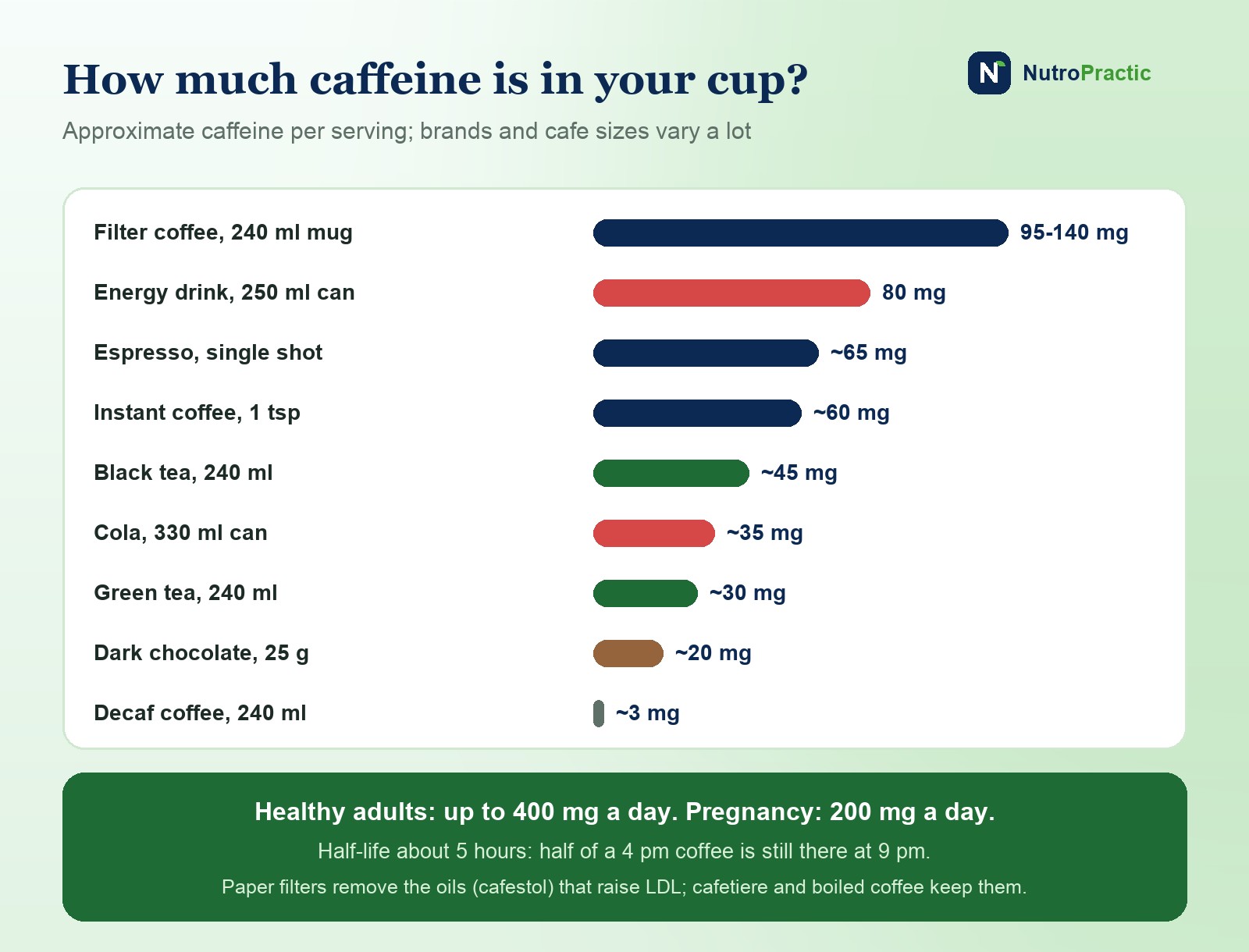
Café sizes are the catch. A large filter coffee from a chain can carry 300 mg or more, so "two cups" can mean 200 mg or 600 mg.
Sleep: the effect people underestimate
Caffeine's half-life is about five hours in an average adult, and it ranges from two to ten. Half of a 4 pm coffee is still in your blood at 9 pm, and a quarter at 2 am. It is longer in pregnancy, in people on the combined pill and in people with liver disease, and shorter in smokers.
In a sleep-lab study, 400 mg of caffeine taken six hours before bed still cut total sleep by more than an hour, and the volunteers didn't notice how much sleep they had lost. Short sleep, in turn, raises blood pressure and appetite the next day, which matters more for the heart than the coffee itself.
A simple rule that works for most people: no caffeine after midday, or at least eight hours before bed. If you sleep badly, try it strictly for two weeks before blaming anything else.
Who should cut back
Frequent "skipped beats" or PVCs that bother you: try two weeks without caffeine and two weeks with it, and see whether the symptoms track the coffee. CRAVE suggests they might.
Very high or uncontrolled blood pressure: keep to one cup until it's treated, and never drink coffee just before a reading.
High LDL: switch from cafetière, boiled or Turkish coffee to paper-filtered.
Pregnancy: stay at or under 200 mg a day from all sources.
Poor sleep, anxiety or reflux: less and earlier.
Everyone else with a healthy heart, including most people with atrial fibrillation, doesn't need to give coffee up. Two or three cups, paper-filtered, before lunch, without a heap of sugar or syrup, fits comfortably in a heart-healthy diet.
Wondering whether your coffee, sleep or blood pressure numbers fit together? Dr. Triveni can look at a normal week of eating and drinking with you and build a plan for your heart in a virtual consultation.
Book a consultationThis article is general information, not medical advice. If you have palpitations, chest pain, fainting, atrial fibrillation or high blood pressure, speak to your doctor before changing your caffeine intake or your treatment.
Sources
Marcus G.M. et al., Acute effects of coffee consumption on health among ambulatory adults (CRAVE), N Engl J Med 388:1092-1100 (2023), and the 2023 insights paper in J Am Heart Assoc (PMC10374881). Wong C.X. et al., Caffeinated coffee consumption or abstinence to reduce atrial fibrillation: the DECAF randomized clinical trial, JAMA (2025). Kim E.J. et al., Coffee consumption and incident tachyarrhythmias, JAMA Intern Med 181(9):1185-1193 (2021). Chieng D., Kistler P.M. et al., The impact of coffee subtypes on incident cardiovascular disease, arrhythmias, and mortality: long-term outcomes from the UK Biobank, Eur J Prev Cardiol 29(17):2240-2249 (2022). Poole R. et al., Coffee consumption and health: umbrella review of meta-analyses of multiple health outcomes, BMJ 359:j5024 (2017). Noordzij M. et al., Blood pressure response to chronic intake of coffee and caffeine: a meta-analysis of randomized controlled trials, J Hypertens 23(5):921-928 (2005). Mesas A.E. et al., The effect of coffee on blood pressure and cardiovascular disease in hypertensive individuals, Am J Clin Nutr 94(4):1113-1126 (2011). Teramoto M. et al., Coffee and green tea consumption and cardiovascular disease mortality among people with and without hypertension, J Am Heart Assoc 12:e026477 (2023). Svatun Å.L. et al., Association between espresso coffee and serum total cholesterol: the Tromsø Study 2015-2016, Open Heart 9:e001946 (2022). Tverdal A. et al., Coffee consumption and mortality from cardiovascular diseases and total mortality: does the brewing method matter?, Eur J Prev Cardiol 27(18):1986-1993 (2020). EFSA Panel on Dietetic Products, Scientific opinion on the safety of caffeine, EFSA Journal 13(5):4102 (2015). Drake C. et al., Caffeine effects on sleep taken 0, 3, or 6 hours before going to bed, J Clin Sleep Med 9(11):1195-1200 (2013). ACOG Committee Opinion 462, Moderate caffeine consumption during pregnancy (2010, reaffirmed).