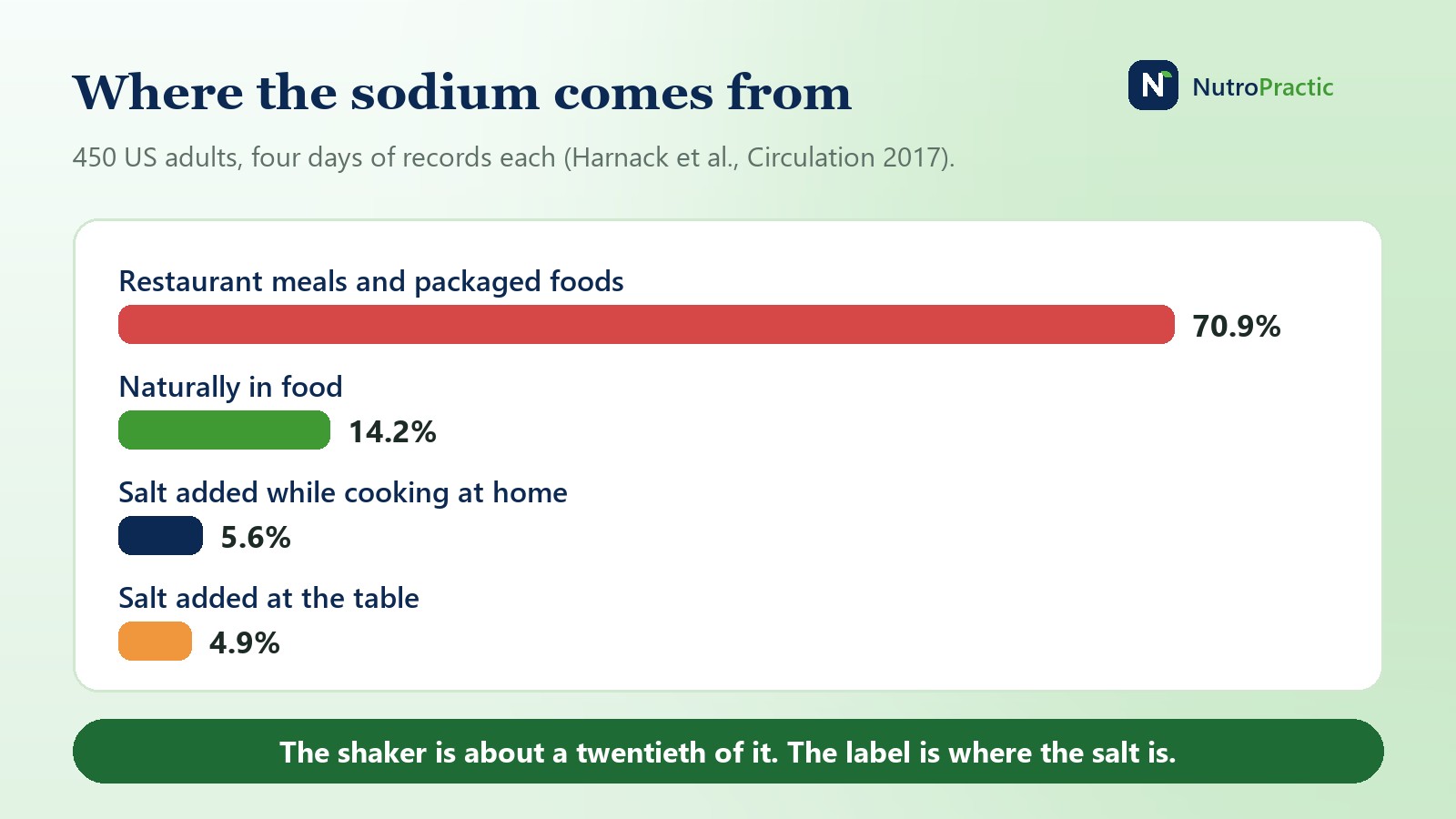
Most people who are told to "cut down on salt" go home and hide the shaker. It's the obvious move, and it barely matters. When researchers in three US cities measured where 450 adults got their sodium, the shaker on the table supplied under 5% of it. Salt added while cooking at home was another 6%. About 71% was already in the food when it was bought: restaurant meals, takeaways and things in packets.
So the advice is right and the aim is off. This article goes through what the best trials found about salt, potassium and blood pressure, including the newer work on potassium-enriched salt, and then turns it into changes that are worth the effort.
DASH: change the food, leave the salt alone
The first DASH trial (Dietary Approaches to Stop Hypertension, 1997) was unusual because the researchers cooked every meal for the 459 adults taking part. That removes the usual weakness of diet studies, which is that nobody knows what people really ate. One group ate a typical American diet. Another ate a diet rich in fruit, vegetables and low-fat dairy, with whole grains, beans, nuts, fish and poultry, and less red meat, sweets and saturated fat. Sodium was held the same in both, at about 3,000 mg a day, and nobody was asked to lose weight.
After eight weeks, blood pressure on the DASH diet was 5.5/3.0 mm Hg lower than on the typical diet. In the people who started with hypertension the drop was 11.4/5.5. Most of it had appeared within two weeks. Nothing in it was exotic. It was a pattern of ordinary food, and it supplied two to three times the potassium, magnesium and calcium of the control diet.
DASH-Sodium: then take the salt down too
The follow-up, published in 2001, asked the next question. 412 adults ate either the typical diet or the DASH diet, and each person spent 30 days at each of three sodium levels: about 3,300 mg a day (roughly what Americans eat), 2,400 mg and 1,500 mg.
Less sodium meant lower blood pressure at every step, on both diets. On the typical diet, going from the highest level to the lowest took 6.7 points off systolic pressure. On the DASH diet, where pressure was already lower, it took off another 3.0. Put together, the DASH diet at the lowest sodium level against the typical diet at the highest came out 7.1 points lower in people without hypertension and 11.5 lower in people with it. That is about what a single blood pressure medicine achieves.
Two details are easy to miss. The second step down, from 2,400 to 1,500 mg, did more than the first, so there was no floor at which cutting stopped helping. And the people who gained most were those with higher pressure to begin with, older adults and Black participants.
These were feeding studies lasting weeks. They show what's possible when someone else does the cooking, not what's easy in a normal week. The diet is not a replacement for medicine you've been prescribed.
Potassium is the other half
Sodium and potassium pull in opposite directions. Potassium helps the kidneys pass sodium out and relaxes the walls of blood vessels. Most of us get the balance backwards: plenty of sodium and not much potassium. The World Health Organization suggests at least 3,510 mg of potassium a day; US reference intakes are 2,600 mg for women and 3,400 mg for men. Typical intakes fall well short of both.
Bananas get the credit, but plenty of foods beat them. Approximate amounts: a medium baked potato with its skin, 900 mg; a cup of plain yogurt, 550 mg; half a cup of white beans, 500 mg; a glass of orange juice, 450 mg; half an avocado, 450 mg; a banana, 420 mg; half a cup of cooked spinach, 420 mg; half a cup of lentils, 365 mg; a salmon fillet, 400 to 500 mg. A day with beans, a potato, yogurt, two pieces of fruit and a couple of servings of vegetables gets most people there. The same foods bring fibre, which we cover in The fibre gap.
The salt-substitute trial
If more potassium and less sodium both help, why not put them in the same shaker? Potassium-enriched salt replaces part of the sodium chloride with potassium chloride. The biggest test of it is SSaSS, the Salt Substitute and Stroke Study, published in the New England Journal of Medicine in 2021.
It enrolled 20,995 people in 600 villages in rural China. All had either had a stroke or were over 60 with high blood pressure. Half the villages were given a salt that was 75% sodium chloride and 25% potassium chloride, free of charge; the other half carried on with regular salt. After nearly five years, the villages using the substitute had 14% fewer strokes, 13% fewer major cardiovascular events and 12% fewer deaths. Serious high-potassium problems were no more common in the substitute group.
It is rare for a food swap to be tested against deaths rather than a lab number, and rarer for it to work. On the strength of this and similar trials, the WHO issued a guideline in January 2025 suggesting that adults replace regular table salt with a lower-sodium, potassium-containing one. The 2025 US blood pressure guideline from the American Heart Association and American College of Cardiology says much the same.
Three cautions. First, it isn't for everyone. The trial left out people with serious kidney disease and people taking potassium supplements or potassium-sparing medicines, and the WHO advice excludes them too, along with pregnant women and children. If you have kidney disease, or take a potassium-sparing diuretic such as spironolactone, an ACE inhibitor or an ARB, ask your doctor or pharmacist before switching. Second, it suits home cooks best. In those villages most sodium came from salt added in the kitchen. Where most of it arrives inside bought food, a different shaker changes less. Third, taste. At 25 to 30% potassium most people don't notice a difference; pure potassium chloride can taste bitter or metallic.
Where the sodium is hiding
The biggest sources are not the foods that taste saltiest. In US surveys, bread and rolls sit at or near the top of the list, not because a slice is very salty but because people eat it several times a day. After that come pizza, sandwiches and burgers, cured meats and cold cuts, soups, savoury snacks, cheese, and chicken that has been brined or breaded. A shop-bought sandwich and a bowl of canned soup can pass 2,000 mg between them, a full day's allowance by the WHO's reckoning, without tasting especially salty. Much of this is the same food discussed in Ultra-processed foods: what the evidence says.
The targets. WHO: under 2,000 mg of sodium a day, which is 5 g of salt, about a level teaspoon. United States: under 2,300 mg, with 1,500 mg as the ideal for people with high blood pressure. United Kingdom: under 6 g of salt. The world average is 4,310 mg of sodium, more than double the WHO figure.
Reading labels. Labels in the US and Canada list sodium; in the UK and Europe they list salt. To convert, salt = sodium × 2.5. On a US label, 5% of the Daily Value or less per serving is low and 20% or more is high. On a UK label, more than 1.5 g of salt per 100 g is high (the red light) and 0.3 g or less is low.
Swaps that are worth the effort
Compare two labels before you compare two recipes. Sodium in the same kind of bread, pasta sauce, stock or breakfast cereal can differ by a factor of two between brands. Choosing the lower one costs nothing in taste and is the single most useful habit.
Rinse canned beans and vegetables, or buy the no-added-salt kind. Draining and rinsing washes away a good part of the sodium and keeps the potassium and fibre.
Cook one more dinner a week from plain ingredients. That's where you control the salt. Use acid and aromatics to carry flavour: lemon, vinegar, garlic, ginger, chilli, toasted spices, fresh herbs. Salt the dish at the end, where you can taste it, rather than at every stage.
Treat cured and smoked foods as seasoning. Bacon, ham, salami, smoked fish, olives, pickles, soy sauce and stock cubes are all fine in small amounts that flavour a dish. They add up fast as the main event.
When eating out, ask for sauces and dressings on the side, and balance a salty lunch with a plain dinner. One meal doesn't matter; the average does.
Add the potassium. Beans or lentils in a soup, a potato in its skin, yogurt, fruit after meals, a handful of greens in whatever you're cooking.
Give it three weeks. Taste adapts. Food that seems flat in the first week tastes normal by the third or fourth, and the old soup will taste too salty.
A plan for the next two weeks
1. For three days, read the sodium or salt line on everything packaged that you eat, and note the three biggest contributors. 2. Swap those three for lower-salt versions or for something you cook. 3. Add two potassium-rich foods a day. 4. If you cook most of your meals and have healthy kidneys, try a potassium-enriched salt in the kitchen, after checking with your doctor if you take blood pressure medicine. 5. Measure your blood pressure at home, morning and evening for a week, before and after. Numbers of your own are the best reason to keep going.
Blood pressure creeping up, or told to cut salt and not sure where to start? Dr. Triveni can go through what you eat in a normal week and find the changes that matter most, in a virtual consultation.
Book a consultationThis article is general information, not medical advice. Don't stop or change blood pressure medicine on your own. Talk to your doctor before using a potassium-enriched salt or raising your potassium intake if you have kidney disease, heart failure or diabetes, or take ACE inhibitors, ARBs, potassium-sparing diuretics or potassium supplements.
Sources
Appel L.J. et al., A clinical trial of the effects of dietary patterns on blood pressure (DASH), N Engl J Med 336(16):1117-1124 (1997). Sacks F.M. et al., Effects on blood pressure of reduced dietary sodium and the Dietary Approaches to Stop Hypertension (DASH) diet, N Engl J Med 344(1):3-10 (2001). Neal B. et al., Effect of salt substitution on cardiovascular events and death (SSaSS), N Engl J Med 385(12):1067-1077 (2021). Harnack L.J. et al., Sources of sodium in US adults from 3 geographic regions, Circulation 135(19):1775-1783 (2017). World Health Organization, Use of lower-sodium salt substitutes: WHO guideline (January 2025) and Sodium reduction fact sheet. 2025 AHA/ACC guideline for the prevention, detection, evaluation and management of high blood pressure in adults (August 2025). US Centers for Disease Control and Prevention, top sources of sodium in the US diet. National Academies, Dietary Reference Intakes for Sodium and Potassium (2019). Potassium values: USDA FoodData Central (approximate). NHS and UK Food Standards Agency front-of-pack salt thresholds.