Most cholesterol advice amounts to a list of things to stop eating. The research that moved LDL the furthest with food did the opposite. In 2003 a team in Toronto led by David Jenkins fed people a diet built around four foods that each lower LDL a little, all eaten every day, and compared it head to head with a statin. After four weeks the diet had lowered LDL by 28.6% and the statin by 30.9%, and the difference between them wasn't statistically significant.
That result gets quoted a lot, usually without the second half of the story: what happened when people had to shop and cook for themselves. This article covers both, how much each of the four foods does on its own, what a realistic day looks like, and the situations where food on its own is not enough.
The four foods, and why these four
Jenkins called it a portfolio, in the investment sense: several small holdings that work in different ways, so they add up instead of overlapping. Per 2,000 calories, the later trials aimed for:
Viscous (gel-forming) fibre, about 20 g a day, from oats, barley, psyllium, beans, lentils, okra and aubergine. It thickens in the gut, binds bile acids and makes the liver pull more cholesterol out of the blood to replace them.
Plant sterols, about 2 g a day, usually from a fortified spread, yogurt drink or supplement. They compete with cholesterol for absorption in the gut.
Plant protein, about 45 g a day, from soy foods (tofu, soy milk, tempeh, edamame) and, in later versions, beans, peas and lentils, eaten in place of meat and full-fat dairy.
Nuts, about 45 g a day, roughly a large handful: almonds in the early trials, any tree nuts or peanuts later.
Under all four sits an ordinary heart-healthy base: little butter, fatty meat and full-fat dairy, and oils such as olive or rapeseed (canola) instead. That base matters on its own. In the 2003 trial the control group ate it without the four foods and their LDL fell by 8%.
What the trials found
2003, the metabolic trial. 46 adults with raised cholesterol ate food prepared for them for four weeks: the low-saturated-fat control diet, the same diet plus 20 mg of lovastatin, or the portfolio. LDL fell 8.0%, 30.9% and 28.6%. C-reactive protein, a marker of inflammation, fell about as much on the portfolio as on the statin (28% and 33%).
2006, one year at home. Participants who had done well in the metabolic studies went home and ran the diet themselves. At three months their LDL was 14.0% lower and at a year 12.8% lower, on average. The average hides a split: about a third of them kept a drop of more than 20%, close to what a first-generation statin gives, while among those who followed less than half the diet, almost nobody did.
2011, the multicentre trial. 351 adults in four Canadian cities were given the portfolio as advice, with either two dietitian visits over six months or seven. LDL fell 13.1% with two visits and 13.8% with seven. The comparison group, given standard low-saturated-fat advice, managed 3%. Again, how much people actually ate of the four foods decided the result; extra visits added little on top.
2018, the pooled trials. A meta-analysis of seven controlled trials (439 people) found the portfolio lowered LDL by about 17% against a low-saturated-fat diet, with smaller falls in non-HDL cholesterol, apolipoprotein B, triglycerides, blood pressure and CRP, and an estimated 13% lower 10-year risk of coronary heart disease. The LDL result was rated high-certainty; the rest moderate.
2023, the long view. No one has run a trial of the portfolio diet against heart attacks. The best evidence on hard outcomes is observational: in about 210,000 US nurses and health professionals followed for up to 30 years, those whose diets came closest to the portfolio had a 14% lower risk of cardiovascular disease, coronary heart disease and stroke than those furthest from it. That fits, but cohort studies can't rule out that portfolio eaters differed in other ways.
On paper the portfolio matches a low-dose statin. In real kitchens it averages about half that, and the people who eat most of it every day get most of the effect.
How much each food moves LDL on its own
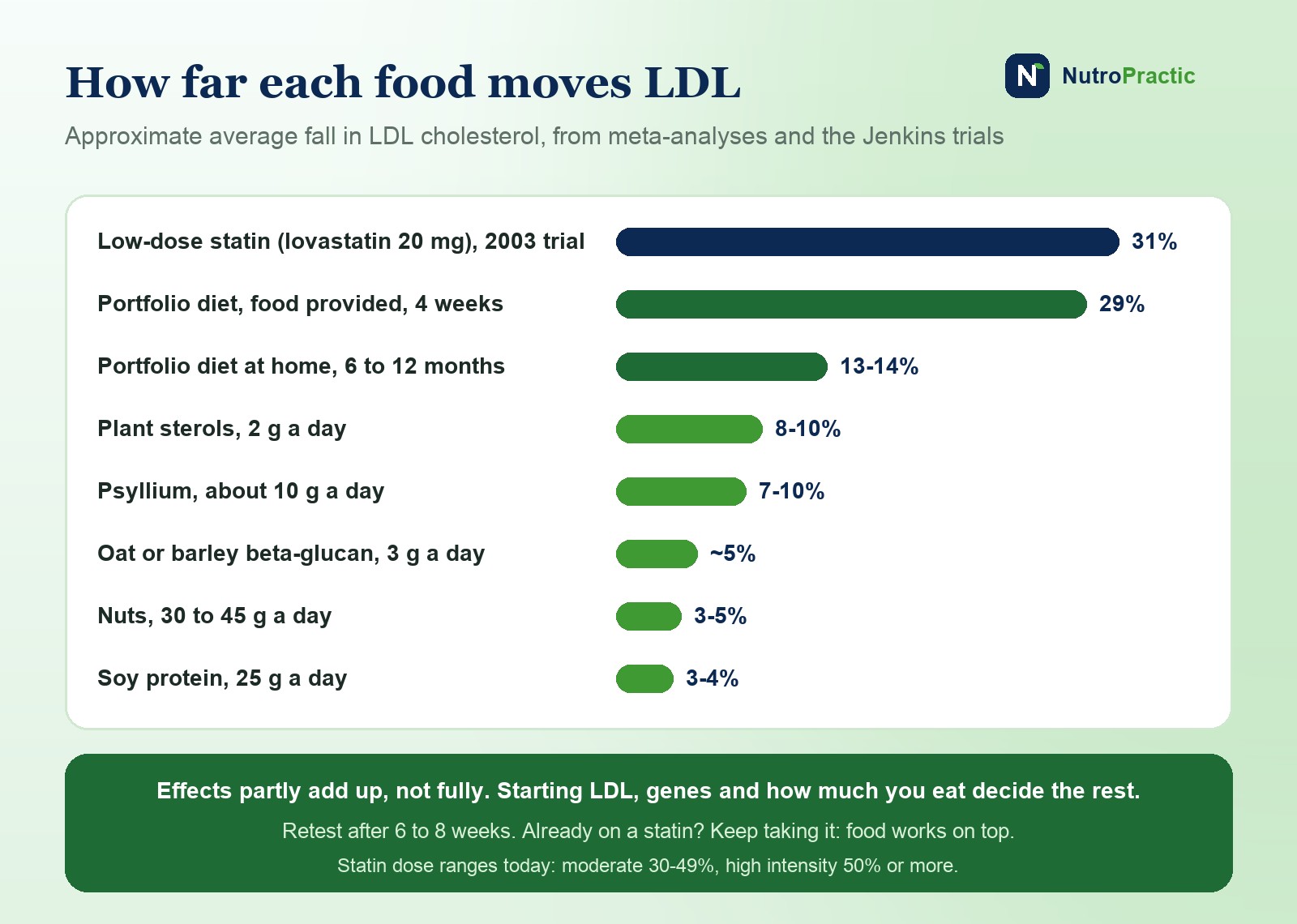
These are averages from pooled trials, rounded. They don't add up neatly, but they show where the leverage is.
Plant sterols, 2 g a day: about 8 to 10%. The biggest single lever, and the one food can't supply without help: an ordinary diet gives 200 to 400 mg. You need a fortified product (a spread, a mini yogurt drink, some milks or a supplement), eaten with a meal. More than 3 g adds little. They are not meant for children under five, or in pregnancy and breastfeeding, unless a doctor advises it.
Psyllium, about 10 g a day: around 7 to 10% in people with raised LDL. A rounded teaspoon of husk in a large glass of water, twice a day with meals. Start with one and drink plenty.
Oat or barley beta-glucan, 3 g a day: about 5%. That is roughly 70 to 80 g of rolled oats, or a bowl of porridge plus a portion of barley or an oat-bran muffin. Instant oats count; sugary oat bars mostly don't, because they carry too little.
Nuts, 30 to 45 g a day: about 3 to 5%. A meta-analysis of 61 trials found each daily ounce (28 g) of tree nuts lowered LDL by about 5 mg/dL (0.12 mmol/L). Peanuts behave similarly. Unsalted, plain or roasted, eaten instead of something else rather than on top.
Soy protein, 25 g a day: about 3 to 4%. The smallest effect, measured across 43 trials. Part of the benefit in practice comes from what soy replaces: a tofu stir-fry instead of beef mince takes saturated fat out at the same time.
For comparison: a moderate-dose statin lowers LDL by 30 to 49%, a high-intensity one by 50% or more. Each 1 mmol/L (39 mg/dL) fall in LDL, kept up for years, cuts major heart attacks and strokes by roughly a fifth, whether it comes from a tablet or a plate.
A realistic portfolio day
This is about 2,000 calories, and it reaches all four targets without anything exotic.
Breakfast. Porridge from 50 g of oats made with a glass of soy milk, topped with berries and a tablespoon of ground flax. A rounded teaspoon of psyllium in a glass of water.
Mid-morning. A sterol-fortified yogurt drink (most give 1.5 to 2 g in one bottle), or the fortified spread on toast at breakfast instead.
Lunch. Barley and bean soup, or a salad of chickpeas, cooked barley, tomato, cucumber and herbs dressed with olive oil and lemon.
Snack. A handful of almonds (30 g) and an apple.
Dinner. Tofu or tempeh stir-fried with okra or aubergine, peppers and greens in rapeseed oil, with brown rice; or a dal made with chana or masoor and a side of bhindi. Another teaspoon of psyllium in water. A small handful of walnuts after, if you like.
Roughly, that is 20 g of viscous fibre, 2 g of sterols, 40 to 45 g of plant protein and 45 g of nuts. It also brings total fibre to about 40 g, so build up over two or three weeks rather than starting on day one. Our fibre gap guide has the ramp.
You don't need all four to start. If you do two things, make them the sterols and the oats-plus-psyllium, which together carry most of the measured effect.
Give it six to eight weeks, then measure
LDL responds within a few weeks. Ask for a repeat lipid test after six to eight weeks on the changes, at the same time of day and fasting if your first one was. Response varies a lot between people: in the one-year study some dropped by a third and some barely moved, and genes, starting level and how much of the diet actually got eaten all played a part. A repeat test tells you which group you are in, which no article can.
Where food isn't enough
The portfolio is a strong first step for someone with mildly or moderately raised LDL and a low to moderate overall risk. It is not a substitute for medicine in these situations:
You've already had a heart attack, stroke or stent, or have diagnosed coronary or arterial disease. Guidelines in the US and Europe aim for very low LDL (below 1.4 to 1.8 mmol/L, 55 to 70 mg/dL), which food alone rarely reaches. Diet then works alongside the statin and can mean a lower dose does the job.
Your LDL is 4.9 mmol/L (190 mg/dL) or higher, or a parent or sibling had heart disease young. That pattern suggests familial hypercholesterolaemia, a genetic condition that runs in about 1 in 250 people. It needs medicine and family testing; a 15% drop from a very high starting point still leaves it very high.
You have diabetes and are over 40, or your calculated 10-year risk is high. Most guidelines recommend a statin here whatever the LDL.
Your lipoprotein(a) is high. Lp(a) is set by genes and barely moves with diet. If it hasn't been measured, ask; many guidelines now suggest testing it once in adulthood.
If you already take a statin, the portfolio still works on top of it. Never stop or cut a prescribed dose on your own because your numbers improved; talk to the doctor who prescribed it first.
Want a portfolio plan built around foods you actually like, whether that's porridge and tofu or dal and roti? Dr. Triveni can work through your test results and a normal week of eating in a virtual consultation.
Book a consultationThis article is general information, not medical advice. Discuss cholesterol results, plant sterol products and any change to cholesterol-lowering medicine with your doctor, especially if you have heart disease, diabetes, a family history of high cholesterol, or are pregnant or breastfeeding.
Sources
Jenkins D.J.A. et al., Effects of a dietary portfolio of cholesterol-lowering foods vs lovastatin on serum lipids and C-reactive protein, JAMA 290(4):502-510 (2003). Jenkins D.J.A. et al., Assessment of the longer-term effects of a dietary portfolio of cholesterol-lowering foods in hypercholesterolemia, Am J Clin Nutr 83(3):582-591 (2006). Jenkins D.J.A. et al., Effect of a dietary portfolio of cholesterol-lowering foods given at 2 levels of intensity of dietary advice on serum lipids in hyperlipidemia, JAMA 306(8):831-839 (2011). Chiavaroli L. et al., Portfolio dietary pattern and cardiovascular disease: a systematic review and meta-analysis of controlled trials, Prog Cardiovasc Dis 61(1):43-53 (2018). Glenn A.J. et al., Portfolio diet score and risk of incident cardiovascular disease, coronary heart disease and stroke, Circulation (2023). Gylling H. et al., Plant sterols and plant stanols in the management of dyslipidaemia and prevention of cardiovascular disease, European Atherosclerosis Society consensus, Atherosclerosis 232(2):346-360 (2014). Jovanovski E. et al., Effect of psyllium fiber on LDL cholesterol and alternative lipid targets, Am J Clin Nutr 108(5):922-932 (2018). Ho H.V.T. et al., The effect of oat beta-glucan on LDL-cholesterol, non-HDL-cholesterol and apoB, Br J Nutr 116(8):1369-1382 (2016). Del Gobbo L.C. et al., Effects of tree nuts on blood lipids, apolipoproteins, and blood pressure, Am J Clin Nutr 102(6):1347-1356 (2015). Blanco Mejia S. et al., A meta-analysis of 46 studies identified by the FDA demonstrates that soy protein decreases circulating LDL and total cholesterol concentrations in adults, J Nutr 149(6):968-981 (2019). Cholesterol Treatment Trialists' Collaboration, Efficacy and safety of more intensive lowering of LDL cholesterol, Lancet 376:1670-1681 (2010). 2018 AHA/ACC cholesterol guideline; 2019 ESC/EAS dyslipidaemia guidelines.