
Magnesium has become the supplement people take for everything at once: sleep, cramps, stress, migraines, blood pressure. Glycinate is said to be the calm one, citrate the one for constipation, oxide the cheap one that "doesn't absorb". Social media has decided most of us are deficient, and the shelves have followed.
Some of this holds up. A lot of adults do eat less magnesium than they should, and for a couple of conditions the trial evidence is real. But for the two reasons most people buy it, sleep and leg cramps, the trials are either small or say no. Here's what's known, who is really likely to be short, and which form to choose if you do take one.
How much you need, and how many people get it
The US recommended intake is 400 to 420 mg a day for men and 310 to 320 mg for women. Europe's food safety authority, EFSA, sets an adequate intake of 350 mg for men and 300 mg for women. Pregnancy adds a little.
Many adults fall short. In the US national survey (NHANES 2003 to 2006), 45% of Americans had a usual intake below the average requirement even after counting supplements (Fulgoni et al., 2011). In the UK's National Diet and Nutrition Survey, about one working-age adult in eight eats less than the lowest reference amount, the level below which almost everyone would be short, and so do around half of teenage girls.
The reason isn't mysterious. Magnesium sits in the outer layers of grains, in nuts, seeds, beans and leafy greens. Refining flour and rice strips most of it, and a diet built on white bread, pasta and processed food delivers far less than one built on whole foods.
Low intake isn't the same as deficiency, though. The kidneys hold on to magnesium when intake drops, and the body keeps a large store in bone. Clinical deficiency, with muscle twitching, tremor or an irregular heartbeat, is uncommon in healthy people and usually has a medical cause.
Why the blood test can't settle it
Less than 1% of the body's magnesium is in the blood. About half is in bone and most of the rest inside muscle and other cells. The body works to keep the blood level steady, drawing on those stores when intake runs low, so a normal serum magnesium doesn't prove your stores are full. A low one is meaningful and worth acting on with your doctor.
Labs usually call 0.75 to 0.95 mmol/L (1.8 to 2.3 mg/dL) normal. A group of researchers has suggested treating anything under 0.85 mmol/L as a possible sign of low stores, but that isn't standard practice. Red-cell magnesium tests sold directly to consumers sound more precise and aren't better validated. In practice, the most useful question is what you eat, plus the risk factors below.
Who is really likely to be short
People with type 2 diabetes, especially when blood sugar runs high: glucose in the urine carries magnesium out with it. People on a proton-pump inhibitor (omeprazole, pantoprazole, esomeprazole and the like) for more than a year: the US FDA warned in 2011 that long-term use can cause low magnesium. People on diuretics, particularly loop and thiazide water tablets. People who drink heavily. People with Crohn's disease, coeliac disease, chronic diarrhoea or a past bariatric operation, who absorb less. And older adults, who tend to eat less and absorb less.
If one of those describes you, ask your doctor whether a magnesium level makes sense, and look at your diet first. Everyone else is better off eating more of the foods below than guessing with a supplement.
What the trials say about the popular claims
Sleep
The evidence is thin. A 2021 review found only three randomised trials in older adults with insomnia, 151 people in all. Pooled, magnesium helped them fall asleep about 17 minutes faster than placebo; total sleep time didn't change significantly. The reviewers rated the evidence low to very low quality (Mah and Pitre, 2021).
The best recent trial gave 155 adults who said they slept poorly either 250 mg of magnesium as bisglycinate or a placebo for four weeks. Both groups improved on the Insomnia Severity Index: by 3.9 points with magnesium and 2.3 with placebo, a difference the authors called modest and that only just reached significance (Schuster et al., 2025). In an exploratory analysis, the people who ate the least magnesium seemed to gain the most, which fits the idea that a supplement helps most where the diet is short.
So: a small effect at best, perhaps larger if your intake is low. Not a sleeping pill, and no substitute for the dull basics of a regular bedtime, less caffeine after midday and less alcohol at night.
Leg cramps
This is where the evidence is clearest, and it says no. A 2020 Cochrane review pooled 11 trials with 735 people. For the night cramps that older adults get, five sound trials found that magnesium is unlikely to reduce how often or how badly cramps happen (moderate-certainty evidence). For cramps in pregnancy, a separate Cochrane review found the trials too mixed to say. Diarrhoea was the main side effect.
Migraine
Here magnesium has a real place. US neurology and headache societies rate it as "probably effective" for preventing migraine (level B, 2012). The best-known trial gave 81 people 600 mg a day of magnesium as trimagnesium dicitrate: in the last month of the 12-week trial, attacks were down 42%, against 16% on placebo (Peikert et al., 1996). Nearly one person in five got diarrhoea. That dose is above the safe upper limit for supplements, so it's a plan to make with your doctor, not to start on your own.
Blood pressure
A 2016 analysis of 34 trials with 2,028 adults found that about 370 mg a day for three months lowered blood pressure by 2.0 mmHg systolic and 1.8 mmHg diastolic (Zhang et al., Hypertension). That's real but small, and a later umbrella review found the effect mainly at 400 mg a day or more, over at least 12 weeks. Eating less salt and more potassium-rich food does more, and the foods that bring potassium tend to bring magnesium too.
A pattern runs through these trials: the people who gain most are the ones who were eating too little magnesium to begin with. If your diet is full of nuts, beans, whole grains and greens, a supplement has little to add.
Food first: where the magnesium is
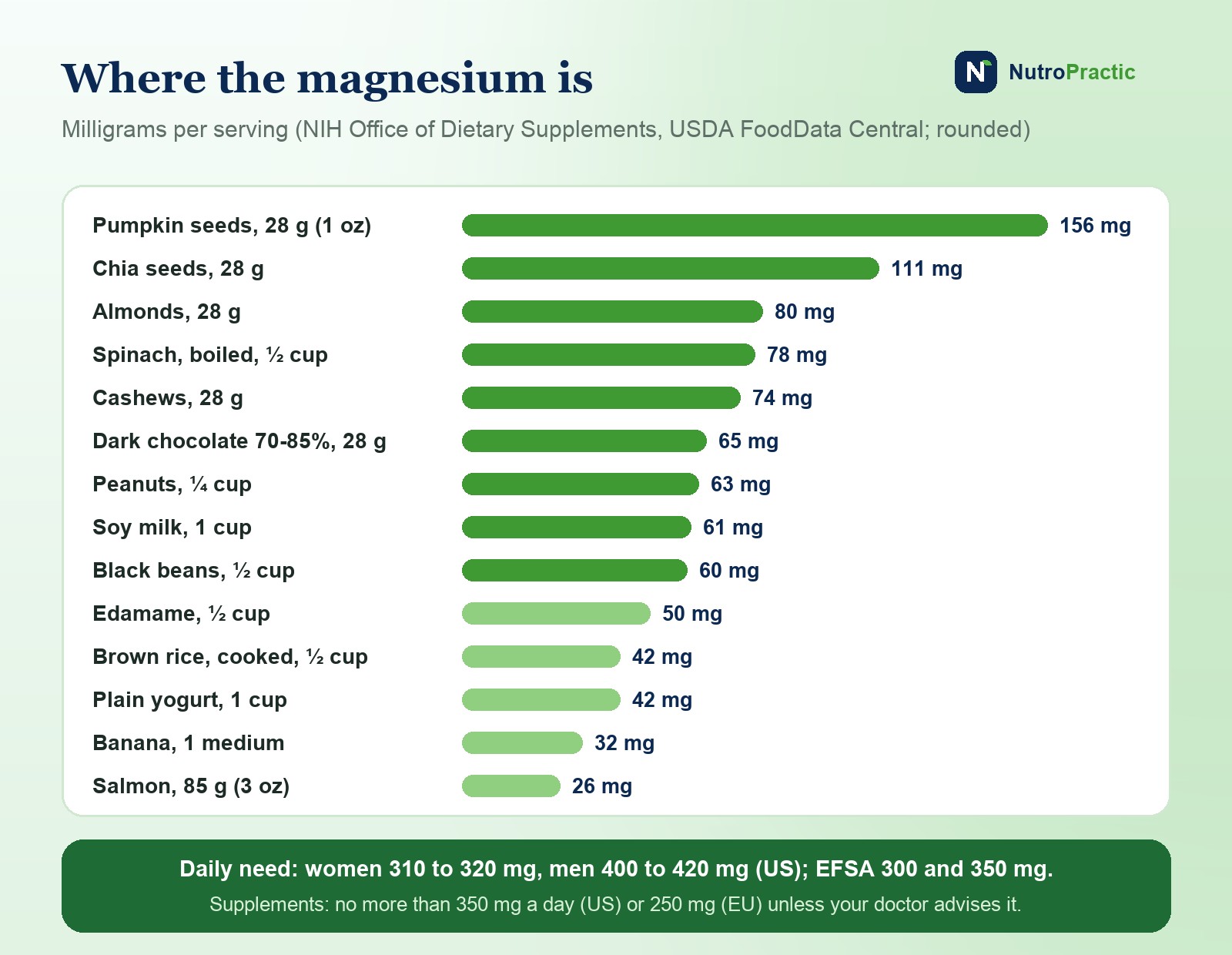
A day that gets there without trying too hard: oats with a spoon of chia or pumpkin seeds at breakfast, a handful of almonds or peanuts in the afternoon, beans or lentils at lunch or dinner, a portion of leafy greens, whole-grain bread or brown rice instead of white. That's 350 to 450 mg. It's the same shopping list as a high-fibre diet, which is no accident: our article on the fibre gap and an easy 30-gram day builds the same kind of day.
Some mineral waters add a useful amount as well; the label lists magnesium in mg per litre.
If you do take a supplement: which form
First, read the number. On a good label it's the elemental magnesium, for example "Magnesium (as magnesium glycinate) 200 mg". If it only says "magnesium glycinate 1,000 mg", most of that weight is the glycine, and the magnesium is closer to 140 mg.
Oxide is about 60% magnesium by weight, cheap and compact, but poorly absorbed. One small study measured about 4% absorption, against noticeably more from citrate, chloride, lactate or aspartate (Firoz and Graber, 2001). It also loosens stools, which is why it's used as a laxative.
Citrate is better absorbed, cheap, and also has a mild laxative effect at higher doses. A reasonable default if your bowels can take it.
Glycinate (or bisglycinate) is well absorbed and generally the gentlest on the stomach, which is the honest reason to choose it. The claim that it's the "sleep" form rests on glycine's calming reputation, not on head-to-head trials against other forms.
Threonate, malate, taurate and other premium forms are sold for the brain, energy or the heart, on very little human evidence. They're mostly a way to charge more.
Dose. The safe upper limit for magnesium from supplements is 350 mg a day in the US and 250 mg in Europe. Food doesn't count towards it, because the kidneys handle food magnesium easily. Taking it with a meal, or splitting it into two doses, cuts the stomach upset.
Who should not take it on their own
Anyone with kidney disease or reduced kidney function. The kidneys are how the body gets rid of extra magnesium; when they can't, it builds up, and high levels can cause weakness, low blood pressure and heart rhythm problems. Large doses of magnesium laxatives or antacids have caused serious harm in older people with weak kidneys.
Anyone taking these medicines, without spacing them: bisphosphonates for osteoporosis (take them at least 2 hours apart), tetracycline or quinolone antibiotics such as doxycycline or ciprofloxacin (take the antibiotic at least 2 hours before or 4 to 6 hours after), and levothyroxine for the thyroid (keep about 4 hours apart). Mention any supplement to your pharmacist; it's quick to check.
The short version
Plenty of adults eat less magnesium than they should, mostly because they eat refined food. A blood test usually can't tell you whether you're one of them; your plate and your medical history tell you more. Fix it with nuts, seeds, beans, greens and whole grains first. Supplements have good evidence for migraine prevention, a small effect on blood pressure, a small and uncertain one on sleep, and no useful effect on night cramps in older adults. If you take one, choose citrate or glycinate, stay at or under 350 mg, and skip it if your kidneys aren't working well. If you're short on magnesium, you may well be short on vitamin D too: see Vitamin D and B12: two common gaps.
Taking three supplements and not sure any of them are doing anything? Dr. Triveni can look at what you eat, your medicines and your reports, and tell you which ones to keep and how to get the rest from food, in a virtual consultation.
Book a consultationThis article is general information, not medical advice. Don't take magnesium supplements if you have kidney disease, and check with your doctor or pharmacist first if you take regular medicines, are pregnant, or want to use magnesium for migraine. Night cramps that are frequent, one-sided or come with swelling or weakness need a doctor's look.
Sources
US National Institutes of Health, Office of Dietary Supplements, Magnesium: fact sheet for health professionals. EFSA Panel on Dietetic Products, Nutrition and Allergies, Scientific opinion on dietary reference values for magnesium, EFSA Journal 13(7):4186 (2015). Bailey R.L. et al., Dietary supplement use is associated with higher intakes of minerals from food sources, Am J Clin Nutr 94(5):1376-1381 (2011), and Fulgoni V.L. et al., Foods, fortificants, and supplements: where do Americans get their nutrients?, J Nutr 141(10):1847-1854 (2011). Public Health England, National Diet and Nutrition Survey, Years 1 to 9 (2019). Costello R.B. et al., Perspective: the case for an evidence-based reference interval for serum magnesium, Advances in Nutrition 7(6):977-993 (2016). US Food and Drug Administration, Drug safety communication: low magnesium levels can be associated with long-term use of proton pump inhibitor drugs (2011). Mah J. and Pitre T., Oral magnesium supplementation for insomnia in older adults: a systematic review and meta-analysis, BMC Complementary Medicine and Therapies 21:125 (2021). Schuster J. et al., Magnesium bisglycinate supplementation in healthy adults reporting poor sleep: a randomized, placebo-controlled trial, Nature and Science of Sleep 17 (2025). Garrison S.R. et al., Magnesium for skeletal muscle cramps, Cochrane Database of Systematic Reviews (2020). Luo L. et al., Interventions for leg cramps in pregnancy, Cochrane Database of Systematic Reviews (2020). Holland S. et al., Evidence-based guideline update: NSAIDs and other complementary treatments for episodic migraine prevention in adults, Neurology 78(17):1346-1353 (2012). Peikert A. et al., Prophylaxis of migraine with oral magnesium: results from a prospective, multi-center, placebo-controlled and double-blind randomized study, Cephalalgia 16(4):257-263 (1996). Zhang X. et al., Effects of magnesium supplementation on blood pressure: a meta-analysis of randomized double-blind placebo-controlled trials, Hypertension 68(2):324-333 (2016). Firoz M. and Graber M., Bioavailability of US commercial magnesium preparations, Magnesium Research 14(4):257-262 (2001).