Sixteen hours without food, eight hours to eat: 16:8 is probably the most popular diet rule of the last ten years, and the claims around it have grown with it. Fasting is said to flip a metabolic switch, burn fat that ordinary dieting can't reach, and reset your body clock. Those are claims about the clock, not about the amount of food. So the useful question is a narrow one. When people eat the same amount, does squeezing it into a window do anything extra?
Since 2020 several good trials have tested exactly that. Here is what they found, why most of the benefit turns out to be eating less, where the timing may still matter, and who shouldn't be fasting at all.
A few terms
Time-restricted eating (TRE) means eating within the same window every day, usually 6 to 10 hours, with only water, black coffee or plain tea outside it. 16:8 is TRE with an 8-hour window. Intermittent fasting is the wider family: it also includes 5:2 (two days a week of about 500 to 600 calories) and alternate-day fasting. Continuous calorie restriction is the ordinary diet: eat somewhat less every day, at whatever times.
The head-to-head trials
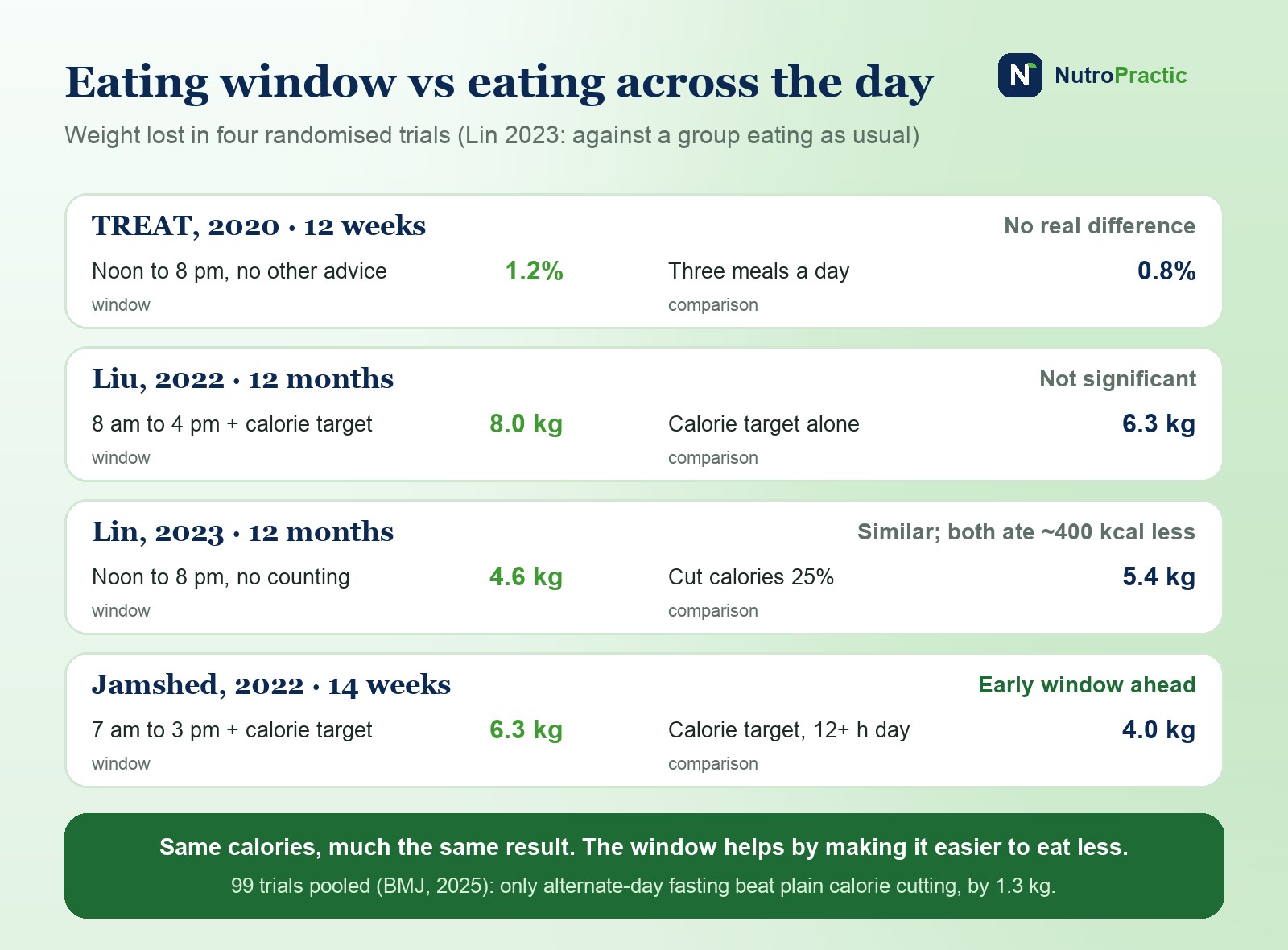
TREAT, 2020 (USA). 116 adults with overweight were told either to eat only between noon and 8 pm, or to eat three meals a day, with no other diet advice. After 12 weeks the window group had lost 1.2% of their weight and the meals group 0.8%, a difference too small to count. In the subgroup that had body scans, the window group lost more of the lean mass in their arms and legs than expected, which the authors flagged as a concern.
Liu, 2022 (China, New England Journal of Medicine). 139 adults with obesity all got the same calorie target for a year (1,200 to 1,500 a day for women, 1,500 to 1,800 for men). Half also had to eat between 8 am and 4 pm. At 12 months the window group had lost 8.0 kg and the calorie-only group 6.3 kg. The 1.8 kg difference was not statistically significant, and waist size, body fat, blood pressure, blood sugar and cholesterol moved the same in both groups.
Lin, 2023 (USA, Annals of Internal Medicine). 90 adults with obesity were assigned to eat between noon and 8 pm without counting anything, to cut calories by 25% at any time of day, or to carry on as usual. Over a year, against the usual-eating group, the window group lost 4.6 kg and the calorie counters 5.4 kg, with no real difference between them. The telling detail is that both groups ended up eating about 400 to 425 calories a day less. The window worked because it cut food, by about as much as counting did.
Jamshed, 2022 (USA, JAMA Internal Medicine). This is the trial that points the other way. 90 adults with obesity all cut calories, and half also ate only between 7 am and 3 pm. After 14 weeks they had lost 6.3 kg against 4.0 kg, a 2.3 kg difference that was significant, with a slightly larger fall in diastolic blood pressure. Fat loss itself didn't differ significantly.
The pooled view, 2025. A network meta-analysis in The BMJ combined 99 trials with 6,582 adults. Every approach, time windows, 5:2, alternate-day fasting and plain calorie restriction, beat eating as usual. Only alternate-day fasting beat ordinary calorie restriction, and only by 1.3 kg. Most of the trials lasted under six months.
Why most of the effect is eating less
Put the trials side by side and the pattern is consistent. When the window group and the comparison group eat the same number of calories, their weight, body fat, blood sugar and cholesterol end up in much the same place. When the window group isn't given a calorie target, it loses weight only because it eats less, typically 300 to 500 calories a day, mostly by dropping late-evening snacks and drinks.
That's not a mark against it. For many people a rule about when is easier to keep than a rule about how much: you don't weigh anything, you just close the kitchen at a set time. If that's how you find it easiest to eat less, it is a perfectly good tool. It just isn't magic, and the same 400 calories cut at random times of day does about the same job.
The muscle question
Any weight loss takes some muscle with it. A narrow window can make that worse in one specific way: two meals instead of three makes it harder to reach your protein, and harder to spread it across the day. That's the likeliest explanation for the lean-mass loss in TREAT, and it matters most for people over 50, who lose muscle more easily to begin with.
If you eat in a window, make the first meal a proper one with 25 to 30 g of protein, keep protein in the second, and do some resistance exercise two or three times a week. Our article on protein after 40 has the amounts and easy ways to reach them.
Early or late window?
The body handles food differently across the day. Insulin sensitivity is generally better in the morning, and the same meal eaten late at night tends to give a higher blood sugar rise. That's the case for an early window, and the small trials support it: in a 2018 study of eight men with prediabetes, eating within six hours ending before 3 pm improved insulin sensitivity and lowered blood pressure by about 10 points, even though their weight didn't change. Jamshed's 7 am to 3 pm trial is the larger version of the same idea.
The catch is that an early window means skipping dinner, which is the meal most people share with family and friends, so few keep it up. A late window (noon to 8 pm) is easier to live with, and in trials it works through eating less, not through timing. If you do want to try a window, an earlier one has the better evidence; a later one is fine if that's the one you'll actually keep.
What about the heart scare?
In March 2024 a conference abstract reported that people eating within eight hours had a 91% higher risk of dying from heart disease. It was based on two days of food recall in a US survey, it was never peer-reviewed at the time, and the people who happened to eat in short windows differed from the rest in ways the analysis couldn't fully adjust for. It can't show that the window caused anything, and its authors said so. It is a reason for more research, not a reason to panic, and equally not evidence that fasting is safe for everyone.
Who shouldn't fast
People taking insulin or sulfonylureas (such as gliclazide, glimepiride or glipizide). Skipping meals on these medicines can cause dangerous low blood sugar. Some diabetes trials have used eating windows safely, but only with the doctor adjusting the doses first. SGLT2 inhibitors (such as empagliflozin or dapagliflozin) add a small risk of ketoacidosis with long fasts. If you have diabetes, talk to your care team before changing meal times.
Pregnant or breastfeeding women. Energy and nutrient needs are higher, and there's no evidence that fasting is safe for the baby.
Anyone with a history of an eating disorder, or who notices that rules about food are making them anxious, bingeing or preoccupied. Long gaps and strict windows can set off the cycle again.
Children and teenagers, people who are underweight, and frail older adults, for whom losing weight or muscle is the bigger risk. Also check with your doctor if you take medicines that need to be taken with food at set times.
A sensible default: a 12-hour overnight gap
Most people don't need a 16-hour fast to get the parts of this that are well founded. When researchers had adults log every bite on their phones, half of them spread their eating over nearly 15 hours or more a day, from the first milky coffee to the last handful of something in front of the screen. Simply closing that spread to about 12 hours, say dinner finished by 8 pm and breakfast at 8 am, removes the late snacking that adds calories without filling anyone up, sits well with the body clock, and is easy to keep for good.
If you want to try a shorter window, give it a fair test: two to four weeks, the same window on weekdays and weekends, a protein-rich first meal, and enough water. Watch whether you're eating less or just eating more in less time. If it makes you hungry, irritable or obsessed with the clock, it isn't the right tool for you, and plain calorie reduction will do the same job.
Thinking about trying 16:8, or already doing it and not seeing results? Dr. Triveni can look at your day, your medicines and your goals and suggest the eating pattern you can actually keep, in a virtual consultation.
Book a consultationThis article is general information, not medical advice. If you have diabetes, take insulin, sulfonylureas or SGLT2 inhibitors, are pregnant or breastfeeding, have a history of an eating disorder, or have any long-term condition, talk to your doctor before you start fasting or change when you eat.
Sources
Lowe D.A. et al., Effects of time-restricted eating on weight loss and other metabolic parameters in women and men with overweight and obesity: the TREAT randomized clinical trial, JAMA Intern Med 180(11):1491-1499 (2020). Liu D. et al., Calorie restriction with or without time-restricted eating in weight loss, N Engl J Med 386(16):1495-1504 (2022). Lin S. et al., Time-restricted eating without calorie counting for weight loss in a racially diverse population: a randomized controlled trial, Ann Intern Med 176(7):885-895 (2023). Jamshed H. et al., Effectiveness of early time-restricted eating for weight loss, fat loss, and cardiometabolic health in adults with obesity, JAMA Intern Med 182(9):953-962 (2022). Sutton E.F. et al., Early time-restricted feeding improves insulin sensitivity, blood pressure, and oxidative stress even without weight loss in men with prediabetes, Cell Metab 27(6):1212-1221 (2018). Semnani-Azad Z. et al., Intermittent fasting strategies and their effects on body weight and other cardiometabolic risk factors: systematic review and network meta-analysis of randomised clinical trials, BMJ 389:e082007 (2025). Gill S. and Panda S., A smartphone app reveals erratic diurnal eating patterns in humans that can be modulated for health benefits, Cell Metab 22(5):789-798 (2015). Zhong V.W. et al., abstract P192, American Heart Association EPI/Lifestyle Scientific Sessions (March 2024), and the critical commentary reported by TCTMD.