Heartburn is the burning that climbs up behind the breastbone after a big dinner, sometimes with a sour taste at the back of the throat. It happens when stomach contents slip back up into the oesophagus. Once it comes back week after week, doctors call it gastro-oesophageal reflux disease: GERD in the US, GORD in the UK.
Most people who get it are handed the same list: no coffee, no chocolate, no tomatoes, no spice, no wine. The trials behind that list are thinner than you would expect, and some of the changes that rarely make the list have much better evidence. Here is what the studies actually measured, with the numbers.
How common it is
In a review of population studies (El-Serag and colleagues, Gut 2014), 18 to 28% of adults in North America had reflux symptoms at least once a week, against 9 to 26% in Europe, 12% in Australia and only 2.5 to 8% in East Asia. Since 1995 the rates have risen, most clearly in North America and East Asia. The Global Burden of Disease estimate puts the age-adjusted rate at about 8.8% of people worldwide, with the highest figures, over 11%, in the USA, Italy, Greece and New Zealand. In India, a pooled analysis of nine studies and 20,614 people found 15.6% (Rai and colleagues, 2021).
No study has measured exactly why richer, Western countries sit at the top of those ranges. The strongest clue is weight, which is also where the evidence is clearest.
Weight: the link with the best numbers
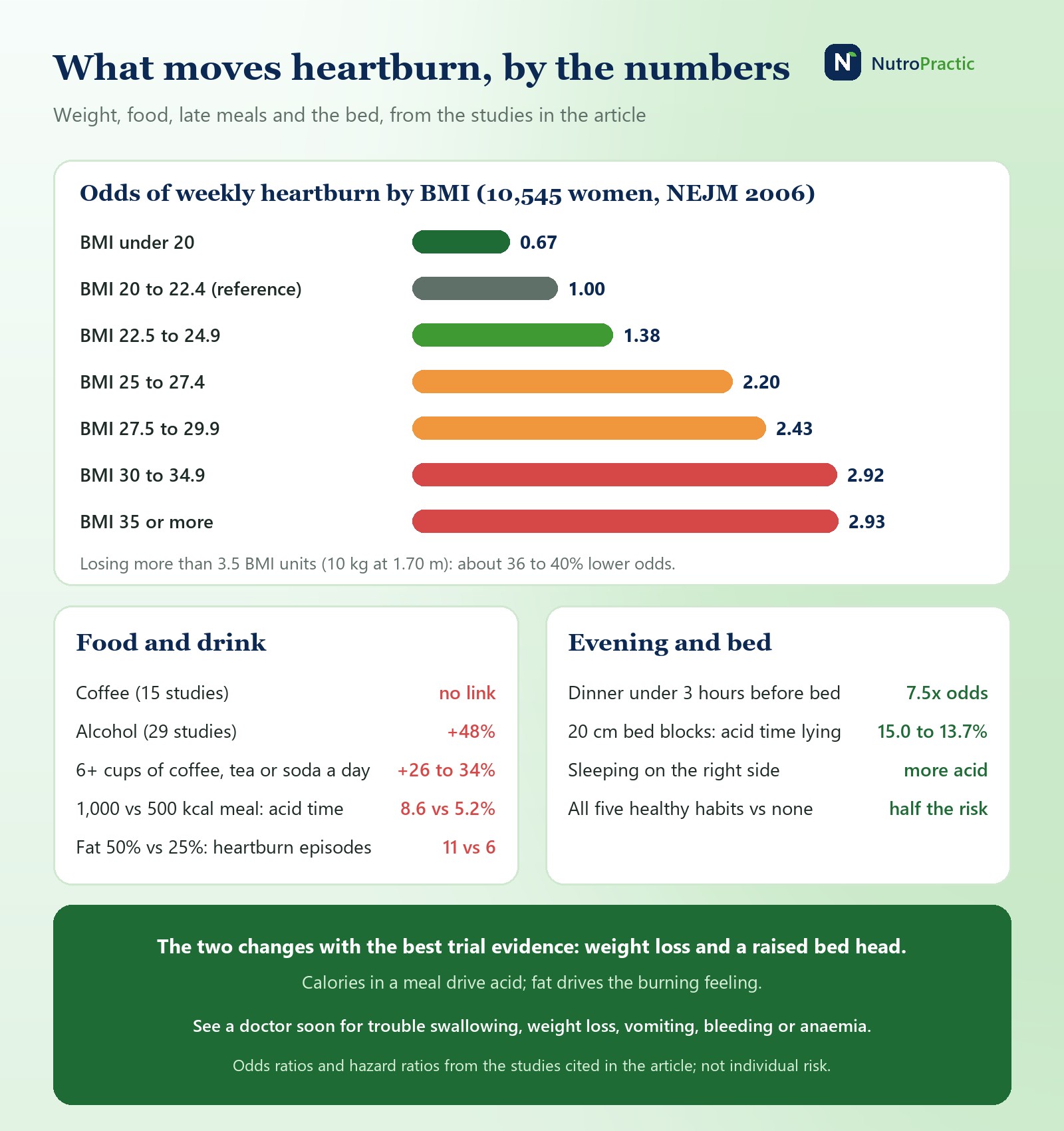
The Nurses' Health Study asked 10,545 women about heartburn and compared it with their body mass index (Jacobson and colleagues, NEJM 2006). Against women with a BMI of 20 to 22.4, the odds of weekly symptoms went up step by step: 1.38 times at a BMI of 22.5 to 24.9, 2.2 times at 25 to 27.4 and about 2.9 times at 30 or more. Even a weight in the upper half of the normal range carried more heartburn.
It works in the other direction too. Women who lost more than 3.5 BMI units had about 36% lower odds of frequent symptoms. In Norway, 29,610 people were asked twice, about ten years apart (Ness-Jensen and colleagues, 2013): those who lost more than 3.5 BMI units were about twice as likely to lose their reflux symptoms, and about four times as likely if they had been taking reflux medicine every week.
What 3.5 BMI units means
BMI is weight divided by height squared, so 3.5 units is 3.5 x height x height. For a woman 1.70 m tall that is 3.5 x 1.70 x 1.70 = about 10 kg; for a man of 1.80 m it is about 11.3 kg. That is a lot, but the Nurses' data show the risk climbing from the first few kilos, so the benefit doesn't wait until the end. In one programme for 332 overweight adults, an average loss of about 13 kg took reflux from 37% of the group to 15% (Singh and colleagues, 2013, no control group).
The 2022 American College of Gastroenterology (ACG) guideline makes weight loss its only strong lifestyle recommendation, for people who are overweight. A 2006 review of 16 trials (Kaltenbach and colleagues, Archives of Internal Medicine) came to the same place: "weight loss and head of bed elevation are effective lifestyle interventions for GERD".
Late dinners
In Japan, Fujiwara and colleagues (2005) compared 147 people with reflux disease with 294 without. Those who usually went to bed less than three hours after dinner had about 7.5 times the odds of reflux, compared with people who left four hours or more. That is a case-control study, so it shows a strong link rather than proof.
A small randomised crossover trial in the US (Piesman and colleagues, 2007) tested it directly: 30 people ate the same meal either six hours or two hours before bed and wore a pH capsule for 48 hours. The late meal brought more acid reflux while lying down (P=0.002), most clearly in people who were overweight, had a hiatal hernia or had heartburn as their main symptom. Oddly, the symptom scores didn't differ between the two nights, a reminder that acid and the burning feeling don't always move together.
The ACG advises against eating in the two to three hours before bed. If dinner is late most nights, moving the larger meal to lunch, or eating a lighter dinner earlier, is usually easier than going to bed later. Our article on food and sleep covers what a late dinner does to sleep itself.
Raising the bed, and which side you sleep on
Gravity helps the oesophagus clear acid. In 1977, Stanciu and Bennett put 28 cm blocks under the head of the bed and measured less acid time and fewer reflux episodes than with the bed flat. A 2012 trial with 20 cm blocks (Khan and colleagues, 20 people) cut the time the oesophagus spent in acid while lying down from 15.0% to 13.7%, shortened each clearance from 3.8 to 3.0 minutes, and 65% slept better. A wedge under the mattress also worked in a 15-person study; 8-inch (20 cm) blocks showed the same trend there, but not significantly.
These are small trials. A 2021 review found five of them, 228 patients in all, with a high risk of bias, though four reported better symptoms. The ACG recommends raising the head of the bed for people whose symptoms come at night. That means the bed itself on blocks or a wedge; extra pillows bend you at the waist instead.
Side matters too. In a pH study of ten people (Khoury and colleagues, 1999), lying on the right side brought more acid and slower clearance than the left. Later work agrees: in a sham-controlled trial of 100 people using a device that keeps you on your left side, 44% improved against 24% on the sham (that trial had industry ties). The ACG advises against sleeping right side down.
Food triggers: what the trials show
This is where the usual advice runs ahead of the evidence. The 2006 Kaltenbach review found that stopping tobacco, alcohol or particular foods had not been shown to improve reflux in trials, even though tobacco, alcohol, chocolate and high-fat meals lower the pressure of the valve at the bottom of the oesophagus. No randomised trial of personalised food elimination has been done. That doesn't mean triggers are imaginary. It means they vary, and the ones worth dropping are the ones that do something to you.
Coffee. A pooled analysis of 15 case-control studies (Kim and colleagues, 2014) found no association between coffee and reflux (odds ratio 1.06). Large amounts are another matter: in 48,308 women (Mehta and colleagues, 2020), more than six servings a day of coffee, tea or fizzy drinks carried 26 to 34% more risk than none, while milk, water and juice carried none. Swapping two servings a day for water lowered the risk a little (by 4% for coffee or tea, 8% for soda).
Alcohol. The case here is firmer. Across 29 studies (Pan and colleagues, 2019), drinkers had 48% higher odds of reflux and frequent drinkers about twice the odds, and the risk rose about 16% for each 12.5 g of alcohol a day, roughly one standard drink.
Meal size and fat. This is the most useful single experiment. Fox and colleagues (2007) fed 15 people meals that differed in either calories or fat. A 1,000 kcal meal kept the oesophagus in acid for 8.6% of the time, against 5.2% after 500 kcal. Raising the fat from 25% to 50% of the calories didn't change the acid (8.6% vs 8.2%) but almost doubled heartburn episodes, from 6 to 11. Big meals bring the acid; fatty meals make it hurt more.
Chocolate, peppermint, spicy food and citrus. Chocolate increased acid exposure in the first hour in a small study of people with oesophagitis, and the ACG lists peppermint among the things that relax the valve. Spicy food and citrus have little to no effect on the valve, but they can sting an oesophagus that is already irritated: capsaicin dripped into the oesophagus brought on symptoms in 28 of 31 people with reflux and only 6 of 17 without.
Smoking. In one study cited by the ACG, 44% of people who quit improved, against 18% of those who kept smoking.
Five habits together
The clearest result comes from looking at habits together rather than one food at a time. Following 42,955 women (Mehta and colleagues, JAMA Internal Medicine 2021), those with all five of a normal BMI, never smoking, at least 30 minutes of moderate to vigorous activity a day, no more than two cups of coffee, tea or soda a day and a prudent diet had half the risk of reflux symptoms of those with none. The authors estimated that 37% of cases could have been prevented if everyone had all five.
Heartburn after food can come with bloating and pain from lower down the gut; if that sounds familiar, our article on IBS and the low FODMAP diet covers the trials there.
A practical plan for the next four weeks
1. Make dinner smaller and earlier. Aim for three hours between the last meal and lying down, and move part of a large dinner to lunch. Given the Fox experiment, calories matter more than any single ingredient.
2. Raise the head of the bed if symptoms come at night: blocks of about 20 cm under the legs at the head end, or a wedge under the mattress. Sleep on your left side.
3. If you are above a healthy weight, losing some helps at every step; the studies above saw clear gains from losses of about 10 kg.
4. Keep coffee, tea and fizzy drinks to two a day or fewer, and cut alcohol, especially in the evening. You don't have to give up coffee.
5. Test one suspect food at a time. Drop it for a week, note your nights, then bring it back. Keep only the restrictions that make a difference to you. Our free heartburn diary keeps the log for you and, after a week, compares your bad nights with and without each food.
Over-the-counter alginates (the foaming liquids and chewable tablets) clearly beat placebo or antacids in 14 trials with 2,095 people (odds ratio 4.4), and against acid-reducing medicines the difference was not significant. If you have heartburn twice a week or more despite these changes, see your doctor: the ACG suggests an eight-week trial of a proton pump inhibitor, once a day 30 to 60 minutes before the first meal, then trying to stop, or using the lowest dose that works.
When not to wait
See a doctor promptly for difficulty swallowing, unexplained weight loss, vomiting, signs of bleeding (vomiting blood, black stools) or anaemia. In the UK, NICE asks for an urgent endoscopy for difficulty swallowing, or at age 55 and over with weight loss and upper abdominal pain, reflux or indigestion. Long-standing reflux plus three or more of being male, over 50, White, a smoker, obese, or having a close relative with Barrett's oesophagus or oesophageal cancer is a reason to ask about screening for Barrett's oesophagus.
A smaller dinner three hours before bed and a raised bed head have better evidence than giving up coffee.
Living with heartburn and not sure which changes are worth it for you? Dr. Triveni can build a meal plan around your evenings, your weight and the foods you actually eat, in a virtual consultation.
Book a consultationThis article is general information, not medical advice. Heartburn can feel like heart pain and the other way round: chest pain with breathlessness, sweating or pain spreading to the arm or jaw needs emergency care. Talk to your doctor before stopping or changing a prescribed medicine.
Sources
El-Serag H.B. et al., Update on the epidemiology of gastro-oesophageal reflux disease: a systematic review, Gut 63(6):871-880 (2014). GBD 2017 Gastro-oesophageal Reflux Disease Collaborators, The global, regional, and national burden of gastro-oesophageal reflux disease, 1990-201730408-X), Lancet Gastroenterol Hepatol 5(6):561-581 (2020). Rai S., Kulkarni A., Ghoshal U.C., Prevalence and risk factors of gastroesophageal reflux disease in the Indian population: a meta-analysis and meta-regression study, Indian J Gastroenterol 40(2):209-219 (2021).
Jacobson B.C. et al., Body-mass index and symptoms of gastroesophageal reflux in women, NEJM 354(22):2340-2348 (2006). Ness-Jensen E. et al., Weight loss and reduction in gastroesophageal reflux: the HUNT study, Am J Gastroenterol 108(3):376-382 (2013). Singh M. et al., Weight loss can lead to resolution of gastroesophageal reflux disease symptoms: a prospective intervention trial, Obesity 21(2):284-290 (2013). Kaltenbach T., Crockett S., Gerson L.B., Are lifestyle measures effective in patients with gastroesophageal reflux disease? An evidence-based approach, Arch Intern Med 166(9):965-971 (2006).
Fujiwara Y. et al., Association between dinner-to-bed time and gastro-esophageal reflux disease, Am J Gastroenterol 100(12):2633-2636 (2005). Piesman M. et al., Nocturnal reflux episodes following the administration of a standardized meal. Does timing matter?, Am J Gastroenterol 102(10):2128-2134 (2007). Stanciu C., Bennett J.R., Effects of posture on gastro-oesophageal reflux, Digestion 15(2):104-109 (1977). Hamilton J.W. et al., Sleeping on a wedge diminishes exposure of the esophagus to refluxed acid, Dig Dis Sci 33(5):518-522 (1988). Khan B.A. et al., Effect of bed head elevation during sleep in symptomatic patients of nocturnal gastroesophageal reflux, J Gastroenterol Hepatol 27(6):1078-1082 (2012). Albarqouni L. et al., Head of bed elevation to relieve gastroesophageal reflux symptoms: a systematic review, BMC Family Practice 22:24 (2021). Khoury R.M. et al., Influence of spontaneous sleep positions on nighttime recumbent reflux in patients with gastroesophageal reflux disease, Am J Gastroenterol 94(8):2069-2073 (1999). Schuitenmaker J.M. et al., sleep positional therapy for nocturnal GERD, Clin Gastroenterol Hepatol 20:2753-2762 (2022).
Kim J. et al., Association between coffee intake and gastroesophageal reflux disease: a meta-analysis, Dis Esophagus 27(4):311-317 (2014). Mehta R.S. et al., Association between beverage intake and incidence of gastroesophageal reflux symptoms, Clin Gastroenterol Hepatol 18(10):2226-2233 (2020). Pan J. et al., Alcohol consumption and the risk of gastroesophageal reflux disease: a systematic review and meta-analysis, Alcohol Alcohol 54(1):62-69 (2019). Fox M. et al., The effects of dietary fat and calorie density on esophageal acid exposure and reflux symptoms, Clin Gastroenterol Hepatol 5(4):439-444 (2007). Murphy D.W., Castell D.O., Chocolate and heartburn: evidence of increased esophageal acid exposure after chocolate ingestion, Am J Gastroenterol 83(6):633-636 (1988). Mehta R.S. et al., Association of lifestyle with gastroesophageal reflux symptoms in women, JAMA Intern Med 181(4):552-554 (2021).
Leiman D.A. et al., Alginate therapy is effective treatment for GERD symptoms: a systematic review and meta-analysis, Dis Esophagus 30(5):1-9 (2017). Katz P.O. et al., ACG clinical guideline for the diagnosis and management of gastroesophageal reflux disease, Am J Gastroenterol 117(1):27-56 (2022). Shaheen N.J. et al., ACG clinical guideline: diagnosis and management of Barrett's esophagus, Am J Gastroenterol 117(4):559-587 (2022). NICE, Gastro-oesophageal reflux disease and dyspepsia in adults (CG184) and Suspected cancer: recognition and referral (NG12).