Most people learn they have a fatty liver by accident. An ultrasound for gallstones or a kidney check comes back with a line at the bottom, "fatty infiltration of the liver", or a routine blood test shows a slightly raised ALT. Often nobody explains what it means, and the advice stops at "lose some weight".
That advice is right, but it can be much more specific. Few conditions have such clear numbers for how much weight loss helps, because doctors have taken liver biopsies before and after. Here is what they found, along with what coffee, alcohol, sugar and the new medicines do.
The new name: MASLD
In 2023 the liver societies renamed non-alcoholic fatty liver disease (NAFLD) as metabolic dysfunction-associated steatotic liver disease, MASLD. "Steatotic" just means fatty. The new name says what drives it: a fatty liver plus at least one sign of metabolic strain, such as a large waist or a high BMI, raised blood sugar or type 2 diabetes, high blood pressure, high triglycerides or low HDL cholesterol.
The inflamed, more serious form, once NASH, is now MASH. People with MASLD who also drink a fair amount (about 140 to 350 g of alcohol a week for women, 210 to 420 g for men, which is roughly 2 to 5 and 3 to 6 drinks a day) now have their own label, MetALD, because both causes are working on the liver together.
How common it is
About one adult in three worldwide: a 2022 Lancet Gastroenterology and Hepatology meta-analysis put it at 32%. In the US the figure is similar; in the UK estimates run from one in five to one in three adults. In India, a 2022 review of 50 studies found it in 38.6% of adults and about a third of children studied, much higher among people living with obesity or diabetes. South Asians develop it at lower body weights than Europeans, so a "normal" BMI doesn't rule it out.
Most people with a fatty liver never have serious liver trouble. The fat matters for two reasons. In a minority, inflammation leads to scarring (fibrosis) and, over decades, to cirrhosis. And for almost everyone with MASLD, the bigger risk is the heart: more people with fatty liver die of heart disease than of liver disease. The changes that clear the liver also help the heart.
The scarring is what counts
Doctors grade fibrosis from F0 (none) to F4 (cirrhosis). Fibrosis stage, more than the amount of fat, predicts who runs into liver problems later. That is why the first question after a fatty liver diagnosis should be "is there scarring?", and why the FIB-4 test below matters.
How much weight loss: 5%, 7%, 10%
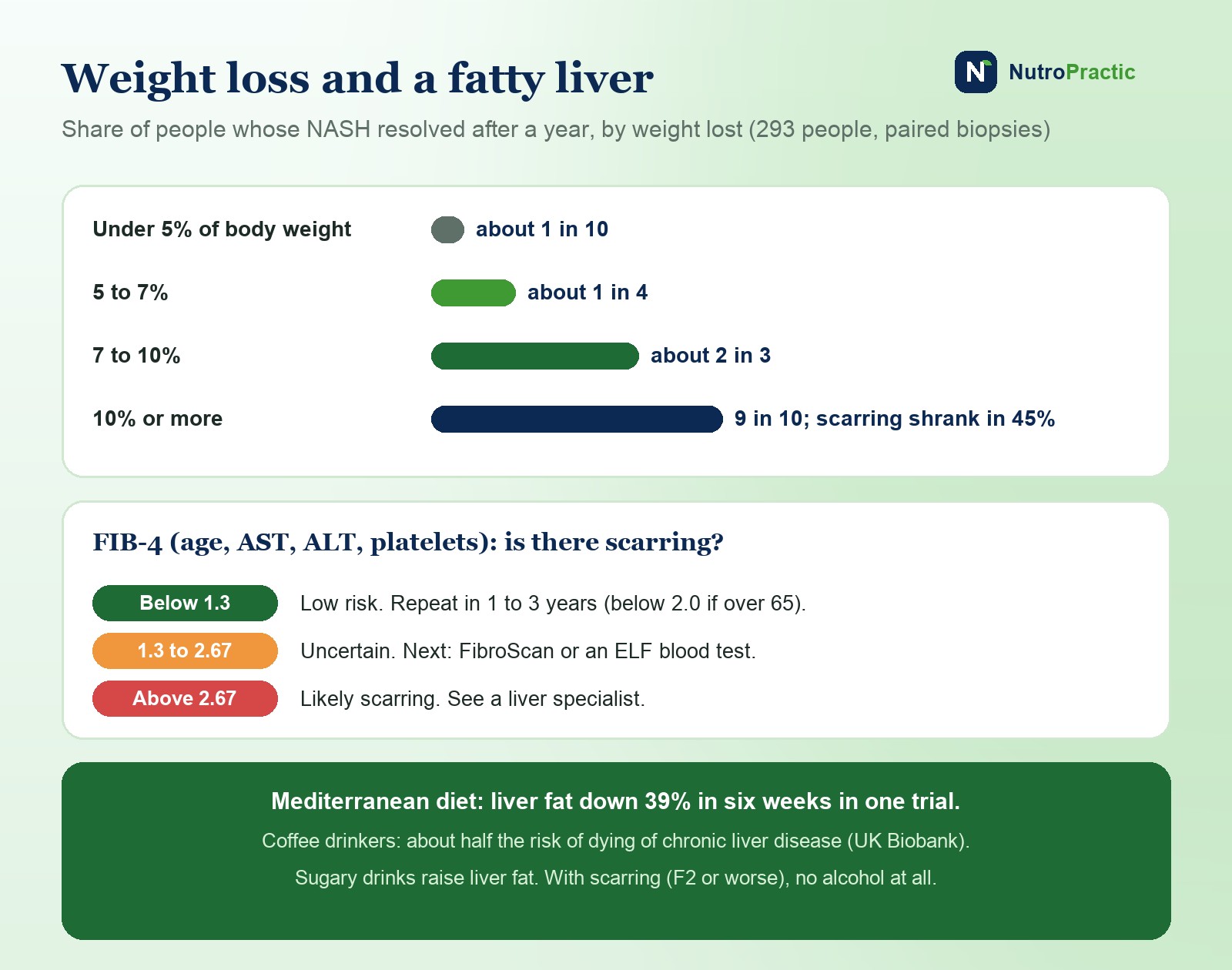
The clearest data come from a study in Havana of 293 people with biopsy-proven NASH who were coached to change their diet and activity for a year, and had a second biopsy at the end (Vilar-Gomez, Gastroenterology 2015). The results scaled with the weight lost:
Under 5% of body weight: NASH resolved in about one person in ten.
5 to 7%: liver fat and inflammation fell in many, and NASH resolved in about a quarter.
7 to 10%: NASH resolved in about two-thirds.
10% or more: NASH resolved in 90%, and fibrosis regressed in 45%. Scarring that people are often told is permanent got better.
For someone weighing 90 kg, 5% is 4.5 kg, 7% is about 6.5 kg and 10% is 9 kg. These thresholds now sit in the American (AASLD) and European (EASL) guidance. The catch was also clear: only about one in ten people in the study managed to lose 10%. Steady, sustainable loss of 0.5 to 1 kg a week is the target; very rapid loss on crash diets can briefly worsen liver inflammation.
Every kilogram counts. Even when weight loss stops short of 10%, the liver fat and inflammation fall in step with it.
Which diet
There is no special liver diet. The trials favour a Mediterranean pattern because it improves the liver even before much weight is lost.
In a small Australian crossover trial, six weeks of a Mediterranean diet cut liver fat by about 39% compared with 7% on a low-fat diet, with the same small weight change (Ryan, J Hepatol 2013). In the 18-month Israeli DIRECT-PLUS trial, a "green" Mediterranean diet (more plants, walnuts, green tea and a duckweed shake, little red meat) halved the share of people with fatty liver and cut liver fat about twice as much as a standard healthy diet, at similar weight loss.
In practice: vegetables, pulses and whole grains as the base; olive oil and nuts as the main fats; fish two or three times a week; less red and processed meat; and far fewer refined snacks and ultra-processed foods (our ultra-processed foods article has realistic swaps). For an Indian kitchen, the same idea works with dal, sabzi, millets or brown rice, curd and nuts, and less fried food and sweets.
Sugary drinks and fructose
The liver turns surplus sugar, especially fructose, straight into fat. In a Finnish study, an extra 1,000 kcal a day of sugary foods for three weeks raised liver fat by about 27% in healthy overweight adults. In the US Framingham cohort, people who drank a sugary drink every day were more likely to have a fatty liver than those who drank none.
Fruit juice, cola, sweet tea and coffee-shop drinks are the easiest to cut, and the change shows up in the liver quickly. Whole fruit is fine: the fibre slows the sugar down, and fruit is part of every diet that helps.
Coffee: good news
Coffee is one of the most consistent findings in liver research. In a 2016 meta-analysis, each two extra cups a day was linked to about 44% less cirrhosis. In half a million UK Biobank participants, coffee drinkers had about 20% less chronic or fatty liver disease and about half the risk of dying from chronic liver disease than non-drinkers, with the benefit for ground, instant and decaf coffee alike.
These are observational studies, and coffee is not a treatment. But if you have a fatty liver and enjoy two or three cups of coffee a day, keep them, ideally paper-filtered and without syrups or a lot of sugar. Our coffee and heart article covers limits, sleep and blood pressure.
Alcohol: less than you might think
The old idea that "a drink a day is fine" for the liver doesn't hold once there is already fat in it. Fat and alcohol add to each other's damage, which is why MetALD now has its own name. The 2024 European guideline advises people with MASLD to keep alcohol as low as possible, and anyone with significant fibrosis (F2 or worse) to stop completely. Heavy drinking sessions are the worst pattern.
If you drink, keep it well under the low-risk limits (14 units a week in the UK, no more than one or two drinks a day in the US) and leave several days a week alcohol-free. If your FIB-4 or scan shows scarring, stop.
Exercise, even without weight loss
Trials of regular aerobic or resistance exercise lower liver fat by a modest amount even when weight doesn't change. The usual target, about 150 minutes a week of brisk walking or similar, plus two sessions of strength work, is enough. Exercise also helps keep muscle while losing weight, which matters for blood sugar.
The new medicines
Two drugs are now approved in the US for MASH with moderate to advanced scarring (F2 to F3), confirmed by biopsy or non-invasive tests:
Resmetirom (Rezdiffra), approved in 2024, acts on thyroid hormone receptors in the liver. In the MAESTRO-NASH trial, MASH resolved in about 26 to 30% of people on it against 10% on placebo, and fibrosis improved in about 24 to 26% against 14%.
Semaglutide (Wegovy), approved for MASH in 2025, works mostly through weight loss. In the ESSENCE trial, MASH resolved in 63% against 34% on placebo after 72 weeks, and fibrosis improved in 37% against 22%.
Neither replaces diet and activity, and both are for people with proven fibrosis, not for everyone with a fatty liver on an ultrasound. If you are on semaglutide, eating enough protein matters to protect muscle (see our GLP-1 eating guide).
The test to ask for: FIB-4
An ultrasound shows fat but not scarring, and ALT can be normal even with fibrosis. The first step recommended by the US, UK and European guidelines is the FIB-4 score, worked out from your age, two liver enzymes (AST and ALT) and your platelet count, all from routine blood tests.
Below 1.3: low risk of significant scarring. Repeat every one to three years, and work on weight, diet and blood sugar.
1.3 to 2.67: uncertain. The next step is an elastography scan (FibroScan) or an ELF blood test.
Above 2.67: likely significant fibrosis; you should be seen by a liver specialist.
For people over 65, the lower cut-off is 2.0 instead of 1.3, because FIB-4 rises with age. If you've been told you have a fatty liver and nobody has calculated FIB-4, ask for it.
A realistic plan
Find your target: 7 to 10% of your current weight, at 0.5 to 1 kg a week.
Swap the drinks first: water, coffee or tea instead of juice, soda and sweet drinks; alcohol as low as you can, none if there is scarring.
Build Mediterranean-style plates: half vegetables, a quarter protein (pulses, fish, eggs, chicken, tofu), a quarter whole grains, olive oil and a handful of nuts.
Move: 150 minutes a week of brisk walking plus two strength sessions.
Know your numbers: FIB-4 now; HbA1c, lipids and blood pressure, because the heart is the bigger risk.
Told you have a fatty liver and not sure where to start? Dr. Triveni can work out a realistic weight target with you and build a Mediterranean-style eating plan that fits your kitchen, in a virtual consultation.
Book a consultationThis article is general information, not medical advice. Fatty liver needs a doctor's assessment, including a check for other causes such as hepatitis, medicines and alcohol. Don't start or stop medicines, or a very low-calorie diet, without your doctor.
Sources
Rinella M.E. et al., A multisociety Delphi consensus statement on new fatty liver disease nomenclature, J Hepatol 79(6):1542-1556 (2023). Riazi K. et al., The prevalence and incidence of NAFLD worldwide: a systematic review and meta-analysis, Lancet Gastroenterol Hepatol 7(9):851-861 (2022). Shalimar et al., Prevalence of non-alcoholic fatty liver disease in India: a systematic review and meta-analysis, J Clin Exp Hepatol 12(3):818-829 (2022). Vilar-Gomez E. et al., Weight loss through lifestyle modification significantly reduces features of nonalcoholic steatohepatitis, Gastroenterology 149(2):367-378 (2015). Rinella M.E. et al., AASLD Practice Guidance on the clinical assessment and management of nonalcoholic fatty liver disease, Hepatology 77(5):1797-1835 (2023). EASL-EASD-EASO Clinical Practice Guidelines on the management of MASLD, J Hepatol 81(3):492-542 (2024). Ryan M.C. et al., The Mediterranean diet improves hepatic steatosis and insulin sensitivity in individuals with non-alcoholic fatty liver disease, J Hepatol 59(1):138-143 (2013). Yaskolka Meir A. et al., Effect of green-Mediterranean diet on intrahepatic fat: the DIRECT PLUS randomised controlled trial, Gut 70(11):2085-2095 (2021). Sevastianova K. et al., Effect of short-term carbohydrate overfeeding and long-term weight loss on liver fat in overweight humans, Am J Clin Nutr 96(4):727-734 (2012). Ma J. et al., Sugar-sweetened beverage, diet soda, and fatty liver disease in the Framingham Heart Study cohorts, J Hepatol 63(2):462-469 (2015). Kennedy O.J. et al., Systematic review with meta-analysis: coffee consumption and the risk of cirrhosis, Aliment Pharmacol Ther 43(5):562-574 (2016). Kennedy O.J. et al., All coffee types decrease the risk of adverse clinical outcomes in chronic liver disease: a UK Biobank study, BMC Public Health 21:970 (2021). Harrison S.A. et al., A phase 3, randomized, controlled trial of resmetirom in NASH with liver fibrosis (MAESTRO-NASH), N Engl J Med 390:497-509 (2024). Sanyal A.J. et al., Phase 3 trial of semaglutide in metabolic dysfunction-associated steatohepatitis (ESSENCE), N Engl J Med (2025).