For years the advice was simple: if you want less sugar, switch to a diet drink or a sweetener in your coffee. Then in 2023 came two headlines a few weeks apart. In May, the World Health Organization said people should not use sweeteners to control their weight. In July, its cancer agency put aspartame on the list of things that are 'possibly carcinogenic to humans'.
A lot of people heard both as 'sweeteners are worse than sugar'. That isn't what either said. Here is what the reviews actually found, what the safety limits mean in cans and sachets, and where the real open questions are.
What the WHO said, and didn't
The WHO guideline covers the common non-sugar sweeteners: aspartame, sucralose, saccharin, acesulfame K, cyclamate, neotame, advantame, and stevia and its extracts. It does not cover sugar alcohols such as erythritol, sorbitol and xylitol, or toothpaste and medicines. Its advice is that these sweeteners should not be used as a way to lose weight or to lower the risk of diseases such as type 2 diabetes and heart disease. It is a 'conditional' recommendation, which in WHO language means the evidence is not strong and countries should discuss how to apply it.
The review behind it found two different pictures. In randomised trials, mostly a few months long, people who swapped sugar for sweeteners lost a little weight: on average under one kilogram. In long-term observational studies, people who consumed more sweeteners had somewhat higher rates of type 2 diabetes, heart disease and early death. The WHO read that as 'no long-term benefit, and possible harm'.
The observational part is hard to interpret. People who are already gaining weight, or who have been told their blood sugar is creeping up, are exactly the people who switch to diet drinks, so the drinks can look guilty when they are a response to the problem (researchers call this reverse causation). Studies try to adjust for this, but can't fully. And importantly, the guideline does not apply to people who already have diabetes, for whom sweeteners were not assessed.
Aspartame and cancer
In July 2023, the International Agency for Research on Cancer (IARC) placed aspartame in Group 2B, 'possibly carcinogenic to humans', based on limited evidence from a few studies on liver cancer. Group 2B is a statement about how strong the evidence is that something can cause cancer, not how much risk it carries. The same group includes aloe vera extract and traditional Asian pickled vegetables.
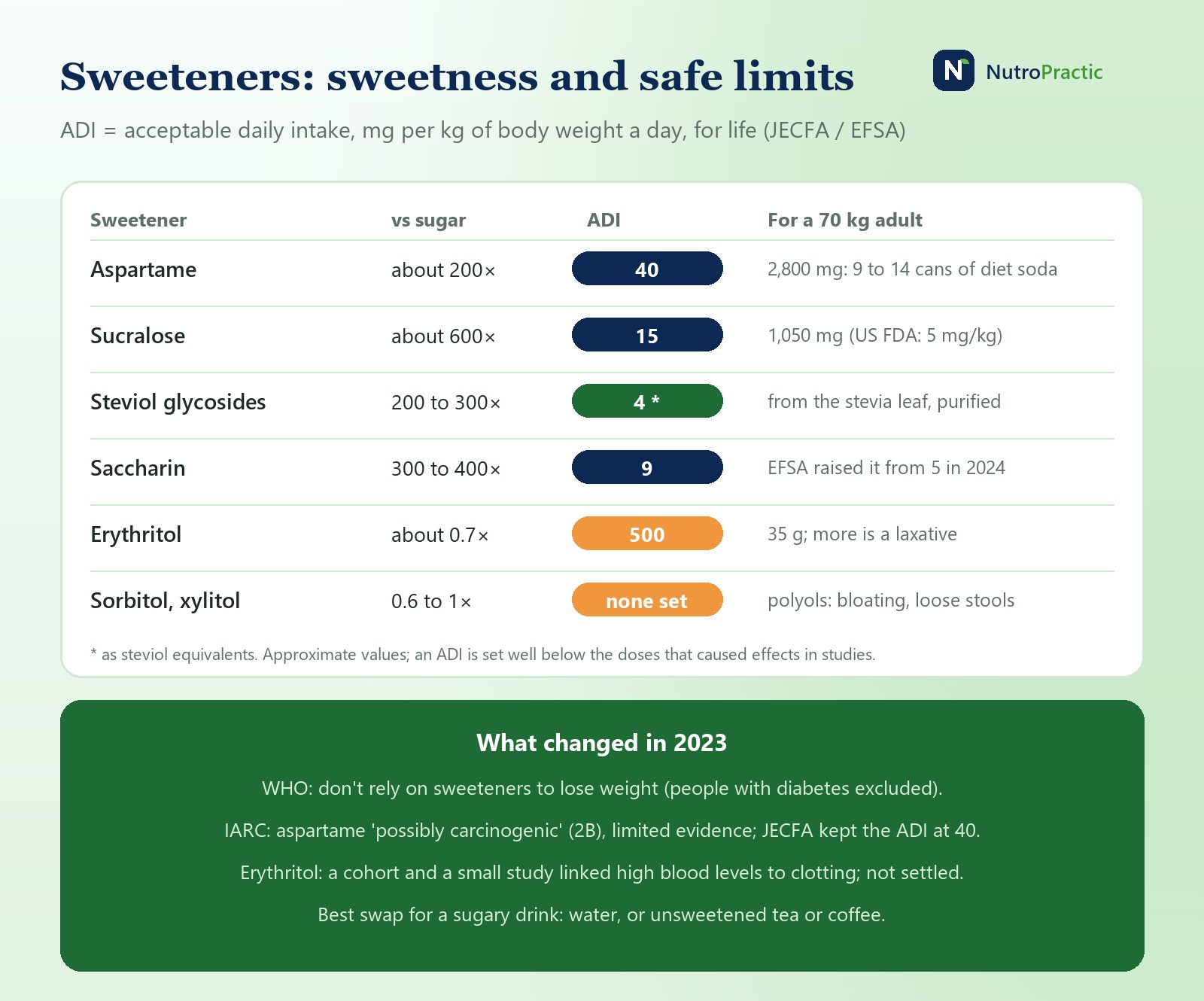
On the same day, the WHO and FAO expert committee on food additives (JECFA), whose job is to say how much is safe, reviewed the same evidence and kept the acceptable daily intake at 40 mg per kg of body weight. For a 70 kg adult that is 2,800 mg a day, or 9 to 14 cans of diet soda every day, for life, before reaching the limit. Most people who use aspartame get a small fraction of that. People with the rare inherited condition phenylketonuria must avoid it, which is why labels say 'contains a source of phenylalanine'.
What the acceptable daily intake means
The ADI is the amount you could take every day of your life without appreciable risk. It is usually set by finding the highest dose that caused no harm in long animal studies and dividing it by 100. Going over it on one day doesn't make you ill; staying far under it is easy for most people, because these sweeteners are hundreds of times sweeter than sugar and very little is used.
Stevia: natural, but still processed
Stevia sweeteners are steviol glycosides purified from the leaves of the stevia plant, 200 to 300 times sweeter than sugar. Purified extracts are approved in the US, EU, India and most other countries, with an ADI of 4 mg per kg (as steviol). Whole leaves and crude extracts are not approved as food additives in the US or EU because they haven't been tested in the same way.
'Natural' does not put stevia in a different category for the WHO: it is included in the guideline, and the evidence for weight or health benefits is no better than for the others. One practical point: because pure stevia is so concentrated, many stevia packets and blends are mostly erythritol or dextrose by weight. Read the ingredients.
Erythritol: the one to watch
Erythritol is a sugar alcohol, about 70% as sweet as sugar with almost no calories, and it is the bulk in many 'keto' and sugar-free products. Unlike most sugar alcohols it is largely absorbed and passed in the urine, so it causes less wind and diarrhoea in normal amounts.
In 2023, a team at the Cleveland Clinic (Witkowski and colleagues, Nature Medicine) reported that among about 4,000 people in the US and Europe, those with the highest blood erythritol were about twice as likely to have a heart attack or stroke over three years. In a small follow-up, eight healthy volunteers drank 30 g of erythritol (the amount in a pint of some sugar-free ice creams or drinks), their blood levels rose more than a thousand-fold for two days, and in the lab that level made platelets clot more easily. A 2024 study in 20 volunteers found the same platelet effect with erythritol but not with glucose.
This is a warning sign, not proof. Most people in the cohort already had heart disease or risk factors, the body makes some erythritol itself (more when blood sugar is high), and no trial has tested whether eating erythritol causes heart attacks. The European Food Safety Authority set an ADI of 0.5 g per kg in 2023, based on its laxative effect. Until more is known, it seems sensible to keep erythritol to small amounts, especially if you have had a heart attack, stroke or clot, and not to build a diet around erythritol-sweetened 'free' foods.
Sucralose, saccharin and the gut
Sucralose (Splenda) is about 600 times sweeter than sugar. Saccharin is the oldest, and in 2024 the European Food Safety Authority raised its ADI from 5 to 9 mg per kg after a fresh review. A 2022 study in Cell gave 120 adults sachets of saccharin, sucralose, aspartame or stevia for two weeks, at doses below the ADI, and found that saccharin and sucralose changed the gut bacteria and blood sugar responses in some people. The changes were small and varied a lot between people. It is an interesting lead about the microbiome, not a reason to panic about a sachet in your tea.
Sugar alcohols such as sorbitol, mannitol, maltitol and xylitol, found in sugar-free gum, mints, chocolate and 'diabetic' sweets, are a different problem: in amounts of 10 to 20 g or more they cause bloating, wind and loose stools, and they are a common trigger in irritable bowel syndrome. Our IBS and low-FODMAP article explains why. Xylitol is also very toxic to dogs.
If you have diabetes
The WHO advice was not written for people with diabetes. The American Diabetes Association's standards say that replacing sugar with non-sugar sweeteners, in moderation, can cut calories and carbohydrate in the short term, and that water is still the better drink. In practice, a diet soda is a far better choice than a regular one for someone whose blood sugar is high, because a 330 ml can of cola carries about 35 g of sugar. The aim is for sweet drinks of any kind to become occasional rather than the default. Our type 2 diabetes remission article covers what changes blood sugar much more.
A diet soda is better than a regular one; water is better than both. Sweeteners are a step on the way down, not where you stop.
Turning down the sweetness
The quiet finding behind all this is that your sense of sweetness adapts. In a US trial (Wise and colleagues, 2016), people who cut sugar for three months rated the same puddings as sweeter than before, while people on their usual diet did not; they liked them no less. Sweeteners keep the taste for very sweet things where it is; cutting back slowly retrains it.
If you drink sugary drinks daily, switching to diet versions is a reasonable first step, and you lose nothing by it. Then move toward sparkling water with a squeeze of lime, unsweetened iced tea, or plain coffee and tea.
In tea and coffee, cut the sugar or sweetener by a quarter every week or two. Most people stop noticing after a month.
For baking and desserts, use less sugar rather than swapping it, and let fruit, cinnamon, vanilla and cardamom carry more of the flavour.
Be wary of 'sugar-free' snacks sweetened with erythritol or sorbitol. They are often just as processed, and portion sizes are easy to forget when something is labelled free.
Trying to cut sugar, manage blood sugar or lose weight without living on 'zero' products? Dr. Triveni can build a plan around the food you like in a virtual consultation.
Book a consultationThis article is general information, not medical advice. If you have diabetes, phenylketonuria, heart disease or a history of blood clots, or take medicines that affect blood sugar, ask your doctor or dietitian before changing what you use.
Sources
World Health Organization, Use of non-sugar sweeteners: WHO guideline (2023). Rios-Leyvraz M., Montez J., Health effects of the use of non-sugar sweeteners: a systematic review and meta-analysis, World Health Organization (2022). IARC Monographs Vol. 134 and JECFA, Aspartame hazard and risk assessment results released (14 July 2023). Riboli E. et al., Carcinogenicity of aspartame, methyleugenol, and isoeugenol, Lancet Oncol 24(8):848-850 (2023). Witkowski M. et al., The artificial sweetener erythritol and cardiovascular event risk, Nat Med 29(3):710-718 (2023). Witkowski M. et al., Ingestion of the non-nutritive sweetener erythritol, but not glucose, enhances platelet reactivity and thrombosis potential in healthy volunteers, Arterioscler Thromb Vasc Biol (2024). EFSA Panel on Food Additives and Flavourings, Re-evaluation of erythritol (E 968) as a food additive, EFSA Journal (2023). EFSA Panel on Food Additives and Flavourings, Re-evaluation of saccharin and its sodium, potassium and calcium salts (E 954) as food additives, EFSA Journal (2024). Suez J. et al., Personalized microbiome-driven effects of non-nutritive sweeteners on human glucose tolerance, Cell 185(18):3307-3328 (2022). American Diabetes Association, Standards of Care in Diabetes, section 5: Facilitating positive health behaviors and well-being (2024). Wise P.M. et al., Reduced dietary intake of simple sugars alters perceived sweet taste intensity but not perceived pleasantness, Am J Clin Nutr 103(1):50-60 (2016).