You're 52. The blood test came back with an HbA1c of 7.2%, the doctor said "type 2 diabetes", wrote a prescription for metformin and told you it's a condition you manage for life. That was two years ago. Then a colleague mentions that her brother "got rid of his" on a soup-and-shake diet, and you spend the evening reading things that contradict each other.
Most of what your colleague said traces back to one study: the Diabetes Remission Clinical Trial, DiRECT, run through ordinary family-doctor practices in Scotland and the north-east of England. It's the best evidence we have that type 2 diabetes can go into remission through weight loss alone. It's also widely misquoted. The headline number is real. So is the five-year number, which gets shared far less.
What the trial did
Starting in 2014, 49 practices were split at random. Half carried on with normal diabetes care. The other half offered a weight-management programme run by the practice's own nurse or dietitian. There were 149 people in each group. To join you had to be 20 to 65 years old, diagnosed within the past six years, with a BMI between 27 and 45, and not on insulin.
The programme had three parts. First, all diabetes and blood-pressure tablets were stopped on day one, and food was replaced completely by formula soups and shakes providing about 825 to 853 kcal a day, for 12 to 20 weeks. Then ordinary food came back in steps over 2 to 8 weeks. Then came the long part: regular appointments to help keep the weight off.
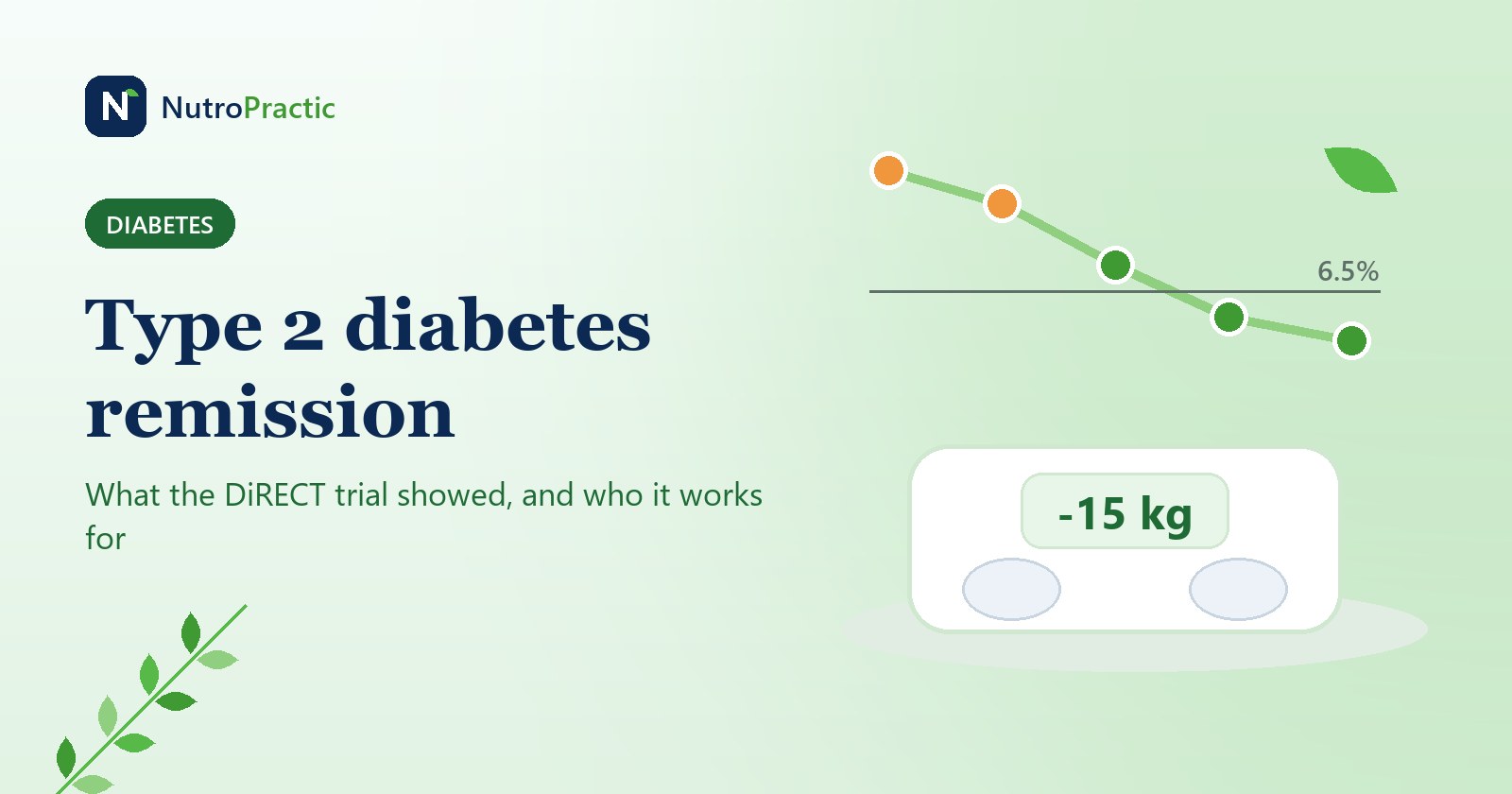
Remission meant an HbA1c under 6.5% (48 mmol/mol) with no diabetes medicines. That matches the definition an international expert group later settled on in 2021: under 6.5%, measured at least three months after the last dose of any glucose-lowering drug.
The numbers, year by year
One year: 46%
After 12 months, 68 of the 149 people in the programme (46%) were in remission, against 6 of 149 (4%) with normal care. Average weight loss was 10 kg (22 lb) in the programme and 1 kg in the comparison group. A quarter of the programme group, 36 people, had lost 15 kg (33 lb) or more.
The more useful finding is what happened when the researchers sorted everyone by how much weight they had lost, whichever group they were in.
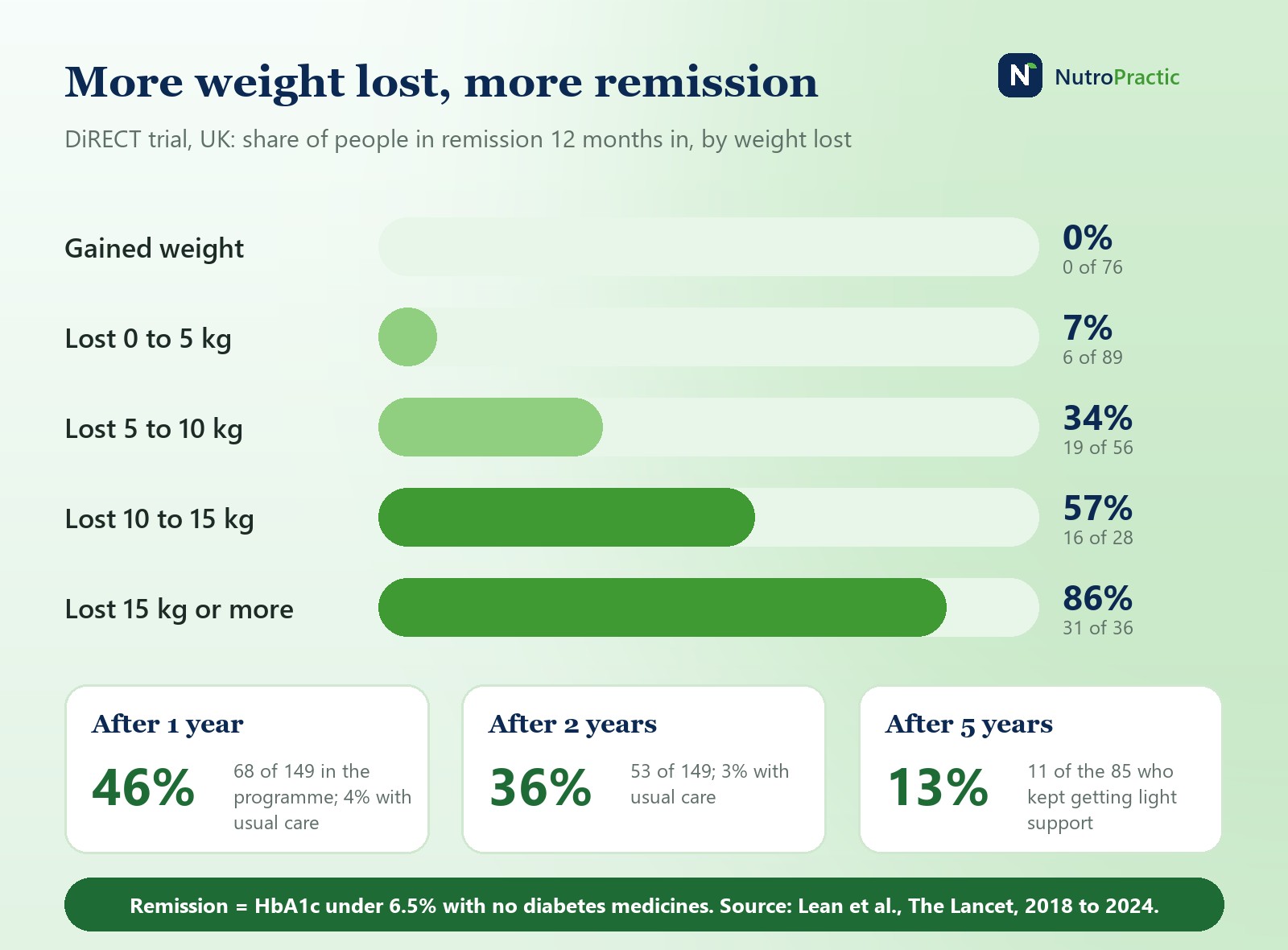
Nobody who gained weight went into remission. Of those who lost 15 kg or more, 86% did. There's no cliff edge at 15 kg; it's a slope, and every band of weight loss did better than the one below it. The soups and shakes were a tool for getting the weight off. What the results tracked was the weight.
Two years: 36%
At 24 months, 53 of 149 (36%) were still in remission, against 5 (3%) with normal care. Among everyone who had kept at least 10 kg off, 64% were in remission. The programme group also had fewer serious medical events in the second year than the comparison group (9 against 22), while using far less medication: 40% were taking a diabetes drug, compared with 84%.
Five years: 13%
This is the number that rarely makes it into the videos. After two years, 95 people from the programme group agreed to three more years of light support. At five years there were data for 85 of them. Their average weight loss from the start had shrunk to 6.1 kg, and 11 of the 85 (13%) were still in remission.
You can read that two ways, and both are fair. Most people regained weight, and their diabetes came back with it. But the group that stayed in touch still spent more of those five years with an HbA1c under 6.5%, and more of them off medication, than the people whose support ended at two years. Years with normal blood sugar count, even if they don't last forever.
Remission of type 2 diabetes is a practical target for primary care.
— Professor Michael Lean and colleagues, in the DiRECT trial's first report (The Lancet, 2018)
Why losing weight can switch it off
The explanation comes from Professor Roy Taylor's group in Newcastle, who ran detailed tests on a subgroup of the trial. In type 2 diabetes the liver holds too much fat and passes fat on to the pancreas, where it interferes with the cells that make insulin. In the people tested, liver fat fell from 16% to about 3% during the programme. In those whose diabetes went into remission, the insulin-making cells started working again.
Those who responded had lived with diabetes for a shorter time, 2.7 years on average against 3.8 years. That's the reason every remission programme asks how long ago you were diagnosed. The insulin-making cells seem able to recover for some years, and then for many people they can't.
It also explains a result that surprises people. In a later Newcastle study of 20 people with type 2 diabetes whose BMI was under 27, so not obviously overweight, 14 went into remission after losing a median of 6.5% of their body weight. The amount of fat a body tolerates before the liver and pancreas struggle differs from person to person. You don't have to look overweight to be over your own limit.
Outside a trial, the results are smaller
England's health service turned DiRECT into a national programme: three months of shakes at 800 to 900 kcal a day, then nine months of coaching. Its first results were published in 2024. Of 1,740 people who started early enough to be followed for a full year, 960 (55%) finished. Those who finished lost 10.3 kg on average. Among the 450 finishers who had two blood tests on record, 145 (32%) were in remission.
So about a third of the people who complete it, and almost half drop out along the way. The authors say plainly that remission in the real world is lower than in the trial. That's a normal gap between a study and everyday life, and it's a reason to go in with honest expectations.
The approach isn't tied to one country. A trial in Qatar, DIADEM-I, used the same structure in adults aged 18 to 50 from the Middle East and North Africa who had been diagnosed within the past three years. They lost about 12 kg in a year, and 61% were in remission, against 12% with usual care. Younger people, diagnosed more recently, did better. That fits everything above.
Who it's most likely to work for
Diagnosed recently. Within six years was the trial's limit, and within three looks better still.
Not on insulin. People on insulin were excluded, so the trial says nothing about them. Needing insulin often means the pancreas has less capacity left to recover.
Able to lose 10 to 15 kg and keep most of it off. For someone who weighs 95 kg (210 lb), that's roughly 10 to 15% of body weight.
With someone to check in with afterwards. In every one of these studies, the people who kept their remission were the ones who kept the weight off, and regular follow-up is what helped them do it.
If you were diagnosed fifteen years ago, or you take insulin, losing weight is still worth it. Blood sugar, blood pressure and the number of tablets you need usually improve. Full remission is just less likely, and it's better to know that at the start.
What remission is not
Remission isn't a cure. The tendency stays. If the weight returns, the diabetes generally returns with it. That's why doctors say remission and not reversal, and why you keep your yearly checks, including the eye screening and the foot check, even when your HbA1c has been normal for years.
Doing it safely
An 800-calorie diet is a medical treatment. Please don't start one from a video.
Medicines have to change on day one. If you take a sulfonylurea (gliclazide, glipizide, glimepiride) or insulin, eating this little without lowering the dose can cause dangerously low blood sugar. SGLT2 inhibitors (the medicines ending in "-gliflozin") are normally stopped before a very low-calorie diet, because the combination raises the risk of ketoacidosis. Blood-pressure tablets often need reducing too, since blood pressure drops quickly. In DiRECT a clinician handled all of this from the first day.
It isn't for everyone. Not during pregnancy or breastfeeding, not with a current or past eating disorder, not with type 1 diabetes, and only with specialist advice if you have kidney disease, gallstones, a recent heart attack or stroke, or you're over 65 and losing muscle is a concern.
Shakes aren't the only route. They were used because they're simple and remove decisions for three months. The link in the data is with weight lost, and a slower plan built on ordinary food can get you there too. It takes longer, and for many people it's easier to live with.
Protect your muscle. Rapid weight loss takes muscle along with fat unless you eat enough protein and keep using your muscles. Our article on protein after 40 covers how much and when.
If you want to try
Start with three questions for your doctor. How long have I had this, counting from when my blood sugar first ran high? What was my last HbA1c? Which of my medicines would need to change if I ate much less? Then decide on the route, shakes or food, and above all who will see you every few weeks for the year after. The first three months are the easy part. The plan for the months after them is what decides the five-year number.
Thinking about remission and not sure where you stand? Dr. Triveni can look at your diagnosis date, your numbers and what you eat now, and tell you honestly what's realistic, in a 15-minute virtual consultation.
Book a 15-minute consultationThis article is general information, not medical advice. Do not start a very low-calorie diet or change any diabetes or blood-pressure medicine without your doctor.
Sources
Lean M. E. J. et al., Primary care-led weight management for remission of type 2 diabetes (DiRECT): an open-label, cluster-randomised trial, The Lancet 391:541-551 (2018). Lean M. E. J. et al., Durability of a primary care-led weight-management intervention for remission of type 2 diabetes: 2-year results of DiRECT, The Lancet Diabetes & Endocrinology 7:344-355 (2019). Lean M. E. J. et al., 5-year follow-up of the randomised Diabetes Remission Clinical Trial (DiRECT) of continued support for weight loss maintenance in the UK: an extension study, The Lancet Diabetes & Endocrinology (2024). Taylor R. et al., Remission of human type 2 diabetes requires decrease in liver and pancreas fat content but is dependent upon capacity for beta cell recovery, Cell Metabolism (2018). Taylor R. et al., Aetiology of type 2 diabetes in people with a 'normal' body mass index: testing the personal fat threshold hypothesis, Clinical Science (2023). Valabhji J. et al., Early findings from the NHS Type 2 Diabetes Path to Remission Programme: a prospective evaluation of real-world implementation, The Lancet Diabetes & Endocrinology (2024). Taheri S. et al., Effect of intensive lifestyle intervention on bodyweight and glycaemia in early type 2 diabetes (DIADEM-I), The Lancet Diabetes & Endocrinology (2020). Riddle M. C. et al., Consensus report: definition and interpretation of remission in type 2 diabetes, Diabetologia (2021).