About 1 person in 100 has coeliac disease and must avoid gluten for life. Far more people avoid it anyway. In US national surveys, the share of people on a gluten-free diet without coeliac disease roughly tripled in five years, from 0.52% in 2009-10 to 1.69% in 2013-14 (Kim and colleagues, JAMA Internal Medicine 2016), and gluten-free shelves have kept growing since.
Many of those people feel better off wheat, and that's real. The question is whether gluten is the reason. That has been tested properly, with gluten and placebo hidden in identical food so nobody knew which they were eating. Here's who those tests say should avoid gluten, how to get tested before you stop, and what going gluten-free costs and takes out of your diet.
Who really has to avoid gluten
Coeliac disease. An immune reaction to gluten damages the lining of the small intestine. Pooled data from 275,818 people worldwide (Singh and colleagues, Clinical Gastroenterology and Hepatology 2018) put the share with coeliac antibodies at 1.4% and biopsy-confirmed disease at 0.7%: 0.8% in Europe, 0.5% in North America, 0.6% in Asia. It's more common in women and children.
Wheat allergy. An IgE allergy, usually in children, to wheat proteins (not only gluten). It's diagnosed by an allergist and means avoiding wheat, though barley and rye are often fine.
Dermatitis herpetiformis, an itchy blistering rash that is coeliac disease in the skin, and the rare gluten ataxia, a balance disorder.
For coeliac disease the bar is strict. In a 90-day blinded trial (Catassi and colleagues, American Journal of Clinical Nutrition 2007), 50 mg of gluten a day damaged the gut lining of people with coeliac disease, while 10 mg did not. That's why "gluten-free" on a label means under 20 mg per kg (20 ppm) in the EU, the US and under the international Codex standard.
India: a wheat line on the map
India's first large national survey (Ramakrishna and colleagues, American Journal of Gastroenterology 2016) tested adults in three regions:
North: coeliac antibodies in 1.23%; coeliac disease 8.5 per 1,000; wheat eaten 455 g a day
Northeast: 0.87%; 4.7 per 1,000; wheat 37 g a day
South: 0.10%; 0.1 per 1,000; wheat 25 g a day
The genes that make coeliac disease possible (HLA-DQ2 and DQ8) were just as common in the south (36%) as in the north (38%). What differed was wheat. So a family from Punjab or Delhi has coeliac rates like Europe's, while a family from Chennai has very low rates, though that can change after a move to a roti-and-bread diet abroad.
Worked example: how much gluten is in a day's food
Gluten makes up roughly 75-80% of wheat protein. Our estimates from typical protein contents:
1 slice of wheat bread (36 g, about 3.4 g protein): about 2.5 g gluten
1 roti from 30 g of atta (about 12% protein): about 3 g gluten
A north Indian day at 455 g of wheat: 455 × 0.12 × 0.8 = about 40 g gluten
The coeliac damage dose of 50 mg: about one-fiftieth of a roti
Get tested before you cut gluten out
This is the step most people skip, and it's the one that matters. The coeliac blood test looks for antibodies your body makes because you're eating gluten. Stop eating it and the test can come back falsely normal within weeks.
The UK's NICE guideline (NG20) says to eat gluten in more than one meal every day for at least 6 weeks before testing. In practice that's a slice of bread or a roti at two meals, around 5-6 g of gluten a day. Adults are tested first for IgA tissue transglutaminase (tTG) together with total IgA, since people with low IgA can test falsely negative and need an IgG-based test. A positive result in an adult is normally confirmed with a biopsy taken during an endoscopy.
If you've already gone gluten-free and don't want to go back, a gene test for HLA-DQ2/DQ8 can help one way: a negative result all but rules coeliac disease out. A positive result means little alone, because 30-40% of people carry those genes. There is no validated blood, stool, saliva or hair test for "gluten sensitivity", and IgG food-intolerance panels aren't recommended by allergy societies.
What the blinded gluten challenges found
Once coeliac disease and wheat allergy are ruled out, people who still react to wheat are said to have non-coeliac gluten sensitivity. The only way to test it is a double-blind challenge: gluten or placebo, hidden in the same food, swapped over, with symptoms scored throughout.
Melbourne, 2011 (Biesiekierski and colleagues; 34 adults): on hidden gluten, 68% said their symptoms weren't controlled, against 40% on placebo. This trial launched the idea that gluten sensitivity is real.
Melbourne, 2013, same team (37 adults with self-reported sensitivity and IBS): everyone first ate low in FODMAPs, a group of fermentable carbohydrates, for 2 weeks, and every participant improved. Then 16 g of gluten a day, 2 g of gluten, or a whey-protein placebo for a week each: symptoms worsened by a similar amount on all three, and gluten-specific effects showed up in only 8%. A re-test didn't reproduce them.
Oslo, 2018 (Skodje and colleagues; 59 adults already gluten-free): muesli bars with 5.7 g gluten, 2.1 g fructans (a FODMAP found in wheat, onion and garlic) or neither, a week each. Symptom scores: 33.1 on gluten, 38.6 on fructans, 34.3 on placebo. Fructans caused more bloating; gluten was no different from placebo. 13 people felt worst on gluten, 24 on fructans and 22 on placebo.
A review of 10 blinded challenge trials with 1,312 adults (Molina-Infante and Carroccio, 2017) found that only 38 of 231 people with suspected gluten sensitivity, 16%, reacted specifically to gluten. And 40% of those reacted just as much, or more, to placebo.
Expecting gluten is enough
In 2024 a trial in the UK and the Netherlands (de Graaf and colleagues, Lancet Gastroenterology and Hepatology; 84 adults with self-reported sensitivity) separated what people ate from what they were told. Each group got oat bread with or without gluten, and was told it did or didn't contain gluten. Average symptom scores on a 100 mm scale:
Told gluten, got gluten: 16.6
Told gluten, got none: 11.7
Told gluten-free, got gluten: 6.9
Told gluten-free, got none: 7.4
People who ate real gluten but believed it was gluten-free felt no worse than those who ate none. Expecting gluten pushed symptoms up whether or not it was there; expectation plus gluten together gave the highest score. The study was part-funded by baking-industry bodies, which is worth knowing, though the design was double-blind.
None of this means the symptoms are imagined. Bloating and pain are real, and the gut-brain link is real. It means that for most people the trigger isn't gluten: it's more often fructans and other FODMAPs, the size and fat of the meal, or the gut's sensitivity in IBS. If that sounds like you, the low-FODMAP approach in our IBS article has better trial evidence than a gluten-free diet.
Does gluten-free help anyone else?
Weight: no trials show that gluten-free eating causes weight loss in people without coeliac disease. People who lose weight usually do it by cutting cakes, biscuits and pastries, which works with or without gluten.
Heart: in 110,017 US nurses and health professionals followed for 26 years (Lebwohl and colleagues, BMJ 2017), the people eating the most gluten had no more heart disease than those eating the least (hazard ratio 0.95, 0.88-1.02). Gluten from whole grains was linked to 15% lower risk (0.85). The authors' conclusion: avoiding gluten may mean eating fewer whole grains, and gluten-free diets shouldn't be promoted to people without coeliac disease.
What gluten-free costs, and what it takes out
In the UK (Fry and colleagues, Journal of Human Nutrition and Dietetics 2018), 679 gluten-free products were compared with 1,045 regular ones:
Price: £1.14 per 100 g gluten-free against £0.44 regular, 159% more
Fat, sugar and salt: more gluten-free products fell in the high or medium bands; gluten-free bread and flour were more often high in fat and sugar
Fibre and protein: gluten-free items were more likely to be lower in both
Worked out for a household eating 2 kg a week of bread, pasta, crackers and similar staples, at those 2016 prices: £8.80 regular against £22.80 gluten-free, £14 a week or about £730 a year more.
In eastern Canada (Jamieson and colleagues, PeerJ 2018; 398 gluten-free against 445 regular products), gluten-free staples had 55% less iron, 44% less folate and 36% less protein, with 1.3 times the fat. Gluten-free pasta had only 37% of the fibre of regular pasta. The flours themselves were similar; the gap was in processed products.
Part of the reason is fortification. US enriched wheat flour must carry folic acid and iron, and from 13 December 2026 UK non-wholemeal wheat flour must carry 250 µg of folic acid per 100 g. Gluten-free flours aren't covered by either rule. Someone who swaps wheat bread for gluten-free bread can lose a folic acid source without noticing, which matters most for anyone who might become pregnant. Check labels for "fortified", and see our fibre gap article for keeping fibre up.
Gluten-free the Indian way
If you do need to avoid gluten, an Indian kitchen makes it cheaper than a supermarket aisle. Rice, idli and dosa (rice and urad dal), poha, besan chilla, and rotis of jowar, bajra or ragi are naturally gluten-free and need no special products. Dal, rajma, chana and curd fill in protein; whole millets keep fibre up where plain white rice would let it drop.
The traps are less obvious: suji/rava, maida, dalia, seviyan and barley (jau) all contain gluten. Oats are often contaminated with wheat unless labelled gluten-free. And hing (asafoetida) is usually sold "compounded" with wheat flour; people with coeliac disease need a hing labelled gluten-free (rice-based) or pure resin. Shared tawas, sieves and flour bins matter for coeliac disease, too.
If you suspect gluten: a sensible order
1. Test first, while still eating gluten: tTG-IgA and total IgA, after 6 weeks of gluten at two meals a day.
2. If coeliac disease is confirmed: strict gluten-free for life, with a dietitian, and a check of iron, folate, vitamin D and B12.
3. If it isn't, and you have IBS-type symptoms: try a dietitian-led low-FODMAP diet for 2-6 weeks, then bring foods back one at a time.
4. If you still think it's gluten: do a blinded test at home. Someone else stirs either 8 g of vital wheat gluten (about 6 g of gluten, the Oslo dose) or 8 g of rice flour into the same yoghurt or soup every day for a week, then switches after a week's break. You score bloating, pain and tiredness 0-10 each evening and only find out the order at the end. Not for anyone with wheat allergy or coeliac disease.
5. If gluten doesn't stand out: you don't need gluten-free products. Eat the wheat you tolerate, and keep whole grains.
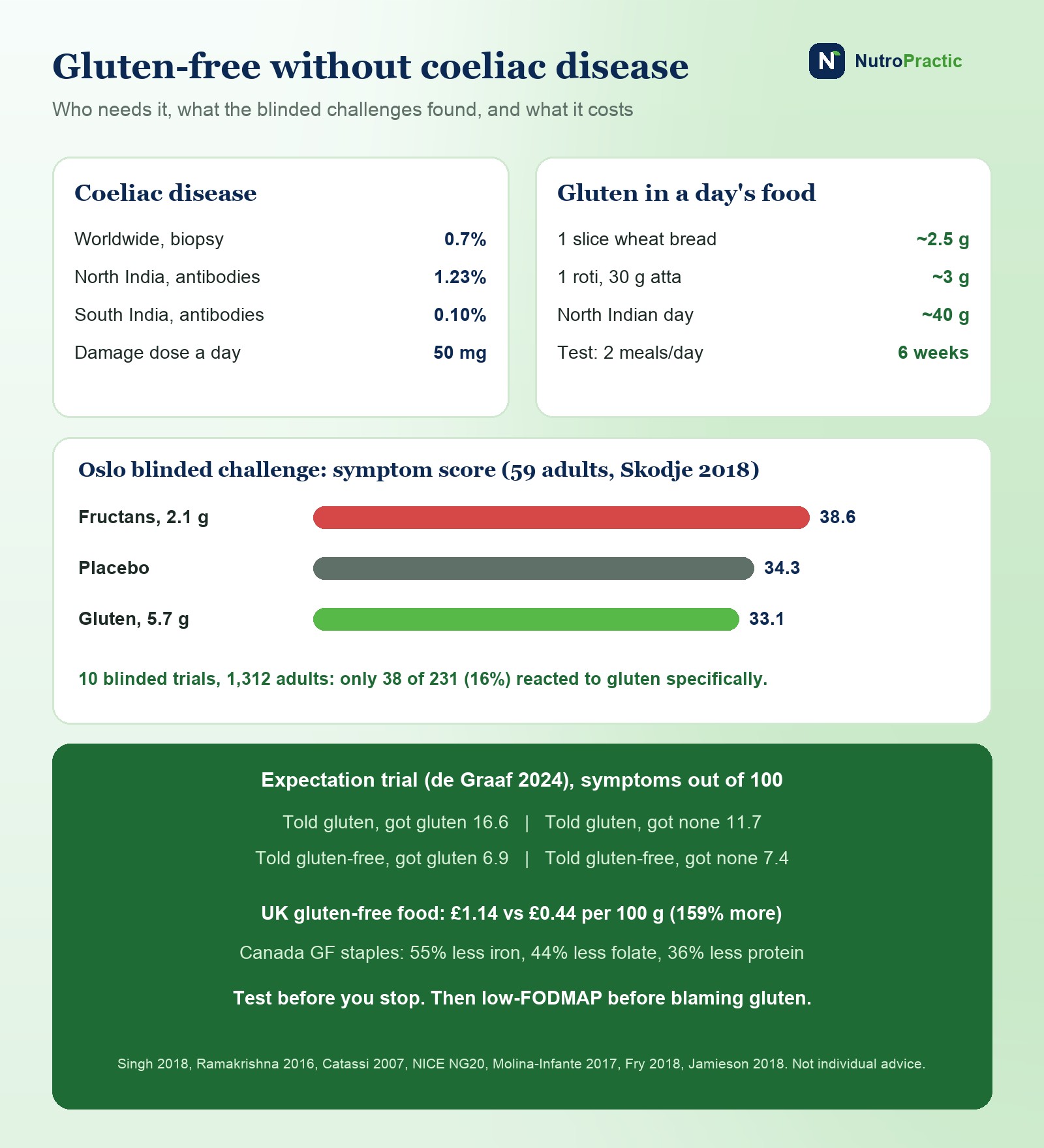
Test before you stop. If coeliac disease is ruled out, look at fructans and portion sizes before you blame gluten, and keep the whole grains.
Bloating, pain or an unpredictable gut, and not sure whether wheat is really the problem? Dr. Triveni can plan a careful elimination and reintroduction with you in a virtual consultation, without cutting more food than you need to.
Book a consultationThis article is general information, not medical advice. Don't start a gluten-free diet before coeliac testing if your doctor has suggested it, and see a doctor promptly for weight loss, blood in the stool, anaemia or symptoms that wake you at night.
Sources
Kim H.S. et al., Time trends in the prevalence of celiac disease and gluten-free diet in the US population: NHANES 2009-2014, JAMA Intern Med 176(11):1716-1717 (2016). Singh P. et al., Global prevalence of celiac disease: systematic review and meta-analysis, Clin Gastroenterol Hepatol 16(6):823-836 (2018). Ramakrishna B.S. et al., Prevalence of adult celiac disease in India: regional variations and associations, Am J Gastroenterol 111(1):115-123 (2016). Catassi C. et al., A prospective, double-blind, placebo-controlled trial to establish a safe gluten threshold for patients with celiac disease, Am J Clin Nutr 85(1):160-166 (2007). NICE, Coeliac disease: recognition, assessment and management (NG20) (2015).
Biesiekierski J.R. et al., Gluten causes gastrointestinal symptoms in subjects without celiac disease, Am J Gastroenterol 106(3):508-514 (2011). Biesiekierski J.R. et al., No effects of gluten in patients with self-reported non-celiac gluten sensitivity after dietary reduction of FODMAPs, Gastroenterology 145(2):320-328 (2013). Skodje G.I. et al., Fructan, rather than gluten, induces symptoms in patients with self-reported non-celiac gluten sensitivity, Gastroenterology 154(3):529-539 (2018). Molina-Infante J., Carroccio A., Suspected nonceliac gluten sensitivity confirmed in few patients after gluten challenge in double-blind, placebo-controlled trials, Clin Gastroenterol Hepatol 15(3):339-348 (2017). de Graaf M.C.G. et al., The effect of expectancy versus actual gluten intake on gastrointestinal and extra-intestinal symptoms in non-coeliac gluten sensitivity, Lancet Gastroenterol Hepatol 9(2):110-123 (2024).
Lebwohl B. et al., Long term gluten consumption in adults without celiac disease and risk of coronary heart disease, BMJ 357:j1892 (2017). Fry L., Madden A.M., Fallaize R., An investigation into the nutritional composition and cost of gluten-free versus regular food products in the UK, J Hum Nutr Diet 31(1):108-120 (2018). Jamieson J.A., Weir M., Gougeon L., Canadian packaged gluten-free foods are less nutritious than their regular gluten-containing counterparts, PeerJ 6:e5875 (2018). UK Government, Bread and flour labelling and composition (folic acid fortification from 13 December 2026). Codex Alimentarius, Standard for foods for special dietary use for persons intolerant to gluten (CXS 118-1979).