Recovery after surgery · November 1, 2026
An AI wrote their diet plan after cancer surgery. Two in three reached their calorie target, against two in five on the usual handout, and the AI may not be the reason
In a 90-patient trial in Wuhan, a tailored plan from a large language model beat a one-page leaflet on food diaries and on symptoms. Weight and blood tests did not budge, and the authors themselves say the trial cannot tell whether the AI did the work or the numbers on the page did.
Going home after stomach or bowel cancer surgery often comes with a short leaflet: small meals, soft foods, enough fluid, some protein at each meal. It is sound advice, and it does not say how much protein, or what soft food means for this person after this operation. A team at Tongji Hospital in Wuhan tested whether a large language model could fill that gap. Their randomised trial was published in Supportive Care in Cancer on 29 October.
They screened 187 people having planned keyhole surgery for gastric or colorectal cancer and randomised 90, half to each arm, average age about 61. In the AI arm a research nurse typed each patient's details into a set prompt: operation, weight, blood results, what they could tolerate, other conditions. DeepSeek v3.2 wrote a week-by-week plan with calorie, protein and fluid targets and familiar foods such as congee with minced pork and steamed fish. A dietitian checked each plan for safety in 3 to 5 minutes, without changing its substance, and it was printed. The other arm got the hospital's usual one-page advice and talk from the surgeon or ward nurse.
Thirty days after discharge, judged from three days of food records, 30 of 45 patients in the AI arm (66.7%) reached at least 90% of their calorie target, against 18 of 45 (40.0%) on usual advice. For protein, at least 1.2 g per kg of body weight a day, it was 62.2% against 35.6%. Fatigue, nausea, appetite loss and gut symptom scores were lower in the AI arm too. Dietitians who did not know the groups rated the plans higher on completeness, tailoring and practicality, but not significantly higher on accuracy or safety. Staff time per patient was 8.2 minutes against 12.5.
Now the limits, several of them stated plainly by the authors. Weight change (-2.1% against -2.5%), albumin, haemoglobin, complications (20.0% against 22.2%) and nutrition-related readmissions did not differ, though 30 days and 90 people could easily miss such changes. The AI arm got tailoring, written targets, nearly three times the words, and a dietitian's check, all at once, so the authors say the trial does not show AI beats similar tailored advice written by a person. 93.3% of AI plans carried numeric targets against 51.1% of the usual advice, and that may be the active ingredient. Patients knew which arm they were in and kept their own food records, the methods describe no correction for the many symptom scales tested, and this was one hospital with patients who were fairly well nourished. No competing interests were declared; funding came from a Chinese clinical nutrition research foundation.
AI-written diet plan against usual discharge advice, 90 patients after gastric or colorectal cancer surgery, Tongji Hospital, Wuhan (Supportive Care in Cancer, 29 October 2026)
66.7% vs 40.0%
Reached at least 90% of calorie target at 30 days, AI plan vs usual advice (OR 3.0, 95% CI 1.3 to 7.1)
62.2% vs 35.6%
Reached at least 1.2 g protein per kg a day (OR 2.9, 95% CI 1.2 to 6.8)
-2.1% vs -2.5%
Weight change from discharge to 30 days (P = .33, no significant difference)
20.0% vs 22.2%
Complications of grade II or above within 30 days (no significant difference)
33.8 vs 41.5
Fatigue score at 30 days, lower is better (P = .04)
2.1 vs 2.5
Gut symptom score (GSRS total) at 30 days, lower is better (P = .03)
8.2 vs 12.5 min
Staff time per patient, logged by the research nurse
845 vs 310
Average words of written guidance
93.3% vs 51.1%
Written guidance containing numeric targets
Figures were read in the open-access full text of the paper. A single-hospital trial with a short 30-day follow-up; clinical outcomes were exploratory. The paper disagrees with itself in two places: it gives the recruitment period as both January to March 2026 and December 2025 to February 2026, and a figure caption gives complications in the usual-advice arm as 24.4% where the table and text give 22.2%. We used the table. The staff-time gap is the authors' measurement of this workflow, not a general estimate.
- The targets in this trial were 25 to 30 kcal per kg of body weight a day and at least 1.2 g of protein per kg. For a 60 kg person that works out at 1,500 to 1,800 kcal, so the 90% pass mark falls between 1,350 and 1,620 kcal, plus 72 g of protein. That sum is ours, not the paper's, and it is not a target for any individual reader.
- The difference between the arms was 12 people out of 45 reaching their calorie target. Put another way, for about every four people given the tailored plan, one more reached the target than on usual advice. That sum is also ours, and the confidence interval around it is wide.
- The usual handout was not a bad document. Dietitians gave it 4.5 out of 5 for accuracy against 4.7 for the AI plans, and 4.8 for safety against 4.9. Where it lost ground was individual tailoring, 2.8 against 4.8.
- Left alone, these models can stumble on nutrition. In a test published in 2025, GPT-4o scored 62% on true-or-false questions about whether dietary supplements work, while a system tied to a curated supplement database scored 99%.
- A 2024 study put 63 prompts on diabetes and metabolic syndrome to ChatGPT, and two dietitians checked the answers against guidelines. They rated clarity good or excellent, but its 1,500 kcal menus were out of line on carbohydrate, fat, vitamin D and calcium.
- AI-facilitated individualized nutritional guidance with ABC-structured prompts improves short-term dietary intake adequacy and patient-reported symptoms after gastrointestinal cancer surgery: a randomized controlled trialSupportive Care in Cancer, 29 October 2026 · The paper's DOI. Open access. Registered as ChiCTR2500111035.
- Full text of the paper (PMC13719733)PubMed Central, US National Library of Medicine · Tables with process measures, outcomes, funding and competing interests.
- Improving Dietary Supplement Information Retrieval: Development of a Retrieval-Augmented Generation System With Large Language ModelsJournal of Medical Internet Research, 2025 · The 62% and 99% accuracy comparison.
- Artificial intelligence chatbots for the nutrition management of diabetes and the metabolic syndromeEuropean Journal of Clinical Nutrition, 2024 · Dietitians' review of 63 chatbot prompts against guidelines.
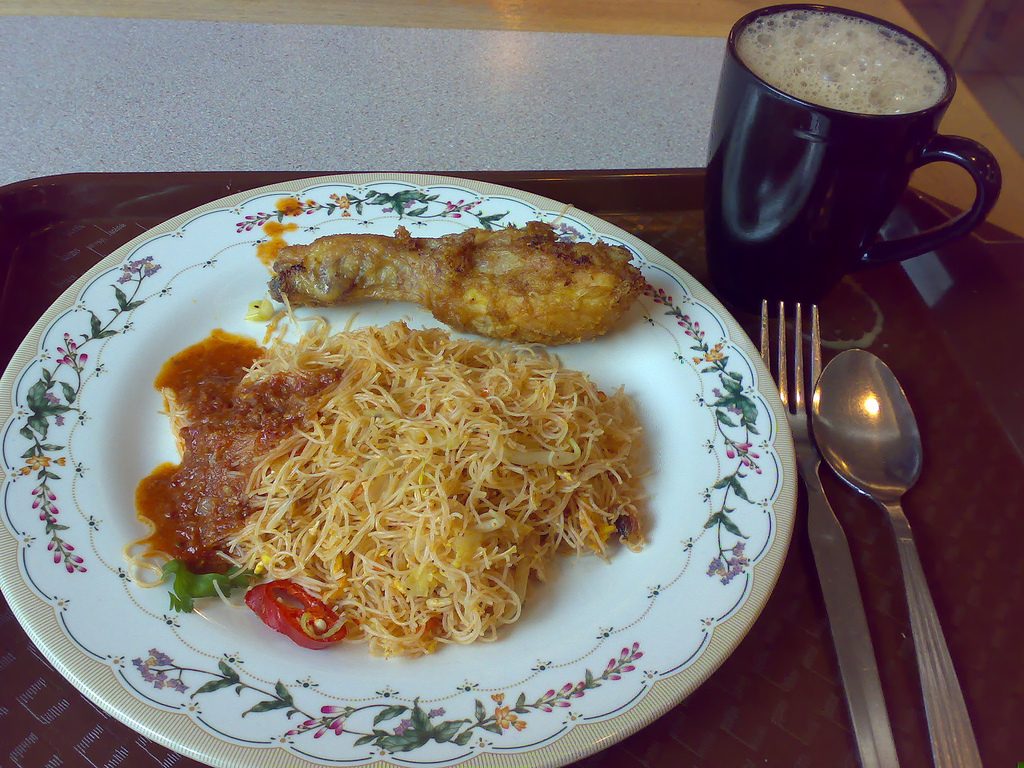
- Hospital lunchWikimedia Commons · CC BY 2.0 photograph by hewyk, used as a general illustration.
General information, not medical advice. This trial shows that a tailored written plan helped people reach food targets for a month, not that it improved recovery or survival, or that AI advice is safe to use unchecked. If you are recovering from cancer surgery, follow your surgical team's instructions and ask them or a registered dietitian before changing what you eat, and do not rely on a chatbot alone.
Analysis by NutroPractic from the sources listed. Written for general readers; it does not replace advice from your own doctor.
From our articles
Read, then eat a little better
Plain-language guides on nutrition and wellness, backed by research.
Gut health
Gluten-free without coeliac disease: who actually benefits, and what the blinded gluten challenges found
In blinded trials only 16% of people who said gluten made them ill reacted to gluten rather than placebo, and in Oslo fructans caused more bloating than gluten. Who really needs to avoid it, how to get tested before you stop, how much gluten is in a slice of bread or a roti, and what gluten-free food costs (159% more in the UK) and lacks.
1 Nov 2026
Diabetes
Fenugreek, cinnamon and turmeric for blood sugar: what the trials in an Indian kitchen measured
Fenugreek seed at 5-10 g a day lowered HbA1c by about 0.85 points in pooled trials, and in a 3-year Hyderabad study 23% went on to diabetes against 55%. Cinnamon trims fasting glucose by 15-25 mg/dL, but a teaspoon of cassia tops the coumarin limit. Curcumin: about 0.3-0.4 points, and rare liver injury from capsules. Doses in teaspoons, and a fair way to test it at home.
1 Nov 2026

Diabetes
Potatoes and blood sugar: boiled, cooled, mashed or fried, and what the cohorts and trials found
Fries were linked to 20% higher diabetes risk per three servings a week in 205,000 US adults; boiled, baked and mashed potatoes to almost none. GI by cooking method, resistant starch in grams after chilling, the glycaemic load of a potato against a cup of rice, and how to fit aloo into an Indian plate.
30 Oct 2026
Newsfeed for your website
Want this feed on your website?
Add it to any site with one copy-and-paste snippet. No sign-up, and it updates itself every hour.
Start with a virtual consultation
Tell Dr. Triveni what you want to change. You will leave with a clear next step, whether you are in Toronto, London, New York or Chennai.