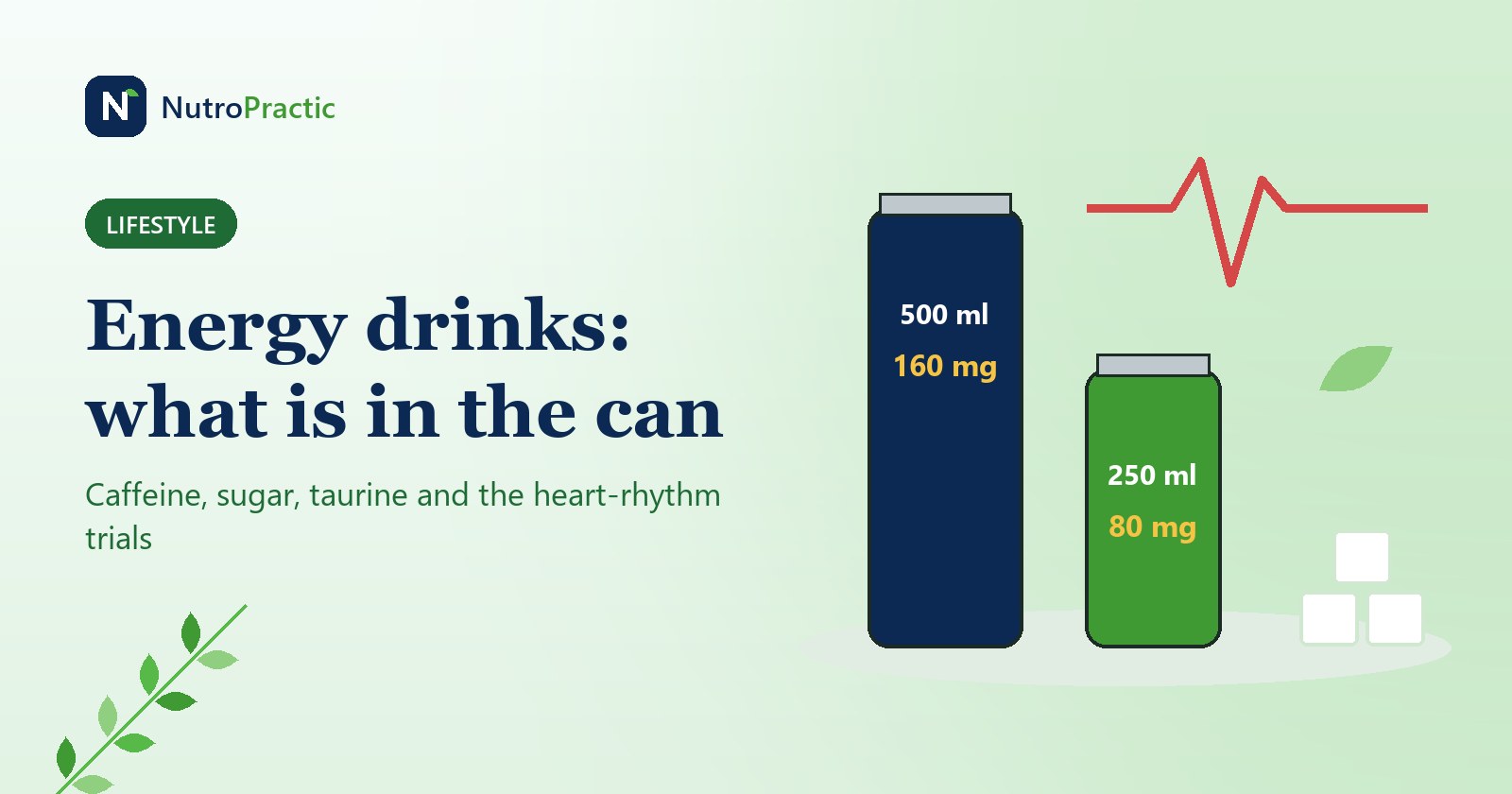
An energy drink can sits on a shop shelf next to cola and looks like the same kind of thing. It might hold 80 mg of caffeine or 300 mg, and 55 g of sugar or none. The name on the front doesn't tell you much, so the first useful step is reading what's in the can.
After that come the two questions people actually ask: are these drinks bad for your heart, and what sent people to emergency rooms? The studies are smaller and messier than the headlines suggest. Some of them are still hard to ignore.
What's in the can
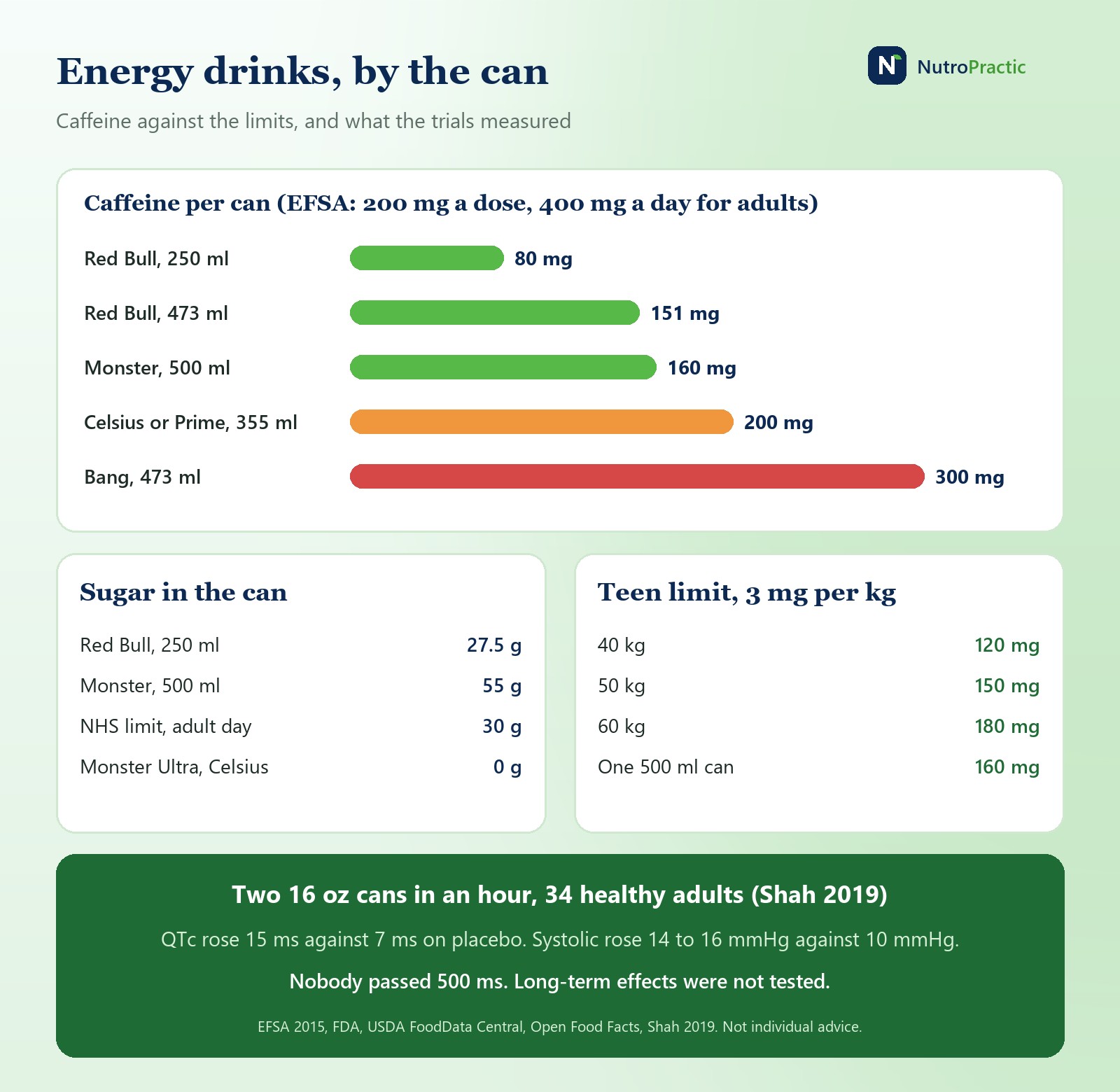
These are label figures, so check your own can, because recipes and sizes change by country. The last columns work out each can as a share of three limits: EFSA's 400 mg a day for adults, 150 mg for a 50 kg teenager (3 mg per kg, more on that below) and the NHS limit of 30 g of free sugars a day for anyone from age 11.
| Drink | Can | Caffeine | Of adult 400 mg | Of 50 kg teen's 150 mg | Sugars | Of NHS 30 g |
|---|---|---|---|---|---|---|
| Red Bull, EU/UK | 250 ml | 80 mg | 20% | 53% | 27.5 g | 92% |
| Red Bull, US | 473 ml | 151 mg | 38% | 101% | 51 g | 170% |
| Monster Energy, UK | 500 ml | 160 mg | 40% | 107% | 55 g | 183% |
| Monster Ultra, UK | 500 ml | 160 mg | 40% | 107% | 0 g | 0% |
| Celsius Original, US | 355 ml | 200 mg | 50% | 133% | 0 g | 0% |
| Prime Energy, US | 355 ml | 200 mg | 50% | 133% | 0 g | 0% |
| Bang, US | 473 ml | 300 mg | 75% | 200% | 0 g | 0% |
The FDA's own range is wider than any single brand: 41 to 246 mg in a 12 oz can and 54 to 328 mg in a 16 oz can. A mug of filter coffee, at 95 to 140 mg, sits inside those ranges, so strength alone doesn't separate energy drinks from coffee. Speed and size do. A cold can goes down quickly, nobody sips it for an hour, and it's easy to have a second.
Sugar is the plainest finding here. The regular 500 ml Monster has 55 g, about 14 teaspoons at 4 g each, which is 183% of the NHS limit for a whole day. That's a bigger and firmer problem for most regular drinkers than anything on an ECG. Zero-sugar versions solve that one problem and leave the caffeine exactly where it was.
The limits, and what they work out to
EFSA's 2015 opinion is still the reference point in Europe. For healthy adults, it found no safety concern with single doses up to 200 mg or up to 400 mg a day. In pregnancy the daily figure is 200 mg. For children and teenagers, it used 3 mg per kg of body weight a day, while noting that the data are limited.
| Body weight | 3 mg per kg a day | One 250 ml can (80 mg) | One 500 ml can (160 mg) | One 473 ml, 300 mg can |
|---|---|---|---|---|
| 40 kg | 120 mg | 67% | 133% | 250% |
| 50 kg | 150 mg | 53% | 107% | 200% |
| 60 kg | 180 mg | 44% | 89% | 167% |
So one large can takes a 40 kg twelve-year-old past the day's figure before any cola or iced tea. Canada is stricter still, advising about 2.5 mg per kg for teenagers, as we covered in our piece on feeding a teenage athlete. It also caps energy drinks at 180 mg per serving, well under the 300 mg can in the table.
A typical heavy day for an adult: a mug of filter coffee at 8 am (120 mg), a 500 ml can at 2 pm (160 mg) and another at 5 pm (160 mg). That's 440 mg, over the daily figure, with no single drink looking excessive. With a half-life of about 5 hours, around 150 mg is still in the body at 10 pm. EFSA noted that 100 mg near bedtime can delay sleep and shorten it in some adults. Our free caffeine counter draws that curve for your own day, and our piece on food and sleep goes into timing.
Taurine: mostly not the villain
Taurine has the most sinister reputation on the label, but it's an amino acid that's already in meat, fish and your own body. EFSA's figures for a typical energy drink are about 4,000 mg of taurine per litre: 1,000 mg in a 250 ml can and 2,000 mg in a 500 ml can.
EFSA's panel looked at taurine in 2009. Using a safe-dose benchmark from animal studies of 1,000 mg per kg a day, a 60 kg person drinking 1.4 cans a day had a safety margin of 43 times. In 2015 it also concluded that taurine and glucuronolactone, at typical levels, wouldn't change the safety of a single caffeine dose up to 200 mg. Two limits are worth noticing. The panel was judging ingredients, not energy drinks as products. And 200 mg is the dose it covered, which leaves out the 300 mg can and the two-can hour.
So taurine alone isn't where the worry lies. Whether the whole mixture acts differently from caffeine is still open, and that's where the trials come in.
What the heart-rhythm trials measured
These trials mostly track the QT interval, the time the heart's lower chambers take to recharge between beats, corrected for heart rate (QTc). A much longer QTc is linked to dangerous rhythms. Drug regulators start paying close attention at an average rise of around 5 ms, and values above 500 ms are the usual point of serious concern.
| Trial | Who | What they drank | Result |
|---|---|---|---|
| Shah, JAHA 2019 | 34 healthy adults, average age 22; crossover, double-masked | 946 ml (two 16 oz bottles) within an hour, 304 to 320 mg caffeine, or placebo | Largest QTc rise (Fridericia): +15.0 and +15.2 ms against +6.9 ms on placebo. Systolic: +15.9 and +14.4 mmHg against +9.8. Diastolic: +9.6 against +6.1 |
| Fletcher, JAHA 2017 (same group) | 18 healthy young adults; crossover | 946 ml energy drink or a caffeine drink, both 320 mg caffeine | QTc at 2 hours: +0.44 against -10.4 ms. Systolic at 6 hours: +4.72 against +0.83 mmHg. No gap at other time points |
| Gray, Int J Cardiol 2017 | 24 people with long QT syndrome; crossover | Energy drink or a control drink | Average QTc no different (+12 against +16 ms). Peak systolic +7 against +1 mmHg, diastolic +8 against +2. Dangerous QT lengthening in some patients |
Reading Shah closely tells you a good deal. Placebo moved these numbers too, which is why the gap matters more than the headline rise. That gap is about 8 ms for QTc and 5 mmHg for systolic pressure, in the range regulators watch but not an alarm for a healthy person on its own. No one crossed 500 ms. On the other hand, two people gained more than 50 ms after the energy drinks and nobody did on placebo, and systolic pressure reached 140 to 160 mmHg in 8 or 9 of the 34 after the drinks against 2 on placebo. These were healthy 22-year-olds.
The limits are large. It tested a big dose fast, once, and followed people for four hours. So it says little about one can a day for ten years, in either direction. The lead author has also acted as an expert witness in energy drink cases, which is worth knowing even though the design was sound.
Fletcher is the trial used to argue that it's not only the caffeine, since the caffeine dose matched. It's small, the gap appeared at single time points, there was no adjustment for many comparisons and no plain placebo arm. The energy drink also had 108 g of sugar in it. It's a reason to study the mixture further, and we wouldn't claim more than that.
The cardiac arrest series
The Mayo Clinic's genetic heart rhythm clinic reviewed 144 survivors of sudden cardiac arrest (Martinez, Heart Rhythm 2024). Seven, or 5%, had drunk an energy drink shortly before; six were women and their average age was 29. Two had long QT syndrome, two had another inherited rhythm disorder (CPVT) and three had no identified cause. Three drank them regularly. All seven stopped and have had no further events.
Seven people at a specialist clinic can't tell you the risk for anyone, and timing alone doesn't prove cause. The authors say so and call it an early warning. It does give a clear practical message for a small group, below.
The emergency-visit numbers
The figure quoted everywhere comes from the US Drug Abuse Warning Network (Mattson, SAMHSA, 2013), and it's now old data. Estimated emergency visits involving energy drinks:
| Measure | 2007 | 2011 | Change |
|---|---|---|---|
| All visits | 10,068 | 20,783 | +106% |
| Adverse reactions | 6,996 | 14,042 | +101% |
| Misuse or abuse | 3,060 | 6,090 | +99% |
| Patients aged 40 or over | 1,382 | 5,233 | +279% |
In 2011, 58% of those visits involved energy drinks alone and 42% also involved other drugs, including alcohol and prescription medicines. Men made up about two-thirds or more each year. Older patients grew fastest, a detail usually lost in stories about teenagers.
A few cautions. The drink being mentioned in a hospital record doesn't show it caused the visit, as the project's own leader said at the time, and Monster called the report misleading. The doubling also has no sales figures beside it here, so part of it may simply reflect more people drinking them. And we couldn't find a newer national figure from the same system, so nobody should quote it as today's number.
Children and the new English ban
The UK figures are why this became law rather than advice. A government-commissioned overview (Khouja, BMJ Open 2022) found that 3% to 32% of children across five UK datasets drank energy drinks weekly, and the government cites about 4% of 11 to 15 year olds in England drinking at least one a day, more than 100,000 children. Links were reported with headaches, sleep problems, irritability, alcohol and smoking. The review's own quality ratings were low, and these are associations.
Earlier coverage called it a proposal, but it has moved on. On 16 July 2026 the government confirmed it will ban sales in England of drinks over 150 mg of caffeine per litre to under-16s, expected from 6 April 2027 subject to Parliament. It covers shops, online sales and vending machines, and leaves out tea and coffee. Fixed penalties are £1,500 for small businesses and £2,500 for larger ones. Of 1,095 consultation responses, 90% supported the idea. The industry body called it unnecessary, and the government itself accepts the evidence is observational and doesn't prove direct harm.
At 150 mg per litre, every can in our table falls in scope: 250 ml of Red Bull comes to 320 mg per litre. The EU has required a "high caffeine content" warning, not recommended for children or during pregnancy or breastfeeding, above the same 150 mg per litre since 2014. The FDA and the American Academy of Pediatrics also advise against energy drinks for children and teens.
Our reading, and what to do
One standard can now and then isn't something a healthy adult needs to fear. The sugar in a regular can, the sleep it costs and the way the cans add up are firmer problems than the heart signal for most people. The heart signal is still real enough that some people should simply stay away.
Skip them altogether if you're under 16 or a child in your care is, you're pregnant or breastfeeding, or you have long QT syndrome, CPVT, another inherited heart rhythm condition, or a family history of sudden death at a young age. Ask your doctor first if you have high blood pressure, a rhythm problem or a stimulant prescription.
If you do drink them:
Read the milligrams on the can. 80 and 300 mg are very different drinks.
Keep one sitting to 200 mg and the day to 400 mg, and count coffee, tea, cola and pre-workout powder.
Drink one slowly. The worrying trial was two big cans in an hour.
Keep them away from alcohol, which was among the other substances in those emergency visits. EFSA's reassurance on alcohol only went up to a 200 mg dose and moderate drinking.
Pick a zero-sugar version, or count the sugar. A regular 500 ml can is nearly two days of the NHS sugar limit.
Set a stop time. For a 10:30 pm bedtime, have the last one by about 1:30 pm.
Stop and get checked if you feel a racing or irregular heartbeat, chest pain or faintness after one.
If you're mainly tired at work, that's a separate problem worth solving at the source. Our pieces on eating on night shifts and coffee and your heart are good next stops.
Read the milligrams, count the sugar, and don't let the second can be automatic.
Leaning on cans to get through the day, or worried about a teenager who is? Dr. Triveni can go through your sleep, meals and caffeine in a virtual consultation, and runs nutrition programmes for workplaces and schools too.
Book a consultationThis article is general information, not medical advice. If you have a heart condition, high blood pressure or are pregnant, talk to your doctor. Seek urgent care for chest pain, fainting or a sustained irregular heartbeat. Brands are named only as label examples; we have no link to them.
Sources
Limits: EFSA NDA Panel, Scientific opinion on the safety of caffeine, EFSA Journal 13(5):4102 (2015). EFSA, Two ingredients commonly used in some energy drinks (2009). FDA, Spilling the beans: how much caffeine is too much?. Health Canada, Caffeinated energy drinks. NHS, Sugar: the facts. FDA, ICH E14 on QT studies.
Trials: Shah S.A. et al., Impact of high volume energy drink consumption on electrocardiographic and blood pressure parameters, J Am Heart Assoc 8:e011318 (2019). Fletcher E.A. et al., Randomized controlled trial of high-volume energy drink versus caffeine consumption, J Am Heart Assoc 6:e004448 (2017). Gray B. et al., Cardiovascular effects of energy drinks in familial long QT syndrome, Int J Cardiol (2017). Martinez K.A. et al., Sudden cardiac arrest occurring in temporal proximity to consumption of energy drinks, Heart Rhythm (2024).
Emergency visits and policy: Mattson M.E., Update on emergency department visits involving energy drinks, SAMHSA DAWN Report (2013), with Monster's response. Khouja C. et al., Consumption and effects of caffeinated energy drinks in young people, BMJ Open 12:e047746 (2022). DHSC, Banning the sale of high-caffeine energy drinks to children: consultation outcome (updated 16 July 2026). EU Regulation 1169/2011, Annex III.
Cans, read 4 November 2026: Open Food Facts, Red Bull 250 ml and Monster Ultra 500 ml. Monster Energy 500 ml sugar and caffeine, News Letter. USDA FoodData Central, Red Bull 8.4 oz branded record, used for the 473 ml sugar estimate. Caffeine in US cans, The Takeout, June 2026 (Red Bull 473 ml, Celsius, Prime, Bang), from brand labels. Sugar-free status of Celsius, Prime and Bang from brand listings; check your can.