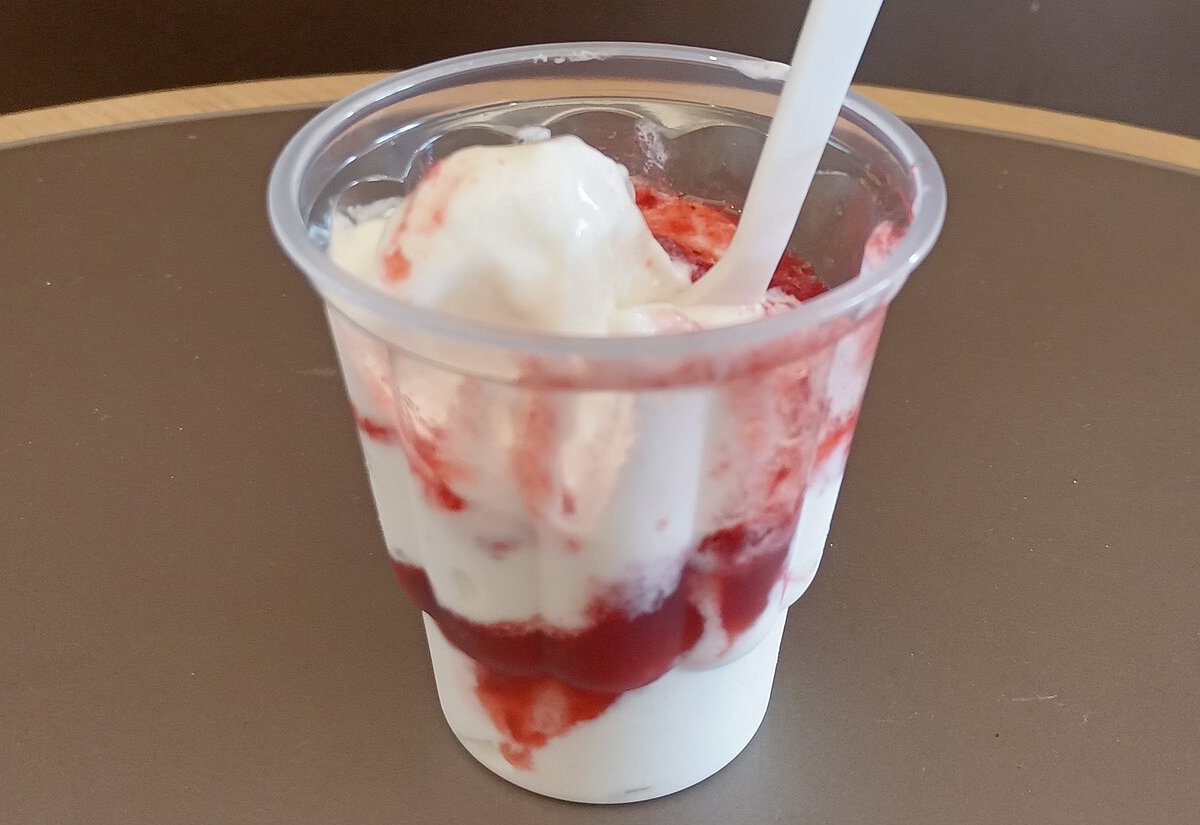
Juice is an odd case in nutrition. It comes from fruit, it has real vitamin C and potassium, and nothing has been added to a 100% carton. It's also, gram for gram, about as sugary as a soft drink. Both of those things are true, and that's why the advice can seem to wobble.
Here are the actual limits, the sums behind them, and what the studies can and can't tell us. Fresh juice stalls and packaged Indian juices get their own section further down.
The limits, side by side
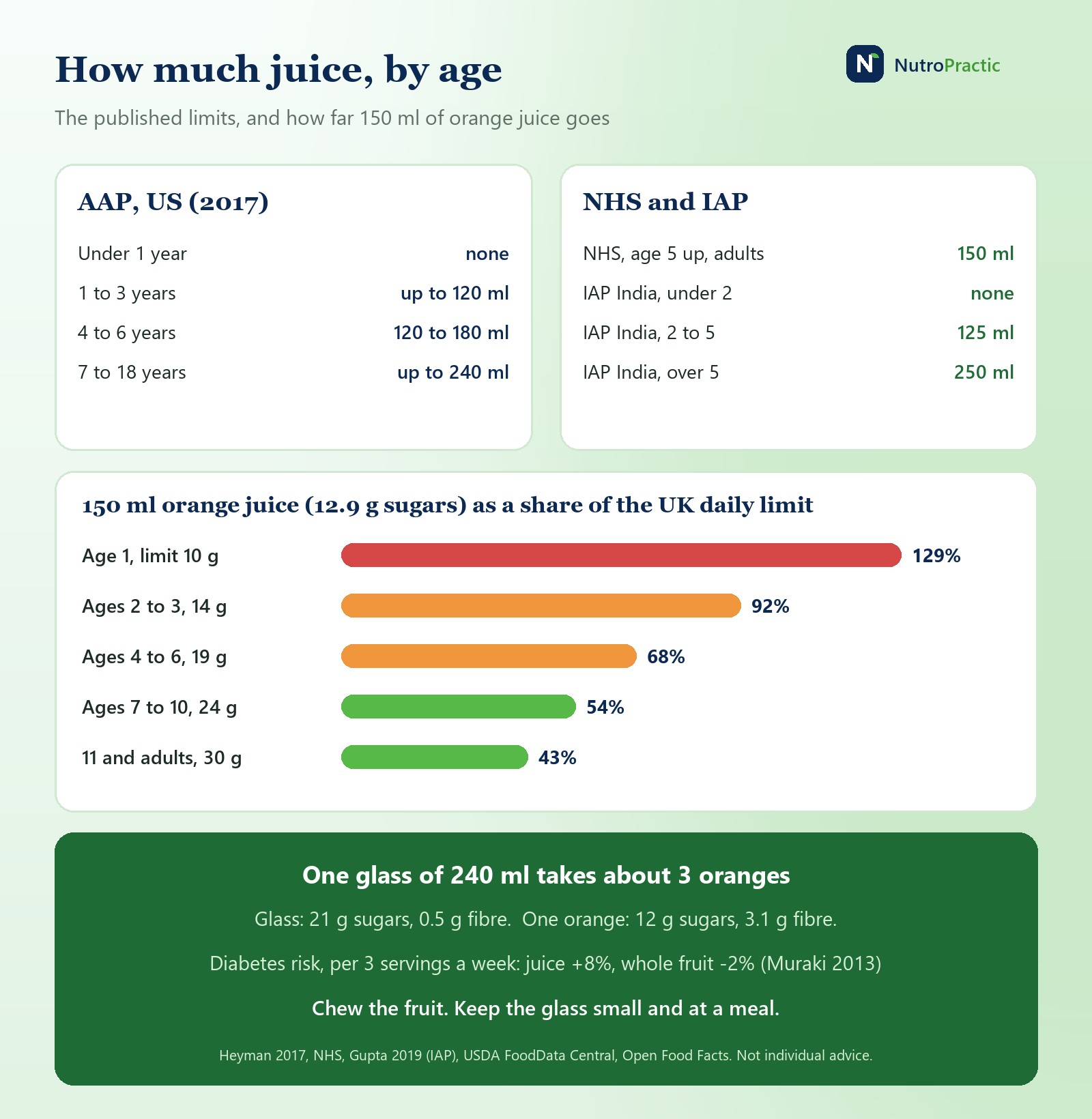
| Age | AAP, US (2017) | NHS, UK | IAP, India (2019) |
|---|---|---|---|
| Under 1 | None, unless clinically indicated | Not needed. If given, 1 part juice to 10 parts water, at meals | None |
| 1 to 3 | Up to 4 oz (120 ml) | No juice figure for ages 1 to 4; sugar limit applies (10 g at age 1, 14 g at 2 to 3) | None under 2; 125 ml at 2 to 5 |
| 4 to 6 | 4 to 6 oz (120 to 180 ml) | 150 ml from age 5, undiluted, at meals | 125 ml to age 5; 250 ml after |
| 7 to 18 | Up to 8 oz (240 ml) | 150 ml | 250 ml |
| Adults | US Dietary Guidelines 2025-2030: "limited portions", consider diluting; no number | 150 ml, juice and smoothies combined, at meals | ICMR-NIN 2024: whole fruit in preference to juice |
Notice that the British figure is lower than the American one for older children, and that the American label's serving is 240 ml for everybody. In the US, a single listed serving of juice is the entire daily allowance for a teenager and twice the limit for a three-year-old. We go into how that works in our piece on serving sizes on food labels.
What the limits are based on
They aren't drawn from a trial that fed children different amounts of juice and compared them years later. The big 2024 review below found 17 cohort studies in children and not one randomised trial. The limits are judgment calls built on three things.
The sugar budget. WHO and the UK's Scientific Advisory Committee on Nutrition count juice sugars as free sugars, in the same group as table sugar, and SACN set the British target at about 5% of energy. The NHS turns that into grams: 10 g a day at age 1, 14 g at 2 to 3, 19 g at 4 to 6, 24 g at 7 to 10 and 30 g from 11 and for adults. A 150 ml glass of orange juice takes a large bite out of each:
| Age | Free sugars limit | 150 ml orange juice (12.9 g) | 250 ml smoothie (25 g) |
|---|---|---|---|
| 1 | 10 g | 129% | 250% |
| 2 to 3 | 14 g | 92% | 179% |
| 4 to 6 | 19 g | 68% | 132% |
| 7 to 10 | 24 g | 54% | 104% |
| 11 and adults | 30 g | 43% | 83% |
Teeth. The AAP's worry is exposure time as much as amount. Frequent sipping keeps sugar on the teeth, so it says no juice in bottles or easily carried sippy cups, none at bedtime for infants and toddlers, and the NHS says to serve it with meals. That part of the advice is about how you drink it, and it costs nothing to follow.
What juice pushes out. A glass has lost nearly all the fibre and is easy to drink past hunger. The AAP adds that juice has no place in treating dehydration or diarrhoea, and that unpasteurised juice should be strongly discouraged at every age.
A glass against the fruit
From USDA data for orange juice, whole fruit and apple juice:
| Item | Amount | kcal | Sugars | Fibre |
|---|---|---|---|---|
| Orange, whole | 1 medium, 131 g | 62 | 12.2 g | 3.1 g |
| Orange juice, fresh | 240 ml (1 cup, 248 g) | 112 | 20.8 g | 0.5 g |
| Apple, with skin | 1 medium, 182 g | 95 | 18.9 g | 4.4 g |
| Apple juice, unsweetened | 240 ml (248 g) | 114 | 23.9 g | 0.5 g |
USDA reckons one orange yields about 86 g of juice, so that glass of 248 g takes nearly three oranges. Few people would sit down and eat three oranges at breakfast with no thought. A glass goes down in under a minute.
Satiety work points the same way. In a Penn State trial (Flood-Obbagy and Rolls, 2009), 58 adults had the same 125 kcal of apple before lunch, as whole apple, applesauce or juice. Whole apple cut the energy eaten at lunch by 15% compared with no starter, and beat both applesauce and juice. Adding fibre back to juice didn't help, which suggests chewing and structure matter too.
Real packs
| Product | Sugars per 100 ml | In 150 ml | In the pack as listed |
|---|---|---|---|
| Tropicana Smooth Orange (UK) | 8.6 g | 12.9 g | 250 ml bottle: about 21.5 g |
| Innocent Strawberries, Bananas and Apples smoothie | 10 g | 15 g | 250 ml bottle: 25 g |
| Innocent Energise Super Smoothie | 10 g | 15 g | 300 ml bottle: 30 g, an adult's entire limit |
| Real Activ 100% Mixed Fruit (India) | 11.4 g | 17 g | Not listed |
| Real Fruit Power Mixed Fruit (India) | 13.1 g | 20 g | 180 ml pack: about 24 g |
| Pomegranate juice, bottled (USDA) | About 12.6 g | About 20 g | Varies |
A British survey of 203 children's drinks (Boulton and colleagues, BMJ Open 2016) found smoothies averaged 13 g per 100 ml, the highest of any group, and juice drinks 5.6 g. Single-serve bottles hold more than the 150 ml limit, so finishing what you bought goes past it.
What cohort studies found
These studies follow people over time, so they show associations, and juice drinkers can differ in other ways. The size of the numbers is the useful part:
| Study | People | Finding |
|---|---|---|
| Nguyen, JAMA Pediatrics 2024 | 45,851 children in 17 cohorts; 268,095 adults in 6 cohorts and 19 trials | Children: 0.03 higher BMI gain per daily serving. Adults: 0.21 kg more in studies not adjusted for calories, 0.08 kg less in those that were |
| Auerbach, Pediatrics 2017 | 34,470 children, 8 cohorts | Per daily 6 to 8 oz: BMI z score 0.087 higher at ages 1 to 6 (a 4% increase in BMI percentile); no link at 7 to 18 |
| Imamura, BMJ 2015 | 17 cohorts, 38,253 cases of type 2 diabetes | Per daily serving: 5% higher risk (-1% to 11%), or 7% (1% to 14%) after adjusting for body fat. Not significant where diabetes was confirmed objectively |
| Muraki, BMJ 2013 | 187,382 US health professionals, 12,198 cases | Per 3 servings a week: juice 8% higher risk; whole fruit 2% lower; blueberries 26%, grapes and raisins 12%, apples and pears 7% lower |
Our reading: juice isn't a poison, and the weight effects at normal amounts are small. The Auerbach authors called the toddler result not clinically significant. Nguyen's adult pattern suggests the effect runs largely through extra calories, so a glass that replaces something else differs from a glass added on top. For diabetes, the signal is modest and inconsistent. The steadier message is the comparison in Muraki: within the same people, whole fruit and juice pointed opposite ways. Whole fruit also does something juice can't, which is help close the fibre gap most adults have.
Smoothies: a closer call than the label suggests
The NHS counts juice and smoothies together in the same 150 ml, and in sugar terms that's fair. Blending does keep the fibre in. On the Innocent labels above, that's 1.1 g per 100 ml against 0 to 0.6 g for the Tropicana records.
There is an intriguing small trial. Crummett and Grosso (Nutrients, 2022) gave 20 students 338 g of apple and blackberries, either whole or blended. Blood glucose peaked lower after the blended version: a rise of 28.8 mg/dL against 42.5, with total glucose response 850 against 1,269. They speculated that blending releases more fibre and polyphenols from the seeds and skin. Results across other studies are mixed, and it's one small group of healthy young people eating one fruit combination, so nobody should take this as permission for a large smoothie. It does say the smoothie isn't simply juice, provided the whole fruit went in.
What goes into the blender decides most of it. Two home versions, using USDA figures:
| Smoothie | Fruit sugars | Total sugars | Fibre | Protein |
|---|---|---|---|---|
| 1 banana, 100 g mango, 200 ml orange juice | 45.5 g | 45.5 g | 5 g | About 3.5 g |
| 100 g strawberries, 30 g oats, 150 ml whole milk | 4.9 g | 12.8 g (7.6 g is milk lactose) | 5 g | About 9 g |
Same fibre, and about a quarter of the sugar. The second one also behaves more like a small breakfast. If you're making it at home, use whole fruit and leave out juice as the liquid.
Fresh juice stalls and Indian packs
A glass of fresh mosambi or orange from the stall on the corner feels like the healthiest thing on the street. Nutritionally it's the same as any other juice: use orange as the proxy and a 300 ml glass has about 26 g of sugars, or most of an adult's day, before any sugar or syrup the stall adds. It's worth asking for none, and for no ice.
Hygiene is the separate issue, and the AAP's caution about unpasteurised juice carries extra weight here. In Amravati, a 2009 study of 52 street-vended juices found E. coli the most common pathogen, at 40%, and blamed dilution water, washing and ice. An exploratory Delhi study published in 2020 found E. coli, Salmonella and Vibrio in samples from five markets, and reported that 95% of vendors used municipal water, with a high bacterial count, for dilution or ice; its authors say the sample was too small to be conclusive. A Mumbai municipal survey reported in 2018 found E. coli in 400 of 410 samples of edible ice, though that's a press report, not a paper. None of these gives a national picture. They're still reason enough to skip stall juice for small children, during pregnancy and for anyone with a weakened immune system, and to choose fruit you can peel.
For packs, the ICMR-NIN guidelines warn that a "real fruit" claim can sit on a drink with as little as 10% fruit pulp. In 2024 FSSAI directed companies to remove "100% fruit juice" claims from reconstituted juices. So read the ingredients: water and sugar near the top means it's a fruit drink, whatever the picture on the carton shows. Our label claims guide covers "no added sugar" on juice too.
What to do with all this
Under 1: no juice. Water or milk as advised for age. Ages 1 to 5: offer fruit rather than juice. If juice is on the table, go by the limit you follow (120 to 125 ml at most), in an open cup, at a meal, or diluted. Not in a bottle, and not at bedtime. School age and teenagers: 150 ml to 250 ml depending on which country's advice you follow, and remember that a lunchbox carton counts. Adults: a small glass at a meal is fine for most people. A 150 ml glass is smaller than most glasses, so measure yours once with water. With diabetes: speak to your care team. Whole fruit is usually an easier fit, and small juice portions have a legitimate use in treating a low blood sugar.
A few swaps stretch the same fruit: top a small amount of juice up with sparkling or plain water, as the US guidelines now suggest, or eat the orange and drink the water. And don't count on juice for your fruit intake. In the UK it counts as one of your 5 A Day at most, no matter how many glasses you have.
Fruit you chew and fruit you drink aren't the same food. Keep the glass small, keep it at a meal, and let the rest of the fruit stay whole.
Not sure how much juice or fruit fits your child's day, or your own blood sugar? Dr. Triveni can go through what your family actually drinks and eats in a virtual consultation.
Book a consultationThis article is general information, not medical advice. If your child has a medical condition or is losing or gaining weight unexpectedly, or if you have diabetes, kidney disease or take medicines affected by grapefruit, talk to your doctor or dietitian. Brands are named only as worked examples; we have no link to them.
Sources
Heyman M.B., Abrams S.A., Fruit juice in infants, children, and adolescents: current recommendations, Pediatrics 139(6):e20170967 (2017), and AAP, AAP recommends no fruit juice for children under 1 year. NHS, Sugar: the facts and Drinks and cups for babies and young children. Public Health England, 5 A Day decision paper. SACN, Carbohydrates and health (2015). WHO, Guideline: sugars intake for adults and children (2015). Gupta P. et al., Indian Academy of Pediatrics guidelines on fast and junk foods, sugar sweetened beverages, fruit juices and energy drinks, Indian Pediatrics 56(10):849-863 (2019). US Dietary Guidelines 2025-2030, summary. FSSAI, on the revised ICMR-NIN guidelines.
Nguyen M. et al., Consumption of 100% fruit juice and body weight in children and adults, JAMA Pediatr 178:237-246 (2024). Auerbach B.J. et al., Fruit juice and change in BMI, Pediatrics 139(4):e20162454 (2017). Imamura F. et al., Consumption of sugar sweetened beverages, artificially sweetened beverages, and fruit juice and incidence of type 2 diabetes, BMJ 351:h3576 (2015). Muraki I. et al., Fruit consumption and risk of type 2 diabetes, BMJ 347:f5001 (2013).
Flood-Obbagy J.E., Rolls B.J., The effect of fruit in different forms on energy intake and satiety at a meal, Appetite 52:416-422 (2009). Crummett L.T., Grosso R.J., Postprandial glycemic response to whole fruit versus blended fruit in healthy, young adults, Nutrients 14(21):4565 (2022). Boulton J., Hashem K.M., Jenner K.H., et al., How much sugar is hidden in drinks marketed to children?, BMJ Open 6:e010330 (2016).
Tambekar D.H. et al., study of street-vended fruit juices in Amravati, J Appl Biosci 14 (2009). Coverage of the Delhi study, Down To Earth (2020). Mumbai edible ice survey, Free Press Journal (2018). FSSAI 2024 juice direction: FoodNavigator. ICMR-NIN on "real fruit" claims: Down To Earth.
Food data: USDA FoodData Central, SR Legacy records (orange juice, raw 169098; oranges, raw 169097; apples with skin 171688; apple juice 167771; pomegranate juice 167787; mangos 169910; bananas 173944; whole milk 171265; strawberries; rolled oats). Open Food Facts, read 3 November 2026: Tropicana Smooth Orange, Innocent smoothie, Innocent Energise, Real Activ Mixed Fruit, Real Fruit Power Mixed Fruit.