It's 7:40 in the morning, the bus is in twenty minutes, and the lunchbox is empty. Most parents pack on autopilot: a sandwich, something crunchy from a packet, a fruit if there's one in the bowl, a juice box. Then at 3 pm the teacher meets a classroom of children who are cranky, unfocused or starving, and the box comes home with the apple still in it.
School meals have been studied far more than most of what we eat, because governments pay for them and want to know what they get. Those studies say a lot about what ends up in packed lunches, what changed when school meal rules got stricter, and what a box that lasts until home time looks like. Here is what they found, and a five-minute formula you can pack half asleep.
What the packed lunch studies found
England has the most detailed data. Since 2006, school meals there must meet food standards: fruit and vegetables every day, no sweets or crisps, no sugary drinks, oily fish regularly. Packed lunches have no rules, so researchers at the University of Leeds checked them against the same standards.
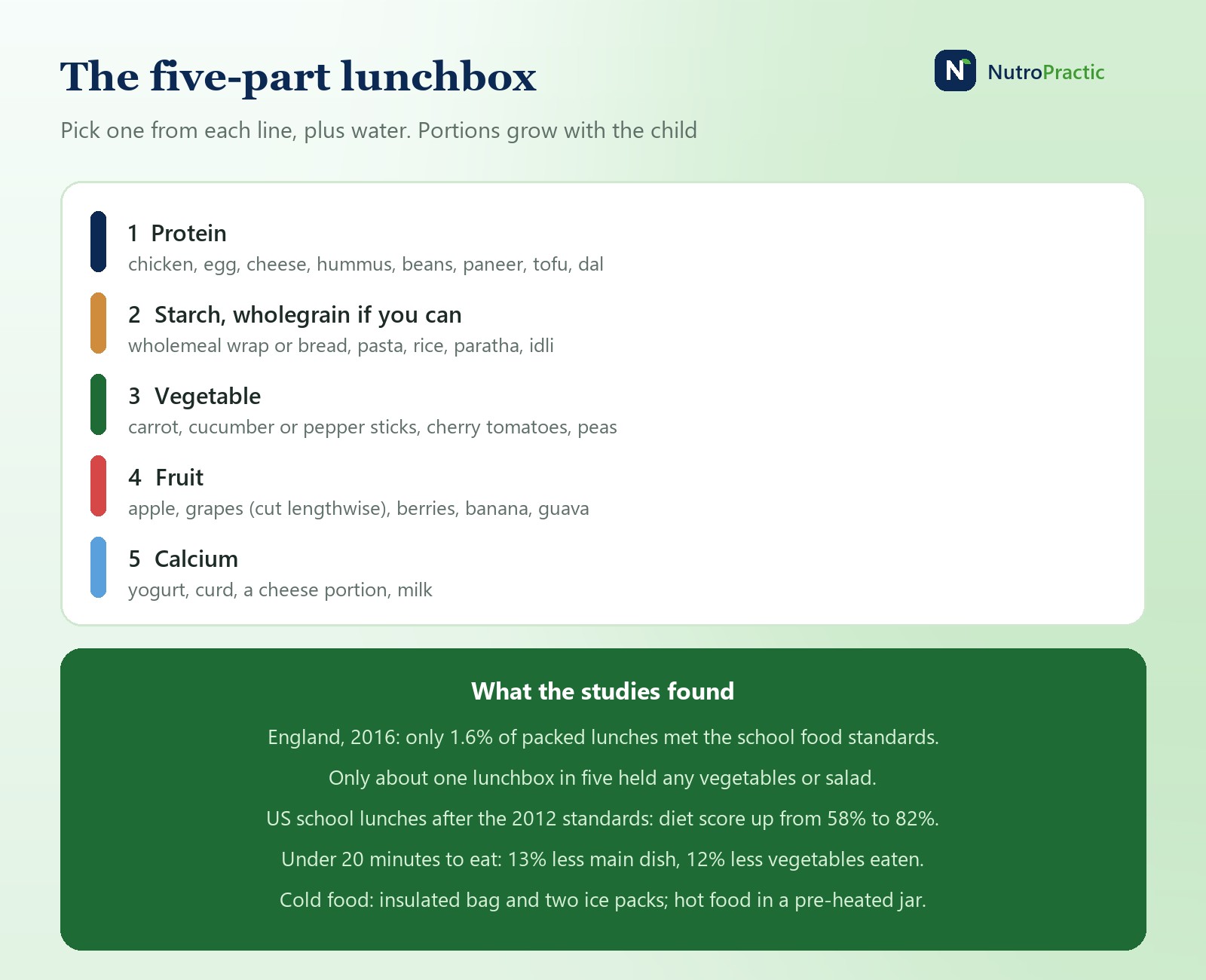
In 2006, 1.1% of 1,294 packed lunches met all the standards. When they repeated the survey ten years later, it was 1.6%. Sugar had come down, from about 40 g to 24 g per lunchbox, mostly because fewer boxes held sugary drinks. But only about one lunchbox in five contained any vegetables or salad, a number that hadn't moved in a decade, and salt and saturated fat were still above the school-meal limits. An earlier review of studies from 1990 to 2007 had found the same pattern: packed lunches higher in sugar, saturated fat and salt than school meals.
Studies in the US and Australia find much the same. The typical packed lunch leans on bread, a packaged snack, a sweet item and a drink, with fruit sometimes and vegetables rarely. None of this means a packed lunch is worse by nature. It means the default one, packed in a hurry, is.
What stricter school meals changed
In the US, the Healthy, Hunger-Free Kids Act of 2010 brought new standards from 2012: more fruit, vegetables and whole grains, less sodium, calorie limits by age. A USDA-funded study scored lunches against the Dietary Guidelines with the Healthy Eating Index: school lunches went from about 58% to 82% of the maximum score. A study in JAMA in 2020 found the diets of children who ate school lunch improved more than those of children who didn't, with the biggest gains in low-income families. New US rules add limits on added sugars in school cereals, yogurts and flavoured milk from 2025, and a weekly added-sugar cap from 2027.
In India, the PM POSHAN scheme serves a free hot lunch to more than 100 million children in government schools, with set minimums for each child: 450 kcal and 12 g of protein in primary school and 700 kcal and 20 g of protein in upper primary. Many states add eggs, milk or fruit. In private schools, the tiffin box from home is still the norm, and the same questions apply.
The lesson from all of this is useful at home: when someone deliberately plans for fruit, vegetables, whole grains and protein, with no sugary drinks, children eat them. School cooks don't have a secret; they have a checklist.
Why some lunches run out by 2 pm
A lunch built mostly on white bread, crackers, a sweet snack and juice is digested quickly. Protein, fibre and some fat slow the meal down and keep a child fuller for longer, which is the whole point when the next food is three hours away.
The evidence that a particular meal makes children concentrate better is honestly mixed. Some trials found children paid attention better after a lower-glycaemic breakfast, others found no difference, and a meta-analysis found no clear effect on memory or attention. What is consistent is simpler: hungry children don't learn well, and children who skip lunch or eat only the sweet part of it are hungry by mid-afternoon.
Time matters too. In a US study of 1,001 pupils, children with less than 20 minutes of seated lunch time were less likely to take fruit and ate about 13% less of their main dish and 12% less of their vegetables than children with at least 25 minutes. If the box keeps coming back full, ask how long they actually get to eat. Food that's quick to eat (cut up, peeled, in a box that's easy to open) gets eaten.
School cooks don't have a secret. They have a checklist: protein, a whole grain, a vegetable, a fruit, something with calcium, and water.
The five-minute lunchbox formula
Pick one from each line. It works for a five-year-old and a fourteen-year-old; only the portions change.
1. Protein: chicken, turkey or tuna; eggs (boiled, or an omelette strip); cheese; hummus; beans or chickpeas; paneer; tofu; leftover dal or rajma in a sealed pot; peanut butter if the school allows nuts.
2. A starch, wholegrain when you can: wholemeal bread, wrap or pitta; brown rice or pasta salad; oatcakes; a paratha or roti; idli; leftover pulao.
3. A vegetable: carrot, cucumber or pepper sticks; cherry tomatoes; sugar snap peas; sweetcorn; a small salad; vegetables cooked into the paratha, pasta or omelette.
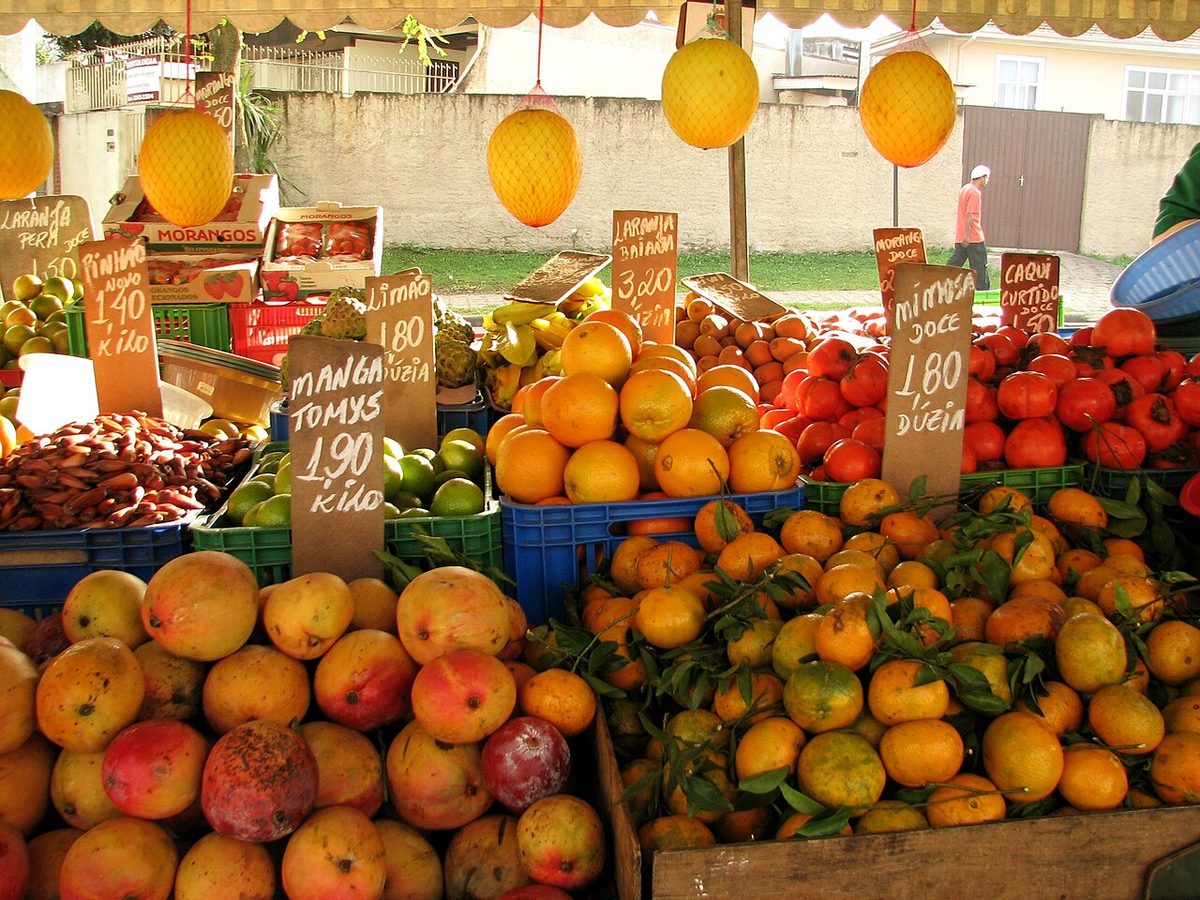
4. A fruit: a whole small fruit, or cut fruit that doesn't brown (grapes cut lengthwise for young children, berries, orange segments, banana, guava, apple with a squeeze of lemon).
5. Something with calcium: plain or lightly sweetened yogurt, a cheese portion, or milk. In a tiffin, curd rice counts.
Plus water. A named bottle, refilled at school. Juice, juice drinks and squash aren't needed; milk is fine.
A treat now and then is fine and fits the formula; make it small, and don't make it the reward for eating the rest (our picky eaters article explains why that backfires).
A week of boxes
Monday: wholemeal wrap with chicken and grated carrot; cucumber sticks; apple slices; yogurt; water.
Tuesday: pasta salad with tuna or chickpeas, sweetcorn and peas; cherry tomatoes; grapes; a cheese portion.
Wednesday: paneer or egg paratha rolled with a little chutney; carrot and cucumber sticks; banana or guava; a small pot of curd.
Thursday: hummus with pitta and pepper sticks; a boiled egg; orange segments; milk.
Friday: leftover rice with dal or rajma in an insulated food jar; sugar snap peas; a pear; yogurt.
Cook once, pack twice: an extra portion of dinner (pasta, pulao, dal, chilli) goes straight into the food jar the next morning. Chopping a tub of vegetable sticks on Sunday covers three days.
Keeping it safe until noon
A lunchbox sits for four or five hours, often in a warm classroom. In a Texas study of preschool lunches, more than nine out of ten perishable items were already at unsafe temperatures by mid-morning, even in many boxes with an ice pack. An insulated bag with two ice packs (or a frozen water bottle) keeps meat, eggs, dairy and cooked rice cold much better than one. Hot food goes in a food jar filled with boiling water for a few minutes first, then emptied and filled with piping-hot food. Cooked rice is a known risk if it's left warm for hours, so keep it either cold or properly hot.
Allergies and school rules
About one child in thirteen in the US has a food allergy, and many schools are nut-free or nut-aware. Check your school's policy before you pack peanut butter or nut bars, label the box, and teach young children not to swap food. If your child has an allergy, the school needs a written plan and, where prescribed, an adrenaline auto-injector kept where staff can reach it.
If the box comes home full
Ask what happened, not whether they liked it: not enough time, couldn't open it, friends were eating something else, too much food.
Shrink the portions and cut things up; a whole apple is often too much work in a 20-minute lunch.
Let them choose between two options in each line of the formula, and pack it with them the night before.
Keep one familiar food in every box, and add new foods in tiny amounts.
Check breakfast and the after-school snack: a child who has a big mid-morning snack may not be hungry at noon.
Packing for a fussy eater, an allergy or a growing teenager? Dr. Triveni works with families one to one, and runs nutrition and lunchbox programmes for schools. Book a virtual consultation, or ask about a programme for your school.
Book or ask about schoolsThis article is general information, not medical advice. For a child with a food allergy, coeliac disease, diabetes or a growth concern, follow the plan from your child's doctor or dietitian.
Sources
Evans C.E.L. et al., Packed lunches in English primary schools: a repeat cross-sectional survey of 2006 and 2016, BMJ Open 10:e029688 (2020), and the University of Leeds summary. Evans C.E.L. et al., A cross-sectional survey of children's packed lunches in the UK: food- and nutrient-based results, J Epidemiol Community Health 64(11):977-983 (2010). Evans C.E.L. et al., Comparison of British school meals and packed lunches from 1990 to 2007: meta-analysis by lunch type, Br J Nutr 104(4):474-487 (2010). Department for Education, School food standards practical guide (2023). Gearan E.C., Fox M.K., Updated nutrition standards have significantly improved the nutritional quality of school lunches and breakfasts, J Acad Nutr Diet 120(3):363-370 (2020), and Fox M.K. et al., The School Nutrition and Meal Cost Study-I: overview of findings, Nutrients 13(4):1219 (2021). Kinderknecht K., Harris C., Jones-Smith J., Association of the Healthy, Hunger-Free Kids Act with dietary quality among children in the US National School Lunch Program, JAMA 324(4):359-368 (2020). USDA Food and Nutrition Service, Child Nutrition Programs: meal patterns consistent with the 2020-2025 Dietary Guidelines for Americans, final rule (April 2024). Ministry of Education, Government of India, PM POSHAN scheme guidelines (2021). Cohen J.F.W. et al., Amount of time to eat lunch is associated with children's selection and consumption of school meal entrée, fruits, vegetables, and milk, J Acad Nutr Diet 116(1):123-128 (2016). Cooper S.B. et al., Breakfast glycaemic index and cognitive function in adolescent school children, Br J Nutr 107(12):1823-1832 (2012). Low versus high glycaemic index breakfasts and cognition in children: systematic review and meta-analysis, Nutrients 11(8) (2019). Almansour F.D. et al., Temperature of foods sent by parents of preschool-aged children, Pediatrics 128(3):519-523 (2011). Gupta R.S. et al., The public health impact of parent-reported childhood food allergies in the United States, Pediatrics 142(6):e20181235 (2018).