At 3 am the body handles food differently from how it does at 1 pm. The same sandwich, eaten in the middle of a night shift, leaves blood sugar higher for longer, because the organs that clear glucose run on a daily clock that a rota cannot reset. That is the main finding of twenty years of shift-work research, and it changes how a night worker might plan meals, snacks and coffee.
About one US worker in seven (14.8%) works outside daytime hours, according to the Bureau of Labor Statistics for 2024-25: 3.4% on regular nights, 5.3% on evenings and 1.9% on rotating shifts. The UK Office for National Statistics counted 8.7 million night-time workers in 2022. Nurses, carers, police, drivers, factory and warehouse staff, call-centre teams and doctors make up much of that number. Here is what the lab studies, the nurse cohorts and the first real-world trials found, and what it means for the plate.
Why a 3 am meal hits harder: the lab studies
The cleanest evidence comes from sleep labs where volunteers live on a schedule shifted by 12 hours, so they eat and sleep when their body clock expects the opposite.
Scheer and colleagues (PNAS, 2009) put 10 adults through this for 10 days. When their meals and sleep were out of step with their clock, average glucose rose 6% and insulin 22%, leptin (a hormone that signals fullness) fell 17%, and three of eight people had after-meal glucose in the prediabetic range, though none had it at baseline.
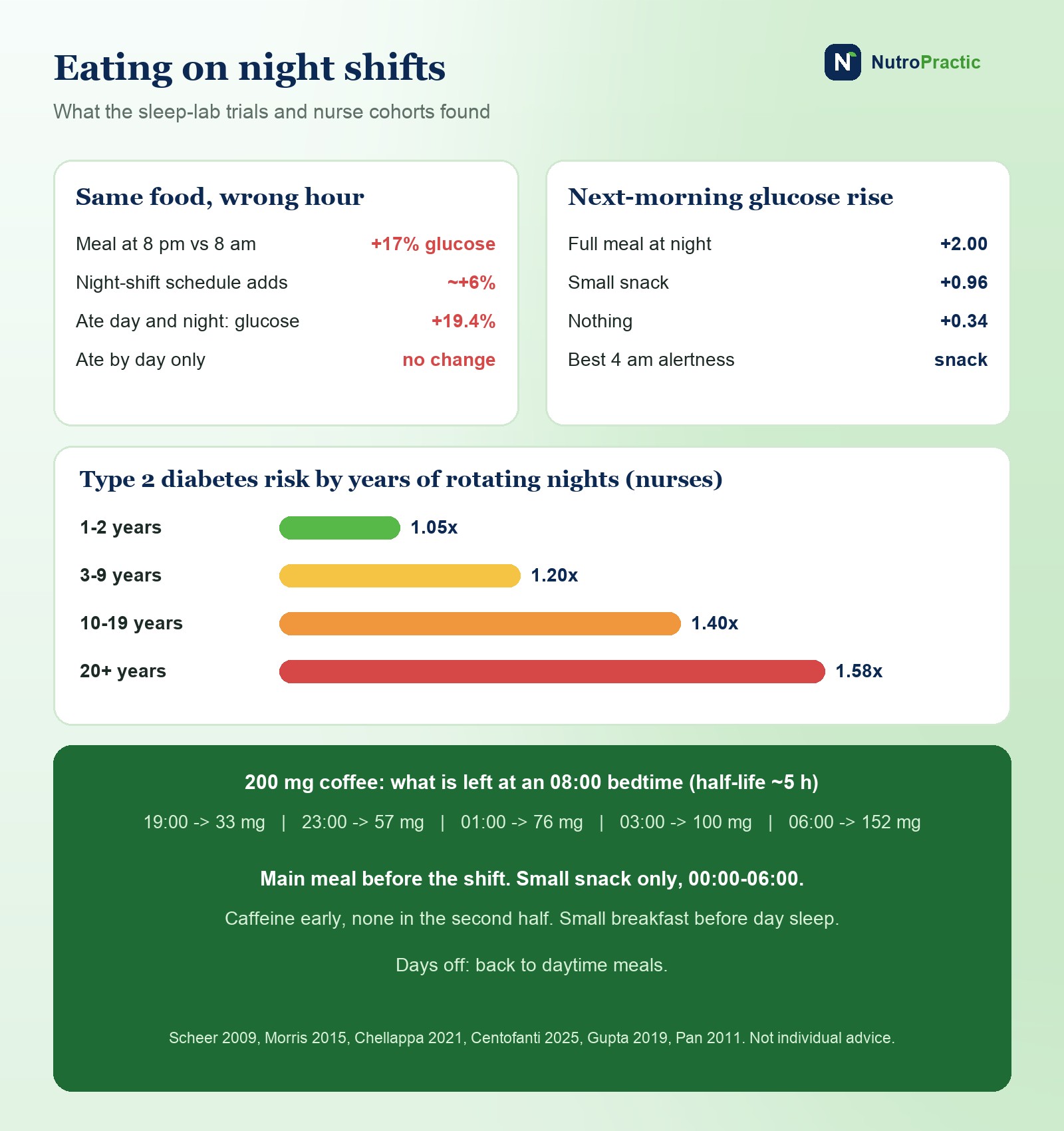
Morris and colleagues (PNAS, 2015) separated the two causes. The body clock alone made the same meal raise glucose 17% more at 8 pm than at 8 am, with early insulin release 27% lower in the evening. Living the night-shift schedule on top of that added a further 6%. A later study by the same group in people with years of shift work behind them (JCEM, 2016) found the same pattern: higher glucose in the evening and after a night-shift schedule.
You don't need a night shift to see the timing effect. In a crossover trial in 20 adults (Gu and colleagues, JCEM 2020), the same dinner eaten at 22:00 instead of 18:00, with bed at 23:00, gave a peak glucose of 150 vs 127 mg/dL (8.3 vs 7.0 mmol/L) and about 18% more glucose over the following four hours. Less of the dinner's fat was burned overnight, too: 74.5% against 84.5%.
What changed when people stopped eating at night
If night-time eating is the problem, does moving meals fix it? Four lab trials have tested that.
Daytime meals only (Chellappa, 2021)
In a 14-day lab study (Chellappa and colleagues, Science Advances 2021), 19 healthy young adults worked simulated night shifts. One group ate across day and night, the usual pattern for night workers; the other ate only during the daytime, with the same food and the same total amount. In the night-eaters, glucose after a standard breakfast rose 19.4% and early insulin release fell 53%; their average glucose over 28 hours went up 6.4%. The daytime-only eaters showed no significant change. Same food, same sleep loss: the only difference was the clock time of eating.
Meal, snack or nothing at 00:30 (Adelaide trials)
A team at the University of South Australia ran a series of simulated night-shift trials. In the largest (Centofanti and colleagues, Diabetologia 2025; 55 adults), people had a full meal, a snack or nothing during the night. The rise in glucose response the next morning was largest after the meal (+2.00 units of glucose area), smaller after a snack (+0.96) and smallest after fasting (+0.34). Insulin sensitivity fell in all three groups, so not eating at night does not cancel out the night shift itself, but a meal made things clearly worse.
For alertness, the earlier trial in the series (Gupta and colleagues, Chronobiology International 2019; 39 adults) compared a meal of about 30% of daily energy, a snack of about 10% and no food at 00:30. At 04:00, the snack group performed best on a simulated drive, with fewer lapses and faster reactions, and the meal group felt sleepiest. Daytime sleep was the same in all three groups. A small snack seems to be the useful middle: less glucose load than a meal, without the 4 am slump of an empty stomach.
A real-world weight trial (SWIFt, 2025)
The SWIFt trial (Bonham and colleagues, eBioMedicine 2025) is the biggest test in actual night workers: 250 nurses, paramedics, police and other shift workers with overweight or obesity, followed for 24 weeks in Melbourne. They were randomised to ordinary calorie restriction or a 5:2 plan of about 2,100 kJ (500 kcal) a day on two days a week, either on days off or on night shifts.
All three approaches worked about equally. Among the 170 people who finished (68%), weight loss was 5.3 kg with calorie restriction, 7.9 kg with fasting on days off and 5.2 kg with fasting on night shifts; the differences between groups were not statistically clear. Fasting on days off lowered LDL cholesterol by about 19 mg/dL more than calorie restriction. The honest take: night workers can lose weight, and the approach matters less than finding one they can keep up around a rota.
Weight and diabetes in shift workers: the cohort numbers
Lab studies are short. The long-term picture comes from large cohorts, and they point the same way.
In the Nurses' Health Studies (Pan and colleagues, PLoS Medicine 2011), the risk of type 2 diabetes climbed with years of rotating night shifts (three or more nights a month on top of days or evenings):
1-2 years: 1.05 times the risk of nurses who never worked nights
3-9 years: 1.20 times
10-19 years: 1.40 times
20 years or more: 1.58 times (95% CI 1.43-1.74)
Allowing for body weight cut the 20-year figure to 1.24, which means part of the extra risk ran through weight gain and part did not. Each extra five years of shift work was linked to about 0.45 kg more weight gain, and about 1 kg in women who started shift work after 1989.
Pooled studies agree on the direction, with smaller numbers. A 2018 meta-analysis (Sun and colleagues, Obesity Reviews) found night shift work linked to 23% higher odds of overweight or obesity and 35% higher odds of abdominal obesity; permanent night workers fared worse (odds ratio 1.43) than rotating ones (1.14). For diabetes, a 2015 meta-analysis (Gan and colleagues) put the overall odds 9% higher, and 37% higher in men. In UK Biobank (Vetter and colleagues, Diabetes Care 2018), people who usually worked nights had 44% higher odds of type 2 diabetes, and those who had done more than eight night shifts a month for years had 36% higher odds.
Cohorts can't prove the shifts cause the gap: shift work often comes with lower pay, less sleep, smoking and canteen or vending-machine food. But with the lab evidence pointing the same way, the timing of food is one of the few parts of that list a worker can change.
Caffeine: when, not just how much
Caffeine works for night workers. A Cochrane review (Ker and colleagues, 2010; 13 trials) found it cut errors and improved performance against no treatment, about as well as a nap or bright light. The catch is the daytime sleep that follows.
Caffeine's half-life averages about 5 hours in adults, ranging from roughly 1.5 to 9.5 (Institute of Medicine, 2001). In a sleep-lab study (Drake and colleagues, 2013), 400 mg taken six hours before bed still cut sleep by more than an hour, and the volunteers didn't notice most of the loss. For someone on a 19:00-07:00 shift going to bed at 08:00, here is what is left of a 200 mg coffee (about a large filter coffee) at bedtime, using the 5-hour average:
Taken at 19:00 (start of shift): 13 h before bed, about 33 mg left
Taken at 23:00: 9 h before bed, about 57 mg left
Taken at 01:00: 7 h before bed, about 76 mg left
Taken at 03:00: 5 h before bed, 100 mg left, the same as a strong cup of tea at bedtime
Taken at 06:00 (for the drive home): 2 h before bed, about 152 mg left
(Worked as 200 mg × 0.5^(hours ÷ 5); slow metabolisers, pregnancy and the contraceptive pill stretch the half-life.) That is why NIOSH's training for nurses advises "only light caffeine" during the shift, and why many UK hospital dietitians suggest no caffeine in the second half of a night shift. If the drive home is the worry, a short nap at break or before leaving is safer than a 6 am espresso. Keep the day's total within the 400 mg that the FDA and EFSA consider safe for healthy adults (200 mg in pregnancy). To see how your own cups add up, try our free caffeine counter.
A night-shift eating plan built on the studies
This follows the trial evidence and the NIOSH guidance ("avoid eating or reduce food intake between midnight and 6 a.m.", "eat a small breakfast before day sleep", "avoid large meals 1 to 2 hours before the main sleep episode"). Times are for a 19:00-07:00 shift; slide them for yours.
16:30-17:30, main meal before the shift. Your biggest meal, at a time your body still treats as day. Protein, vegetables and a whole-grain or pulse-based carbohydrate: for example chicken or dal with rice and salad, or a bean chilli with a jacket potato.
21:00-23:00, a light second meal if you're hungry. Soup and a sandwich, yogurt and fruit, or leftovers. Still before midnight.
00:00-06:00, one small snack if you need it, about 10% of the day's energy (150-250 kcal): a handful of nuts and an apple, a boiled egg and crackers, plain yogurt, hummus with carrot sticks. Skip the vending machine's biscuits, sweets and sugary drinks, which give the biggest glucose surge when the body handles it worst.
Drinks: water through the shift (about 2 litres across 24 hours is a common hospital guide); caffeine early, and none in the last half.
07:30-08:00, small breakfast before sleep, so hunger doesn't wake you: toast with peanut butter, a small bowl of cereal with milk, or a banana and yogurt. Not a full fry-up.
Days off: move back to daytime meals. In the SWIFt trial, the lighter days that worked best were the days off, not the shifts.
For people with diabetes on insulin or sulfonylureas, changing meal times can cause lows. Plan any change with your diabetes team, and check glucose more often during the first weeks on a new rota.
For employers: what a night-shift food plan needs
Most of the plan above depends on the workplace as much as on willpower. When the canteen shuts at 20:00, the vending machine becomes the night meal. Things that make the evidence easy to follow: hot food or a well-stocked fridge available before the night starts, a microwave and fridge for food brought from home, small healthy snacks on sale overnight, free water, and a quiet place for a short nap on long shifts. Our article on eating well at a desk job covers what workplace food trials changed for day workers; the night-shift version builds on the same levers.
If sleep is the bigger struggle, see what the trials found on food and sleep, from late meals to kiwis and caffeine.
Eat your main meal before the shift, keep the hours from midnight to six for a small snack, and stop the coffee halfway through.
Working nights and gaining weight, or running a hospital, factory or contact centre with night teams? Dr. Triveni can plan meals around your rota in a virtual consultation, or build a shift-work nutrition programme for your staff.
Book a consultationThis article is general information, not medical advice. If you have diabetes, take medicines that affect blood sugar, or are pregnant, talk to your doctor before changing when you eat.
Sources
US Bureau of Labor Statistics, Job flexibilities and work schedules 2024-2025, Table 7. Office for National Statistics, The night-time economy, UK (2022 figures).
Scheer F.A.J.L., Hilton M.F., Mantzoros C.S., Shea S.A., Adverse metabolic and cardiovascular consequences of circadian misalignment, PNAS 106(11):4453-4458 (2009). Morris C.J. et al., Endogenous circadian system and circadian misalignment impact glucose tolerance via separate mechanisms in humans, PNAS 112(17):E2225-E2234 (2015). Morris C.J. et al., Effects of the internal circadian system and circadian misalignment on glucose tolerance in chronic shift workers, J Clin Endocrinol Metab 101(3):1066-1074 (2016). Gu C. et al., Metabolic effects of late dinner in healthy volunteers: a randomized crossover clinical trial, J Clin Endocrinol Metab 105(8):2789-2802 (2020).
Chellappa S.L. et al., Daytime eating prevents internal circadian misalignment and glucose intolerance in night work, Sci Adv 7(49):eabg9910 (2021). Grant C.L. et al., Timing of food intake during simulated night shift impacts glucose metabolism: a controlled study, Chronobiol Int 34(8):1003-1013 (2017). Gupta C.C. et al., Altering meal timing to improve cognitive performance during simulated nightshifts, Chronobiol Int 36(12):1691-1713 (2019). Centofanti S. et al., Fasting as an intervention to alter the impact of simulated night-shift work on glucose metabolism in healthy adults: a cluster randomised controlled trial, Diabetologia 68(1):203-216 (2025). Bonham M.P. et al., Intermittent fasting for weight loss in night shift workers: a three-arm, superiority randomised clinical trial, eBioMedicine 117:105803 (2025).
Pan A., Schernhammer E.S., Sun Q., Hu F.B., Rotating night shift work and risk of type 2 diabetes: two prospective cohort studies in women, PLoS Med 8(12):e1001141 (2011). Sun M. et al., Meta-analysis on shift work and risks of specific obesity types, Obes Rev 19(1):28-40 (2018). Gan Y. et al., Shift work and diabetes mellitus: a meta-analysis of observational studies, Occup Environ Med 72(1):72-78 (2015). Vetter C. et al., Night shift work, genetic risk, and type 2 diabetes in the UK Biobank, Diabetes Care 41(4):762-769 (2018).
Ker K. et al., Caffeine for the prevention of injuries and errors in shift workers, Cochrane Database Syst Rev CD008508 (2010). Institute of Medicine, Caffeine for the Sustainment of Mental Task Performance (2001). Drake C. et al., Caffeine effects on sleep taken 0, 3, or 6 hours before going to bed, J Clin Sleep Med 9(11):1195-1200 (2013). US FDA, Spilling the beans: how much caffeine is too much? (consumer update). EFSA, Scientific opinion on the safety of caffeine (2015). CDC NIOSH, Training for nurses on shift work and long work hours, module 9.