A desk job shapes how you eat more than most people notice. Breakfast is a coffee on the way in. Lunch is eaten at the keyboard between two calls. There are biscuits at the 11 o'clock meeting, someone's birthday cake at three, and by five the vending machine is the most interesting thing in the building. Then you sit for eight or nine hours, and sit again at home.
Employers have spent billions on wellness programmes to fix this, and some of them were tested properly, in randomised trials with thousands of employees. The results are humbling for the classic programme and encouraging for a few cheap, unglamorous changes. Here is what the trials found, and what that means for your own working day.
The wellness programme that didn't work
In 2016, the University of Illinois ran one of the best-designed tests of a workplace wellness programme ever done. Nearly 5,000 employees were randomly offered, or not offered, a two-year programme: health screenings, a health risk assessment, and a menu of activities such as nutrition classes, exercise sessions and stress management, with cash rewards for taking part.
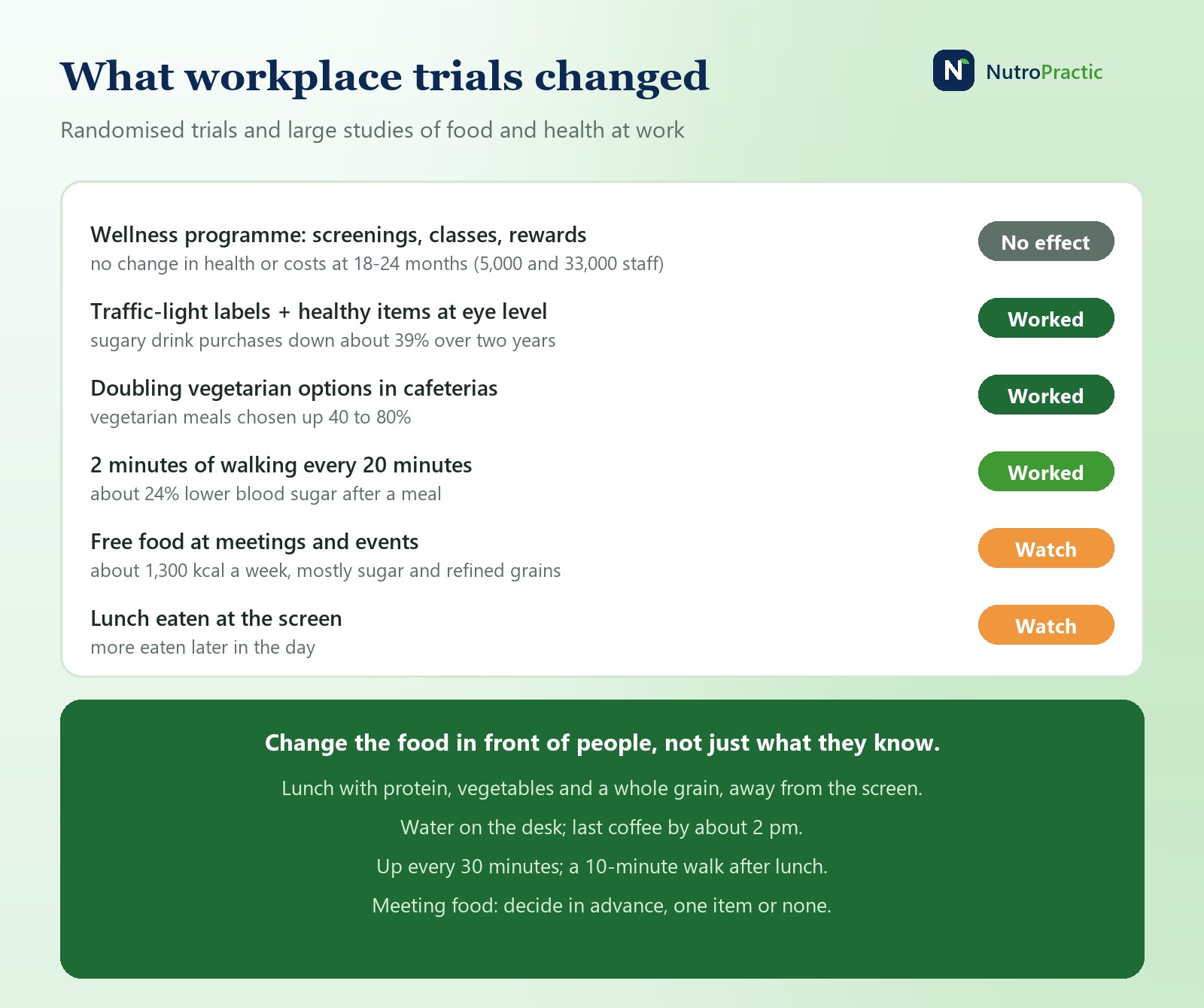
Many people took part. But after two years, compared with the control group, there was no meaningful change in weight, blood pressure, cholesterol, gym visits, medical spending, sick days or how healthy people said they felt. The people who signed up were mostly those who were already healthier, which is why earlier, non-randomised studies had made wellness programmes look so good.
A second large trial at BJ's Wholesale Club in the US, across 160 worksites and about 33,000 employees, found the same thing after 18 months: more people said they exercised and watched their weight, but blood pressure, cholesterol, blood sugar, weight, sick days and health spending didn't change.
The lesson isn't that nothing works at work. It's that information and incentives on their own rarely change what people eat. What did work in the trials was changing the food environment itself.
What did change: the food in front of people
Labels plus placement. At Massachusetts General Hospital, the staff cafeteria colour-coded every item green, amber or red and moved the healthier ones to eye level and the front of the fridges. Over two years, purchases of red items fell, green items rose, and purchases of red drinks, mostly sugary ones, fell by about 39%. The changes lasted; they didn't fade as people got used to the labels.
More good options. In Cambridge college cafeterias, simply doubling the number of vegetarian dishes on the menu raised the share of vegetarian meals chosen by roughly 40 to 80%, with no campaign at all. People mostly eat what is in front of them.
Smaller defaults. Reviews of portion and package size find that smaller plates, portions and packs reduce how much people eat, consistently and without anyone feeling deprived. A canteen that serves a smaller portion of chips by default, with more on request, changes more than a poster ever will.
If you have any say in your workplace (a kitchen budget, a vending contract, the meeting catering order), these are the changes to push for. If you don't, you can apply the same idea to your own desk: make the better choice the easy one.
Information and incentives rarely change what people eat at work. Changing the food in front of them does.
Meeting food: the calories nobody counts
A CDC study of more than 5,000 US workers found that nearly one in four got food at work in a typical week, adding up to about 1,300 kcal a week. Most of it was free food at meetings and events, and it was high in sodium, refined grains and added sugar: pastries, cookies, pizza, sweets. Those calories rarely feel like a meal, so they don't replace one.
You can't control the platter, but you can decide in advance: one item, on a plate, sitting down, or a coffee and nothing. If you order for meetings, swap half the pastries for fruit, nuts, yogurt pots or a vegetable platter with hummus; in Indian offices, roasted chana, fruit and sprouts chaat instead of samosas and biscuits with the tea. In practice, the fruit goes too.
Lunch at the desk
Eating while working, scrolling or watching a screen has a measurable cost. In a review of 24 studies, people who ate a meal while distracted ate a little more at that meal and noticeably more later in the day, probably because they remembered less of what they'd eaten. A 15-minute lunch away from the screen is not a luxury; it's portion control.
A lunch that holds you until evening has protein (25 to 30 g: chicken, fish, eggs, tofu, paneer, a good portion of beans or lentils), fibre from vegetables, pulses and whole grains, and some fat. A large white-bread sandwich, crisps and a sweet drink is fast to eat and fast to digest. Packing a lunch two or three days a week, from a double batch of dinner, is the change most people find they can keep.
The afternoon slump
The dip in alertness in the early afternoon is mostly built into the body clock: it shows up even in people who skip lunch. A very large or high-sugar lunch makes it worse for many people; a moderate, balanced one makes it smaller.
Before you reach for a third coffee or the vending machine, try a glass of water, daylight and a five-minute walk. If you do want coffee, have it before about 2 pm: caffeine's half-life is around five hours, so a 4 pm coffee is still half there at 9 pm (our caffeine counter shows your own curve). For a snack, pair something with protein or fat with something with fibre: an apple and a handful of nuts, yogurt and berries, hummus and carrots, a boiled egg and fruit.
Sitting, and the two-minute walk
Long, unbroken sitting raises blood sugar after meals. In an Australian lab study, overweight office workers who got up for two minutes of light walking every 20 minutes after a meal had about 24% lower blood sugar and 23% lower insulin over the afternoon than when they sat throughout. A 2022 review of seven studies found that even a few minutes of light walking after eating lowered the post-meal rise, while standing helped less.
Practical versions: a walk to the farthest kitchen or toilet, walking meetings or calls, a 10-minute walk after lunch, standing up whenever the phone rings. For people with type 2 diabetes or prediabetes, a short walk after the biggest meal is one of the cheapest tools there is.
Your desk-day plan
Breakfast or an early snack with protein: eggs, yogurt, overnight oats with milk and nuts, an idli and sambar, not just a coffee.
A water bottle on the desk, refilled twice a day.
Lunch with protein, vegetables and a whole grain, eaten away from the screen; pack it two or three days a week.
Get up every 30 minutes, and walk for 10 minutes after lunch.
Decide meeting food in advance: one item, or none.
Last coffee by about 2 pm, and a planned afternoon snack in your bag so the vending machine isn't the default.
For employers
If you run a team or an HR budget, the trials point one way: spend less on screenings and step challenges and more on what's in the canteen, the vending machine, the meeting catering and the kitchen, plus time and space to take a real lunch break. Change the defaults, put water and fruit where the biscuits were, and make the healthy option the cheapest and closest. Measure purchases, not sign-ups. For the people side, a short talk works best when it comes with those changes; our workshops for teams include one on eating well at a desk job and one on energy after lunch.
Dr. Triveni runs corporate wellness programmes, from canteen and catering reviews to nutrition talks and one-to-one consultations for staff. For yourself, book a virtual consultation to plan eating around your working day; for your company, ask about a programme.
Book or ask about a programmeThis article is general information, not medical advice. If you have diabetes, heart disease or another condition, check changes in diet and activity with your doctor.
Sources
Jones D., Molitor D., Reif J., What do workplace wellness programs do? Evidence from the Illinois Workplace Wellness Study, Q J Econ 134(4):1747-1791 (2019), and Reif J. et al., Effects of a workplace wellness program on employee health, health beliefs, and medical use: a randomized clinical trial, JAMA Intern Med 180(7):952-960 (2020). Song Z., Baicker K., Effect of a workplace wellness program on employee health and economic outcomes: a randomized clinical trial, JAMA 321(15):1491-1501 (2019). Thorndike A.N. et al., Traffic-light labels and choice architecture: promoting healthy food choices, Am J Prev Med 46(2):143-149 (2014), and Harvard summary. Garnett E.E. et al., Impact of increasing vegetarian availability on meal selection and sales in cafeterias, PNAS 116(42):20923-20929 (2019). Hollands G.J. et al., Portion, package or tableware size for changing selection and consumption of food, alcohol and tobacco, Cochrane Database Syst Rev (2015). Onufrak S.J. et al., Foods and beverages obtained at worksites in the United States, J Acad Nutr Diet 119(6):999-1008 (2019). Robinson E. et al., Eating attentively: a systematic review and meta-analysis of the effect of food intake memory and awareness on eating, Am J Clin Nutr 97(4):728-742 (2013). Monk T.H., The post-lunch dip in performance, Clin Sports Med 24(2):e15-e23 (2005). Dunstan D.W. et al., Breaking up prolonged sitting reduces postprandial glucose and insulin responses, Diabetes Care 35(5):976-983 (2012). Buffey A.J. et al., The acute effects of interrupting prolonged sitting time in adults with standing and light-intensity walking on biomarkers of cardiometabolic health: a systematic review and meta-analysis, Sports Med 52(8):1765-1787 (2022).