The blood test comes back with an HbA1c in the prediabetes range, and the advice takes ten seconds: lose a little weight, walk more, cut down on rice. You nod. Then you go home to a kitchen with a 10 kg bag of rice in the cupboard, a pressure cooker on the hob and a family that expects sambar rice on Tuesday and biryani when friends come over.
"Cut down on rice" is fair advice, and it's not much use. It doesn't say which rice, how much, or what to do about the fact that everything else on the table was designed to be eaten with it. This is the first in a series for families who cook Indian food outside India: one staple at a time, with what the research supports and one change that's easy to keep. We start with rice because that's where the argument at the table starts.
Why this matters more for us
People of South Asian family origin develop type 2 diabetes earlier and at a lower body weight than people of white European origin. Diabetes UK puts the risk at up to six times higher. In England, NICE asks doctors to treat a BMI of 23, not 25, as the point where risk starts to rise for South Asian adults, and to offer checks from age 25. Moving abroad doesn't remove any of that. It usually adds a desk job, a car and a supermarket.
Rice is part of the picture, in proportion. The largest study on the question, PURE, followed 132,373 adults in 21 countries for about nine and a half years. People who ate 450 g or more of cooked white rice a day (three cups) were more likely to develop diabetes than those who ate under 150 g (one cup): 20% more likely overall, and 61% more likely in South Asia. In China there was no clear link at all.
Read that carefully. It's an observational study, so it can't prove rice was the cause. And the comparison is three cups a day against one. Nobody in it was harmed by a cup of rice with dinner. The finding is about rice being most of the plate, twice a day, for years.
Which rice, from the shops you actually have
Abroad, the choice on the shelf is different from the one your parents had. A few things are worth knowing.
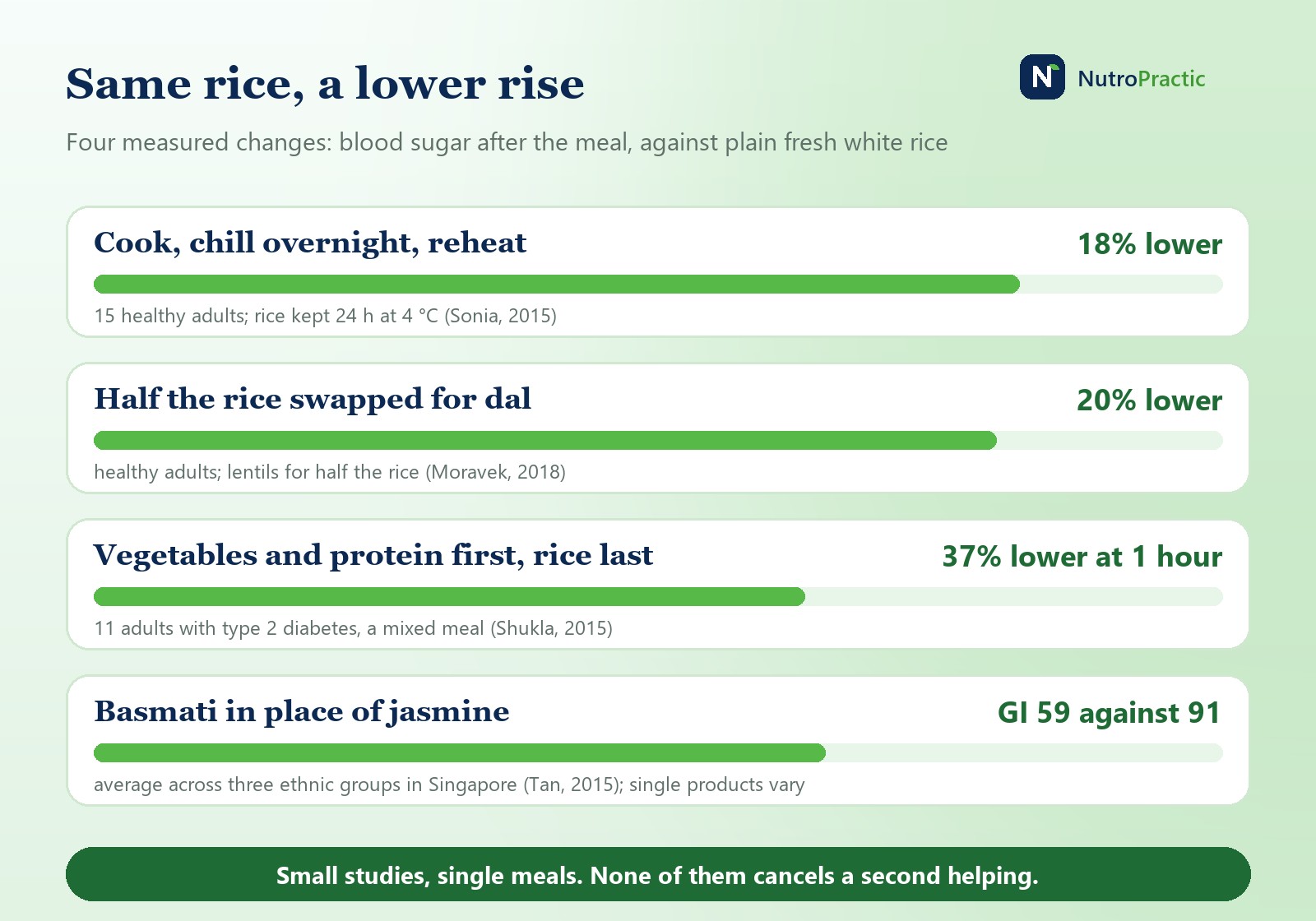
Basmati is the gentlest of the common white rices. Its starch has more amylose, which digests more slowly. A study in Singapore that tested the same rices in Chinese, Malay and Indian volunteers found an average glycaemic index (GI) of 59 for basmati and 91 for jasmine. Easy-cook (parboiled) long grain is also on the lower side.
Short, soft and sticky rices are the fastest. Jasmine, most short-grain rices and the softer everyday varieties many of us grew up on, such as sona masoori and ponni, raise blood sugar faster than basmati. That doesn't make them forbidden. It makes them the rices where portion and company matter most.
Brown basmati helps a little, not a lot. It has more fibre and minerals, and it's a good choice if your family will eat it. But the GI gap between brown and white basmati is smaller than the gap between basmati and jasmine, and a large plate of brown rice is still a large plate of rice.
Skip the microwave pouches for everyday meals. They're convenient and usually softer and more processed, and it's hard to serve less than the whole pouch.
How much is a portion
One cup of cooked rice, about 150 g, is a reasonable serving for most adults at a meal. That's roughly what fits in a cupped hand and a half, or a quarter of a dinner plate, and it comes from about 50 g (a quarter of a cup) of dry rice.
Most of us have never weighed it. Do it once: cook your usual amount, serve your usual plate, and put the plate on a kitchen scale. Many people find they've been eating 300 to 400 g without thinking. You don't have to halve it overnight. Take one serving spoon off this month and fill the space with sabzi or dal.
Four changes that were measured
These aren't tips from a wellness account. Each one comes from a trial where blood sugar was measured after a meal.
1. Cook it the night before
When cooked rice is chilled, some of its starch changes into a form the gut digests slowly, called resistant starch. In a 2015 trial, rice that was cooked, kept in the fridge for 24 hours and reheated had more than twice the resistant starch of fresh rice (1.65 g against 0.64 g per 100 g), and 15 healthy adults had an 18% lower blood sugar response after eating it.
This suits a working household abroad better than almost any other advice: cook a batch in the evening, chill it, reheat portions for the next day's lunch boxes and dinner. Lemon rice, curd rice and fried rice with vegetables are all better made from yesterday's rice anyway.
Chilled rice needs care. Cool it quickly, within about an hour of cooking, and put it in the fridge. Eat it within 24 hours, reheat it until it's steaming hot all the way through, and reheat it only once. Rice left out on the hob overnight can cause food poisoning.
2. Let dal take half the space
Canadian researchers replaced half the rice in a meal with cooked lentils and measured blood sugar in healthy adults. It rose about 20% less. Lentils bring protein and fibre and take the place of fast starch, so the effect comes from both directions.
Indian cooking already knows this. Khichdi, pongal, bisi bele bath, and a plain plate of dal chawal are all rice and lentils together. The change is the ratio: a thick dal you can eat by the bowl, with rice beside it, in place of a mound of rice with a little thin dal poured over.
3. Rice last
In a small trial at Weill Cornell in New York, 11 adults with type 2 diabetes ate the same meal twice, a week apart. When they ate the vegetables and protein first and the carbohydrate 15 minutes later, their blood sugar an hour after the meal was 37% lower than when they ate the carbohydrate first.
At an Indian table that means: start with the sabzi, the salad, the dal, the egg or the fish. Finish with the rice. It feels odd for a week and then it's just how you eat.
4. Choose basmati for the plain-rice days
Keep the softer rice for the dishes that need it, idli and dosa batter or pongal, and use basmati or easy-cook long grain for everyday plain rice. Cook it so the grains stay separate. Rice boiled soft and mashed is digested faster than rice with some bite.
One plate, put together
A weeknight dinner that uses all of it: yesterday's basmati, reheated until steaming, one cup. A full bowl of thick dal or sambar. A dry vegetable dish taking up half the plate, a spoon of curd, a few slices of cucumber or carrot. Eat the vegetables and dal first. A ten-minute walk afterwards if the weather lets you.
Nothing on that plate would look strange to your grandmother, except how small the rice is.
What this won't do
These trials are small and each measured one meal. They show the direction. They don't show what happens to your HbA1c over a year, and none of them makes rice a free food. The things with the strongest evidence for preventing type 2 diabetes are still losing some weight if you carry extra, moving most days and eating less overall.
If you already take medicine or insulin for diabetes, changing how much carbohydrate you eat can lower your blood sugar more than you expect. Check your readings and tell your doctor or diabetes nurse, because doses may need adjusting.
Next in the series: roti and the flour you can buy abroad.
Want a plan built around what your family actually cooks, and the shops you actually have? Dr. Triveni sees clients by video wherever they live.
Book a virtual consultationThis article is general information, not medical advice. If you have diabetes, are pregnant or take medicines that lower blood sugar, talk to your doctor before making large changes to what you eat.
Sources
Bhavadharini B. et al., White rice intake and incident diabetes: a study of 132,373 participants in 21 countries, Diabetes Care 2020;43:2643. Sonia S. et al., Effect of cooling of cooked white rice on resistant starch content and glycemic response, Asia Pacific Journal of Clinical Nutrition 2015;24:620. Moravek D. et al., Carbohydrate replacement of rice or potato with lentils reduces the postprandial glycemic response in healthy adults, The Journal of Nutrition 2018;148:535. Shukla A.P. et al., Food order has a significant impact on postprandial glucose and insulin levels, Diabetes Care 2015;38:e98. Tan V.M.H. et al., Glycaemic and insulin responses, glycaemic index and insulinaemic index values of rice between three Asian ethnic groups, British Journal of Nutrition 2015;113:1228. Diabetes UK, Ethnicity and type 2 diabetes. NICE, BMI: preventing ill health and premature death in black, Asian and other minority ethnic groups (PH46). Food Standards Scotland, Food storage: storing and reheating cooked rice.