"Morning sickness" is a poor name. When 160 women in Montreal kept a daily record of their symptoms, just 1.8% had nausea only in the morning, while 80% said it lasted all day. The same study found the nausea was similar in character and intensity to what people describe during chemotherapy. If you've been told it's a small thing that passes, you've been told only part of it.
Here's another surprise. The biggest review on the subject, a Cochrane review of 41 trials and 5,449 women, found no eligible trials of diet or lifestyle at all. So the toast, the small meals and the cold food come from clinical experience, and that's worth knowing when they don't work for you. We went through what was tested for ginger, vitamin B6 and medicine, and what should send you to a doctor instead of the kitchen. It sits alongside our guides on what to eat in pregnancy and folic acid.
How common it is, and how long it lasts
| Measure | Figure | Source |
|---|---|---|
| Any nausea or vomiting in pregnancy | 69% pooled; studies range from 35% to 91% | Einarson 2013, 59 studies, 93,753 women |
| Severity among those affected | Mild 40%, moderate 46%, severe 14% | Einarson 2013 |
| Hyperemesis gravidarum, the severe form | 1.1% pooled; range 0.3% to 3.6% | Einarson 2013; RCOG 2024 gives the same range |
| Usual course | Starts at weeks 4 to 7, peaks near week 9, gone by week 20 in 90% | RCOG 2024 |
| In the daily diaries | Half had relief by week 14, 90% by week 22 | Lacroix 2000 |
| Still present in the third trimester | 23.5% pooled | Einarson 2013 |
One timing detail matters. ACOG says this usually starts before week 9. If nausea and vomiting first appear after week 9, or come with fever, belly pain, headache or a swollen neck, your clinician will want to look for something else, such as an ulcer, food-related illness, or thyroid or gallbladder disease. NHS guidance adds urinary tract infections to that list.
Score it, so you and your midwife are talking about the same thing
Clinicians use a short score called PUQE-24 to grade severity. Add up the three answers, using the points in brackets:
| In the last 24 hours | 1 point | 2 | 3 | 4 | 5 |
|---|---|---|---|---|---|
| How long have you felt nauseated? | Not at all | 1 hour or less | 2 to 3 hours | 4 to 6 hours | Over 6 hours |
| How many times did you vomit? | None | 1 to 2 | 3 to 4 | 5 to 6 | 7 or more |
| How many times did you retch with nothing coming up? | None | 1 to 2 | 3 to 4 | 5 to 6 | 7 or more |
6 or under is mild, 7 to 12 moderate, and 13 to 15 severe. It's worth noting the number down each day, because a figure is harder to wave away than "I feel awful". The score helps track treatment for mild to moderate symptoms, though RCOG says it isn't valid for following severe disease and hyperemesis. A score of 13 isn't a reason to try more ginger. It's a reason to phone someone.
Food: sensible advice, not trial results
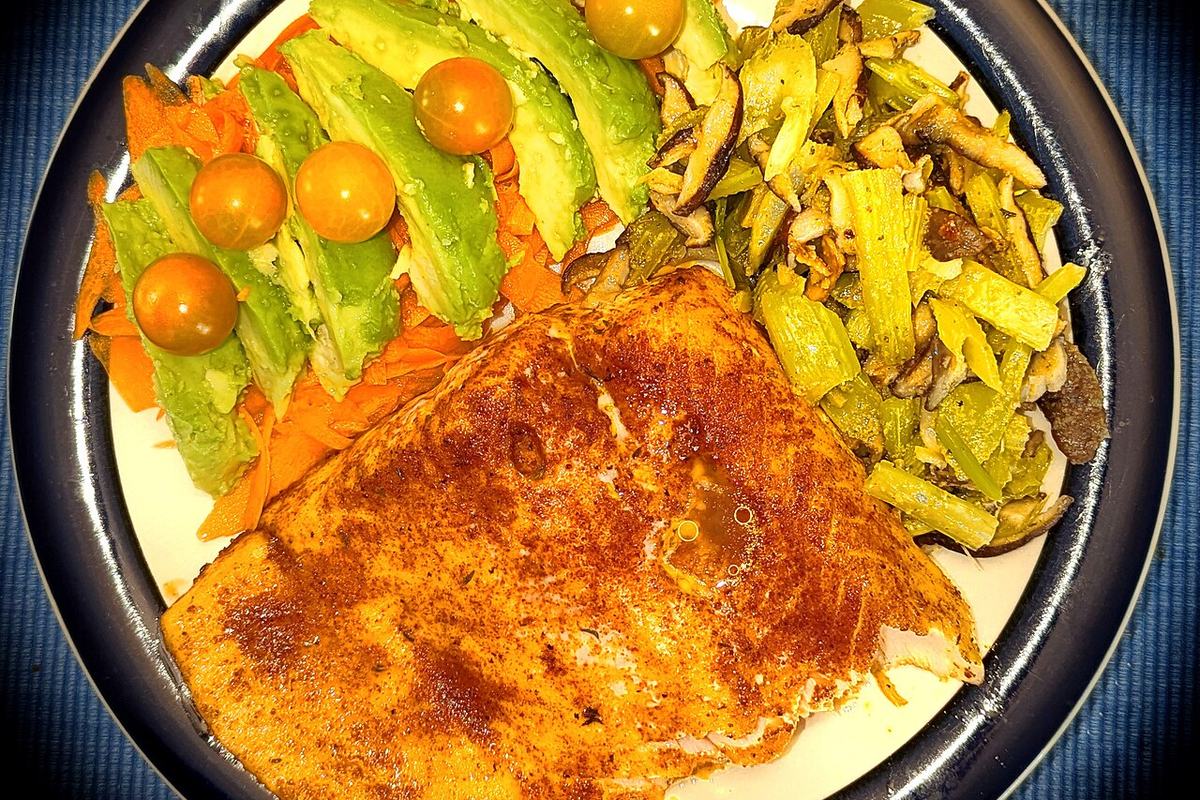
With no diet trials to draw on, the advice comes from guideline bodies, and they mostly agree. From the NHS and ACOG: something dry like toast or a plain biscuit before you get up; five or six small meals so your stomach is never empty; plain, carbohydrate-rich, low-fat foods; cold food when the smell of hot food is too much; and fluids in small sips through the day. ACOG's goal is 8 to 12 cups of water a day, which many women will struggle to reach at their worst. RCOG's short version is "eat little and often".
There's one small experiment. Jednak and colleagues tested 14 nauseated women in their first trimester, and protein-based meals eased nausea and calmed the stomach's electrical rhythm more than carbohydrate or fat meals with the same calories. ACOG also suggests adding protein to each meal, from yoghurt, milk, nuts, nut butters or a shake, even as the NHS leans towards carbohydrate. We wouldn't lose sleep over that gap. The aim at this stage is food that stays down. Plain curd rice served cold, a boiled egg, peanut butter on toast and a plain idli all fit that description, though none has been put through a trial.
Check your iron tablet. RCOG cites a Canadian study in which two-thirds of 97 women who stopped iron-containing supplements felt their nausea improve, and it says women should consider avoiding iron preparations if they make symptoms worse. Don't simply drop your whole prenatal, though. Ask whether you can take folic acid on its own for now and come back to the iron later. Folic acid matters most in these early weeks, as we explain in our folic acid guide, and iron can be picked up from food as your appetite returns.
Ginger, vitamin B6 and medicine: what each trial found
| Option | Dose tested | Result against placebo | The catch |
|---|---|---|---|
| Ginger (Vutyavanich 2001, 70 women) | 1 g a day, 4 days | Nausea fell 2.1 against 0.9 on a 0-10 scale. Vomiting episodes fell 1.4 against 0.3 a day. 28 of 32 improved against 10 of 35 | Small, short |
| Ginger (Viljoen 2014, 12 trials, 1,278 women) | 600 to 2,500 mg a day, mostly 1,000 mg | Nausea 1.20 points better; vomiting not significant (p=0.06) | Only two trials could be pooled for nausea; low-quality evidence |
| Vitamin B6 (Vutyavanich 1995, 342 women) | 30 mg a day, 5 days | Nausea significantly better (p=0.0008); vomiting just short (p=0.055) | Largest B6 trial, and only 5 days |
| Vitamin B6 (Sahakian 1991, 59 women) | 25 mg every 8 hours, 3 days | Severe nausea fell 4.3 against 1.8. No difference in mild to moderate nausea. Vomiting in 8 of 31 against 15 of 28 | Helped mostly those who were worse off |
| Doxylamine with B6 (Koren 2010, 256 women) | 10 mg + 10 mg delayed-release tablets, 14 days | PUQE fell 4.8 against 3.9. 48.9% asked to keep taking it, against 32.8% on placebo | A 0.9-point gain on a 3 to 15 scale |
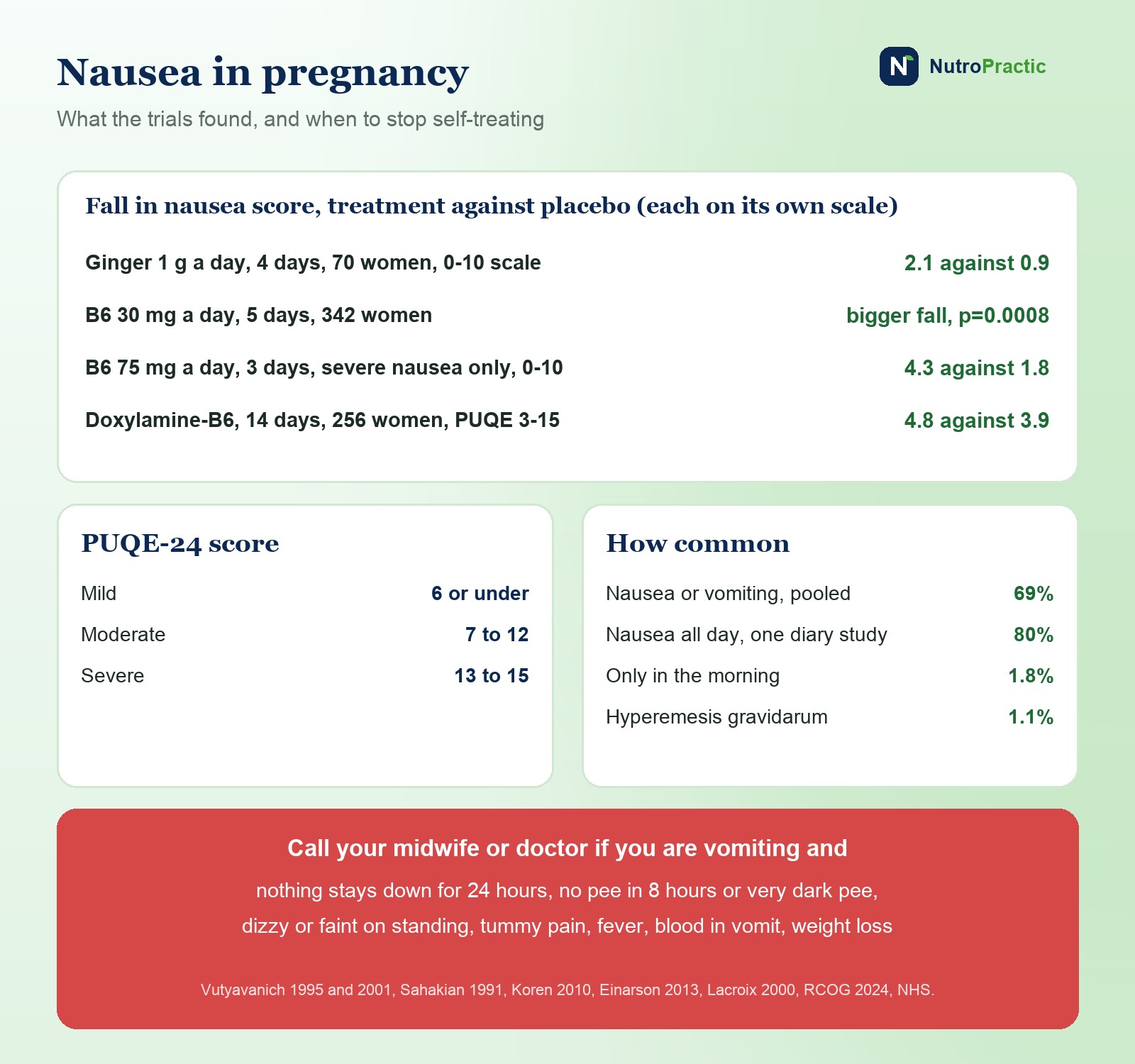
Notice how much placebo did in that last row: a fall of 3.9 points on its own. Nausea tends to ease with time, and that alone makes small trials look better than they are. Cochrane's overall verdict was "a lack of high-quality evidence to support any particular intervention", and it added that this doesn't mean the options are useless, only that none is strongly proven. Wristbands are an example of the muddle. One 100-woman trial found a clear benefit, while several others found none.
Ginger
The placebo-controlled trials mostly used about 1 g of ginger a day as a measured dose. You can't easily tell what a ginger biscuit or fizzy ginger ale delivers, so food-based ginger isn't the same thing as the trial dose, though the NHS and ACOG both list it as worth trying. On safety, a Norwegian cohort of 68,522 women, 1,020 of whom used ginger, found no rise in malformations, stillbirth, preterm birth or low birth weight. Viljoen's pooled miscarriage figure was too uncertain to say much (RR 3.14, 95% CI 0.65 to 15.11). The same review notes that concentrated ginger may reduce platelet clumping, so check with a pharmacist before taking capsules, particularly if you use a blood thinner.
One firm limit: RCOG says clinicians shouldn't suggest ginger for severe symptoms. In a survey of 512 women with hyperemesis, it did little and worsened things for 54%, and being told to try it damaged their trust in the person who suggested it.
Vitamin B6
The doses tested were 30 mg a day and 75 mg a day, for just a few days. The US limit for adults, including in pregnancy, is 100 mg a day; nerve damage has been documented at far higher long-term doses, and the limit doesn't apply when a doctor is supervising treatment. Evidence on B6 alone is split. Those two trials were positive for nausea, but RCOG reads the overall evidence as inconsistent, and a trial in 46 women with hyperemesis found no benefit from 20 mg three times a day. Check what's already in your prenatal, and ask before adding more.
Doxylamine with pyridoxine
This combination is a delayed-release tablet with 10 mg of an antihistamine and 10 mg of B6. It's sold as Diclegis in the US, Diclectin in Canada and Xonvea in the UK, where RCOG lists it as a first-line choice. The US label starts at two tablets at bedtime and goes up to a maximum of four a day if symptoms carry on. Drowsiness was the main side effect, 14.3% against 11.7% on placebo, so don't drive until you know how it affects you and don't combine it with alcohol or sedatives. It hasn't been studied in hyperemesis. Other antihistamines and phenothiazines are also first-line in RCOG's guideline, so if this one isn't available or doesn't suit you, there are others to ask about.
When it's hyperemesis, and what should happen
The international Windsor definition, used by RCOG, describes hyperemesis gravidarum as nausea and vomiting, at least one of them severe, that begins before 16 weeks, stops you eating and drinking normally, and strongly limits daily life. Signs of dehydration support the diagnosis. Older definitions leaned on weight loss and blood tests, and RCOG sees this change as a way to catch more women. Clinicians still look for rapid loss of 5% or more of pre-pregnancy weight: 3 kg for someone who weighed 60 kg, or 3.75 kg at 75 kg.
The NHS says to call your midwife, GP or 111 if you're vomiting and any of these apply: very dark urine, or no urine in 8 hours; you can't keep food or fluids down for 24 hours; you feel very weak, dizzy or faint when standing; tummy pain; a high temperature; vomiting blood; or you've lost weight. ACOG adds a racing or pounding heartbeat. Outside the UK, use your obstetrician, midwife or local emergency line. If you can't reach anyone and nothing is staying down, go to a hospital.
| If it gets this far | What the 2024 RCOG guideline says |
|---|---|
| Medicine | First-line antiemetics should be prescribed when needed. Ondansetron and metoclopramide are second-line options, and drugs can be combined if one fails |
| Ondansetron worry | Women can be reassured: there is a very small rise in the absolute risk of cleft lip or palate with first-trimester use, to be weighed against the risks of poorly managed hyperemesis |
| Fluids | If you can't keep down fluids or tablets, day-unit care is appropriate. IV normal saline with added potassium, guided by daily blood tests |
| Thiamine (B1) | 100 mg three times a day by mouth, or IV, for anyone admitted with vomiting or severely reduced eating, because the deficiency can cause Wernicke encephalopathy |
| Urine ketones | Not an indicator of dehydration and should not be used to judge severity, so a clear ketone test on its own doesn't rule out dehydration |
It's worth asking for treatment early. ACOG says experts recommend it so symptoms don't become severe, and the NHS says early help can prevent dehydration and weight loss. On the baby, the NHS says hyperemesis is unlikely to cause harm if treated effectively, though weight loss raises the chance of a lower birth weight. Researchers have also linked nausea and hyperemesis to sensitivity to a hormone called GDF15, which fits the point many women need to hear: this isn't weakness or a matter of attitude.
It can also wear you down emotionally. RCOG notes that women with hyperemesis are three to six times more likely than those with ordinary pregnancy sickness to report low quality of life, and that psychological support should be offered. In the UK, Pregnancy Sickness Support is a charity for this. If you've had it before, plan ahead for the next pregnancy, as recurrence estimates run from 15% to 89%, depending on how it's counted.
What we'd do, step by step
1. Score it with PUQE-24 and note the number each day. 2. Eat little and often, cold if smells are the problem, with protein if you can manage it. 3. Sip fluids through the day. 4. Look at your iron tablet with your midwife if it's making things worse. 5. Try ginger at about 1 g a day if symptoms are mild, after checking with a pharmacist. 6. Ask about doxylamine-pyridoxine or another antiemetic when food changes aren't enough. There's no prize for putting up with it. 7. Call your midwife or doctor promptly with any warning sign above, or if your score reaches 13.
Toast and ginger are fine for a bad morning. Nothing staying down for 24 hours is a phone call, not a recipe.
Struggling to eat enough once the worst has eased, or planning ahead after a hard pregnancy? Dr. Triveni can build a realistic food plan around what you can manage, in a virtual consultation alongside your maternity care.
Book a consultationThis article is general information, not medical advice, and it does not replace care from your midwife, obstetrician or doctor. Check any supplement or medicine with them or a pharmacist before taking it in pregnancy, and seek help promptly for the warning signs above. Brand names are given only so you can recognise the medicine; we have no link to them.
Sources
Guidelines and patient guidance: Nelson-Piercy C. et al., The management of nausea and vomiting in pregnancy and hyperemesis gravidarum, Green-top Guideline No. 69, BJOG 131:e1-e30 (2024), read from the copy NHS Scotland hosts. NHS, Vomiting and morning sickness and Severe vomiting in pregnancy. ACOG, Morning sickness: nausea and vomiting of pregnancy. All read 5 November 2026.
How common: Einarson T.R. et al., Quantifying the global rates of nausea and vomiting of pregnancy, J Popul Ther Clin Pharmacol 20:e171-183 (2013). Lacroix R. et al., Nausea and vomiting during pregnancy: a prospective study, Am J Obstet Gynecol 182:931-937 (2000).
Treatments: Matthews A. et al., Interventions for nausea and vomiting in early pregnancy, Cochrane Database Syst Rev (2015). Vutyavanich T. et al., Ginger for nausea and vomiting in pregnancy, Obstet Gynecol 97:577-582 (2001). Viljoen E. et al., A systematic review and meta-analysis of the effect of ginger, Nutr J 13:20 (2014). Heitmann K. et al., Safety of ginger use in pregnancy, Eur J Clin Pharmacol 69:269-277 (2013). Vutyavanich T. et al., Pyridoxine for nausea and vomiting of pregnancy, Am J Obstet Gynecol 173:881-884 (1995). Sahakian V. et al., Vitamin B6 is effective therapy for nausea and vomiting of pregnancy, Obstet Gynecol 78:33-36 (1991). Koren G. et al., Delayed-release doxylamine and pyridoxine, Am J Obstet Gynecol 203:571.e1-7 (2010). FDA, Diclegis prescribing information (2013). NIH Office of Dietary Supplements, Vitamin B6 fact sheet.
Food: Jednak M.A. et al., Protein meals reduce nausea and gastric slow wave dysrhythmic activity in first trimester pregnancy, Am J Physiol 277:G855-861 (1999). The iron study (Gill 2009), the hyperemesis ginger survey, the B6 trial in hyperemesis (Tan 2009) and the Windsor definition are as cited in the RCOG guideline.