Mental health · November 6, 2026
Can people with schizophrenia or bipolar disorder keep to a ketogenic diet? In a Queensland trial, 26 of 40 assigned to it finished 12 weeks, and those who did spent 70% of it in ketosis. Whether their symptoms improved is still unreported
Weekly dietitian visits, daily finger pricks and meals people cooked for themselves. The first results from this randomised trial answer a practical question, and only that one.
Ketogenic diets for serious mental illness have gathered plenty of enthusiasm and a shortage of controlled data. Before anyone can test whether the diet helps symptoms, there's a more basic question: can people living with these conditions, often on several medicines, keep to something this strict in their own kitchens? The North Queensland Dietary Intervention Trial in Townsville, Australia, set out to find out.
Adults with schizophrenia, schizoaffective disorder or bipolar disorder were randomised to a ketogenic diet or to the Australian Guide to Healthy Eating. Both groups had weekly contact with a dietitian and practical help with shopping and cooking, but they prepared their own food; no ready meals were delivered. The trial enrolled 71 people. The headline number in the abstract is 52 completers, split evenly at 26 and 26, and that even split hides something.
Allocation wasn't even: 40 people were assigned to the ketogenic diet and 31 to the guideline diet. So 65% of the keto group completed the 12 weeks, against 84% of the comparison group. Among those assigned to keto, three never started it, two were removed for not adhering or attending, and nine withdrew. Five of those nine couldn't stay in ketosis. Others had reasons that any real-world trial can recognise: a needle phobia that made daily blood tests impossible, a move out of the area, domestic violence unrelated to the participant's illness. One left on day three when a flood destroyed their kitchen.
Those who stayed did remarkably well on the measures the trial tracked. On average they spent 70% of the 12 weeks with blood ketones of at least 0.5 mmol/L, and 19 of the 26 were in ketosis on more than 80% of measurements. They attended 92% of dietitian appointments, against 85% in the comparison group. Counting everyone who began the diet and had the chance to show adherence, 30 of 36 (83%) managed at least partial adherence for as long as they took part, which is a fairer number than the completer figure. BMI fell by 6.5% on keto and 2.7% on the guideline diet, though the authors treat that as a check on adherence, not as a result in itself.
Gut symptoms were common in both groups and mostly settled by week six. Among completers, headache was reported by 35% on keto and 15% on the comparison diet, and nausea by 31% against 19%; hunger went the other way, 15% against 38.5%. None of those differences was statistically significant, in a trial this small, and no serious adverse events were recorded in either group. Nearly everyone completing the trial, 94%, was on at least one psychiatric medicine at the start.
Here is what this paper doesn't say. It reports nothing on psychosis, mood, cognition or metabolic health; those results are promised separately, and the authors state that no conclusions on efficacy can be drawn. The people who sign up for a trial like this are likely to be more motivated than most, and they had support few clinics could offer. Funding came from philanthropy, including the Baszucki Brain Research Fund, and one author has consulted for the Baszucki Group among others. So the answer to the narrow question looks like a qualified yes, for some people, with a lot of help. The bigger question is still open.
Who started, who finished, who stayed in ketosis
71
Adults enrolled in Townsville, January 2024 to October 2025; 96 were assessed, against a recruitment target of 100
26 of 40
Assigned to the ketogenic diet who completed 12 weeks (65%); 26 of 31 did on the guideline diet (84%)
70%
Share of the 12 weeks completers spent with blood ketones of 0.5 mmol/L or more
19 of 26
Completers fully adherent, in ketosis on more than 80% of measurements
92% v 85%
Dietitian appointments attended, keto v guideline diet
−6.5% v −2.7%
Average change in BMI over 12 weeks among completers, keto v guideline diet
Feasibility results from a randomised, single-blinded trial at one Australian site; 65% and 84% are our arithmetic from the paper's enrolment numbers. Adherence was measured differently in each arm: daily blood ketones for keto, self-reported 24-hour recalls for the guideline diet, so the rates aren't directly comparable. Psychiatric and metabolic efficacy results aren't in this paper. Funded by philanthropic grants and a staff research fellowship.
- The trial's comparison diet was no easier to follow: 61.5% of its completers reached moderate or better adherence, and none met its recommendations all of the time.
- Participants on keto had a daily deadline. If their blood readings hadn't come in by 17:00, the team contacted them.
- On average, more than 96% of blood glucose readings on the diet sat in the normal range of 4.0 to 7.8 mmol/L, with under 1% showing mild hypoglycaemia.
- Bruising was reported only on keto, by three people, and muscle cramps by three on keto against one on the comparison diet. Both are small counts that a trial of this size can't interpret with confidence.
- Ketogenic metabolic therapy in schizophrenia spectrum and bipolar disorders: population descriptors and feasibility outcomes from a randomized, controlled clinical trialFrontiers in Nutrition, 4 November 2026 (CC BY) · Primary study; enrolment flow, adherence, side effects, limitations, funding and conflicts read in the full text. Trial registration ACTRN12623000854639.
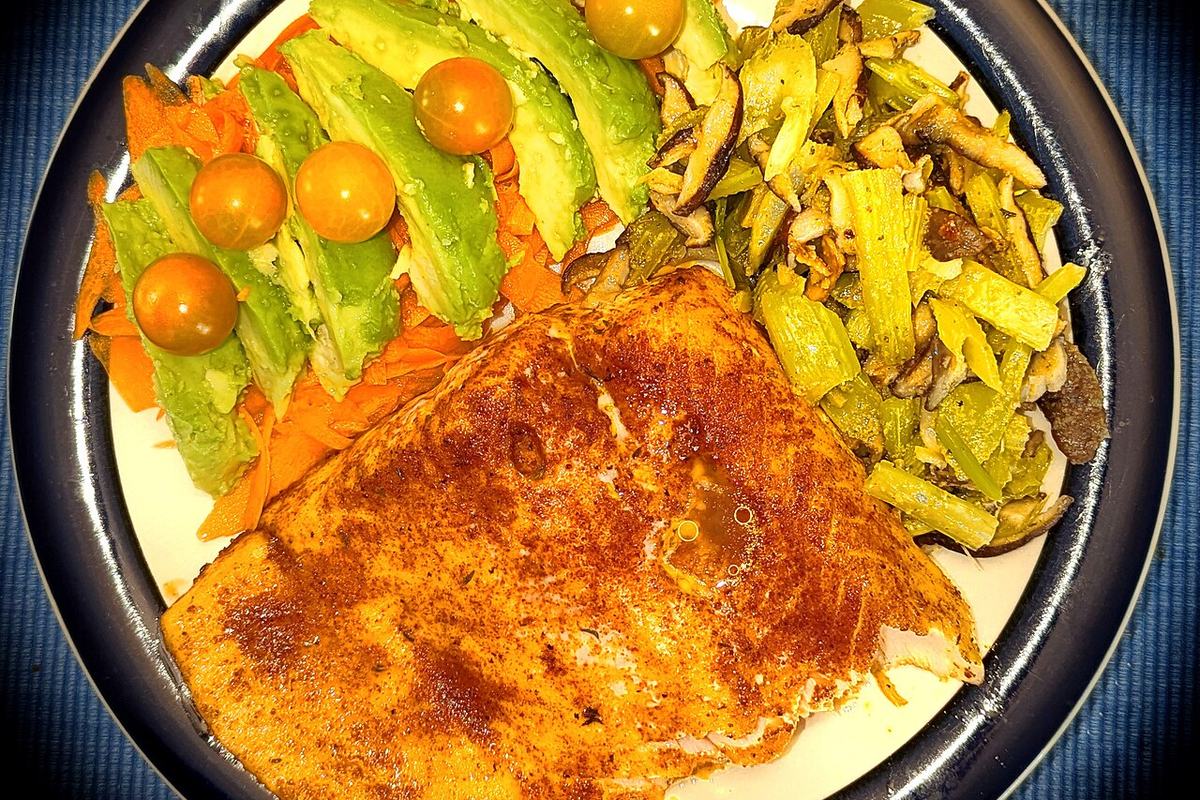
- Cherry tomatoes and avocado on carrots, with celery and mushrooms, plus salmonWikimedia Commons · Photograph by Daderot, CC0; general illustration only.
General information, not medical advice. This paper doesn't show that a ketogenic diet treats schizophrenia, schizoaffective disorder or bipolar disorder. Never stop or change psychiatric medication because of a diet. Keto can alter how the body handles some medicines and isn't suitable for everyone, so it should only be tried with the agreement and monitoring of your psychiatric team and a dietitian.
Analysis by NutroPractic from the sources listed. Written for general readers; it does not replace advice from your own doctor.
From our articles
Read, then eat a little better
Plain-language guides on nutrition and wellness, backed by research.
Women's health
Nausea in pregnancy: ginger, vitamin B6, small meals and when it's hyperemesis, from the trials
Only 1.8% of women in one diary study had nausea just in the morning. Ginger at 1 g a day, B6 at 30 to 75 mg and doxylamine with B6 each have trial data, while diet advice has none. The score to track it, the doses, and the signs that mean a phone call.
5 Nov 2026
Diabetes
Vinegar before meals: what the trials measured on blood sugar, and how much is enough
Two teaspoons to a tablespoon with a starchy meal trims the glucose peak at 30 minutes, and the gap fades by two hours. HbA1c reviews range from -0.39 to -1.53, and we explain which to trust. Two gummies hold about 50 mg of acetic acid against 750 mg in a tablespoon.
5 Nov 2026
Diabetes
Pasta and blood sugar: al dente, cooled and reheated, and what the glucose tests measured
Head-to-head tests found little gap between 5 and 15 minutes of boiling. Chilling and reheating ranged from no change to a large drop. Moving from 80 g to 150 g adds 50 g of carbs. The tests, the sums, and legume and whole-wheat pastas per 100 g.
4 Nov 2026
Newsfeed for your website
Want this feed on your website?
Add it to any site with one copy-and-paste snippet. No sign-up, and it updates itself every hour.
Start with a virtual consultation
Tell Dr. Triveni what you want to change. You will leave with a clear next step, whether you are in Toronto, London, New York or Chennai.