Glycine powder is sold as a sleep aid, and the dose everyone quotes is 3 g before bed. That number comes from a handful of small Japanese trials, several of them with authors from a company that makes amino acids. Here is what those trials measured, what the newest review says, how much glycine is in gelatin, bone broth and collagen, and who should not take it.
What the 3 g trials did
- Inagawa 2006 (crossover): people with sleep complaints took 3 g of glycine or placebo at bedtime. The result was better self-rated sleep quality in the morning. It was a randomised, double-blind crossover, but small.
- Yamadera 2007 (polysomnography): the same 3 g dose, this time with sleep recorded in a lab. The reported result was a shorter time to fall asleep. We could not open the full paper, so we don't quote its sample size or minutes.
- Bannai 2012 (sleep restriction): healthy volunteers had their time in bed cut by 25% for three nights (7.3 hours down to about 5.5). They took 3 g of glycine or placebo 30 minutes before bed. Ten men were enrolled and seven were analysed (mean age 40.6). Fatigue ratings fell, sleepiness only showed a tendency, and reaction time on a vigilance test improved on day 1 (p = 0.003) and on day 3 only borderline (p = 0.05).
- 2026 scoping review (Fan, Nelson and Wallace, J Diet Suppl): 22 trials in all. Only 3 were glycine sleep trials, and all 3 reported a benefit on at least one sleep outcome. The authors also say the evidence for glycine explaining collagen's sleep effects "has not been directly tested" and ask for larger trials.
The limits, plainly
- The trials are small: only seven men were analysed in the sleep-restriction one. A 2024 systematic review of glycine in adults found the longer sleep studies in healthy people had small samples and a high risk of bias.
- The Bannai trial's authors work at Ajinomoto, a company that makes amino acids. That doesn't make the result wrong, but nobody independent has repeated it at scale that we could find.
- Results are mostly how people felt (a visual scale) plus one reaction-time test. Nothing here shows fewer hospital visits or any long-term outcome.
- The most you can say: in small short trials, 3 g taken about 30 minutes before bed made some sleepy or sleep-restricted adults feel better the next day. It is not a treatment for insomnia.
The body-temperature idea
The popular explanation is that glycine lowers core body temperature, and falling temperature helps sleep start. That comes from rat studies: oral glycine raised skin blood flow and lowered core temperature, and the effect disappeared when the brain's body-clock region (the suprachiasmatic nucleus) was destroyed (Kawai 2015, Neuropsychopharmacology). The human trials above did not report a temperature drop we could verify. A 2024 crossover of collagen peptides in 13 men recorded core temperature on the seventh night and found no difference from placebo. So treat the temperature story as a hypothesis.
How much glycine is in food
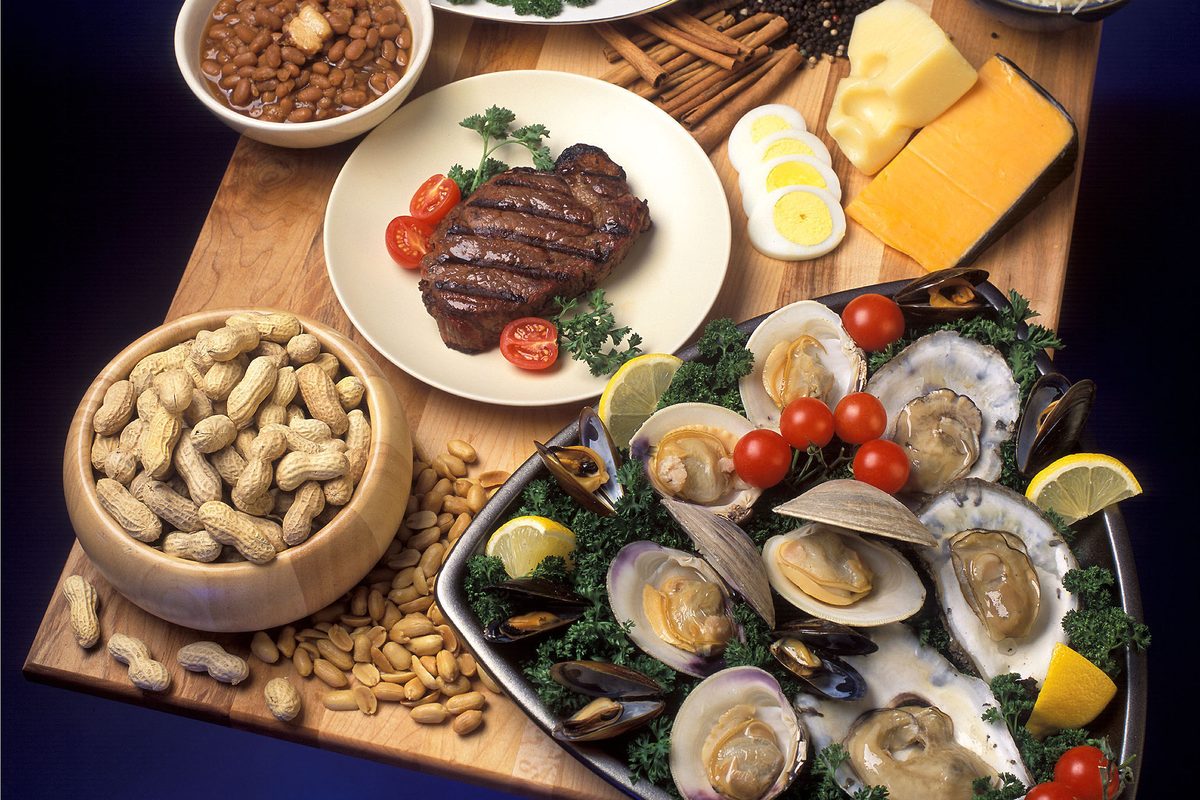
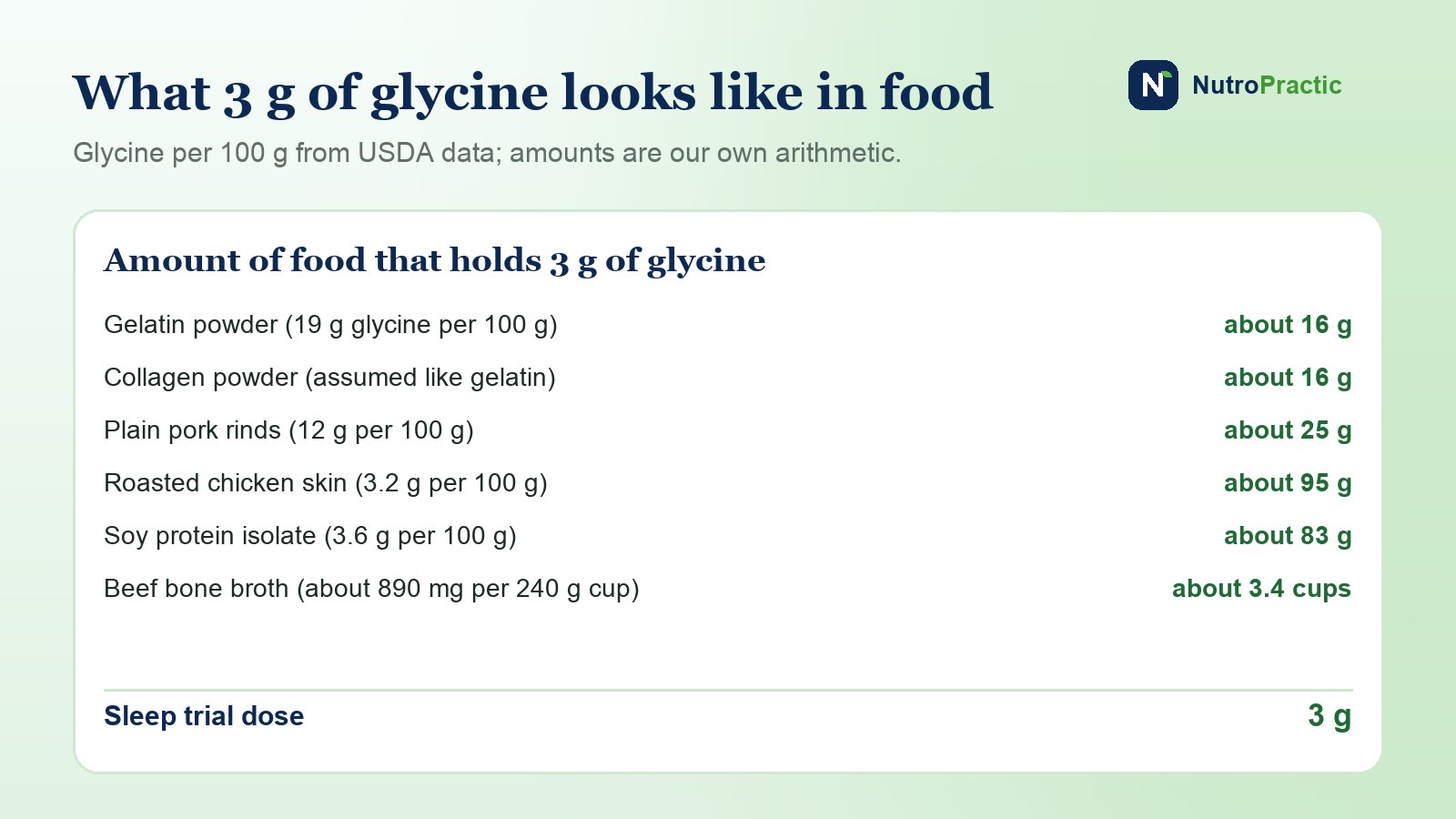
Glycine is a non-essential amino acid: your body makes some and protein foods supply the rest. Below is the glycine content of foods from USDA data (read from a table of USDA values), and the amount of each that holds 3 g. The grams of food are our own arithmetic.
| Food | Glycine per 100 g | Food that holds 3 g |
|---|---|---|
| Gelatin powder, dry, unsweetened | 19 g | about 16 g (2 to 3 small packets) |
| Pork rinds, plain | 12 g | about 25 g |
| Chicken skin, roasted | 3.2 g | about 95 g |
| Soy protein isolate | 3.6 g | about 83 g |
| Egg white powder | 3.1 g | about 97 g |
| Beef bone broth (one lab analysis) | about 0.37 g (3.7 mg per g) | about 810 g, or 3.4 cups of 240 g |
- Gelatin is the one food where 3 g is easy. A 7 g packet holds about 1.3 g of glycine, so a bit over two packets, in a warm drink or a jelly.
- Bone broth is a weak source. The one lab figure we found (about 3.7 mg of glycine per gram of broth, so roughly 890 mg a cup) comes from an undergraduate chemistry paper we could not trace to a title. Home-made broths vary a lot with bones, time and water, so a cup of yours could be well under that or several times higher.
- Collagen powder is mostly the same protein as gelatin, so a 10 g scoop is about 1.9 g of glycine and a 15 g scoop about 2.9 g (our arithmetic from gelatin's 19%). Labels vary, so read the amino acid panel if there is one.
Collagen at bedtime: what one trial found
In a 2024 crossover trial, 13 athletic men with sleep complaints took 15 g of collagen peptides or placebo an hour before bed for 7 nights. Lab recordings on night 7 showed fewer awakenings with collagen (21.3 versus 29.3, p = 0.028), and sleep diaries agreed on awakenings (1.3 versus 1.9, p = 0.023). But sleep quality, sleepiness, fatigue and core temperature did not differ. A glycine-only trial, a collagen trial and the 2026 review all point the same loose way, and none proves the glycine is what does it. If you already take collagen for your skin or joints, our collagen powders article covers the dose and protein quality, and evening is a harmless time to take it.
Safety and who should skip it
- Clozapine. In a small double-blind trial (Potkin 1999, 19 people), 30 g a day of glycine added to clozapine did not help symptoms, while those on clozapine alone had a 35% drop in positive symptoms. That is ten times the sleep dose and a very different group, but anyone on clozapine or another antipsychotic should check with their prescriber first.
- Kidneys and liver. We found no sleep-dose safety data in people with kidney or liver disease. Ask your doctor before starting.
- Pregnancy and breastfeeding. No sleep-trial data. Food amounts are fine, supplements are a question for your doctor.
- Side effects. We did not find adverse-event numbers for the 3 g dose, so we can't quote a rate. Stop if it upsets your stomach.
What we'd do
- Sleeping badly most nights? Fix the basics first: a fixed wake time, caffeine cut off by early afternoon, a lighter late meal. Our food and sleep article goes through what the trials found, and our magnesium article covers magnesium glycinate.
- Want to try glycine? 3 g, 30 minutes before bed, for two weeks, with a sleep diary. If you notice nothing, stop. A cheap test, and gelatin in warm milk is a food-first way to run it.
- Short on sleep on purpose (shift work, travel)? The evidence is thinnest here: seven men for three nights.
Not sleeping well and not sure what is behind it? Dr. Triveni can go through your meals, caffeine, medicines and supplements in a virtual consultation and set out food-first steps.
Book a consultationThis article is general information, not medical advice. Talk to your doctor before taking supplements or changing your diet, especially if you take regular medicines, are pregnant or breastfeeding, or have a medical condition.
Sources
Bannai M. et al., The effects of glycine on subjective daytime performance in partially sleep-restricted healthy volunteers, Front Neurol 2012;3:61 (PubMed 22529837, PMC3328957); Bannai M., Kawai N., New therapeutic strategy for amino acid medicine: glycine improves the quality of sleep, J Pharmacol Sci 2012 (PubMed 22293292), which cites Inagawa 2006 and Yamadera 2007 (Sleep Biol Rhythms); Kawai N. et al., Neuropsychopharmacology 2015 (PubMed 25533534); Fan Z., Nelson J.M., Wallace T.C., Glycine bioavailability and sleep-related outcomes following oral glycine and collagen supplementation: a scoping review, J Diet Suppl 2026 (PubMed 42687500); collagen peptides before bedtime in physically active males, 2024 crossover (Europe PMC abstract); glycine administration in human adults, systematic review 2024; Potkin S.G. et al., Am J Psychiatry 1999;156:145-7 (PubMed 9892314). Glycine per 100 g from USDA FoodData Central (SR Legacy) as tabulated at getfoodfacts.com/nutrient/glycine; bone broth glycine from a lab analysis reported by scienceinsights.org (original not traced). Read 18 Nov 2026.