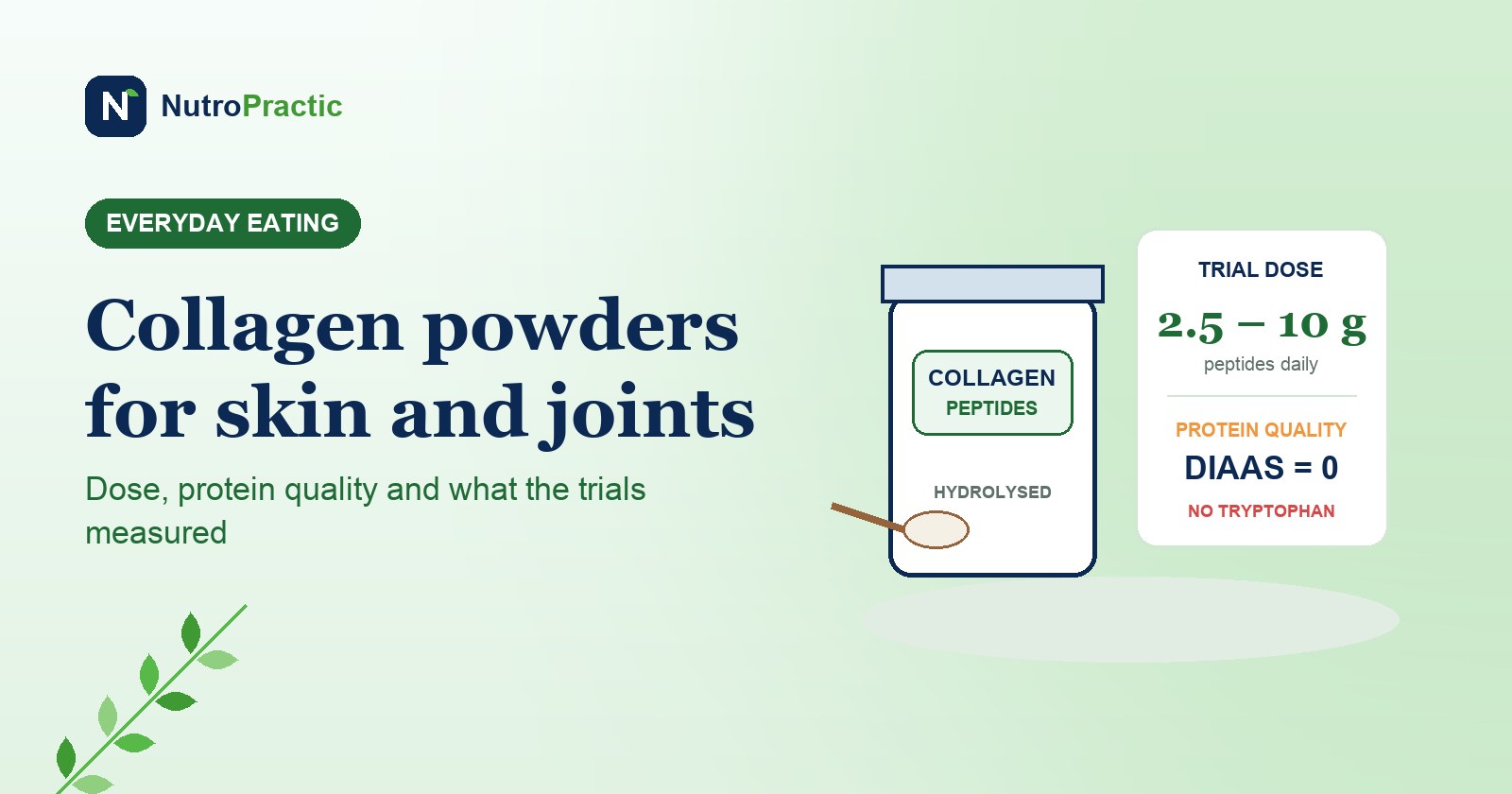
Tubs of collagen peptides promise firmer skin, resilient joints, and 10 to 20 grams of protein per serving. Because the powder dissolves smoothly into morning coffee without thickening, millions of people treat it as their primary protein supplement.
Before spending $30 to $50 a month, look at the label math and the clinical trials. Hydrolysed collagen has unique bioactive peptides that produce modest, measurable changes in skin and joints. But its protein quality score is zero. If you count collagen toward your daily muscle or recovery targets, the arithmetic breaks down.
Protein quality math: why collagen's DIAAS score is zero
Protein quality is measured by how well a food supplies the nine essential amino acids humans cannot manufacture. Under the FAO's Digestible Indispensable Amino Acid Score (DIAAS) and the older PDCAAS system, collagen scores 0.0.
The reason is straightforward: collagen contains zero tryptophan (0.0 g per 100 g protein). If a protein completely lacks even one essential amino acid, its utilisation score drops to zero. You cannot survive on collagen as a sole protein source, and it cannot replace complete proteins like eggs, Greek yogurt, lentils, fish, or tofu.
| Amino acid profile (g / 100 g protein) | Hydrolysed bovine collagen | Whey isolate | Whole egg | Cooked lentils |
|---|---|---|---|---|
| Glycine (connective tissue) | 33.0 g | 1.8 g | 3.4 g | 4.2 g |
| Proline + Hydroxyproline | 23.5 g | 5.5 g | 3.8 g | 4.4 g |
| Leucine (mTOR muscle trigger) | 2.7 g | 11.5 g | 8.6 g | 7.6 g |
| Tryptophan (essential) | 0.0 g | 1.9 g | 1.5 g | 1.0 g |
| DIAAS / PDCAAS quality score | 0.00 | 1.15–1.30 | 1.13 | 0.60–0.75 |
Muscle protein synthesis needs a threshold of about 2.5 to 3.0 g of leucine per meal to activate the mTOR pathway. In whey protein, 25 g of powder delivers about 2.8 g of leucine. In collagen powder, getting 2.8 g of leucine requires eating over 100 grams of powder (about 360 kcal). Our protein-after-40 guide explains how to hit that leucine target with ordinary meals.
What the skin trials actually measured
Does eating collagen do anything for skin, or is it broken down into generic amino acids? In 2021, the International Journal of Dermatology published a systematic review and meta-analysis of 19 randomised, double-blind, placebo-controlled trials with 1,125 participants (95% women aged 20 to 70).
The trials evaluated oral hydrolysed collagen peptides taken daily for 60 to 90 days (doses ranging from 2.5 g to 10 g per day). The outcomes were measured using objective dermatological instruments:
• Skin hydration: Measured by electrical capacitance (Corneometer). Supplementation showed a statistically significant improvement versus placebo, with mean hydration increasing by 7% to 12% after 8 to 12 weeks.
• Skin elasticity: Measured by suction cutometry (Cutometer R2 and R7 parameters). Participants taking collagen peptides showed a 6% to 9% relative increase in gross elasticity compared to placebo.
• Dermal collagen density and wrinkles: High-frequency ultrasound showed denser dermal echo structures, and optical 3D profilometry recorded modest reductions in periorbital wrinkle volume (about 8% to 15% reduction in depth).
Why does this happen despite collagen's low protein score? Human pharmacokinetic studies (such as Shigemura et al.) show that enzymatic hydrolysates yield small, stable dipeptides—primarily proline-hydroxyproline (Pro-Hyp) and hydroxyproline-glycine (Hyp-Gly). These dipeptides resist stomach degradation, appear in human plasma within 1 to 2 hours of ingestion, and signal dermal fibroblasts to ramp up hyaluronic acid and collagen synthesis.
Realistic perspective: a 7% to 10% change in skin hydration is helpful, especially in dry climates or during menopause when skin collagen drops by about 30% in the first five years. But it is not a facelift. Daily broad-spectrum sunscreen (preventing ultraviolet matrix-metalloproteinase activation) and adequate vitamin C (an essential cofactor for collagen cross-linking) do far more to preserve dermal integrity.
Joint pain: what the osteoarthritis trials found
In joint health, trials split into two distinct forms of collagen:
1. Hydrolysed collagen peptides (Type I/III, 5 g to 10 g/day): A 2019 meta-analysis in International Orthopaedics pooled 5 clinical trials (519 patients with knee osteoarthritis). Taking 10 g daily for 12 to 24 weeks showed a statistically significant reduction in Western Ontario and McMaster Universities Osteoarthritis Index (WOMAC) visual analogue pain scores (mean reduction of 0.8 to 1.2 points on a 10-point scale). It acts by supplying glycine and proline pool for chondrocyte extracellular matrix synthesis.
2. Native / Undenatured Type II Collagen (UC-II, 40 mg/day): This is not a peptide powder; it is a microscopic dose of uncoiled chicken cartilage. In randomised trials (such as Lugo et al. in the Nutrition Journal), 40 mg daily improved knee extension and physical function through oral tolerance—interacting with Peyer's patches in the gut immune system to turn down joint-directed T-cell inflammation, rather than supplying building blocks.
What collagen cannot do: it does not regrow worn joint cartilage, it does not rebuild bone, and it does not reverse bone-on-bone arthritis. In athletic trials (Clark et al., Penn State), 10 g daily reduced activity-related joint discomfort in runners after 24 weeks, but had no effect on acute tendon tears.
Dose summary: how much delivers evidence?
| Target outcome | Evidence-backed daily dose | Trial duration | Clinical note |
|---|---|---|---|
| Skin hydration & elasticity | 2.5 g to 5.0 g | 8 to 12 weeks | Higher doses (>5 g) did not produce significantly greater skin changes in head-to-head trials. |
| Joint discomfort / Osteoarthritis | 10.0 g (hydrolysed) or 40 mg (UC-II) | 12 to 24 weeks | Takes at least 3 months to notice joint comfort changes; not an immediate analgesic. |
| Bone mineral density (postmenopausal) | 5.0 g | 12 months | A 2018 trial (König et al.) found a 4.2% increase in femoral neck T-score when taken with calcium/vitamin D. |
| Muscle hypertrophy / Gym recovery | Not recommended | – | Whey, milk, egg, soy or pea protein provide the complete essential amino acid profile needed. |
Notice that 2.5 g to 5.0 g daily is sufficient for skin benefits. Many commercial tubs provide scoops of 15 to 20 g simply to advertise a higher protein number on the front panel. Taking 20 g instead of 5 g quadruples the cost and adds 80 calories of incomplete protein without improving dermatological outcomes.
Purity and heavy metals: what independent tests found
Because collagen is extracted from bovine hides, porcine skin, fish scales, or chicken cartilage, animal feed and environmental exposure dictate contaminant levels. In 2020 and 2025 testing by the Clean Label Project and independent laboratories, several top-selling collagen powders showed detectable levels of arsenic, lead, and cadmium.
While most products remained below acute toxicity thresholds, collagen is consumed daily over months or years. Chronic low-level heavy metal ingestion is cumulative. When selecting a product:
• Look for independent, lot-specific certifications on the label: NSF Certified for Sport, USP Verified, or Informed Choice.
• If a brand claims 'rigorously tested', ask for their third-party Certificate of Analysis (CoA) confirming heavy metals (lead, cadmium, arsenic, mercury) are under 0.5 mcg per daily serving.
• People who are pregnant or nursing should be particularly cautious about uncertified, daily collagen supplements.
Can ordinary foods replace a collagen tub?
Homemade bone broth, gelatin desserts, slow-cooked meat on the bone, and fish with skin are traditional collagen sources. However, the concentration in food varies dramatically:
• Bone broth: A 2019 study in the International Journal of Sport Nutrition and Exercise Metabolism tested commercial and homemade bone broths and found collagen content ranged from 1.5 g to 9.2 g per cup, alongside highly variable sodium.
• Gelatin: Gelatin is cooked, partially hydrolysed collagen. It supplies the same amino acids (glycine and proline) at roughly one-fifth the cost of branded peptide tubs, but its larger molecular weight forms a gel and does not dissolve invisibly in cold water.
• Your body's own collagen synthesis: Your body builds collagen from any balanced complete protein, provided you have sufficient vitamin C (citrus, bell peppers, amla, guava), zinc (pumpkin seeds, lentils, shellfish), and copper (sesame seeds, cashews, dark chocolate).
A 30-second checklist before buying
1. Check the goal: Buy collagen for skin hydration or joint stiffness, never as your workout recovery protein. See our protein bars and shakes comparison for whole protein benchmarks.
2. Read the scoop size: You need 2.5 g to 5 g for skin, or 10 g for joints. Don't waste money taking 20 g daily.
3. Check the ingredient list: Unflavoured, pure hydrolysed collagen peptides should have one single ingredient. Avoid tubs padded with maltodextrin, artificial flavours, or proprietary blends.
4. Verify third-party safety: Confirm NSF, USP, or lot-specific heavy metal testing.
5. Give it 8 to 12 weeks: Collagen peptides take 60 to 90 days to register on skin hydration meters or joint scoring scales. If you see no difference at 3 months, stop.
Collagen is a functional peptide supplement, not a dietary protein foundation. Dose it at 2.5 to 10 grams for skin or joints, but keep your daily protein anchored in whole, complete foods.
Want to review your supplements, daily protein targets, and evidence-based nutrition plan? Dr. Triveni can help you build a personalized, balanced routine.
Book a consultationThis article is for educational purposes only and does not constitute medical advice. Consult your physician or registered dietitian before starting any new dietary supplement, particularly if you have kidney disease, are pregnant, or are taking medications.
Sources
Miranda R.B. et al., Effects of hydrolyzed collagen supplementation on skin aging: a systematic review and meta-analysis, International Journal of Dermatology 60(12):1449–1461 (2021). Choi F.D. et al., Oral Collagen Supplementation: A Systematic Review of Dermatological Applications, Journal of Drugs in Dermatology 18(1):9–16 (2019).
García-Coronado J.M. et al., Effect of collagen supplementation on osteoarthritis symptoms: a meta-analysis of randomized placebo-controlled trials, International Orthopaedics 43(3):531–538 (2019). Lugo J.P. et al., Efficacy and tolerability of an undenatured type II collagen supplement in modulating knee osteoarthritis symptoms, Nutrition Journal 15:14 (2016).
Shigemura Y. et al., Dose-dependent changes in the levels of free and peptide forms of hydroxyproline in human plasma after collagen hydrolysate ingestion, Food Chemistry 159:328–332 (2014). König D. et al., Specific Collagen Peptides Improve Bone Mineral Density and Bone Markers in Postmenopausal Women, Nutrients 10(1):97 (2018). FAO, Dietary protein quality evaluation in human nutrition, FAO Food and Nutrition Paper 92 (2013).