Inflammation is the body's repair crew. Cut your finger and it swells, reddens and heals; that is inflammation doing its job, then switching off. The kind people mean when they talk about "anti-inflammatory eating" is different: a low, steady hum of immune activity that never quite switches off. It doesn't hurt, but over years it is tied to heart disease, type 2 diabetes, fatty liver and some cancers.
That second kind is real, measurable and changeable. It has also become one of the most profitable words in the wellness industry. This guide separates the two.
How it's measured: hs-CRP
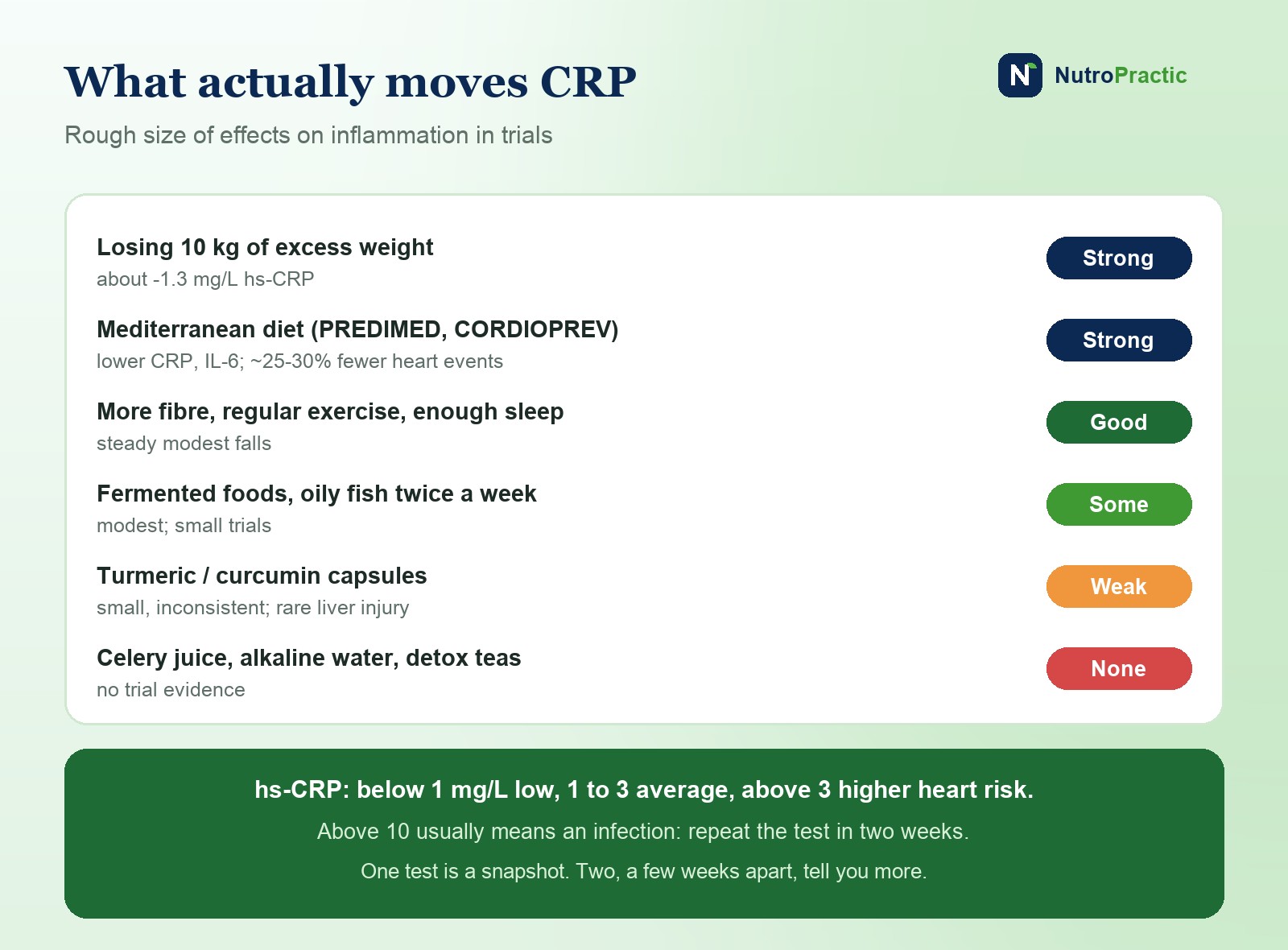
C-reactive protein (CRP) is made by the liver when the immune system is active. A standard CRP test picks up big rises from infection. A high-sensitivity CRP (hs-CRP) test measures the low levels that matter for long-term risk. Cardiology groups in the US use these bands:
Below 1 mg/L: low.
1 to 3 mg/L: average.
Above 3 mg/L: higher cardiovascular risk.
Above 10 mg/L usually means a passing infection or injury, and the test should be repeated in a couple of weeks. Because CRP moves with colds, hard training and even a bad night, one number is a snapshot; two tests a few weeks apart tell you more.
Does lowering inflammation actually prevent anything? In 2017 the CANTOS trial gave 10,000 heart attack survivors a drug that blocks one inflammatory signal, without touching cholesterol, and heart attacks and strokes fell by about 15%. Inflammation is not just a marker; it is part of the disease.
The largest lever: losing excess fat
Fat tissue, especially around the waist and in the liver, releases inflammatory signals of its own. So the single strongest dietary influence on CRP in people carrying extra weight is losing some of it.
A meta-analysis of 33 weight-loss studies found CRP fell by about 0.13 mg/L for every kilogram lost, whether the loss came from diet, exercise, medicine or surgery. Losing 8 to 10 kg typically takes someone from the "higher risk" band into the "average" one. No food or supplement in the trials comes close to that.
This matters because many "anti-inflammatory diets" work largely by making people eat less. That is fine, but it is worth knowing where the effect comes from.
Whole diets: the Mediterranean trials
PREDIMED (Spain, 7,447 people at high cardiovascular risk) compared a Mediterranean diet with extra-virgin olive oil or with nuts against advice to eat low-fat. In a subgroup followed for three years, both Mediterranean diets lowered CRP, interleukin-6 and several other inflammatory markers, and the falls in the main markers were larger than on the low-fat diet. The main trial found about 30% fewer heart attacks, strokes and heart deaths, without anyone being told to lose weight.
CORDIOPREV (Spain, 1,002 people who had already had coronary heart disease) ran for seven years and compared a Mediterranean diet with a low-fat diet. The Mediterranean group had about a quarter fewer major cardiovascular events, with the clearest benefit in men.
The pattern in both trials is the same: plenty of vegetables, fruit, pulses, whole grains, nuts and olive oil; fish a few times a week; little processed meat, sweets or refined starch. Nothing exotic.
No single food in the trials lowers inflammation as much as losing excess weight. The diets that work are ordinary ones eaten consistently: plants, fibre, olive oil, fish, and less of the ultra-processed food that crowds them out.
What else moves CRP
Fibre. In US national surveys, adults eating the most fibre were about 40% less likely to have raised CRP, and small trials of extra fibre lowered it. Our fibre gap guide has an easy 30-gram day.
Fermented foods. In a Stanford trial, ten weeks of six servings a day of yogurt, kefir, kimchi and similar foods lowered 19 inflammatory proteins, including interleukin-6, while a high-fibre diet didn't in the same short time. It was a small study, but a promising one; we covered it in fermented foods and your gut.
Oily fish. Omega-3 fats lower some inflammatory markers, and eating fish twice a week is part of every pattern that works. High-dose capsules are a different story; see omega-3: fish, walnuts or capsules?.
Moving, sleeping and not smoking. Regular exercise lowers CRP even without weight loss; short sleep and smoking raise it. These belong in any honest "anti-inflammatory plan".
Less ultra-processed food. Diets heavy in sugary drinks, refined starch and processed meat are linked with higher CRP; see our guide to ultra-processed foods for realistic swaps.
The single-food claims
Turmeric and curcumin. Curcumin is the best-studied single "anti-inflammatory" food compound. Meta-analyses of supplement trials do find modest falls in CRP, mostly with high doses (around 1 g of curcumin a day) in absorption-boosted capsules with black pepper extract, and mostly in people with conditions such as metabolic syndrome or arthritis. A teaspoon of turmeric in a curry gives about 100 to 200 mg of curcumin, little of which is absorbed: lovely in food, not a treatment. Concentrated capsules have been linked to rare cases of liver injury in the US and Europe, so they're not risk-free, and they can interact with blood thinners.
Ginger, green tea, cinnamon, garlic. Small trials, mixed results, mostly with extracts rather than amounts you would eat. Fine to enjoy, not worth paying a premium for.
Celery juice, alkaline water, "detox" teas. No trials showing a fall in CRP or any inflammatory marker.
Cutting out nightshades, gluten or dairy "for inflammation". For people with coeliac disease, gluten matters enormously. For everyone else, trials haven't shown that removing tomatoes, wheat or dairy lowers CRP; plain yogurt and whole grains are, if anything, linked with lower levels.
"Inflammation tests" sold online that score dozens of foods as inflammatory for you personally (often IgG food sensitivity panels) aren't validated, and allergy societies in Europe and the US advise against them.
A plain anti-inflammatory week
No special products. This is what the trial diets looked like on a normal plate.
Breakfasts: porridge with berries and walnuts; Greek yogurt or kefir with fruit and seeds; wholegrain toast with eggs and tomatoes; idli or besan chilla with sambar.
Lunches: lentil or bean soup with wholegrain bread; a big salad of chickpeas, leaves, peppers, olive oil and lemon; leftover dinner.
Dinners, across the week: salmon or sardines with potatoes and greens (twice); a bean or dal curry with brown rice and a vegetable side; chicken and vegetable tray bake in olive oil; wholewheat pasta with tomato, lentils and spinach; a tofu or paneer stir-fry with lots of vegetables; an omelette with salad and wholegrain bread.
Snacks: a handful of nuts, fruit, carrot sticks with hummus, a pot of yogurt, a small square of dark chocolate.
Cooking fat: extra-virgin olive oil for most things; rapeseed (canola) or groundnut oil for high heat.
Less of: processed meat, sugary drinks, sweets and pastries, white bread and fried snacks. Not never, just less.
Keep it up for three months, alongside activity and sleep, and repeat the hs-CRP test if your doctor ordered one. If you're carrying extra weight, that's when you'll see the biggest change.
Raised CRP, joint pain or a strong family history of heart disease? Dr. Triveni's anti-inflammatory package builds this pattern around your own foods, tests and goals, in virtual consultations.
Book a consultationThis article is general information, not medical advice. A raised CRP can have many causes, including infection and autoimmune disease, and needs to be interpreted by your doctor. Talk to your doctor before taking turmeric or other supplements, especially if you take blood thinners or have liver disease.
Sources
Ridker P.M. et al., Antiinflammatory therapy with canakinumab for atherosclerotic disease (CANTOS), N Engl J Med 377:1119-1131 (2017). Pearson T.A. et al., Markers of inflammation and cardiovascular disease: AHA/CDC scientific statement, Circulation 107:499-511 (2003). Selvin E. et al., The effect of weight loss on C-reactive protein: a systematic review, Arch Intern Med 167(1):31-39 (2007). Estruch R. et al., Primary prevention of cardiovascular disease with a Mediterranean diet supplemented with extra-virgin olive oil or nuts (PREDIMED), N Engl J Med 378:e34 (2018). Casas R. et al., The 3-year effect of the Mediterranean diet intervention on inflammatory biomarkers related to cardiovascular disease, 2021. Delgado-Lista J. et al., Long-term secondary prevention of cardiovascular disease with a Mediterranean diet and a low-fat diet (CORDIOPREV), Lancet 399:1876-1885 (2022). Ajani U.A. et al., Dietary fiber and C-reactive protein: findings from National Health and Nutrition Examination Survey data, J Nutr 134(5):1181-1185 (2004). Wastyk H.C. et al., Gut-microbiota-targeted diets modulate human immune status, Cell 184(16):4137-4153 (2021). Umbrella meta-analysis of inflammatory biomarkers after curcumin supplementation, 2023. Sahebkar A., Are curcuminoids effective C-reactive protein-lowering agents in clinical practice?, Phytother Res 28(5):633-642 (2014). Halegoua-DeMarzio D. et al., Liver injury associated with turmeric: a growing problem, Am J Med 136(2):200-206 (2023). European Academy of Allergy and Clinical Immunology, position paper on IgG testing for food (2008).