Food additives · October 31, 2026
People with Crohn's or colitis in a Belgian study ate more emulsifiers than healthy volunteers, but not more ultra-processed food
Emulsifiers are the additives that keep oil and water mixed in foods from dressings to ice cream. Researchers in Leuven compared 121 people with inflammatory bowel disease with 65 healthy volunteers. The patients took in clearly more emulsifiers, while ultra-processed food servings were about the same. Over the next year, heavier eaters of both had more flare-related trouble at first glance, but the link did not survive adjustment.
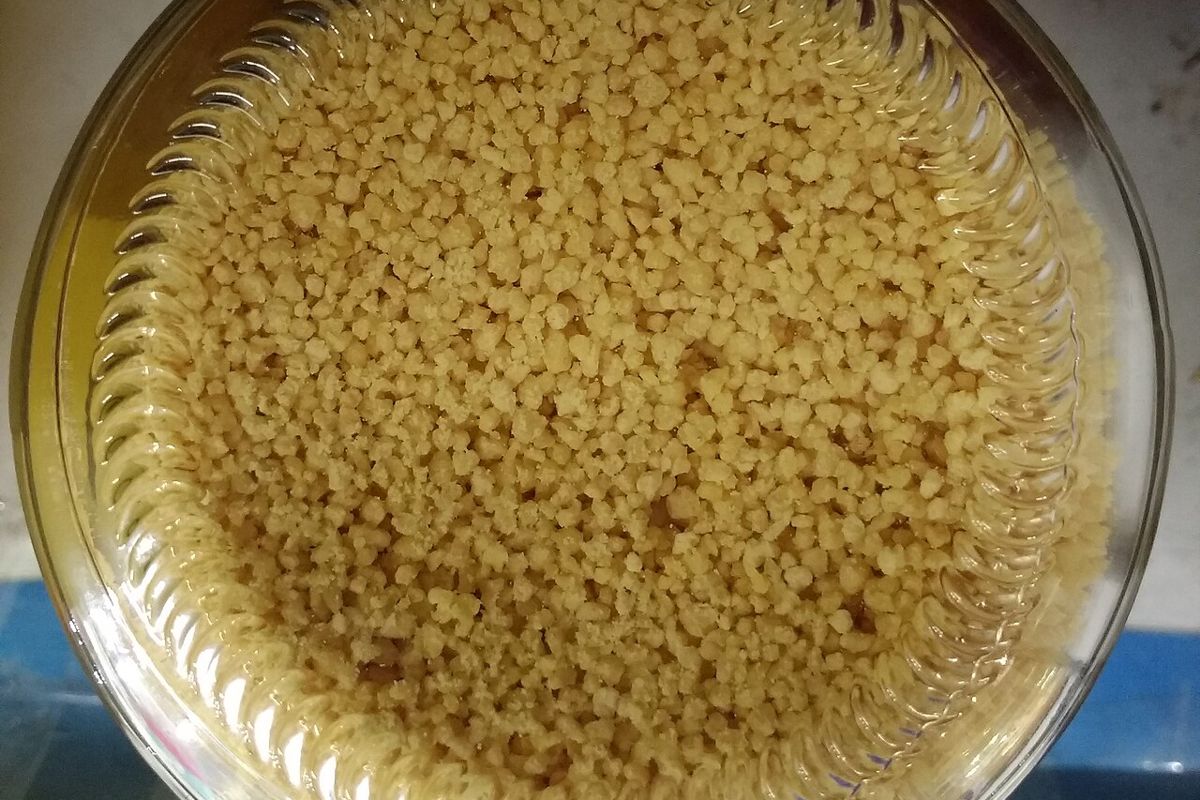
Emulsifiers such as lecithins, polysorbates, carboxymethylcellulose and carrageenan are added to many packaged foods to stop ingredients separating and to give a smooth texture. They have drawn attention in inflammatory bowel disease (IBD), the group of conditions that includes Crohn's disease and ulcerative colitis, because animal studies suggest some of them can disturb the gut lining and its bacteria. Whether people with IBD actually eat more of them, and whether it matters for their illness, is much less clear.
A team at University Hospitals Leuven and KU Leuven in Belgium set out to test both questions. Their study, published online on 17 October in the Journal of the Academy of Nutrition and Dietetics, analysed 186 adults: 65 healthy volunteers recruited for a separate diet study between November 2022 and April 2023, and 121 patients (59 with Crohn's disease and 62 with ulcerative colitis) recruited at the hospital's infusion unit between September 2023 and April 2024. Everyone filled in a food frequency questionnaire. Patients also completed two 24-hour dietary recalls and the healthy volunteers two food records, and the researchers then followed the patients for a year.
The researchers had expected the patients to eat more of both ultra-processed food and emulsifiers. Only the second part held. Ultra-processed food servings did not differ between the groups. Emulsifier intake did: it averaged 5.64 servings in the healthy volunteers, 8.50 in people with ulcerative colitis and 9.02 in people with Crohn's disease, and the gap stayed after adjusting for age, sex, disease activity, energy and fibre intake.
Over the year of follow-up, the team counted hospital stays, surgery and emergency visits linked to IBD. When patients were split into higher and lower consumers, the higher groups had more of these events, with a hazard ratio of 4.85 for emulsifiers, though the 95% confidence interval ran from 1.05 to 22.47, a sign of how few events there were. Counting ultra-processed food servings as a continuous number was also linked with more events. But once age, sex, disease activity, energy and fibre were taken into account together, neither ultra-processed food nor emulsifiers remained an independent predictor. The study cannot say whether emulsifiers worsen IBD, or whether people with the disease simply eat differently, for example choosing softer, smoother foods. The authors call for larger studies.
Emulsifier and ultra-processed food intake in IBD patients and healthy controls, Leuven, Belgium (Journal of the Academy of Nutrition and Dietetics, 2026)
186
Adults analysed: 65 healthy volunteers, 59 with Crohn's disease, 62 with ulcerative colitis
5.64
Mean emulsifier servings in healthy volunteers (SD 4.94)
8.50
Mean emulsifier servings in ulcerative colitis (SD 6.13), higher than controls
9.02
Mean emulsifier servings in Crohn's disease (SD 5.28), the highest of the three groups
HR 4.85
IBD-related events, higher vs lower emulsifier consumers over one year (95% CI 1.05 to 22.47), unadjusted
1 year
Patient follow-up; after full adjustment neither emulsifiers nor ultra-processed food independently predicted IBD events
Cross-sectional comparison of diet in patients and healthy controls, with one year of follow-up for patients only. Diet came from food frequency questionnaires plus 24-hour recalls (patients) or food records (controls), so the two groups were not assessed in exactly the same way. Events counted were IBD-related hospitalisation, surgery and emergency department visits. Kaplan-Meier and Cox models were used; adjusted models included age, sex, disease activity, energy and fibre intake. Observational data cannot show cause and effect.
- An emulsifier has one end that is attracted to water and one that is attracted to fat, which lets it hold tiny droplets of oil spread through a watery liquid, or the other way round.
- Egg yolk is a natural emulsifier: its lecithin is what lets oil and lemon juice or vinegar come together as mayonnaise.
- In the European Union, food emulsifiers carry E numbers on ingredient lists, such as E322 for lecithins, E407 for carrageenan, E433 for polysorbate 80 and E466 for carboxymethylcellulose.
- The patients in this study were recruited at a hospital infusion unit, the place where people receive treatments given through a drip, so they were people under active specialist care.
- Ultra-processed food and emulsifier intake are not the same measure: some ultra-processed foods contain no added emulsifiers, and some emulsifiers turn up in foods that are not usually counted as ultra-processed.
- Emulsifier Intake in Healthy Controls and Patients with Inflammatory Bowel Disease: A Cross-Sectional Comparative Study with Longitudinal Follow-Up of Long-Term OutcomesJournal of the Academy of Nutrition and Dietetics · Original study, published online ahead of print 17 October 2026
- PubMed record PMID 42892326US National Library of Medicine · Structured abstract used for participant numbers, recruitment dates, intake figures, hazard ratios and the adjusted results
- Lecitina de soja en MontevideoWikimedia Commons · CC0 photograph by Mx. Granger used as a general illustration
General information, not medical advice. This was a small observational study at one Belgian hospital and does not show that emulsifiers cause or worsen inflammatory bowel disease. If you have Crohn's disease or ulcerative colitis, talk with your gastroenterologist or a registered dietitian before making big changes to your diet, as restrictive diets can lead to poor nutrition.
Analysis by NutroPractic from the sources listed. Written for general readers; it does not replace advice from your own doctor.
From our articles
Our guides on this subject
Plain-language guides on nutrition and wellness, backed by research.
Nutrition science
Ultra-processed foods: what the evidence says, and a realistic way to eat fewer
Ultra-processed foods now make up more than half of the calories eaten in the US and the UK. What counts as ultra-processed, what a landmark NIH trial and a 2024 BMJ review found, where the science is still uncertain, and simple swaps that don't require cooking everything from scratch.
3 Oct 2026
Diabetes
Potatoes and blood sugar: boiled, cooled, mashed or fried, and what the cohorts and trials found
Fries were linked to 20% higher diabetes risk per three servings a week in 205,000 US adults; boiled, baked and mashed potatoes to almost none. GI by cooking method, resistant starch in grams after chilling, the glycaemic load of a potato against a cup of rice, and how to fit aloo into an Indian plate.
30 Oct 2026
Children's nutrition
Picky eaters aged 2 to 8: what feeding studies show works at the table
Fussy eating peaks between two and six and is usually a normal stage, not a parenting failure. Feeding trials show what moves it: small repeated tastes, eating together, no pressure and the right kind of reward. Here is how to use them, and the signs that mean it's more than picky eating.
30 Oct 2026
Newsfeed for your website
Want this feed on your website?
Add it to any site with one copy-and-paste snippet. No sign-up, and it updates itself every hour.
Start with a virtual consultation
Tell Dr. Triveni what you want to change. You will leave with a clear next step, whether you are in Toronto, London, New York or Chennai.