Oats are the most famous food for cholesterol, and the number behind it is 3 g of beta-glucan a day. The US FDA and the European Food Safety Authority both use it. But the porridge in your bowl is not 3 g of beta-glucan, and steel-cut, rolled and instant oats are not the same on the glycaemic side. Here are the grams, the LDL drop in numbers, and what each type gives you.
What 3 g of beta-glucan does to LDL
The main pooled analysis (Whitehead 2014, 28 randomised trials) looked at oat beta-glucan at 3 g a day or more. Compared with control it lowered:
| Measure | Change | In US units (×38.67) |
|---|---|---|
| LDL cholesterol | −0.25 mmol/L (95% CI −0.20 to −0.30) | about −9.7 mg/dL |
| Total cholesterol | −0.30 mmol/L (−0.24 to −0.35) | about −11.6 mg/dL |
| HDL and triglycerides | no effect | – |
- Trial doses ran from 3.0 to 12.4 g a day for 2 to 12 weeks, and the authors found no extra effect from higher doses or longer trials. More oats don't mean a bigger drop.
- They only counted high-molecular-weight beta-glucan (at least 100 kDa), because short-chain extracts didn't work well.
- Worked example: if your LDL is 3.4 mmol/L (about 131 mg/dL), a 0.25 drop is about 7%. If it is 4.0 mmol/L (155 mg/dL) it is about 6%. A real dent, not a statin: our portfolio diet article shows what happens when oats are stacked with nuts, soy and plant sterols.
What the rules say
- FDA (21 CFR 101.81): the heart-disease claim covers oat bran, rolled oats, whole oat flour and oatrim. It names 3 g or more a day of beta-glucan soluble fibre from whole oats or barley, and each labelled food needs at least 0.75 g of soluble fibre per serving. The wording is that it "may reduce the risk of heart disease" as part of a diet low in saturated fat and cholesterol.
- EFSA (2010 opinion): a cause-and-effect link between oat beta-glucan and lower blood LDL, with at least 3 g a day needed. The approved claim is that it lowers blood cholesterol, which the opinion ties to a possibly lower coronary heart disease risk.
How many grams of oats is 3 g of beta-glucan?
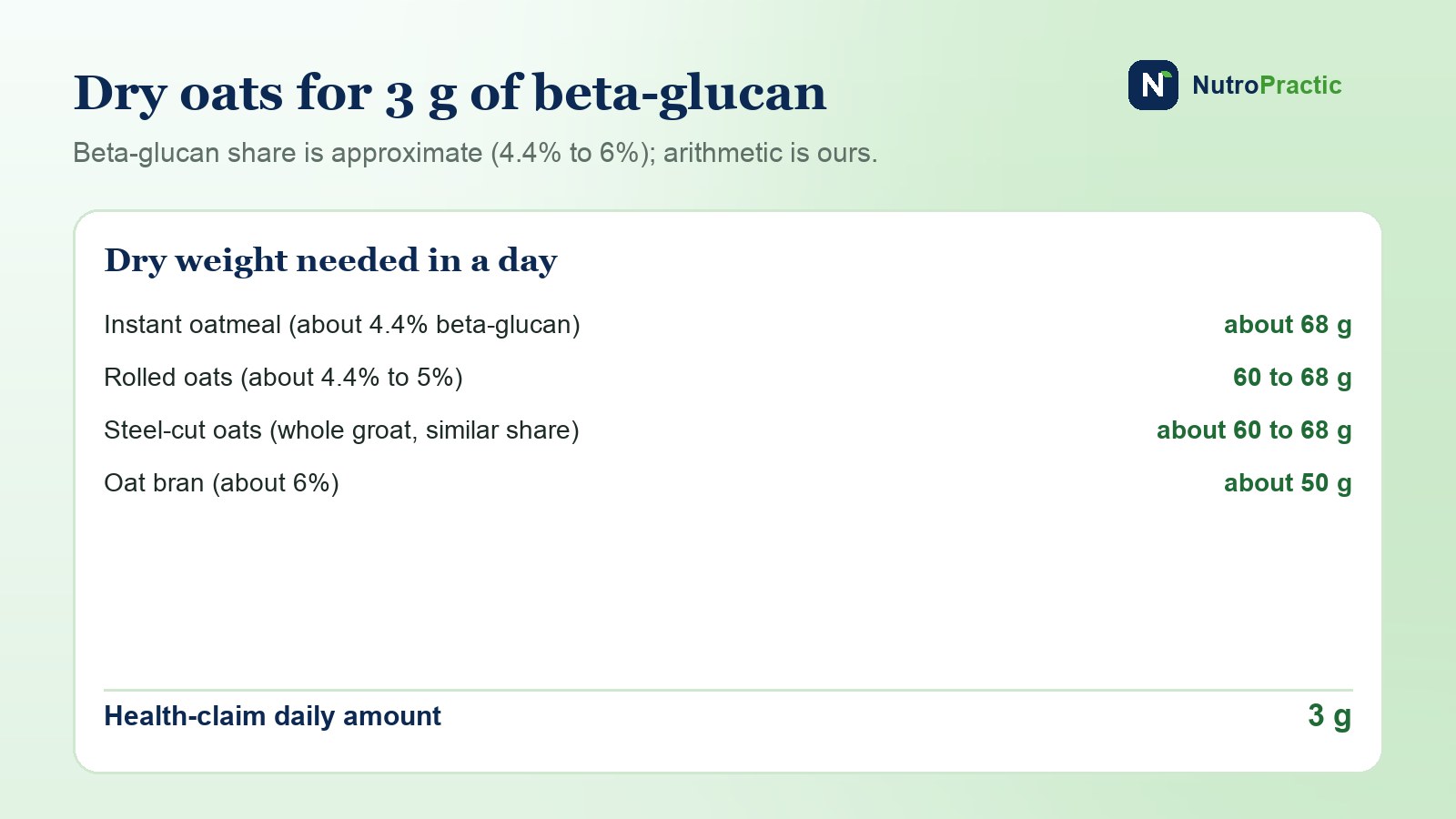
Food tables rarely list beta-glucan, so the shares below come from papers and are approximate. A trial of instant oatmeal put 27 g of dry instant oatmeal at 1.2 g of beta-glucan (4.4%). Oat bran is the concentrated form: at least 5.5% by weight, typically 6% to under 7%. One guide gives 2 g in a 40 g serving of rolled oats (5%). The arithmetic is ours.
| Oat | Beta-glucan share (approx.) | Dry weight for 3 g | In a measure |
|---|---|---|---|
| Instant oatmeal | about 4.4% | about 68 g | roughly ¾ cup |
| Rolled oats | about 4.4% to 5% | 60 to 68 g | roughly ¾ cup |
| Steel-cut oats | similar to rolled (same grain, cut not flattened) | 60 to 68 g | roughly ⅓ to ½ cup dry |
| Oat bran | about 6% | about 50 g | roughly ½ cup |
- One bowl isn't enough. A usual 40 g bowl of rolled oats gives about 1.8 g (40 × 4.4%). That clears the label's 0.75 g per serving but is about 60% of the 3 g. Two bowls, or one bowl plus oat bran stirred into yoghurt or a smoothie, gets you there.
- A tablespoon or two of oat bran in the bowl is the cheap way to top up: 15 g of oat bran at 6% adds about 0.9 g.
Steel-cut, rolled or instant: what changes
Per gram of dry oats the beta-glucan is in the same range. What changes with processing is how fast the starch is digested, and possibly the beta-glucan's chain length, which is what makes it thick and cholesterol-active. We found no head-to-head LDL trial of steel-cut against instant, so we can't say one lowers LDL more. On blood sugar there are numbers (a 2015 systematic review in the British Journal of Nutrition):
| Oat type | Glycaemic index (mean) |
|---|---|
| Large-flake (rolled) oats | 53 |
| Steel-cut oats | 55 |
| Quick-cooking oats | 71 |
| Instant oatmeal | 75 |
- Smaller particles and more cooked-through starch mean a higher glucose response. If you have diabetes or prediabetes, steel-cut or large-flake is the better pick.
- Beta-glucan itself flattens the glucose rise. In a 40-person crossover (Wolever 2018), adding oat bran to instant oatmeal cut the glucose peak by about 15% per gram of beta-glucan and the total glucose area by about 7% per gram. 0.4 g was enough for a 20% lower peak; 1.6 g for a 20% lower area.
- Baking and heavy processing can shorten the chain: one cereal-chemistry study found baked oat-bran breads had much lower molecular weights (24 to 167 ×10⁴ g/mol) than the raw oat products (206 to 230 ×10⁴). Porridge, overnight oats and muesli are the safest ways to eat them.
- Flavoured instant packets often add sugar. Read the label: plain oats plus fruit beats a sweet packet.
A 3 g day, in a kitchen
- Breakfast: 40 g rolled or steel-cut oats cooked in water or milk: about 1.8 g.
- Mid-morning or lunch: 15 g oat bran in yoghurt or a smoothie: about 0.9 g.
- Evening: a small second bowl, or oat flakes in a crumble topping, for the last 0.3 g or more.
Our fibermaxxing plan adds fibre 4 g at a time so the extra oats don't cause bloating, and psyllium is the other soluble fibre with a heart claim.
Gluten and oats
Oats don't contain gluten, but they are often grown and milled next to wheat, barley and rye, so ordinary oats can carry some. If you have coeliac disease, buy oats labelled gluten-free (under 20 parts per million) and check that your doctor is happy with oats in your diet, because a minority of people with coeliac disease react to the oat protein itself. Our gluten-free article covers who benefits from going gluten-free.
Who this suits, and cautions
- Most adults with raised LDL: it is a low-risk food change with a measurable effect.
- It does not replace cholesterol medicine; ask your doctor before changing medicines.
- A fast jump in fibre can cause gas and bloating: build up over two weeks and drink water.
Want a cholesterol-lowering plate built around foods you actually like? Dr. Triveni can put a plan together in a virtual consultation.
Book a consultationThis article is general information, not medical advice. Talk to your doctor before taking supplements or changing your diet, especially if you take regular medicines, are pregnant or breastfeeding, or have a medical condition.
Sources
Whitehead A. et al., Cholesterol-lowering effects of oat β-glucan: a meta-analysis of randomized controlled trials, Am J Clin Nutr 2014 (Lancaster University eprints 71835). US FDA, 21 CFR 101.81, Health claims: soluble fiber from certain foods and risk of coronary heart disease (law.cornell.edu). EFSA Panel on Dietetic Products, Scientific opinion on the substantiation of a health claim related to oat beta glucan and lowering blood cholesterol, EFSA Journal 2010;8(12):1885. Wolever T.M.S. et al., Effect of adding oat bran to instant oatmeal on glycaemic response in humans, Food Funct 2018;9:1692-1700 (PubMed 29480316). Systematic review of the effect of processing of whole-grain oat cereals on glycaemic response, Br J Nutr 2015 (PubMed 26330200). Oat bran beta-glucan share from a US patent (7494683) review text and oat product molecular-weight study, Cereal Chemistry 2004; rolled oats 2 g per 40 g from nutrifyi.com guide (secondary). Cup measures are rough kitchen conversions of ours. Read 18 Nov 2026.