The usual advice about healthy eating assumes you can spend more: buy the salmon, the berries, the organic spinach, the nuts. For a family watching every dollar or pound, that advice reads like a bill. So it is fair to ask what healthier food really costs, and whether a tight budget and a good diet can live in the same kitchen.
The short answer from the research is that a healthier diet does cost more on average, but not by as much as most people think, and the gap is not spread evenly. Some of the most nourishing foods are among the cheapest in the shop. Below are the figures: what the cost studies found, what the US government says a thrifty healthy diet costs, our own price check of protein and fibre per dollar using September 2026 prices, and what frozen and tinned produce lose (very little).
What the cost studies found
The most cited answer comes from a 2013 meta-analysis in BMJ Open by Mayuree Rao, Dariush Mozaffarian and colleagues at Harvard. They pooled 27 studies from 10 countries that priced healthier and less healthy foods and diet patterns. Comparing the healthiest diet patterns with the least healthy, the healthier ones cost about $1.48 more per person per day (95% range $1.01 to $1.95), or about $1.54 more per 2,000 calories.
That is roughly $550 a person a year. It is real money for a family on a tight income, but it is far less than the cost of diet-related illness, and the difference came mostly from one place: meat and protein foods, which were $0.29 a serving more expensive in their healthier forms (lean meat and fish against processed meat and fatty cuts). Grains, dairy, fats and snacks showed small differences.
In the UK the picture is sharper. The Food Foundation's Broken Plate 2026 report found that the poorest fifth of households would need to spend 49% of their disposable income on food to follow the government's Eatwell Guide, rising to 85% for the poorest households with children, against 11% for the richest fifth. Healthier food cost nearly twice as much per calorie as less healthy food, and that gap widened by 27% between 2015 and 2025. The lesson is not that eating well is hopeless on a low income; it is that calorie for calorie, sugary and fatty foods are cheap, so the shopping has to be chosen with care.
What a thrifty healthy diet costs in the US
The US Department of Agriculture publishes a Thrifty Food Plan: a list of foods, in amounts that meet the Dietary Guidelines, at the lowest cost it can find. It sets the maximum SNAP (food stamp) benefit. In June 2026 the plan for a reference family of four (two adults, two children aged 6 to 11) cost $236.10 a week, or $1,023.20 a month. That is about $8.50 per person per day for a diet that meets the guidelines, cooked at home.
Put the two numbers side by side and the gap looks manageable. The extra $1.48 a day from the meta-analysis, for four people over a month, is about $178: roughly 17% more than the thrifty plan. Much of that can be clawed back by choosing which healthy foods to buy, which is what the next section is about.
Our price check: protein and fibre per dollar
We took the US Bureau of Labor Statistics average retail prices for September 2026 and the nutrient values in USDA FoodData Central, and worked out what you pay for 20 g of protein (about one meal's worth) and 10 g of fibre (a third of a day's target). For meat and fruit we used only the edible part, after bones and peel.
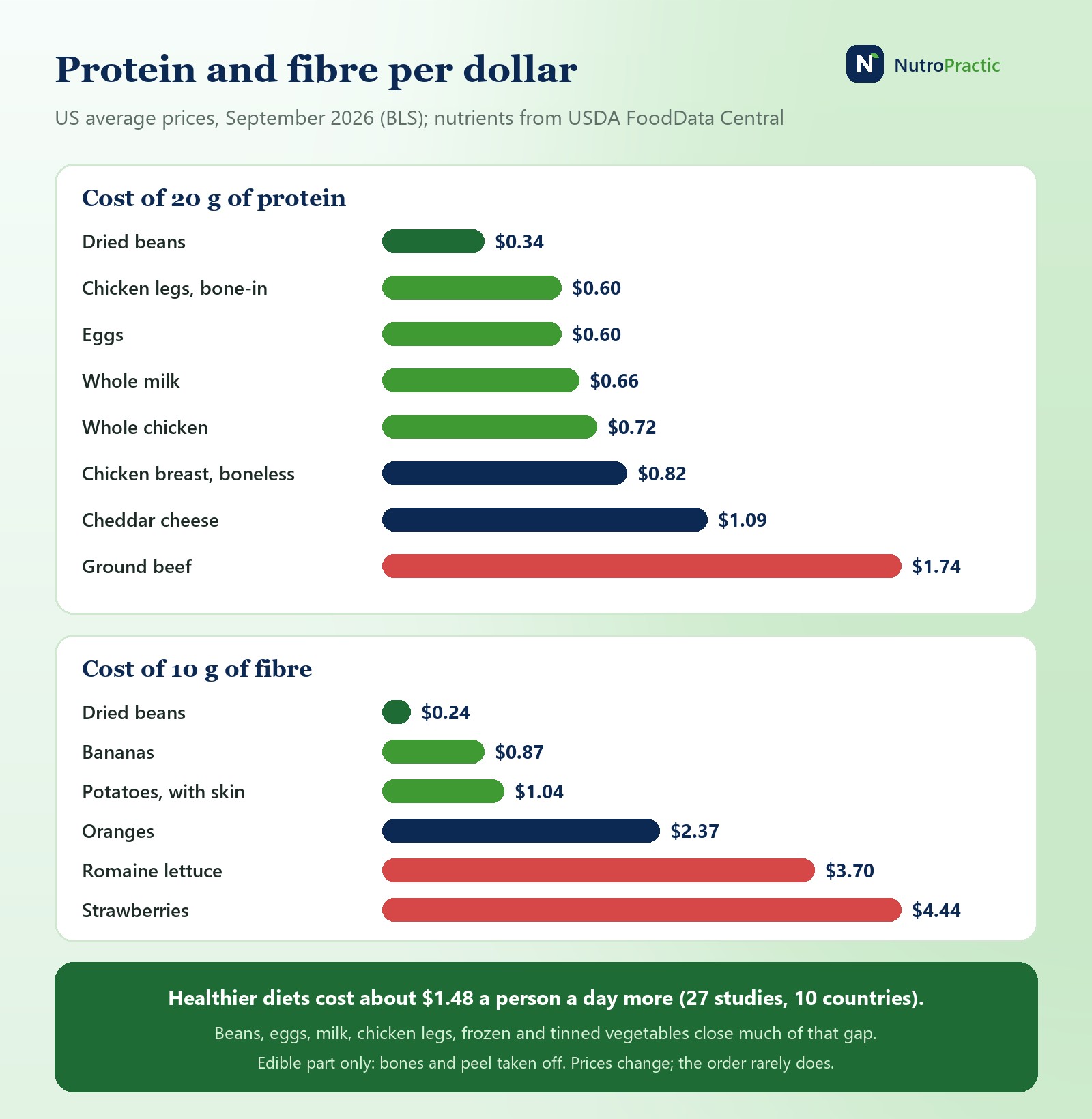
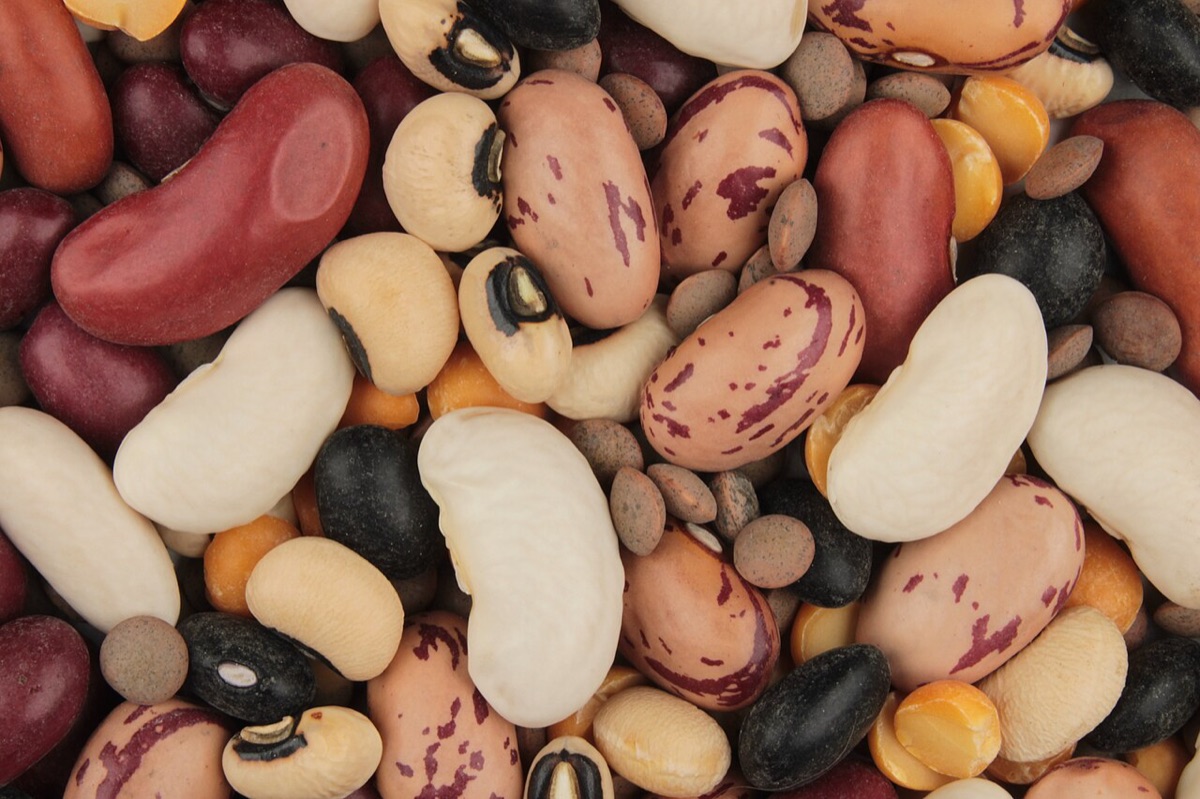
How the numbers work, with one example. A pound of dried beans cost $1.669 in September 2026. Dry pinto beans have about 21 g of protein and 15.5 g of fibre per 100 g, so a pound (454 g) holds about 97 g of protein and 70 g of fibre. That makes 20 g of protein cost $1.669 ÷ 97 × 20 = $0.34, and 10 g of fibre $1.669 ÷ 70 × 10 = $0.24. A dozen large eggs at $2.27 gives about 76 g of protein: $0.60 per 20 g. Ground beef at $6.79 a pound gives about 78 g: $1.74 per 20 g, five times the price of beans.
Three things stand out. Beans and lentils win on both counts: they are the cheapest protein and by far the cheapest fibre. Eggs, milk and bone-in chicken cost less per gram of protein than boneless breast, cheese or beef. And for fibre, bananas and potatoes with their skins beat salad leaves and berries several times over. Salad and strawberries are good food, but they are not where a tight budget gets its fibre.
Prices move every month (eggs were much dearer in early 2025), but the order of this list rarely changes much. If you shop outside the US, the same arithmetic works with your own receipt: price ÷ grams of protein in the pack × 20.
Frozen and tinned are not second best
Many people on a budget feel guilty buying frozen peas or tinned tomatoes, as if fresh were the only healthy kind. The tests say otherwise. In a 2017 study in the Journal of Food Composition and Analysis, Li and colleagues measured vitamin C, provitamin A and folate in eight fruits and vegetables (broccoli, cauliflower, corn, green beans, peas, spinach, blueberries and strawberries) bought fresh, frozen, and fresh then kept in the fridge for five days, as most of us do. In most comparisons there was no significant difference. Where there was one, frozen beat the fresh-stored produce more often than the other way round.
Frozen produce is picked ripe and frozen within hours; fresh produce loses some vitamins every day it waits in the truck, the shop and your fridge. Tinned vegetables lose some vitamin C in the heating, but keep their fibre and minerals, and tinned tomatoes have more available lycopene than raw ones. The things to watch on a tin are added salt and syrup: choose 'no added salt' vegetables and fruit in juice, or rinse beans and vegetables in a sieve, which washes off a good part of the salt.
On price, the USDA's Economic Research Service found that in 2022 a person could meet the full fruit and vegetable recommendation for about $2.50 to $3.00 a day. Neither fresh nor processed forms were cheaper across the board: for a spinach quiche, frozen spinach cost $1.10 and tinned $0.90 per cup-equivalent against $1.77 for fresh, while fresh carrots ($0.38) beat the processed ones. In its 2023 update the cheapest item of all was dried pinto beans, at $0.23 a cup-equivalent.
The cheapest healthy kitchen is built on beans, eggs, milk, oats, potatoes, bananas, onions and a freezer drawer of vegetables. The expensive foods are the extras, not the base.
Batch cooking: one pot, eight meals
Cooking a big pot once and eating it several times saves money twice: you buy in bulk, and less food goes in the bin. WRAP, the UK waste charity, estimates that an average family of four throws away about £1,000 of food a year, around £20 from a typical weekly shop, and the US Environmental Protection Agency's 2025 estimate for a US household of four is $2,913 a year. Planning meals around what is already in the fridge is the cheapest change on this page.
Here is a worked example at September 2026 US prices: a pot of chicken, bean and potato stew with rice on the side.
1 lb dried beans, soaked overnight: $1.67
2 lb bone-in chicken legs: $3.48
2 lb potatoes, skins on: $1.98
1 lb tomatoes (or a large tin): $1.99
1 lb white rice: $1.12
Onions, garlic, spices: about $1.00
Total: about $11.25 for 8 servings, or $1.40 a serving
Each serving carries about 33 g of protein and 12 g of fibre. Two servings a day cover most adults' protein needs and nearly the full fibre target of 25 to 30 g for under $3. Freeze half in portions and the second week costs nothing to cook. Swap the chicken for a second pound of beans or lentils and the cost per serving falls to about $1.00.
Store brands, and where the money really goes
Store brands are usually the same food in a plainer pack. Price studies by the Private Label Manufacturers Association, an industry group, found savings of about 35% on a basket of store-brand items against national brands; a 2025 comparison of seven staples by GlobalData put US savings at about half. For plain staples such as oats, rice, flour, frozen vegetables, tinned tomatoes, milk and dried beans, there is little reason to pay for the brand.
The other place the money goes is drinks and snacks. A daily soft drink, packet of crisps and chocolate bar can cost $3 to $5, more than the extra $1.48 a day that a healthier diet costs. Swapping those for water, a banana and a handful of peanuts funds most of the healthier shopping by itself. Our article on eating fewer ultra-processed foods has realistic swaps, and the fibre gap article shows how to reach 30 g a day with ordinary foods.
A budget shopping list that covers the basics
Protein: dried or tinned beans, lentils and chickpeas; eggs; milk and plain yoghurt in large tubs; bone-in chicken legs or a whole chicken; tinned sardines or mackerel once or twice a week for omega-3; peanut butter.
Starch and fibre: oats, brown or white rice, wholemeal bread or flour, pasta, potatoes with the skins on.
Vegetables and fruit: onions, carrots, cabbage, frozen peas, spinach and mixed vegetables, tinned tomatoes, bananas, apples and whatever is in season and on offer.
Flavour: a large bottle of a plain vegetable oil, garlic, dried herbs and spices, stock cubes, lemon or vinegar.
Four habits make the list go further: plan the week's meals before you shop, check what is in the fridge first, compare the unit price (per kg or per 100 g) on the shelf label rather than the pack price, and cook double so that tomorrow's lunch is already made.
For Indian kitchens
The same logic holds in India, where dal, chana, rajma, eggs, milk and curd are among the cheapest sources of protein, and seasonal vegetables and fruit from the local market cost far less than packaged foods. Affordability is still a real barrier: the UN's State of Food Security and Nutrition in the World 2026 report puts the cost of a healthy diet in India at $4.11 a person a day (in purchasing-power terms) in 2025, and estimates that 520 million people, 35.5% of the population, could not afford it, down from 59.8% in 2017. A plate built on a dal or pulse at two meals, a cup of curd or milk, an egg where eaten, millets or rice with a whole grain, and two seasonal vegetables is the low-cost Indian version of the list above.
Feeding a family on a tight budget, with a health condition to manage as well? Dr. Triveni builds family and lifestyle plans around the foods you can buy and cook, in a virtual consultation.
Book a consultationThis article is general information, not medical or financial advice. Prices are US national averages for September 2026 and vary by region, shop and season. If you have a medical condition that needs a special diet, ask your doctor or dietitian how to adapt these ideas.
Sources
Rao M., Afshin A., Singh G., Mozaffarian D., Do healthier foods and diet patterns cost more than less healthy options? A systematic review and meta-analysis, BMJ Open 3:e004277 (2013). US Department of Agriculture, Food and Nutrition Service, Official USDA Thrifty Food Plan: U.S. Average, June 2026. The Food Foundation, Broken Plate 2026 (10 June 2026).
US Bureau of Labor Statistics, Average retail food and energy prices, U.S. city average, September 2026. US Department of Agriculture, Agricultural Research Service, FoodData Central (SR Legacy values for dry pinto beans, eggs, whole milk, chicken, cheddar, ground beef, pasta, potatoes, bananas, oranges, romaine lettuce and strawberries).
Li L., Pegg R.B., Eitenmiller R.R., Chun J.-Y., Kerrihard A.L., Selected nutrient analyses of fresh, fresh-stored, and frozen fruits and vegetables, Journal of Food Composition and Analysis 59:8-17 (2017). USDA Economic Research Service, Satisfying fruit and vegetable recommendations possible for under $3 a day (Amber Waves, September 2024) and Fruit and Vegetable Prices: highlights (2023 data).
WRAP, Halving household food waste could put £10 back into every household, every week. US Environmental Protection Agency, household food waste cost estimate (April 2025 report). Private Label Manufacturers Association, store brand price studies; GlobalData analysis presented at the PLMA show 2025. FAO, IFAD, UNICEF, WFP and WHO, The State of Food Security and Nutrition in the World 2026, India figures as reported by Down To Earth.