Hospital nutrition · October 28, 2026
Extra protein in hospital after a broken hip or pelvis did not get older patients home sooner: a German trial of 218 people over 70 found that frailty, not the menu, decided who went back to living on their own
Nearly half of the older patients admitted with fragility fractures to a German trauma centre screened at risk of malnutrition. Those who got three protein-rich meals a day plus 20 g protein drinks had no fewer complications, no better walking at discharge and no shorter stay than those on the usual hospital food. Only a quarter of all patients went home without extra help.
When an older person breaks a hip, pelvis, spine or shoulder in a simple fall, the days in hospital often decide whether they go back to their own home or into care. Guidelines ask hospitals to screen these patients for malnutrition and to feed them more protein, at least 1.2 to 1.5 g per kilogram of body weight a day and up to 2.0 g during acute illness, to protect muscle and help wounds and bones heal. Most of the trials behind that advice looked only at hip fractures and kept the extra nutrition going well into rehabilitation. The NuTra trial, published on 17 October in BMC Geriatrics by trauma surgeons at the University of Tübingen, asked a narrower question: does a protein-enriched diet during the acute hospital stay alone make a difference?
Between May 2024 and June 2025 the team enrolled 218 patients aged 70 or over with fragility fractures at a Level I trauma centre in Germany. They averaged 81.8 years and 72% were women; almost half had broken the top of the thigh bone and a fifth the pelvis. Within 48 hours of admission everyone was screened with two standard tools, the Nutritional Risk Screening 2002 and the Mini Nutritional Assessment. The 100 patients (45.9%) who screened positive on either were randomised: 46 to a protein-enriched diet and 54 to the usual hospital food. The 118 who screened negative were followed as a comparison group.
The enriched diet aimed for 1.5 to 2.0 g of protein per kilogram a day: three protein-rich main meals and snacks built on yoghurt, quark, cheese, eggs, meat, fish and plant proteins, plus oral nutritional supplement drinks with 20 g of protein a serving. It usually started the day after admission. How much patients actually ate and drank was not measured, so nobody knows whether they reached the target.
On the main outcomes the diet made no measurable difference. At least one medical complication, such as acute kidney injury, a urinary tract infection or pneumonia, hit 39.1% of the enriched-diet group and 50.0% of the usual-diet group, a gap that could be chance. Among patients who had surgery, wound infections were 2.6% against 11.6%, again not statistically significant. Almost everyone (98.6%) left hospital walking worse than before the fracture, and stays averaged 11.5 and 11.6 days. No patient died in hospital and no harms from the diet were recorded.
What did separate patients was where they started. Those at nutritional risk were frailer and had more illnesses: before the fracture only about half of them walked without an aid, against 79.7% of the well-nourished group. At discharge, 30.5% of the well-nourished group went home without extra support, compared with 22.2% on the usual diet and 13.0% on the enriched diet; across all 218 patients, 58.7% went on to a rehabilitation unit, nursing home or other institutional care. In the adjusted analysis the strongest predictor was the burden of other illnesses, with each extra point on an age-adjusted comorbidity score raising the odds of institutional care by about 75%. The authors read nutritional risk as one sign of overall frailty and argue that nutrition care has to continue through rehabilitation, not just the acute stay.
The trial has clear limits. It needed 64 patients per arm and got 46 and 54, so it was too small to rule out a real benefit, especially for uncommon events like wound infections. It was run at one centre, under German reimbursement rules that tend to fix hospital stays at around 11 to 12 days, and it was registered on ClinicalTrials.gov (NCT07582575) only after it had finished. Comparisons with the well-nourished group are observational. The study had no external funding and the authors declare no competing interests. Follow-up at 120 days and 12 months is planned for part of the group.
NuTra trial: protein-enriched hospital diet after fragility fractures, 218 patients aged 70+, Germany
45.9%
Patients (100 of 218) who screened at nutritional risk on admission
1.5-2.0 g/kg
Daily protein target in the enriched diet, with 20 g protein drinks on top of protein-rich meals
39.1% vs 50.0%
At least one medical complication, enriched vs usual hospital diet (not significant, p = 0.553 across groups)
98.6%
Patients who left hospital walking worse than before the fracture
24.8%
Patients discharged home without extra support; 58.7% went to institutional care
46 / 54
Patients in the two randomised groups, against 64 each needed for the planned power
Single-centre randomised trial with a non-randomised comparison group, University of Tübingen trauma centre, May 2024 to June 2025. Outcomes measured up to hospital discharge. Protein and energy intake and supplement adherence were not recorded. Wound infections among the 179 operated patients: 2.6% enriched diet, 11.6% usual diet, 0% well-nourished group (enriched vs usual p = 0.207). Average stay 11.5, 11.6 and 10.2 days. Registered retrospectively as NCT07582575. Published 17 October 2026, open access (CC BY).
- In this trial, nearly half of the patients had broken the top of the thigh bone (proximal femur), and a fifth had broken the pelvis.
- Serum albumin, often read as a nutrition marker, fell by an average of 0.58 g/dL during the hospital stay with no difference between groups; inflammation, surgery and fluid shifts drive it more than food in the short term.
- Before the fracture, 79.7% of the well-nourished patients walked without any aid; at discharge none of the 218 patients did.
- A 20 g serving of protein is roughly what you get from 200 g of quark or about three eggs.
- Patients with an upper-arm fracture had about a third of the odds of going into institutional care compared with those who broke a leg, hip, spine or pelvis.
- Impact of malnutrition and protein-enriched oral nutrition on early recovery after fragility fractures in older adults: the NuTra trialBMC Geriatrics · The study, published 17 October 2026; figures from the full text and its tables
- PubMed record (PMID 42934566)PubMed · Abstract and author details
- Full text (PMC13700238)PubMed Central · Open access full text with methods, limitations and funding
- NCT07582575ClinicalTrials.gov · Trial registration (retrospective, 12 May 2026)
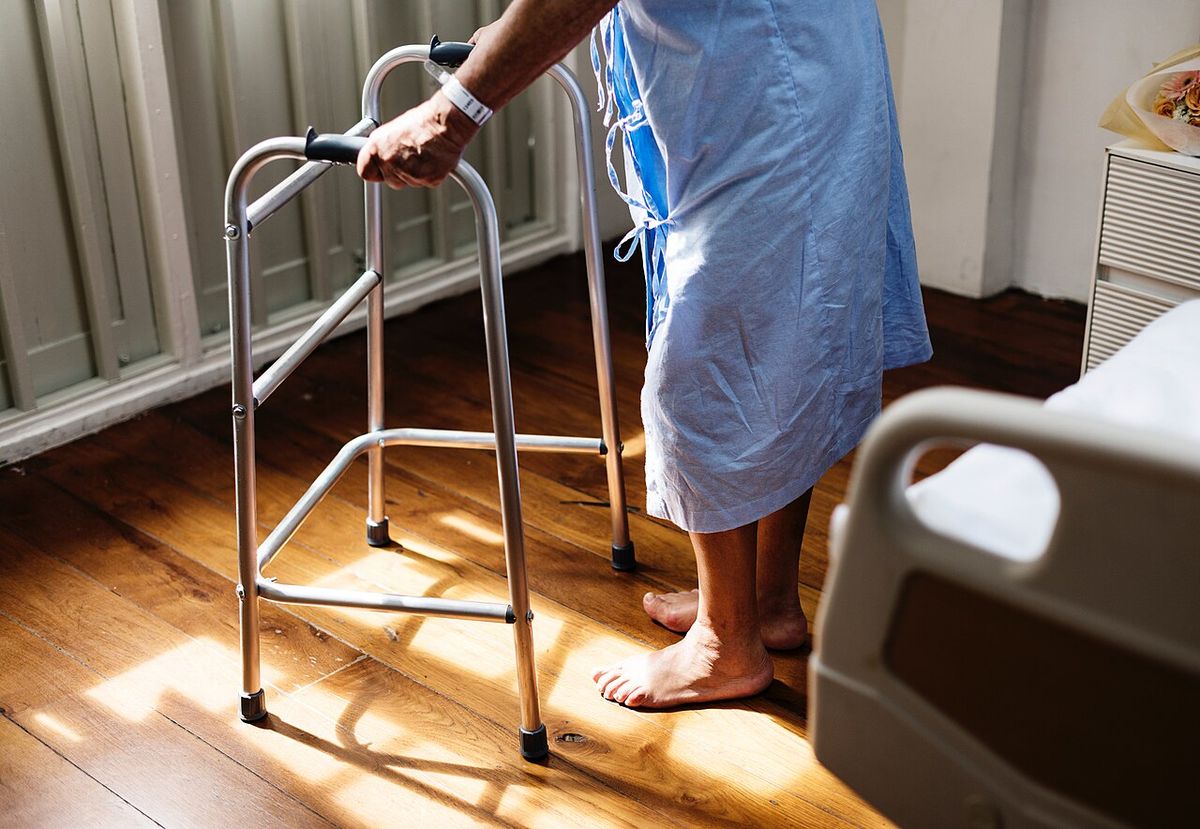
- A woman supporting herself with a walking frameWikimedia Commons · The image, CC0
General information, not medical advice. If you or a family member is in hospital after a fracture, ask the care team or a dietitian about nutrition and rehabilitation, and don't start or stop supplements on the strength of a single study.
Analysis by NutroPractic from the sources listed. Written for general readers; it does not replace advice from your own doctor.
From our articles
Our guides on this subject
Plain-language guides on nutrition and wellness, backed by research.
Weight-loss medicines
Eating on Ozempic, Wegovy or Mounjaro: protein first, so the weight you lose isn't your muscle
GLP-1 medicines shrink your appetite, and with it often your protein. In the big trials a quarter to more than a third of the weight lost was lean mass. What the 2025 joint nutrition advisory recommends, the arithmetic for your own target, and four small plates that get there.
8 Oct 2026
Healthy ageing
Protein after 40: how much you really need, and why timing matters
The standard protein target was set to prevent deficiency, not to protect muscle as you age. What the research and expert groups suggest for adults over 40, how to spread protein across the day, and easy ways to hit 25 to 30 grams at breakfast.
3 Oct 2026
Women's health
Eating through menopause: what changes for your bones, muscle and heart, and what to put on the plate
Around the final period, bone density at the spine drops by about 2% a year and LDL cholesterol jumps within a year or two. Hot flushes get the attention, but these quieter changes are where food and strength training do the most. Targets for protein, calcium and vitamin D, an honest look at soy, and a week you can start on Monday.
8 Oct 2026
Newsfeed for your website
Want this feed on your website?
Add it to any site with one copy-and-paste snippet. No sign-up, and it updates itself every hour.
Start with a virtual consultation
Tell Dr. Triveni what you want to change. You will leave with a clear next step, whether you are in Toronto, London, New York or Chennai.