Gluten-free living · October 30, 2026
528 Canadians on a strict gluten-free diet knew beans were safe and good for them. Fewer than 1 in 100 ate them every day
A University of Guelph survey run with Celiac Canada asked people with coeliac disease or gluten sensitivity about beans. Most were confident beans are naturally gluten-free and full of fibre and protein, and three quarters named nutrition as a reason to eat them. Yet 30% never cooked dry beans at all. The gap wasn't knowledge of what beans do, it was knowing what to do with them.
People with coeliac disease spend a lot of time reading labels. The only treatment is a lifelong gluten-free diet, and the specialist breads, pastas and crackers that replace wheat cost more and are often lower in fibre and higher in fat, sugar and salt. Beans look like an obvious answer: naturally gluten-free, cheap, and rich in protein, fibre, iron and folate. A survey published in Nutrients on 28 October asked whether people who live gluten-free actually eat them.
Researchers at the University of Guelph in Ontario, working with colleagues at the University of Hohenheim in Germany, recruited adults through Celiac Canada, a national charity. 528 people completed the online questionnaire: 490 with coeliac disease and 38 with non-coeliac gluten sensitivity. Nearly all (96.4%) strongly agreed that the gluten-free diet is an important part of their daily lives. Their health histories showed why food matters to them: at diagnosis, 69.0% of those who reported a deficiency had iron-deficiency anaemia, 42.3% low vitamin D and 32.9% low vitamin B12, and fatigue (72.2%) and wind and abdominal pain (71.2%) were the commonest symptoms.
Plant foods in general were no problem: 88.6% said they ate fruit, vegetables, whole grains, legumes or nuts every day. Beans were another story. Only 0.9% ate dry beans daily and 0.4% canned beans daily. 30.1% never ate dry beans and 45.1% rarely did. Canned beans fared a little better, with most people eating them once a week or less. On a combined score, 39.8% were low bean eaters, 47.9% moderate and 12.3% high. When beans did appear, it was mostly at dinner (87.8%) and mostly at home.
It wasn't for lack of goodwill. Three quarters (74.9%) of those who named a motivator picked nutritional value, 60.1% the fact that beans make a vegetarian meal and 52.4% the price. 85.2% were confident that beans are naturally gluten-free, and around three quarters were confident about their fibre and protein. The weak spot was the kitchen: only 56.7% felt confident about how to prepare beans, the lowest of any knowledge question. The commonest barriers were long soaking and cooking times (40.2%), beans simply not being a habit (38.7%), gut discomfort (31.6%) and not knowing how to cook them (26.5%). Some also worried about gluten cross-contamination, since beans in Canada don't have to carry a gluten-free label even when they are safe.
When the researchers looked at who ate more beans, two things stood out after adjusting for age, gender, education, income and diagnosis: interest in learning more about beans, and confidence in preparing them. Each step up the agreement scale for preparation confidence went with about a quarter of a point more on the 2-to-12 bean score. Each extra motivator a person ticked went with a slightly higher score and each extra barrier with a slightly lower one. 68.9% agreed that knowing more about how to prepare beans would get them eating more, and when asked what they wanted to learn, recipes came first, then preparation, then how to avoid gut discomfort. The internet was the preferred way to get that information.
The authors are frank about the limits. The sample came mainly through Celiac Canada and academic networks and skewed towards people who are health-conscious and well educated: 91.3% were women, 91.4% identified as White, and more than half had household incomes of $100,000 or more. Diagnoses and diets were self-reported, the survey was online only, the bean score counted only dry and canned beans (not bean pasta or wraps) and hasn't been formally validated, and none of the individual barriers stayed significant once the authors corrected for testing 20 of them at once. A survey like this shows associations, not that cooking lessons would change what people eat. The authors call for trials of how well people with coeliac disease tolerate beans and what eating more of them does over time. The study was funded by the University of Guelph, and the authors declared no conflicts of interest.
Exploring Knowledge and Consumption of Beans Among Adults with Gluten-Related Disorders: A Cross Sectional Study in Canada (Nutrients, 2026)
528
Adults who completed the survey: 490 with coeliac disease and 38 with non-coeliac gluten sensitivity, recruited with Celiac Canada
0.9% and 0.4%
Share eating dry beans and canned beans every day, against 88.6% eating plant foods of some kind daily
30.1%
Never ate dry beans at all; another 45.1% ate them rarely
85.2% vs 56.7%
Confident that beans are naturally gluten-free, against confident about how to prepare them
40.2%
Named long soaking and cooking times as a barrier, the commonest one (among 465 who named any barrier)
68.9%
Agreed that knowing more about how to prepare beans would encourage them to eat more
Cross-sectional online survey (Qualtrics), so it shows associations, not cause and effect. Bean consumption score was the sum of dry and canned bean frequency (each 1 = never to 6 = daily, total 2 to 12; mean 4.90). Motivator and barrier percentages are among the 471 and 465 people who named at least one. Regression models adjusted for age, gender, education, household income and diagnosis, with robust (HC3) standard errors; preparation confidence (B = 0.246) and interest in learning about beans (B = 0.303) were both linked to higher scores (p < 0.001), while no single motivator or barrier survived false-discovery-rate correction. Diagnoses self-reported; sample mostly women, White and high-income. Figures from the open-access article (CC BY 4.0).
- The paper cites Canadian figures that gluten-free products cost 150% to 500% more than the regular versions, while dried beans in Canada retail for roughly CAD 1.34 to 4.00 a kilogram.
- Beans cause wind because they contain raffinose and stachyose, sugars that human enzymes can't break down. Gut bacteria ferment them instead, making hydrogen, carbon dioxide and methane.
- Coeliac disease affects about 1% of people in Canada, and women are around 1.5 times as likely to be diagnosed as men, according to the studies the authors cite.
- Only 2 of the 528 people said they were unwilling to try new foods, so dislike of novelty wasn't what kept beans off the plate.
- Exploring Knowledge and Consumption of Beans Among Adults with Gluten-Related Disorders—A Cross Sectional Study in CanadaNutrients (MDPI) · The study, published 28 October 2026 (open access, CC BY 4.0); figures from the abstract, results sections 3.1 to 3.7, discussion, strengths and limitations, funding and conflict-of-interest statements
- Full text and supplementary tables S1 and S2MDPI · Article page with the figures and the regression tables
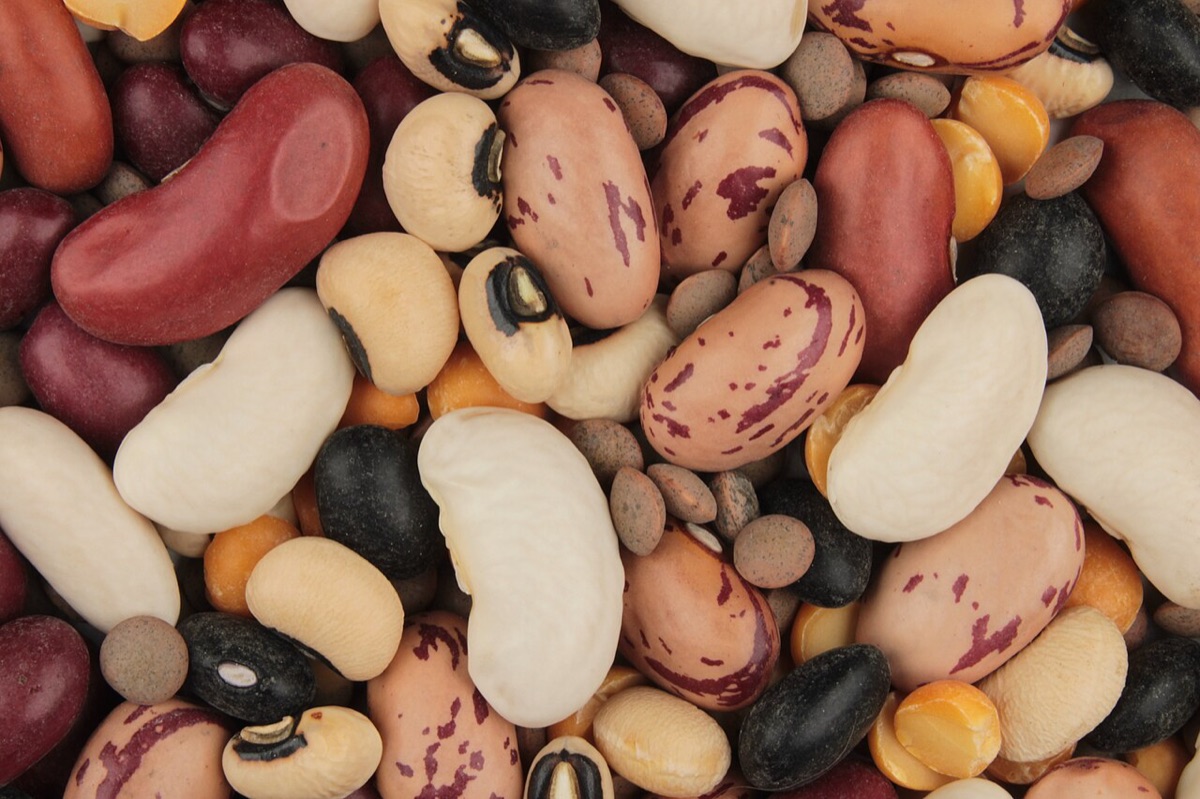
- Mixture of beans (small red, cannellini, pinto, roman, red kidney, black), peas (blackeye, yellow split), and pardina lentilsWikimedia Commons · The image, CC0; an illustration, not beans from the study
General information, not medical advice. This was a survey and can't show that eating more beans improves health in coeliac disease or gluten sensitivity. If you have either condition, check that packaged beans are free of gluten cross-contamination, add beans gradually if they upset your gut, and talk to your doctor or a registered dietitian before making big changes to your diet.
Analysis by NutroPractic from the sources listed. Written for general readers; it does not replace advice from your own doctor.
From our articles
Our guides on this subject
Plain-language guides on nutrition and wellness, backed by research.
Everyday eating
Eating well on a tight food budget: what the cost studies found, and the cheapest protein and fibre per dollar
Healthier diets cost about $1.48 a person a day more, according to a meta-analysis of 27 studies. What the USDA's Thrifty Food Plan costs in 2026, our price check of protein and fibre per dollar at September 2026 prices, why frozen and tinned vegetables are not second best, and a batch-cooked stew at $1.40 a serving.
20 Oct 2026
Diabetes
Potatoes and blood sugar: boiled, cooled, mashed or fried, and what the cohorts and trials found
Fries were linked to 20% higher diabetes risk per three servings a week in 205,000 US adults; boiled, baked and mashed potatoes to almost none. GI by cooking method, resistant starch in grams after chilling, the glycaemic load of a potato against a cup of rice, and how to fit aloo into an Indian plate.
30 Oct 2026
Children's nutrition
Picky eaters aged 2 to 8: what feeding studies show works at the table
Fussy eating peaks between two and six and is usually a normal stage, not a parenting failure. Feeding trials show what moves it: small repeated tastes, eating together, no pressure and the right kind of reward. Here is how to use them, and the signs that mean it's more than picky eating.
30 Oct 2026
Newsfeed for your website
Want this feed on your website?
Add it to any site with one copy-and-paste snippet. No sign-up, and it updates itself every hour.
Start with a virtual consultation
Tell Dr. Triveni what you want to change. You will leave with a clear next step, whether you are in Toronto, London, New York or Chennai.